
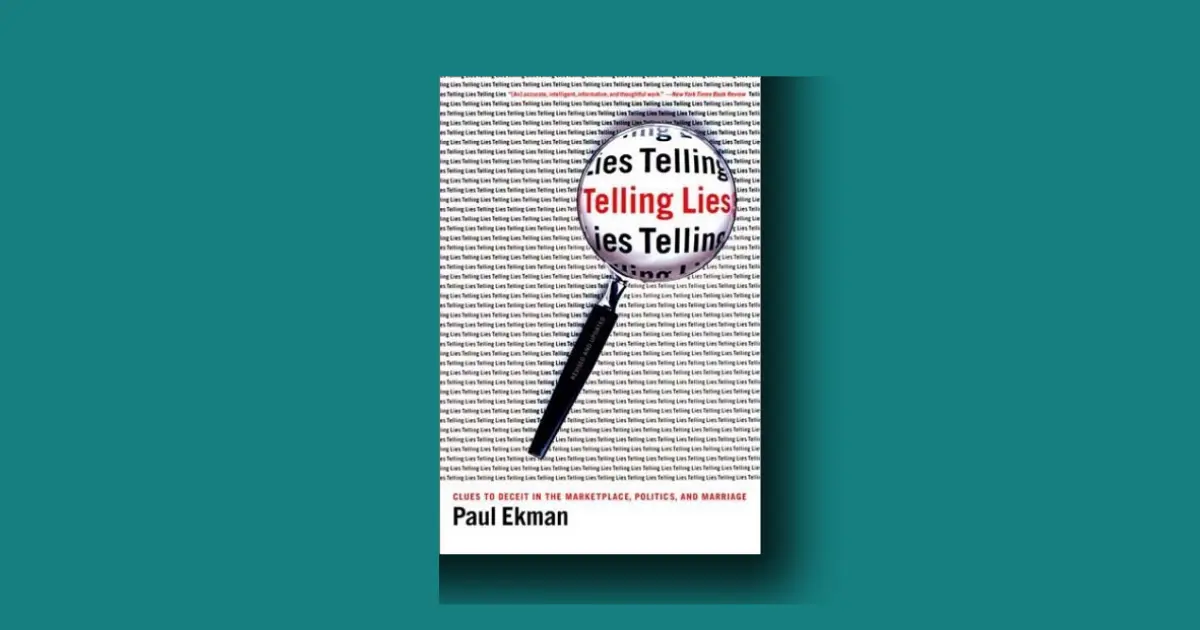
Telling Lies: Clues to Deceit in the Marketplace, Politics, and Marriage by Paul Ekman is the book you reach for when you realise how terrifying it is that you probably can’t tell when even the people closest to you are lying.
Telling Lies argues that we are much worse at detecting deceit than we think, but that under specific high-stakes conditions subtle “leakages” in face, voice, and body can sometimes betray a liar—if, and only if, we understand the psychology of both liar and lie-catcher.
The evidence snapshot is both sobering and fascinating: more than a hundred deception experiments show average lie-detection accuracy hovering at about 50–54%—barely better than chance—while a tiny minority of exceptionally skilled “wizards” have reached around 70% accuracy in high-stakes lab tasks, and Ekman’s own micro-expression research has inspired technologies and training tools that are still being vigorously debated in recent studies.
If you are the kind of reader who underlines every sentence about power, ethics, and emotional nuance—and perhaps already loves books and films dissected on Probinism, from The Godfather to The Kite Runner and Knife—you will probably inhale Telling Lies and then spend days watching the faces around you differently.
If you want a quick “how to catch a liar in five tricks” handbook, or you are searching for a magical formula that will guarantee you never get deceived again, this book will frustrate you, because Ekman is relentlessly cautious about overclaiming and repeatedly warns that many lies will leave no behavioral trace at all.
Table of Contents
1. Introduction
Telling Lies: Clues to Deceit in the Marketplace, Politics, and Marriage is a non-fiction psychology classic by Paul Ekman, a professor of psychology at the University of California, San Francisco, and one of the most influential researchers on emotion and nonverbal communication in the late 20th century.
First published in 1985 and revised in 1992, with later updated paperback editions from W.W. Norton, the book now sits at the crossroads of psychology, criminology, security studies, and everyday relationship advice.
Ekman is already known for earlier works like Emotion in the Human Face, the Facial Action Coding System (FACS), and Unmasking the Face, and Telling Lies extends that program directly into the territory of deceit.
The genre is best described as scientific non-fiction with strong case-based storytelling: Ekman moves from diplomatic crises and presidential scandals to therapy rooms, marriages, and financial fraud, always tying them back to controlled laboratory experiments.
As a reader, I felt like I was being walked through both a detective manual and a philosophy seminar on truth, because the book never lets you forget the ethical danger of probing too eagerly into other people’s secrets.
Ekman’s authority is grounded not only in his decades-long research program but also in his advisory work with law-enforcement and intelligence agencies, which he describes cautiously and sometimes with visible unease.
At its core, Telling Lies has a clear thesis: lies succeed or fail not because liars are clever or lie-catchers are intuitive, but because of a complex interaction between (1) what is at stake emotionally, (2) how practiced and naturally expressive the liar is, and (3) how motivated, unbiased, and skilled the lie-catcher is at reading subtle, often fleeting cues.
2. Background
Before Ekman, a lot of everyday wisdom about lying rested on myths: liars “can’t look you in the eye,” they fidget, they scratch their noses.
Large-scale reviews of deception research, however, show that ordinary people—even judges, police officers, and mental-health professionals—usually perform at around chance level when asked to decide whether someone is lying or telling the truth.
According to meta-analytic summaries of over a hundred experiments, average accuracy is roughly 50–54%, which is only slightly above what random guessing would give you.
Ekman’s work emerged in the 1960s and 70s, initially on universal facial expressions, and only later shifted toward deceit when clinicians asked whether these expressions could help them spot suicidal patients pretending to be better.
He and Wallace Friesen spent years building FACS, a painstaking coding system that breaks the face into individual muscle movements, allowing researchers to catalogue subtle, involuntary twitches that might reveal concealed feelings.
In parallel, Ekman ran deception experiments where participants either lied or told the truth about emotional material, while observers tried to judge them from body, voice, or face alone.
Outside psychology labs, public interest in lie-detection surged with the growth of polygraph testing, espionage anxieties, and later popular culture hits like the TV show Lie to Me, loosely based on Ekman himself.
Meanwhile, broader cultural conversations—like BBC World Service’s CrowdScience and BBC Ideas shorts on why we lie—have highlighted just how early children start lying (around two-and-a-half years old) and how differently cultures evaluate deception, from white lies of politeness to more strategic fraud.
Against this backdrop, Telling Lies positions itself as both a synthesis and a corrective: Ekman wants to show where behavioral clues do exist, but he is equally determined to show their limits, and to warn against overconfidence in courts, diplomacy, and intimate relationships.
3. Telling Lies Summary
Ekman opens with one of the 20th century’s most catastrophic instances of misplaced trust: Neville Chamberlain’s meetings with Adolf Hitler in September 1938, when Hitler secretly planned to invade Czechoslovakia while assuring the British prime minister that he wanted only peace and a redrawn border.
Chamberlain, after seeing Hitler face-to-face, wrote to his sister that he believed Hitler was “a man who could be relied upon when he had given his word,” a judgment that, in retrospect, stands as a haunting example of how personal impressions can be fatally wrong.
In sharp contrast, Ekman describes an ordinary but life-and-death clinical case: “Mary,” a 42-year-old housewife recovering from a serious suicide attempt, who told her psychiatrist she felt much better and wanted a weekend pass, while secretly intending to kill herself once released.
After the interview, she admitted that she had been lying to get the pass; only then did Ekman re-examine the filmed session in extreme slow motion, painstakingly hunting for any nonverbal clue that might have betrayed her.
From Mary’s film, Ekman and Friesen noticed two kinds of leakage: tiny, incomplete shrugs whose meaning conflicted with her upbeat words, and a fleeting “micro-expression” of despair that flashed across her face for a fraction of a second before being masked by a smile.
That discovery launches one of the book’s major themes—the idea that strong, concealed emotions sometimes burst through in extremely short, involuntary expressions that can be trained for and recognised, but are usually missed by untrained observers.
Ekman then generalises from these examples to a formal definition of lying, drawing on both common-sense language and the Oxford English Dictionary: lying involves deliberate attempts to mislead another person, either by concealment (withholding relevant information) or falsification (presenting false information as true), where the liar believes the target is not expecting deception.
This apparently simple definition allows him to distinguish lies from self-deception, acting, jokes, and agreed-upon make-believe, while also sharpening our sense of how often everyday social life depends on small, cooperative deceptions.
The early chapters map out the landscape of deceit: white lies used for politeness, lies of omission in relationships, lies in the marketplace from sales to job interviews, and high-stakes lies in espionage, war, and political scandal, such as Watergate, the Vietnam War, Iran-Contra, and the Challenger disaster.
Ekman stresses that in many of these contexts the lie-catcher has as much at stake as the liar, which shapes how willing they are to see or ignore clues, from a husband overlooking signals of infidelity to a government reluctant to accept evidence of treaty violations.
A key point—one that I kept circling in the margins—is that some victims “unwittingly cooperate in being misled,” preferring a comforting falsehood to a painful truth because recognising the lie would force them into costly action.
Ekman calls Chamberlain a “willing victim,” but he quickly extends this to everyday scenarios in marriages, friendships, and workplaces, where not seeing the lie buys us emotional or practical time, at great long-term risk.
From there the book moves into mechanics: why lies fail. Ekman introduces the concept of “leakage”—unintended signs that contradict the spoken message—and analyses physical and mental workload, emotional arousal, and fear of being caught as three main forces that make leakage more likely, especially under high stakes.
He carefully separates channels of communication: words, voice, body, and face, arguing that the face and voice are the most likely sources of leakage when strong emotions are involved, while the body may leak when cognitive load is high and the liar is concentrating on their story rather than their hands or posture.
In practice, that means a liar can control one channel—for example, rehearsed words—while another channel, like a brief tightening around the eyes or a change in pitch, betrays tension or contempt.
Ekman devotes whole chapters to each channel, summarising dozens of studies in which observers were asked to judge truthfulness from body-only videos, audio-only recordings, or silent close-ups of faces.
Repeatedly, he finds that the face—especially the upper face around the eyes and brows—and the voice’s pitch and hesitations carry more reliable information than general body fidgeting, which is far more influenced by personality and culture.
In the central chapters on facial clues to deceit, Ekman describes different emotion families (anger, fear, disgust, sadness, enjoyment, surprise, contempt) and explains how each has a characteristic pattern of muscle movements, such as the inner brow raise of sadness or the tightened lips of anger.
He distinguishes between macro-expressions (lasting seconds and easily seen), micro-expressions (lasting 1/25–1/5 of a second), and “subtle expressions” where only a small part of a full expression appears, and claims that micro- and subtle expressions are especially useful when people are trying to hide or downplay strong feelings.
We learn that micro-expressions were first spotted in Mary’s tape and then replicated in other cases; in lab training, most people can learn to recognise them with about an hour of intensive practice, using rapidly flashed photographs, feedback, and repeated trials.
Ekman connects this to his later Micro-Expressions Training Tool (METT), which modern research has tested with mixed results: some studies report modest improvement while others find overall accuracy still hovers near chance, reminding us again that skill in recognising emotion does not automatically translate into reliable lie detection.
Crucially, Ekman never suggests that micro-expressions equals “liar caught”; rather, he argues they signal felt emotion, which must then be interpreted in context. A fleeting flash of fear could mean fear of being caught, fear of not being believed while telling the truth, or fear of the consequences of any outcome.
As a reader, I appreciated this nuance: it stops the book from becoming a simplistic “spot this face, know the truth” guide and instead turns it into a training in probabilistic, ethically constrained inference.
The later chapters expand from interpersonal lies to institutional ones.
Ekman analyses the limitations and dangers of polygraph testing, arguing that while physiological arousal can sometimes track deception, it is just as likely to reflect anxiety, anger, or shame in innocent people, and that both false positives and false negatives are common enough to make policy-level use deeply problematic.
He then introduces “lie checking”, his term for using behavioral clues retrospectively when more information has come to light, as in re-examining footage of Hitler, or Kennedy’s meeting with Soviet foreign minister Andrei Gromyko during the Cuban Missile Crisis, once one knows what each side already knew.
In these historical case studies, he shows how leaders’ prior beliefs, political needs, and emotional investments—Chamberlain’s desire to avoid war, Kennedy’s fury at being deceived—shape what behavioral cues they notice or ignore.
To help practitioners think systematically, Ekman offers a 38-item checklist in the appendix, covering the nature of the lie, the liar, and the lie-catcher: how much is at stake, how rehearsed the story is, whether the liar must falsify or merely conceal emotion, whether the lie-catcher is motivated to see the truth, biased for or against the suspect, or “seized by an emotional wildfire” that will produce many false accusations.
The final new chapters, added in the expanded edition, bring the story into public life: Ekman re-examines cases like Richard Nixon and Watergate, Lyndon Johnson’s handling of Vietnam, the Challenger disaster, and the Anita Hill–Clarence Thomas hearings, not to play armchair prosecutor but to illustrate patterns of self-deception, motivated reasoning, and the uneasy coexistence of lying and democracy.
By the end of Telling Lies, the reader has been given a dense but coherent toolkit: a working definition of lies; an understanding of leakage across face, voice, and body; vivid case studies from therapy rooms to world politics; and a strong warning that the more you think you can never be fooled, the more likely you are to be.
Highlighted takeaways across all chapters
Ekman demonstrates that most people are poor lie-catchers, performing only slightly above chance in experiments, while a tiny minority—often certain federal agents—reach about 70–73% accuracy in specific high-stakes tasks, showing that better skill is possible but rare and context-bound.
He argues that emotion-laden lies (about affairs, crimes, serious wrongdoing) are more likely to leak through micro-expressions and vocal tension, especially when the liar must fabricate emotion, such as feigning remorse or calm, rather than simply hiding it.
He shows that cultural and situational factors complicate everything: display rules, politeness norms, and power hierarchies can either mask or mimic the cues we think of as “tells,” making cross-cultural lie detection especially risky without deep contextual knowledge.
He underlines that lie-catchers’ motives matter: a spouse, doctor, or diplomat may unconsciously collude with a liar because recognizing the lie would demand painful change, while interrogators or loan officers, who only lose by being deceived, are more motivated to scrutinise every inconsistency.
And he ends by insisting that any responsible use of these tools demands humility: there is no infallible method, and the cost of believing in one can be as morally disastrous as missing a lie in the first place.
4. Telling Lies Analysis
From a reader’s perspective, the intellectual honesty of Telling Lies is its greatest strength.
Ekman does not simply present his own experiments as decisive; instead, he frequently notes when findings are tentative, when replication is lacking, or when another interpretation is plausible, especially in the notoriously messy area of real-world deception.
His argument that micro-expressions and other leakages can sometimes betray concealed emotion is backed by a clear chain of evidence: filmed clinical interviews like Mary’s, controlled experiments with known truths and lies, and training studies where participants learn to recognise brief expressions over dozens or hundreds of trials.
However, Ekman is careful to say that even perfect recognition of emotion does not equal perfect lie detection, because a liar and a truth-teller may both feel anxiety or fear for different reasons, and only context and corroborating evidence can disambiguate them.
Where the book is slightly less explicit—unsurprising given its era—is about the limitations of these methods in large-scale screening, modern border security, or algorithmic lie detection, areas that later research and critical commentaries have explored more directly.
Recent papers and commentaries have questioned the robustness of micro-expression-based training, with some studies finding that METT-type courses do not significantly improve overall lie-detection accuracy beyond modest gains in emotion recognition.
Still, when I compare Telling Lies with more sensational modern books and YouTube tutorials promising fool-proof “body language hacks,” Ekman’s caution feels almost refreshing.
He repeatedly emphasises the risk of false positives and the ethical gravity of accusing someone—whether a suicidal patient, a spouse, or a politician—of lying based solely on a fleeting facial twitch.
In that sense, the book absolutely fulfils its purpose: it provides a rigorous, deeply contextual framework for thinking about deceit, and it makes a meaningful contribution to psychology, law, and public ethics—even if some of its more optimistic hopes for training-based lie detection have been scaled back by subsequent research.
5. Strengths and Weaknesses
What I found most compelling in Telling Lies was the way Ekman weaves theory with story.
The leap from Mary’s micro-expression of sadness to Hitler’s charm offensive with Chamberlain is audacious, but it works, because he consistently returns to the same questions: who wants to believe what, who has most to lose, and how do emotions break through when people try to hide them.
I also appreciated how often the book challenges my own wish for certainty. Like many readers, I went in secretly hoping for a reliable set of cues—some way to never again be blindsided in love, politics, or business—but Ekman’s insistence on ambiguity felt, paradoxically, like a more respectful guide to reality than a confident checklist ever could.
On the less pleasant side, parts of the book are dense and, at times, dated.
Methodological explanations, lists of muscle movements, and detailed descriptions of experimental setups can feel heavy, especially if you’re used to the more narrative-driven style of contemporary popular psychology, and some examples assume familiarity with 20th-century political crises that younger readers might only vaguely know.
There is also an unavoidable tension between Ekman’s practical engagement—consulting with law-enforcement, intelligence, and even foreign governments—and his own fears about misuse, a tension that occasionally left me wishing for even more explicit ethical guidelines or case-studies of when he refused to collaborate.
Finally, later critical work has argued that Ekman sometimes overstates the universality of expressions and the usefulness of micro-expressions in lie detection, especially when cultural and individual differences are large, and reading Telling Lies today means holding its claims alongside these critiques rather than swallowing them whole.
6. Reception
Since its first publication, Telling Lies has become a staple in discussions of deception, frequently cited in academic chapters on lie-catching and micro-expressions, and inspiring everything from training courses for law-enforcement to plot devices in fiction and television.
Ekman’s research has influenced the design of security protocols, investigative interviewing practices, and even machine-learning systems that attempt to classify facial expressions for lie detection, though many of those applications remain controversial and, in some cases, scientifically under-validated.
Critically, scholars like Charles Bond and Bella DePaulo have pointed out that despite intense interest and training efforts, typical lie-detection accuracy remains stubbornly low, and that even the much-celebrated 73% “wizard” figures represent a minority of observers in carefully controlled tasks rather than a readily replicable standard.
More recently, Louise Jupe and others have argued that there is insufficient clear evidence that micro-expressions alone provide a reliable route to detecting lies, urging regulators—particularly in aviation and security—to demand stronger validation before adopting such techniques.
At the same time, broader public discussions, from BBC programmes on why we lie to popular science pieces on “prolific liars” (where 5% of people account for nearly 50% of lies in some samples), show that Ekman’s central question—how deceit intertwines with everyday life—remains urgent and unsettling.
7. Comparison with Similar Works
Telling Lies sits comfortably beside narrative-driven books about trauma, justice, and moral compromise, but it comes at the same questions from a more methodical, experimental angle.
Compared to general-audience books on lying and persuasion, Ekman’s work is more technical but also more honest about what we don’t know. Many modern books on the psychology of lying, and even some BBC-featured popular pieces, lean heavily on simple heuristics (“look for inconsistencies in the story,” “ask unexpected questions”), while Telling Lies insists we account for emotional stakes, cultural norms, and the lie-catcher’s own biases.
Where Telling Lies differs from neuro-focused accounts of deception is that it prioritises observable behavior and interpersonal context over brain imaging; more recent reviews on the neuroscience of lying, for instance, map activation in prefrontal and limbic regions but often struggle to convert that into actionable tools, whereas Ekman’s focus on face and voice offers at least some concrete, if fallible, skills.
Finally, in comparison with later critiques of polygraphy and so-called “brain-based lie detection,” Ekman’s skepticism about any single test being decisive still feels prescient; modern consensus remains that no current technology can reliably separate truth from lies across all situations, which is exactly the humility his book tries to instil.
8. Conclusion – Who Is Telling Lies For?
If you are a therapist, lawyer, journalist, investigator, negotiator, or simply someone who has been deeply hurt by deception and wants to understand it rather than be ruled by it, Telling Lies is worth every patient, note-taking hour you invest in it.
The book is not “for” human lie detectors who think they already know how to read people; it is for readers willing to have their confidence shaken, to admit how often they miss clues, and to learn a slower, more ethically cautious way of listening and looking.
It will especially reward readers who enjoy the long-form where psychological insight is never separated from questions of power, politics, and personal responsibility.
In practical terms, Telling Lies will not guarantee that you catch every liar, but it will almost certainly make you less naive, more attuned to emotional undercurrents, and more aware of your own motives for believing or disbelieving others—which, for me, is a deeper kind of protection than any single “tell.”
In the end, Ekman’s own warning still echoes: “The most determined liars may be betrayed by their own behavior”—but we, as lie-catchers, are just as likely to be betrayed by our wishful thinking, our fears, and our hunger for certainty where only probabilities exist.
And a final reminder I took personally from both Ekman and contemporary BBC psychology features: in a world where people lie once or twice a day on average, and where a small fraction of “prolific liars” produce a huge share of deception, the goal is not to live in paranoid suspicion, but to cultivate relationships and institutions where telling the truth becomes less costly than the lie.
