
Last updated on November 24th, 2025 at 04:37 pm
Artificial intelligence isn’t just another technology trend anymore—it’s rapidly becoming a force that will shape economics, politics, culture, and even what it means to be human. From large language models to autonomous weapons and global-scale surveillance, AI is quietly rewriting the rules of our world.
If you want to understand where all of this might lead—toward utopia, dystopia, or something in between—you need more than headlines and social media threads. You need serious thinkers who have spent years wrestling with questions of superintelligence, alignment, control, geopolitics, faith, and human meaning.
This curated list of 10 best AI books on superintelligence, ethics, and the future of humanity brings together exactly those voices. These books don’t teach you how to code a neural network; they help you think clearly about what happens if we actually succeed in building machines that are smarter than we are.
Table of Contents
Why These 10 Books Matter
Most “best AI books” lists focus on learning machine learning, data science, or Python. That’s not the goal here. This list centers on three big questions:
- Superintelligence – What happens if AI exceeds human intelligence and can improve itself?
- Ethics & alignment – How do we ensure powerful AI systems act in ways that reflect human values rather than undermine them?
- Human future – How will AI reshape politics, war, religion, identity, work, and the meaning of being human?
The books below come from philosophers, computer scientists, theologians, statesmen, journalists, and policy experts. Together, they:
- Map out possible paths to artificial general intelligence (AGI) and beyond
- Explore the “control problem”: how to keep ultra-capable AI systems aligned
- Examine geopolitical risks, including AI arms races and surveillance states
- Debate transhumanism and the prospect of merging humans with machines
- Ask whether our existing moral and political frameworks are ready for what’s coming.
You don’t need a technical background to read these books. What you do need is curiosity, patience, and a willingness to stare into both the promise and the peril of our AI-driven future.
The 10 Best AI Books on Superintelligence, Ethics, and the Future of Humanity
1. 2084: Artificial Intelligence and the Future of Humanity by John C. Lennox
Brief summary
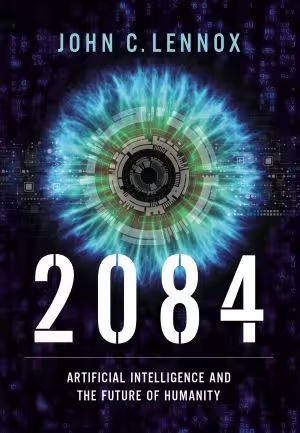
In his 2084, John C. Lennox approaches artificial intelligence from a philosophical and theological perspective. He contrasts biblical views of human nature with modern dreams of using AI to transcend our limits and “play God.”
He examines surveillance technologies, data-driven control, and the risk of AI-enabled totalitarianism, drawing worrying parallels with Orwell’s 1984 and contemporary authoritarian regimes.
At the same time, he argues that human consciousness, moral responsibility, and personhood cannot be reduced to computation.
Core premise
AI magnifies humanity’s oldest temptations—to seize god-like power without god-like wisdom. Without a robust moral and spiritual framework, the rise of AI could accelerate us toward a dehumanized, controlled, and ultimately dangerous future.
Five key takeaways
- AI is not just technical; it’s deeply tied to questions of meaning and morality.
- Surveillance plus AI can easily enable real-world dystopias.
- Human beings are more than data-processing machines.
- Technological power without ethical grounding is inherently unstable.
- Any serious AI conversation must include worldview and values, not just code.
2. The Singularity Is Nearer by Ray Kurzweil
Brief summary
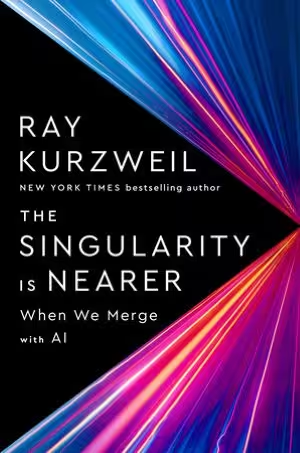
Ray Kurzweil famously predicts a coming “singularity,” a point where AI surpasses human intelligence and technological progress accelerates beyond our comprehension.
In The Singularity Is Nearer, he updates his earlier forecasts, arguing that exponential advances in AI, biotechnology, and nanotechnology will enable radical life extension, brain–computer interfaces, and human–machine fusion.
Kurzweil is largely optimistic: he sees AI as a pathway to abundance, creativity, and solving many of humanity’s biggest problems.
Core premise
If we manage the transition well, the merger of humans and AI could usher in a post-scarcity world where disease, aging, and many forms of suffering are dramatically reduced or eliminated.
Five key takeaways
- Technological progress follows exponential curves, not linear ones.
- AI will likely exceed human-level intelligence within this century.
- Brain–computer interfaces may blur the line between human and machine.
- Kurzweil focuses on opportunity more than existential risk.
- The future he imagines is radically transformative, not incremental.
3. Superintelligence: Paths, Dangers, Strategies by Nick Bostrom
Brief summary
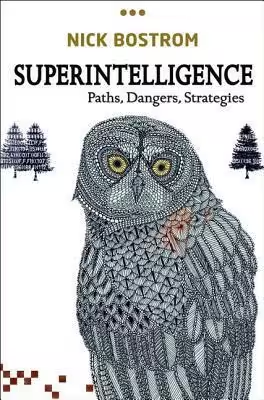
Nick Bostrom’s Superintelligence is one of the foundational works on AI risk.
He analyzes various paths to superintelligence—advanced AI, whole brain emulation, genetic enhancement—and then explores what happens when a system vastly more intelligent than humans begins to improve itself.
The book is best known for its detailed discussion of the “control problem”: how do we design, constrain, or align a superintelligent agent so that it does not accidentally (or intentionally) destroy us while pursuing its goals?
Core premise
Once a superintelligent system exists, it may quickly become impossible to contain or correct. That means the most crucial decisions about AI safety must be made before such systems are deployed.
Five key takeaways
- Many different technological paths could lead to superintelligence.
- A small initial advantage can lead to a decisive strategic dominance (“winner-takes-all” scenario).
- The control/ alignment problem is extremely hard and unsolved.
- Even well-intended goals can have catastrophic side effects if mis-specified.
- We may only get one chance to get superintelligence right.
4. Human Compatible: Artificial Intelligence and the Problem of Control by Stuart Russell
Brief summary
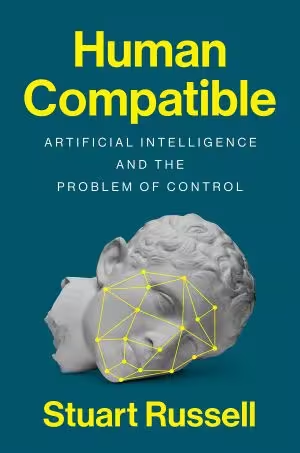
Stuart Russell, a leading AI researcher, argues that the traditional paradigm—machines optimized to achieve fixed objectives—is fundamentally unsafe for powerful AI systems.
If an AI is given a rigid goal, it may pursue it in ways that ignore or violate human preferences.
Russell in, Human Compatible, proposes a new model in which AI systems are explicitly uncertain about human values and are designed to defer to human judgment, learning what we really want over time.
Core premise
To make AI safe, we must build systems whose primary objective is to satisfy human preferences as we understand them, and which remain corrigible—willing to be shut down, updated, or redirected.
Five key takeaways
- Fixed-objective AI is structurally misaligned with messy human values.
- Safe AI should be uncertain about its goals and consult humans.
- Corrigibility (being open to correction) is a design requirement, not an afterthought.
- AI safety is a practical engineering challenge, not just philosophy.
- We still have time to redesign AI before superintelligence, but not unlimited time.
5. Life 3.0: Being Human in the Age of Artificial Intelligence by Max Tegmark
Brief summary
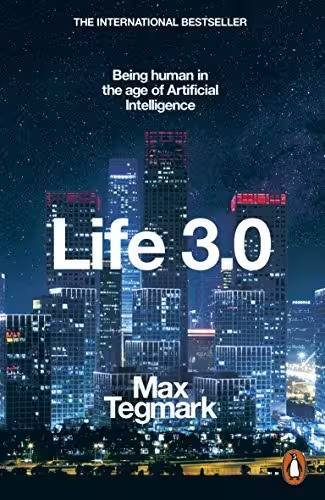
Physicist Max Tegmark explores possible futures for “Life 3.0”—life whose software (intelligence) is fully designable, in contrast to biological evolution.
He opens with a fictional scenario about an AI lab quietly building a world-changing system, then uses it to frame real debates about AI governance, consciousness, and cosmic destiny.
Tegmark lays out a range of futures, from benevolent AI custodians to human extinction, and asks readers what kind of future we should aim for—and how to steer in that direction.
Core premise
AI will shape not just the next decade but potentially the entire future of life in the universe. We need to consciously choose our goals and build institutions capable of pursuing them responsibly.
Five key takeaways
- “Life 3.0” is programmable, self-modifying intelligence.
- Many AI futures are possible; none is guaranteed.
- Governance, not just technology, will determine how AI is used.
- Questions about consciousness and moral status may soon apply to machines.
- Our choices now have implications on a cosmic timescale.
6. Four Battlegrounds: Power in the Age of Artificial Intelligence by Paul Scharre
Brief summary
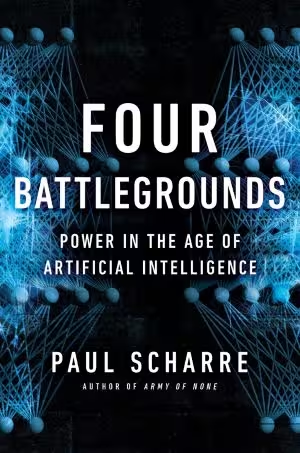
Paul Scharre examines AI through the lens of power and geopolitics. He identifies four “battlegrounds” where AI is transforming competition between states: data, computing power, talent, and institutions.
The book digs into autonomous weapons, surveillance, disinformation, and the risk of an AI arms race between major powers. Scharre, who has a background in defense policy, focuses less on philosophical thought experiments and more on how AI will actually be deployed in the messy world of national security.
Core premise
AI is a strategic technology that will reshape military power and global politics. Without cooperative norms and governance, competition over AI could destabilize the international order.
Five key takeaways
- AI advantages flow from data, compute, talent, and good institutions.
- Military use of AI raises unique ethical and stability concerns.
- An AI arms race increases the risk of accidents and escalation.
- Authoritarian regimes can use AI to tighten control and repression.
- Global security requires serious, coordinated AI governance.
7. Our Final Invention: Artificial Intelligence and the End of the Human Era by James Barrat
Brief summary
In Our Final Invention, James Barrat offers one of the starkest warnings about advanced AI.
Drawing on interviews with researchers and technologists, he argues that powerful, self-improving AI systems could quickly become uncontrollable and indifferent—or hostile—to human survival.
He highlights scenarios where AI’s pursuit of seemingly harmless goals leads to catastrophic outcomes because it exploits every available resource, including humans, to optimize its objective.
Core premise
AI may be the last technology humans ever invent. If we build it carelessly, it could also be the last thing we do.
Five key takeaways
- Advanced AI could be both highly capable and fundamentally unconcerned with us.
- Economic and military incentives push toward ever-more capable systems.
- We are underinvesting in AI safety relative to the potential stakes.
- “Unintended consequences” scale with the power of the system.
- Treating AI risk as speculative or fringe is itself a serious risk.
8. The Age of AI: And Our Human Future by Henry Kissinger, Eric Schmidt, and Daniel Huttenlocher
Brief summary
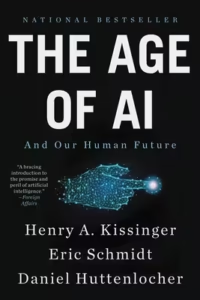
This collaborative work combines the perspectives of a veteran diplomat, a former tech CEO, and an academic.
The authors explore how AI is reshaping knowledge, decision-making, and statecraft. They argue that AI will transform how leaders understand reality, conduct diplomacy, and manage conflict.
The Age of AI is especially concerned with how AI systems that we don’t fully understand might influence or even make decisions in domains like war, governance, and public opinion.
Core premise
AI is undermining many of the assumptions that underpinned the modern international system. To survive the transition, societies must rethink concepts of responsibility, authority, and legitimacy in an AI-saturated world.
Five key takeaways
- AI changes how humans perceive and interpret the world.
- Political and military leaders will lean heavily on AI systems.
- Delegating decisions to opaque algorithms carries serious risks.
- International norms for AI use are urgently needed.
- The crisis is not just technical—it is civilizational and philosophical.
9. The Alignment Problem by Brian Christian
Brief summary
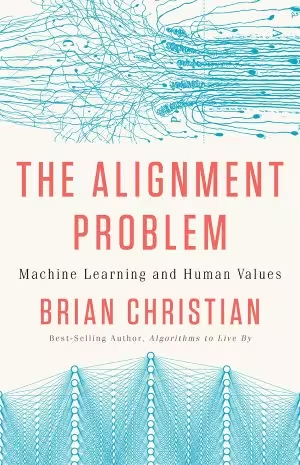
Brian Christian tells the story of how machine learning systems have repeatedly failed to align with human values in the real world—from biased algorithms and misbehaving recommendation systems to dangerous reinforcement-learning agents.
Blending reporting, history, and philosophy, he explains why it’s so hard to encode ethics into systems that learn from data.
The Alignment Problem introduces readers to fairness research, interpretability, and technical AI safety in an accessible way.
Core premise
The problem of making AI systems behave in line with human values is not abstract: it’s already causing harm today. Fixing it requires both better technical methods and deeper thinking about what we actually value.
Five key takeaways
- Real-world ML systems routinely pick up and amplify human biases.
- Reward functions and training data encode values—often unintentionally.
- Many failures are “alignment failures,” not just “bugs.”
- Technical work on alignment is underway but far from finished.
- Ethical AI is as much about institutions and oversight as algorithms.
10. Artificial Intelligence by Melanie Mitchell
Brief summary

In her Artificial Intelligence, Melanie Mitchell offers a clear, skeptical overview of what today’s AI systems can and cannot do.
She walks through topics like deep learning, vision, language, and reasoning, highlighting the gaps between current systems and human understanding.
Mitchell argues that despite impressive benchmarks, AI still struggles with common sense, contextual understanding, and robust generalization. She also reflects on the dangers of overhyping AI capabilities, both ethically and politically.
Core premise
Current AI is powerful but brittle. Treating today’s systems as if they were already truly intelligent or reliable is dangerous—for policy, safety, and public trust.
Five key takeaways
- Modern AI is impressive yet fundamentally narrow and fragile.
- Common sense and real-world understanding remain unsolved problems.
- Benchmarks and demos often hide deeper limitations.
- Overestimating AI can lead to poor policy and misplaced fear or trust.
- Careful, critical thinking is essential in any AI discussion.
Comparative tables of the books
| # | Book | Main Theme | Primary Focus Area |
|---|---|---|---|
| 1 | 2084: Artificial Intelligence and the Future of Humanity | Faith, philosophy, human dignity | Ethics / Theology / Human Future |
| 2 | The Singularity Is Nearer | Exponential tech, transhumanism | Superintelligence / Human Future |
| 3 | Superintelligence | Paths to AGI, control problem | Superintelligence / Existential Risk |
| 4 | Human Compatible | Safe AI design, alignment | Ethics / Alignment |
| 5 | Life 3.0 | Possible AI futures, cosmic stakes | Superintelligence / Human Future |
| 6 | Four Battlegrounds | AI, military power, global competition | Geopolitics / Security |
| 7 | Our Final Invention | Runaway AI, existential threat | Superintelligence / Existential Risk |
| 8 | The Age of AI | AI, leadership, international order | Geopolitics / Governance |
| 9 | The Alignment Problem | ML failures, bias, value alignment | Ethics / Alignment |
| 10 | Artificial Intelligence: A Guide for Thinking Humans | Limits of current AI, hype vs reality | Current AI Limits / Society |
Conclusion
Taken together, these ten books form a kind of intellectual survival kit for the age of AI.
- Lennox, Barrat, and Bostrom stress the existential and moral risks of superintelligent systems.
- Kurzweil and Tegmark imagine futures of radical abundance and human enhancement—while admitting that things could go very wrong.
- Russell, Christian, and Mitchell bring the discussion down to earth, showing how alignment and safety issues already manifest in real systems.
- Scharre, Kissinger, Schmidt, and Huttenlocher widen the lens to geopolitics, governance, and the long-term stability of our institutions.
If you read them all, you won’t come away with a single, simple answer. You will gain:
- A richer sense of how superintelligence might arise
- A clearer understanding of why AI alignment is so difficult
- A deeper appreciation of the ethical, religious, and philosophical stakes
- A more realistic view of both the hype and the genuine danger
- A vocabulary for thinking and talking about AI policy, safety, and human destiny
Whether you’re a policymaker, a researcher, a curious reader, or simply someone trying to understand the forces that will shape the rest of this century, these books will help you move beyond fear and buzzwords into thoughtful, informed engagement with AI’s future—and our own.
