
Last updated on September 2nd, 2025 at 02:24 pm
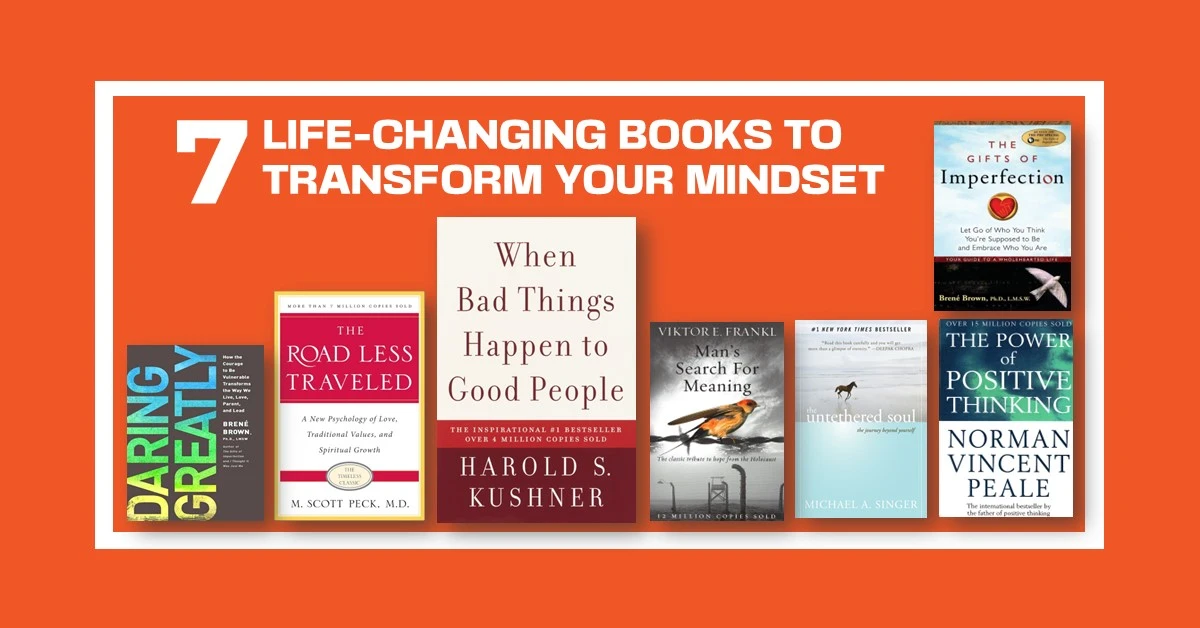
Books have a unique way of shaping our perspectives, especially those that challenge us to rethink our beliefs, embrace vulnerability, and find meaning even in hardship. Here I have combined a post on the 7 life-changing books of all time.
These seven books each offer profound lessons, weaving together themes of resilience, self-discovery, and the search for purpose. Here, I explore their shared insights, along with reflections on how they have the power to transform our lives.
Harold Kushner’s When Bad Things Happen to Good People, Viktor Frankl’s Man’s Search for Meaning, and Norman Vincent Peale’s The Power of Positive Thinking each grapple with the complexities of human suffering, the search for meaning, and the power of perspective.
While Daring Greatly, The Road Less Traveled, The Untethered Soul and The Gifts of Imperfection explore human weaknesses, vulnerabilities and flaws not to criticise but to point out that they can be our strength and sources of transformation of lives.
Although they differ significantly in their approaches, all three books offer ways of coping with life’s challenges, focusing on resilience and the human capacity to find purpose and hope even in the darkest times. Here’s a deeper look at how these works relate to each other.
1. Man’s Search for Meaning by Viktor Frankl
Holocaust survivor and Austrian psychiatrist Viktor Frankl’s Man’s Search for Meaning is both a harrowing account of life in a concentration camp and a profound treatise on the human quest for purpose. Frankl’s assertion that “Life is never made unbearable by circumstances, but only by lack of meaning and purpose” has been a guiding beacon for me.
I was so inspired and motivated by the book that I translated in Man’s Search for Meaning Bengali.
Frankl’s theory of logotherapy—finding meaning through work, love, or suffering—offers a roadmap for resilience. His reminder that “When we are no longer able to change a situation, we are challenged to change ourselves” has helped me navigate my darkest moments.
Frankl’s wisdom underscores the transformative power of purpose and the strength of the human spirit.
Explore the whole article: Man’s Search For Meaning (1946) Explains The Meaning of Life and Suffering in Absolute Term
2. When Bad Things Happen to Good People by Harold Kushner
Harold Kushner’s When Bad Things Happen to Good People is a deeply personal exploration of suffering and faith.
Born from the grief of losing his son, Kushner rejects the idea that all suffering is divinely orchestrated. Instead, he posits that God’s role is not to prevent suffering but to provide strength and comfort.
“The question we should be asking is not, ‘Why did this happen to me?’ but, ‘Now that this has happened, what am I going to do about it?’” Kushner’s words shifted my perspective on adversity, urging me to focus on resilience and agency.
This book is a testimony to the human capacity to find meaning in the face of tragedy and to transform pain into compassion.
Read the whole analysis: When Bad Things Happen to Good People (1981): Can an Omnipotent God Control Our Suffering in Life?
3. The Power of Positive Thinking by Norman Vincent Peale
Norman Vincent Peale’s The Power of Positive Thinking champions the transformative power of mindset. “Believe in yourself,” Peale urges, “and have faith in your abilities.” His blend of practical advice and spiritual guidance offers tools to overcome doubt and embrace possibility.
Peale’s emphasis on visualization and affirmations has been particularly impactful. The simple practice of envisioning success and cultivating gratitude has shifted my outlook on life. “Change your thoughts,” Peale asserts, “and you change your world.” This book is a powerful reminder that our mindset shapes our reality and that optimism is a choice.
With many practical suggestions of self-improvement, The Power of Positive Thinking can be one of the life-changing books that you might have been expecting. It has left a profound impression on me, and made me pause and re-think, revise and reconsider a lot of affairs in my life.
If you think you are struggling with destructive forms of negativity, hopelessness, consistent failure, losing influence, lack of mental vitality and spiritual degradation The Power of Positive Thinking can be a true friend in that regard.
Read the full review: The Power of Positive Thinking (1952) book review: reasons you should read it
4. The Untethered Soul by Michael A. Singer
Michael A. Singer’s The Untethered Soul delves into the nature of consciousness, urging us to observe the incessant chatter of our minds without attachment. “You are not your thoughts,” Singer writes. “You are simply aware of your thoughts.” This simple yet profound idea helped me step back from my mental noise and reclaim a sense of inner stillness.
One of the most transformative lessons in this book is the art of letting go. Singer’s analogy of the “inner thorn” encapsulates our tendency to protect wounds rather than release them.
His wisdom that “Everything will be okay as soon as you are okay with everything” has been a guiding principle in my life, reminding me to release resistance and embrace the flow of life.
Reading this book feels like embarking on an intellectual and spiritual journey toward understanding the mind’s incessant chatter and the barriers we unknowingly build around our inner freedom. Singer’s work resonated deeply with me from the very first chapter, where he challenges the reader to confront the “voice inside your head.” This constant internal dialogue, as Singer describes, often becomes our reality, trapping us in a limited, ego-driven existence.
Follow the whole analysis: Reflecting On The Untethered Soul by Michael A. Singer And Its 10 Life-Changing Lessons On New Self
5. The Road Less Traveled by M. Scott Peck
Peck’s The Road Less Traveled begins with a truth that is both stark and liberating: “Life is difficult.” This opening sets the stage for an exploration of discipline, love, and spiritual growth. Peck’s assertion that “Problems are the cutting edge that distinguishes between success and failure” reframed my understanding of struggle. Rather than fearing challenges, I began to see them as opportunities for growth.
One of the book’s most profound teachings is its redefinition of love as an act of will—a deliberate choice to nurture another’s spiritual growth alongside our own. Peck’s insights have deepened my relationships, inspiring me to approach them with intentionality and authenticity.
Discipline, according to Peck, is built on four cornerstones: delaying gratification, accepting responsibility, dedication to truth, and maintaining balance. Each of these principles serves as an antidote to the avoidance tendencies we often employ, consciously or unconsciously. His stark assertion that “Without discipline, we can solve nothing” is a reminder of the uncomfortable yet necessary commitment to self-mastery.
Read the full review: The Road Less Traveled (1978) by M. Scott Peck: A Groundbreaking Treatise on The Psychology of Change
6. Daring Greatly by Brené Brown
In Daring Greatly, Brené Brown redefines vulnerability as the birthplace of courage, creativity, and connection. She writes, “Vulnerability is not knowing victory or defeat; it’s understanding the necessity of both”—a stark reminder that to live fully, we must embrace the discomfort of uncertainty.
Brown’s exploration of shame and the false armor of perfectionism resonated deeply with me. It made me rethink the ways I shield myself from emotional exposure, realizing that these defenses only stifle growth.
By daring to show up authentically, we reclaim the fullness of our human experience. This book challenged me to ask myself: What drives my fear of vulnerability? and to dismantle the societal myths that equate vulnerability with weakness. It’s a call to step into the arena of life, imperfections and all.
Daring Greatly by Brené Brown is not merely a book; it is an invitation to engage in the raw and transformative power of vulnerability. From the very first pages, Brown challenges the deeply entrenched societal notion that vulnerability equates to weakness.
Do not miss the whole review of the great book: Daring Greatly (2012) Review: 10 Surprising Lessons on Unmasking the Fear of Vulnerability and Finding Strength in Weakness
7. The Gifts of Imperfection by Brené Brown
Brené Brown continues her journey into authenticity with The Gifts of Imperfection. She encourages us to live “wholeheartedly,” embracing courage, compassion, and connection. Brown’s insights into shame and self-compassion were particularly impactful. “Owning our story can be hard,” she writes, “but not nearly as difficult as spending our lives running from it.”
This book made me realize that letting go of perfectionism is not a surrender but a liberation. Authenticity, Brown argues, requires courage—the courage to let go of who we think we’re supposed to be and embrace who we are.
Learning to cultivate self-compassion and silence the inner critic has been a transformative journey for me, one that Brown’s words illuminated with clarity.
At the core of Brown’s teachings are 11 guideposts that outline a path toward embracing our true selves. From letting go of perfectionism to practicing gratitude and cultivating resilience, each lesson builds upon the next, offering practical wisdom that can transform the way we approach our lives and relationships.
Read the full analysis: 11 Life-Changing Lessons from The Gifts of Imperfection by Brené Brown That Will Crush Your Fear of Imperfections
Commonly Agreed Themes Of the 7 Life-changing Books
Each of these books, while unique in focus, converges on themes that resonate deeply:
1. Resilience in Adversity
From Frankl’s profound lessons on finding purpose amid the horrors of concentration camps to Kushner’s compassionate insights on enduring personal tragedy, these books collectively illustrate that pain, while inevitable, can be transformative.
Frankl’s concept of “tragic optimism” demonstrates how even the bleakest circumstances can lead to spiritual triumph.
His assertion that “When we are no longer able to change a situation, we are challenged to change ourselves” offers a roadmap for resilience. Similarly, Kushner’s focus on agency—choosing how to respond rather than questioning why something happened—shifts the narrative from victimhood to empowerment.
Both authors emphasize the importance of faith—whether in a higher power, a sense of purpose, or the resilience of the human spirit. Kushner highlights how community and support systems play a critical role in navigating hardship, reminding us that we are never truly alone in our struggles. Frankl, in turn, points to love as a force that sustains and uplifts us during our darkest moments.
2. The Nature of Suffering: Acceptance vs. Overcoming
In When Bad Things Happen to Good People, Harold Kushner tackles the problem of suffering from a theological perspective, proposing that not all suffering is caused by divine will. Kushner argues that suffering is often the result of natural laws or human free will, and the task for individuals is not to ask “Why did this happen?” but rather to find a way to move forward in the face of hardship.
Kushner emphasizes that suffering is often random and not something deserved by the victim. The book invites readers to accept suffering as an inevitable part of life and seek strength from within, supported by their faith and community.
Viktor Frankl’s Man’s Search for Meaning approaches suffering from an existential psychological standpoint. Frankl, a Holocaust survivor, emphasizes that suffering is unavoidable, but humans can find meaning in how they respond to it.
Frankl believes that even in the most horrendous circumstances, like the concentration camps where he was imprisoned, people can choose their attitude and find meaning in their suffering. This, he argues, is the key to psychological resilience and personal fulfillment.
Norman Vincent Peale’s The Power of Positive Thinking takes a somewhat different approach by focusing on the power of mindset.
Peale argues that much of human suffering can be alleviated or minimized through the practice of positive thinking and faith. His philosophy is grounded in optimism, faith, and self-empowerment. Peale’s emphasis on mental attitude suggests that positive thinking can help individuals overcome challenges, reshape their lives, and reduce the emotional toll of suffering.
This outlook contrasts with Frankl’s existential realism and Kushner’s acceptance of suffering as a natural, sometimes inexplicable part of life.
3. Meaning: Imposed or Discovered?
All three authors are concerned with the role of meaning in life, though they approach it differently.
In When Bad Things Happen to Good People, Kushner argues that we must create meaning out of suffering. While suffering itself is often random and senseless, the response to suffering is where we can impose meaning. He encourages acts of love, resilience, and community as a way of making sense of tragedies.
Kushner’s approach suggests that meaning is something we impose upon our circumstances to make life more bearable and to maintain our connection to God and others.
Frankl’s approach in Man’s Search for Meaning is more about discovering meaning rather than creating it. For Frankl, meaning exists inherently in the choices we make, even in the face of extreme suffering. His concept of “logotherapy” asserts that the primary human drive is not pleasure (as Freud suggested) or power (as Adler believed), but the pursuit of meaning.
For Frankl, meaning is found in taking responsibility for one’s attitude toward suffering and in recognizing that every situation, no matter how dire, offers the opportunity for personal growth and moral decision-making.
Peale, in The Power of Positive Thinking, implies that meaning is somewhat tied to the individual’s mental and emotional perspective.
Through faith and positivity, Peale argues, one can transform challenges into opportunities for growth and success. Meaning, for Peale, is closely linked with the ability to stay optimistic, trust in God’s plan, and use faith to turn negative situations into positives.
Peale’s emphasis is less on grappling with suffering directly and more on transcending it through a shift in mindset.
4. The Power of Mindset
Whether it’s Peale’s positive affirmations or Singer’s teachings on letting go, these authors emphasize the transformative potential of our inner world.
Norman Vincent Peale’s approach in The Power of Positive Thinking revolves around the idea that optimism is a skill that can be developed through practice. He is for cultivating positive mindset.
He urges us to “believe in yourself” and to visualize success, arguing that these mental habits can transform external realities. For me, adopting daily affirmations has been a practice that not only uplifts but also reinforces my self-belief, creating a foundation for greater resilience and achievement.
Michael Singer’s The Untethered Soul expands on the concept of mindset by teaching us to detach from the mental chatter that often holds us back. His lesson that “you are not your thoughts” serves as a reminder that the true self exists beyond our mental narratives.
Learning to observe and release these thoughts has been instrumental in fostering a sense of inner peace and clarity in my own life. To him, peace is in having letting go mindset.
Both authors emphasize the importance of aligning a positive mindset with purposeful action. Peale’s practical steps for cultivating faith and confidence complement Singer’s spiritual teachings on inner freedom, demonstrating that mindset is not passive but actively shapes the way we engage with the world.
This dual approach reinforces the idea that changing our inner world is the first step toward creating external change.
5. Authenticity and Vulnerability
Brené Brown’s works shine a light on the courage it takes to live authentically, a lesson echoed in Peck’s exploration of love and discipline.
Brené Brown redefines vulnerability as the birthplace of meaningful connection and creativity. In Daring Greatly, she asserts, “Vulnerability is the core of all emotions and feelings. To feel is to be vulnerable.” This perspective challenges societal norms that equate vulnerability with weakness, emphasizing instead that true strength lies in the willingness to show up fully, even when uncertain.
Moreover, Both Brown and Peck stress the importance of authenticity in living a fulfilling life. Brown’s concept of wholehearted living involves letting go of who we think we should be and embracing who we are. Peck’s exploration of love as an act of will aligns with this, encouraging us to extend ourselves for the growth of others and ourselves.
Authenticity requires intentional choices and a commitment to self-awareness.
Furthermore, Brown’s emphasis on self-compassion is a key to unlocking authenticity. She writes, “Talk to yourself like you would to someone you love.” This practice dismantles the inner critic and fosters a kinder, more accepting relationship with ourselves. Peck echoes this by highlighting the need for discipline and love—toward oneself and others—as cornerstones of personal growth and meaningful relationships.
Authenticity and vulnerability are deeply intertwined with connection. Brown teaches that to foster true relationships, we must allow ourselves to be fully seen. Peck’s notion of love as a deliberate act further reinforces this, showing that authentic connection requires both courage and effort. Together, these ideas inspire us to create relationships built on honesty and mutual growth.
6. The Role of Faith and God
Kushner’s When Bad Things Happen to Good People reflects a nuanced view of God’s role in human suffering. Kushner challenges traditional theodicy, suggesting that God is not responsible for every tragedy or misfortune, but that He provides the strength to endure suffering. This view portrays God as a compassionate partner in human suffering, offering solace and support but not necessarily controlling or preventing pain.
Kushner’s take on faith is one of comfort in the midst of chaos, emphasizing God’s presence as a source of resilience, not an all-powerful controller of human fate.
In contrast, Frankl’s Man’s Search for Meaning does not focus directly on religion, though it is deeply spiritual in nature. Frankl, a Jewish psychiatrist, often speaks of “ultimate meaning” or “the transcendent” as something that goes beyond individual understanding, which can be akin to a divine force.
However, Frankl emphasizes human responsibility in finding meaning, suggesting that individuals are active participants in their spiritual and existential journeys. For him, faith may play a role in the search for meaning, but it is not necessarily tied to a traditional understanding of God.
Peale, however, places a strong emphasis on faith in The Power of Positive Thinking. His approach is distinctly Christian, and he advocates for the power of prayer, faith in God, and the transformative power of belief in divine assistance. For Peale, faith is not only a source of comfort but also a tool for overcoming obstacles and achieving success.
Peale’s God is one who helps individuals realize their potential and succeed in life through positive belief and trust in His plan.
7. Human Agency and Empowerment
Each of these books offers a perspective on human agency in the face of suffering.
Kushner emphasizes that while humans cannot always control what happens to them, they have the power to control how they respond. This form of empowerment is rooted in resilience, emotional strength, and finding meaning through love and community. Kushner is not concerned with individuals gaining mastery over their circumstances, but rather with how they cope and find meaning within them.
Frankl’s approach similarly emphasizes human agency but goes deeper into the existential freedom of choice.
Frankl argues that even in a concentration camp, where everything was taken from him, the ability to choose one’s attitude was the last and greatest freedom. This ability to choose gives humans tremendous power over their internal state, even if they cannot change external circumstances. Frankl’s view is that meaning is found in this freedom to choose how to react to suffering.
Peale, in The Power of Positive Thinking, empowers individuals through the belief in the transformative power of optimism and faith. His focus is less on enduring suffering and more on overcoming challenges through a positive mental attitude. For Peale, human agency is tied to the capacity to reshape one’s circumstances by thinking positively, trusting in God, and acting with confidence.
8. Different Paths to Hope and Resilience
When Bad Things Happen to Good People, Man’s Search for Meaning, and The Power of Positive Thinking all offer valuable insights into how humans can face suffering, but they do so through different lenses.
Kushner advocates for acceptance of life’s inherent randomness and the pursuit of meaning through love and community.
Frankl stresses the importance of finding meaning in every circumstance, particularly through the freedom to choose one’s response to suffering.
Peale champions the transformative power of positive thinking and faith as tools to rise above adversity.
Together, these works provide a comprehensive toolkit for approaching suffering and hardship. Whether through theological inquiry, existential choice, or the power of optimism, each offers a path to hope, resilience, and ultimately, meaning in the face of life’s inevitable difficulties.
Conclusion
These seven books are more than just words on a page; they are companions on the journey of self-discovery and growth.
They challenge us to confront our fears, embrace our imperfections, and find meaning even in the face of adversity. As I reflect on their teachings, I am reminded that transformation begins within—with the courage to see ourselves and the world anew.
