
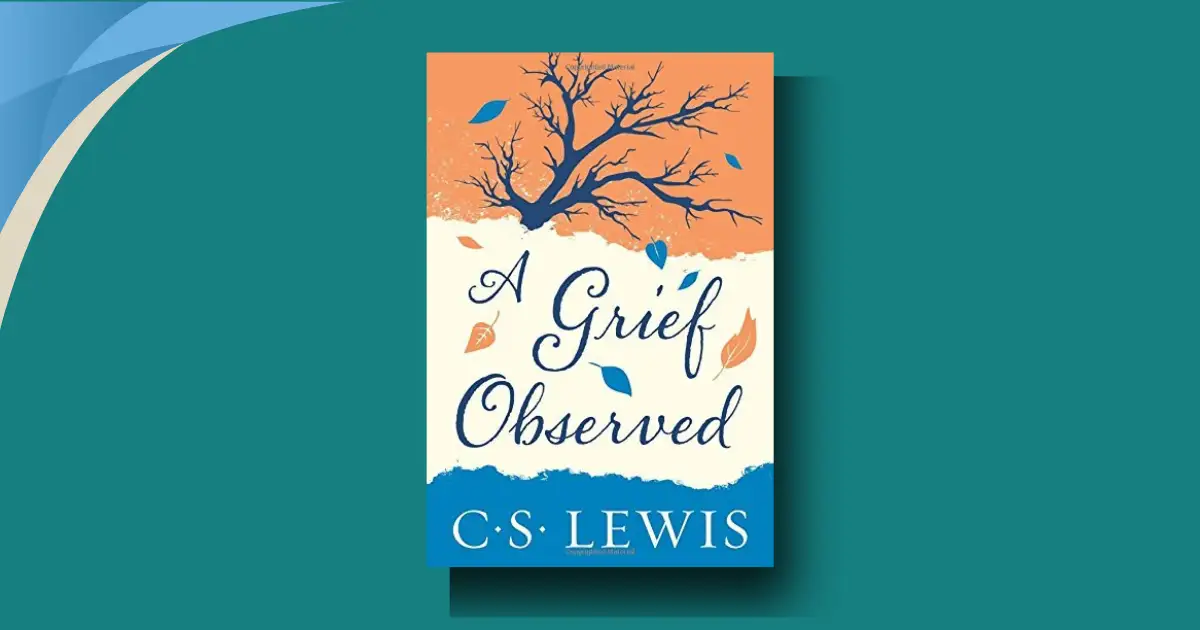
Ever wonder why you feel so alone in your grief, even when surrounded by people who love you? What if I told you that one of the 20th century’s most brilliant Christian minds screamed the same questions into the void, and wrote it all down in a book that has comforted millions? A Grief Observed is the raw, unvarnished journal of C.S. Lewis grappling with the brutal reality of grief after his wife’s death, arguing that true faith isn’t about having neat answers but about honestly facing the pain, the doubt, and the silence, and discovering that love—not explanation—is the final reality.
A Grief Observed is best for Anyone experiencing deep personal loss, Christians wrestling with doubt in suffering, seekers wanting an unflinching look at raw human emotion, and readers who find polished, theological comfort rings hollow.
Not for: Readers seeking a traditional, linear Christian apologetic on suffering; those who prefer strictly theological or impersonal analyses of grief; anyone uncomfortable with profound doubt and anger directed at God.
Table of Contents
1. Introduction
The book in question is A Grief Observed by Clive Staples Lewis (1898–1963), first published under the pseudonym N.W. Clerk in 1961. This is not a formal treatise but a personal journal, a genre-defying masterpiece that sits at the crossroads of memoir, theology, and philosophy.
The author, a towering intellectual figure of the 20th century and the prolific mind behind Mere Christianity and The Chronicles of Narnia, was uniquely credentialed yet utterly leveled by his subject.
His background as a celebrated Christian apologist makes his descent into doubt not a betrayal, but a profound credential for writing about authentic grief.
The central thesis of A Grief Observed is not an argument but an experience: that grief is a chaotic, non-linear process that shatters neat theological boxes, and that the only way through it is to observe it ruthlessly, question everything—even God—and in doing so, perhaps encounter a love more real and demanding than any comforting platitude.
Lewis’s purpose is not to console with doctrine, but to validate the terrifying, messy reality of mourning.
As he writes, “Talk to me about the consolations of religion or I shall suspect that you don’t understand” (Page 23). This book is his attempt to understand, not to be consoled.
2. Background
To appreciate the seismic shift this book represents, one must understand the context. By 1960, C.S. Lewis was known as “the Apostle to the Skeptics.”
His logical, clear-eyed defenses of Christianity, like The Problem of Pain (1940), systematically addressed suffering from a theological distance.
Then, in 1956, he married Joy Davidman, an American writer, in a civil ceremony to secure her residency. What began as a marriage of convenience for a dying friend (she had bone cancer) blossored into a profound, late-life romance. They had a religious wedding in 1957 during a miraculous remission, but the cancer returned, and Joy died in July 1960.
The man who had theorized about pain was now eviscerated by it. In his agony, he filled four notebooks. Published anonymously, the book was a stark departure.
Readers familiar with “Lewis the Apologist” were confronted with “Lewis the Bereaved,” a man whose faith house, as he describes it, was revealed to be “a house of cards” (Page 28).
The book’s power lies in this brutal authenticity. It wasn’t until after Lewis’s own death in 1963 that the authorship was widely acknowledged, allowing the world to fully grasp the depth of his journey.
3. A Grief Observed Summary
A Grief Observed is a short book, but its emotional and intellectual density is immense. Let’s walk through its landscape, which Lewis himself describes as “a long valley, a winding valley where any bend may reveal a totally new landscape” (Page 38).
Chapter One: The Physical and Spiritual Shockwave
Lewis immediately dismantles any romantic notion of grief. “No one ever told me that grief felt so like fear,” he begins (Page 14). He catalogues the physical sensations: the fluttering stomach, the restlessness, the yawning.
Grief is lazy, making the slightest effort—shaving, reading—seem Herculean. The world is muffled by “a sort of invisible blanket” (Page 14).
But the core crisis is theological. The God who felt present in times of joy has vanished. “Go to Him when your need is desperate… and what do you find? A door slammed in your face, and a sound of bolting and double bolting on the inside.
After that, silence” (Page 15). This is the agonizing heart-cry of the book. He rejects the idea that his rich marital love was a substitute for God—if God were a substitute, having the “real thing” would have made Him irrelevant, but it didn’t.
He grapples with memory, fearing the transformation of his vibrant, sharp-witted wife H. (his pet name for Joy) into a “mere doll to be blubbered over” (Page 14). He describes her mind as “lithe and quick and muscular as a leopard” (Page 14), a reality already threatening to be smoothed over by his own sorrow.
The chapter ends with the stark, repeated finality: “She died. She is dead. Is the word so difficult to learn?” (Page 19).
Chapter Two: Memory, Fear, and the Horror of “Going On”
Here, Lewis turns his critical eye inward, horrified by his own self-absorption. “From the way I’ve been talking anyone would think that H.’s death mattered chiefly for its effect on myself” (Page 20).
He fears his memory is already fictionalizing her, creating a composite “more and more my own” (Page 20), because her living reality is no longer there to correct him.
This leads to a devastating examination of belief. He realizes his easy prayers for other dead were strong only “because I have never really cared, not desperately, whether they existed or not” (Page 22). Now, praying for H. feels like speaking “into a vacuum about a nonentity” (Page 22). He mercilessly deconstructs the well-meaning clichés of comfort.
- “She is with God”: This renders her “incomprehensible and unimaginable” (Page 23), which is no comfort to the one who longs for the tangible, earthly her.
- “She is at peace”: “Why are they so sure that all anguish ends with death?” he asks (Page 24). If God’s goodness allowed her suffering here, what guarantees its cessation?
- “You will be reunited”: He finds this “unscriptural,” a sentimental “bait” that promises merely “the happy past restored” (Page 23), which he admits he craves with “mad, midnight endearments” (Page 24).
He spirals into the darkest theological suspicion: “What reason have we… to believe that God is… ‘good’? Doesn’t all the prima facie evidence suggest exactly the opposite?” (Page 25). He entertains the idea of God as a “Cosmic Sadist” or an “Eternal Vivisector” (Page 25, 29).
Chapter Three: The Slow Turn – Grief as a Phase of Love
A subtle shift begins. Lewis starts to think about his feelings. He realizes his previous faith was an “imaginary faith playing with innocuous counters” (Page 29). True belief is only tested when “you find that you are playing… for every penny you have in the world” (Page 29). The destruction of his “house of cards” faith, he admits, was necessary.
He then makes a crucial reframing. He begins to see bereavement “not as the truncation of married love but one of its regular phases—like the honeymoon” (Page 34).
The task is to “live our marriage well and faithfully through that phase too.” This is a monumental shift from seeing grief as an interruption to seeing it as an integral, continuing part of the love story.
He experiences his first moments of relief, where “H. rushes upon my mind in her full reality, her otherness” (Page 36), not distorted by his pain. He realizes “passionate grief does not link us with the dead but cuts us off from them” (Page 36). The goal becomes loving her, not loving his grief, his memory, or his past.
Chapter Four: Iconoclasm and a New Kind of Presence
The final chapter is where Lewis’s fractured thoughts begin to coalesce into a new, sturdier understanding. He realizes grief is a “process,” not a “state,” requiring a history, not a map (Page 38).
The central, triumphant theme emerges: Iconoclasm. “All reality is iconoclastic,” he writes (Page 41).
The living, breathing Joy constantly shattered his mere idea of her. He loved her for her “foursquare and independent reality,” her resistances and faults (Page 41). This, he argues, is the key to loving both the dead and God: “Not my idea of God, but God. Not my idea of H., but H.” (Page 41).
He describes a profound, non-emotional experience of H.’s presence—like a “telephone call,” business-like, full of “intelligence and attention” (Page 44).
It suggests the dead may be “sheer intellects” (Page 44), and this intimacy, free of sensory emotion, feels “brisk, cheerful, keen, alert… solid. Utterly reliable” (Page 45).
He concludes not with answers, but with a chastened, open-handed faith. Heaven, he posits, won’t solve our problems by subtle logic, but by knocking “the notions… from under our feet. We shall see that there never was any problem” (Page 43).
The book ends with Joy’s own words, “I am at peace with God” (Page 45), which he can now accept not as a trite consolation, but as her hard-won truth, separate from his own anguish.
4. Most important takeaways from C.S. Lewis’s A Grief Observed
1. Grief Isn’t a State, It’s a Process—and It’s Non-Linear.
You don’t “get over” grief; you move through it, often in circles. Lewis compares it to “a long valley, a winding valley where any bend may reveal a totally new landscape” (Page 38). Some days feel like progress, others like you’re back at the start. This is normal. The spiral—whether going up or down—is the nature of the journey.
2. Grief Feels Like Fear.
That physical sensation—fluttering stomach, restlessness, yawning, constant swallowing—isn’t anxiety in the usual sense. It’s the body’s shock response to profound loss. Acknowledging this can remove a layer of panic: you’re not going mad; you’re grieving.
3. The “Door Slammed in Your Face” Feeling Toward God is a Valid Part of Faith.
The most searing takeaway is Lewis’s description of divine absence: “Go to Him when your need is desperate… and what do you find? A door slammed in your face, and a sound of bolting and double bolting on the inside. After that, silence” (Page 15). This isn’t faithlessness; it’s an honest record of spiritual crisis. True faith can include rage, doubt, and feeling abandoned.
4. Your Faith is Only as Real as What You’re Willing to Lose for It.
Lewis realizes his prior theological understanding was abstract: “I thought I trusted the rope until it mattered to me whether it would bear me. Now it matters, and I find I didn’t” (Page 29). Faith isn’t truly tested until the stakes are everything. Grief reveals whether your beliefs are a “house of cards” or something sturdier.
5. Beware of Memory’s Betrayal.
There’s a terrifying fear that you will replace the real, complicated person with a softened, fictionalized memory—a “doll to be blubbered over” (Page 14). The real person was “other,” independent, and would correct you. The work of grief is to fight the saintly portrait and honor the true, flawed, vibrant human.
6. Clichés and “Comforts” Can Be Wounds in Disguise.
Lewis dissects hollow condolences:
- “She is at peace”: “Why are they so sure that all anguish ends with death?” (Page 24).
- “You’ll be reunited”: Often a sentimental desire for “the happy past restored” (Page 23), not a theological truth.
- “Don’t mourn like those without hope”: This only comforts “those who love God better than the dead” (Page 24). It’s okay if your human love makes that impossible right now.
7. Bereavement Is Not the End of Love, But a Phase of It.
This is the book’s most transformative idea: “Bereavement is not the truncation of married love but one of its regular phases—like the honeymoon. What we want is to live our marriage well and faithfully through that phase, too” (Page 34). You haven’t stopped loving; the love has entered a new, painful, but legitimate season.
8. Passionate Grief Can Cut You Off From the Dead; Calm Remembrance Can Restore Connection.
A paradoxical but crucial insight: “Passionate grief does not link us with the dead but cuts us off from them” (Page 36). When you are drowning in sorrow, you lose the real them. In moments of calm, their true presence—their “otherness”—can rush back more clearly.
9. All Reality is Iconoclastic—Love the Reality, Not Your Idea.
The supreme takeaway for all relationships: “All reality is iconoclastic. The earthly beloved… incessantly triumphs over your mere idea of her. And you want her to… And this, not any image or memory, is what we are to love still, after she is dead” (Page 41). Apply this to God, to the living, and to the dead: love the real, not your projection.
10. The Goal Isn’t to Find Answers, But to Learn to Ask Better Questions—or to Stop Asking Unanswerable Ones.
Lewis concludes that many of our agonizing “why” questions are like asking “How many hours are there in a mile?” (Page 42). They are nonsense questions. The solution won’t be a neat philosophical answer but a shattering of the question itself by a reality beyond our current comprehension.
11. Healing Doesn’t Mean Returning to Who You Were.
Lewis uses the perfect analogy: losing a loved one is an amputation. “Healing” means the stump mends, you learn to walk with a “wooden leg,” but you are forever a “one-legged man” (Page 35). You will adapt, find joy, and live fully, but you are permanently changed. That’s okay.
12. The “Proof” of Love is in the Will, Not Just the Feeling.
Near the end, Lewis experiences H. not as an emotion, but as a presence of “intelligence and attention” (Page 44), a “sheer intellect” that includes will. Love, ultimately, is an act of attention and will—a choice to turn toward the other, even in absence, beyond the fluctuation of feelings.
The One Sentence to Carry:
Grief is the price of love, faith is not the absence of doubt but the struggle through it, and the only way out is to surrender your comforting illusions and embrace the shocking, iconoclastic reality of the other—and of God.
These takeaways make A Grief Observed not just a book about losing Joy Davidman, but a manual for enduring one of the most human experiences with honesty, courage, and the faint, hard-won hope that love, in its truest form, endures all things—even death, even silence, even God’s slammed door.
5. Strengths and Weaknesses: A Personal Take
Strengths (The Unforgettable Impact):
- Unparalleled Honesty: This is the book’s cardinal virtue. Lewis gives permission to feel the unsayable: the anger at God, the boredom of grief, the shame at “recovering,” the fear of forgetting. It’s a sacred validation of doubt.
- Psychological Precision: His descriptions of grief’s mechanics—the laziness, the fear, the cyclical nature—are so exact they feel diagnostic. Anyone who has grieved will find their experience named with terrifying accuracy.
- Theological Courage: For a public defender of the faith to publish such doubt was an act of immense bravery. It strengthens, rather than weakens, the Christian witness by showing it can survive a furnace of real anguish.
- The Iconoclasm Thesis: The idea that we must love the reality of the other, not our idea of them, is a profound insight applicable to all relationships, with the living and the dead.
Weaknesses (Or Rather, Points of Friction):
- Density of Thought: Lewis’s mind, even in chaos, operates at a high philosophical level. Some passages, especially on time and eternity, require slow, careful reading. It’s not a light, accessible guide for the first hours of shock.
- A Particular Grief: As Madeleine L’Engle notes in the Foreword, Lewis’s grief was for a glorious but brief marriage. Those who lose a partner after 40 years, or a child, may find the dynamic different, though the core emotions resonate.
- Limited Practicality: It is a journal of observation, not a handbook with “5 steps.” Readers seeking actionable advice on “moving on” may be frustrated. Its gift is companionship, not instruction.
6. Comparison with Similar Works
A Grief Observed stands unique, but it dialogues with other key texts:
- Vs. The Problem of Pain (Lewis’s own): This is the clearest contrast. Problem is a third-person theological lecture; Grief is a first-person scream. Reading them together shows the chasm between theory and experience.
- Vs. The Year of Magical Thinking (Joan Didion): Didion’s memoir is similarly a masterful observation of grief’s irrationality. Yet, Didion’s lens is more literary and psychological, while Lewis’s is relentlessly theological. Both are essential, side-by-side maps of the same terrible territory.
- Vs. Modern Grief Handbooks: Most contemporary books aim to therapize and resolve grief. Lewis offers no resolution, only witness. He is less interested in “healing” than in honest enduring.
7. Conclusion: Who Should Walk This Path with Lewis?
A Grief Observed is a necessary book, but not an easy one. It is not for the early days of raw, blinding shock when one needs simple, gentle holding. It is for the phase that comes after—when the numbness wears off and the questions, the anger, and the terrifying silence begin.
It is perfect for:
- The bereaved person who feels alienated by cheerful platitudes.
- The doubting Christian who fears their anger is a failure of faith.
- The thinker who needs to interrogate their pain intellectually to survive it emotionally.
- Anyone who wants to understand the human condition in one of its most universal yet isolating trials.
In the end, Lewis does not give us the answers he sought. He gives us something better: the company of a brilliant, broken-hearted companion who assures us that the valley, however winding, is passable, and that the love which causes the grief is, in its shattered, iconoclastic reality, the one thing that remains true.
As he ultimately realizes, the journey is about learning to love the actual, even in absence, and to turn that love, painfully, back toward the source of all reality. That is this book’s lasting, difficult, and invaluable gift.
