
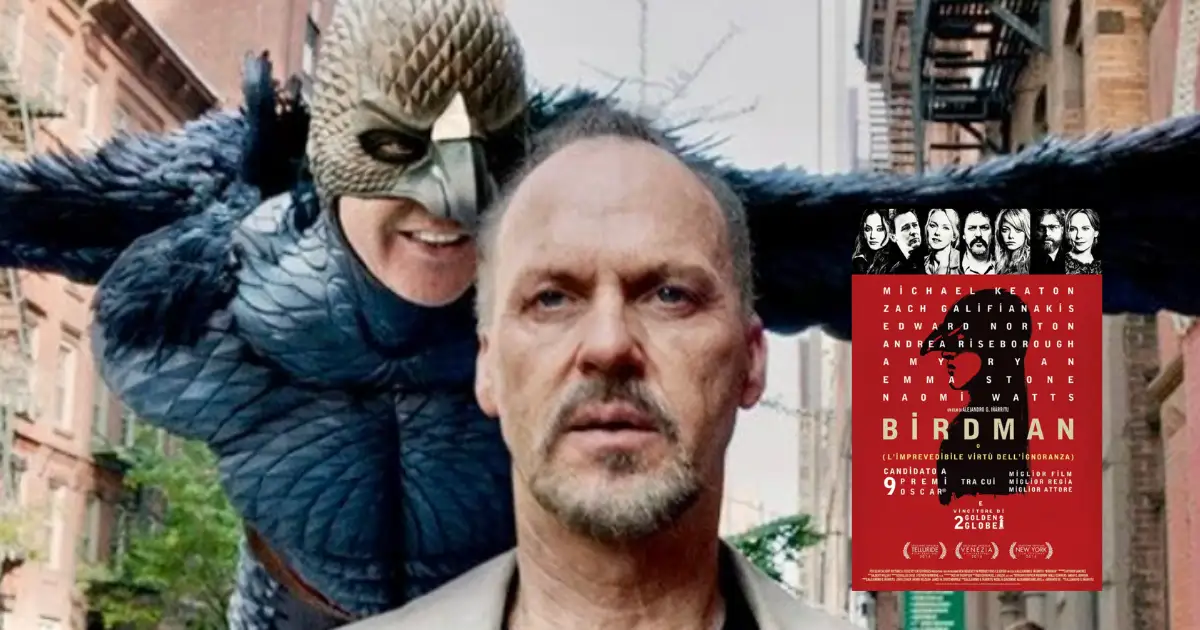
Have you ever wondered what it sounds like inside an actor’s crumbling ego? Birdman or (The Unexpected Virtue of Ignorance), Alejandro G. Iñárritu’s 2014 cinematic tour de force, doesn’t just ask this question—it straps you into the chaotic, drum-scored psyche of its protagonist for a relentless, one-shot fever dream.
This satirical black comedy-drama, starring Michael Keaton in a career-resurrecting role, is far more than a film about Hollywood vanity; it is a raw, technically audacious exploration of art, relevance, and the deafening noise of our own expectations.
For me, it remains a staggering achievement, a movie that marries theatrical bravura with cinematic innovation so seamlessly it feels like watching a man walk a tightrope over his own obsessions.
It is, without doubt, one of the essential modern films and a permanent entry on any serious list, including our own 101 must-watch films you need to see.
Table of Contents
Background
Emerging from a desire to break his own dramatic patterns after Biutiful, director Alejandro G. Iñárritu conceived Birdman as a comedy set almost entirely within a Broadway theatre, captured to look like a single, continuous take.
Co-written with Nicolás Giacobone, Alexander Dinelaris Jr., and Armando Bó, the script is deeply personal, weaving Iñárritu’s own professional anxieties with themes from Raymond Carver’s short story.
Filmed in New York in spring 2013 on a modest $16.5 million budget, the project was a monumental risk.
The director’s “suicidal” technical vision required unprecedented precision from cinematographer Emmanuel Lubezki and the entire cast and crew, creating an immersive, inescapable reality that would become the film’s defining characteristic.
Birdman Plot Summary
Riggan Thomson, once famous for portraying the superhero Birdman in a blockbuster trilogy, is a man haunted by the phantom of his own past success.
His internal monologue is the mocking, gravelly voice of Birdman himself, a constant reminder of faded glory that contrasts sharply with his current reality: a desperate attempt to regain artistic legitimacy by writing, directing, and starring in a Broadway adaptation of Raymond Carver’s “What We Talk About When We Talk About Love.”
The film unfolds in real-time over several days before the play’s opening, trapping us in the labyrinthine backstage corridors of the St. James Theatre and the chaotic streets of New York, mirroring Riggan’s own claustrophobic mental state.
His support system is a collection of fragile egos.
His daughter and assistant, Sam, a recovering drug addict, oscillates between contempt and a desperate need for his attention. His girlfriend and co-star, Laura, seeks validation. His best friend and producer, Jake, is a pragmatic anchor amidst the storm.
The fragile production is upended when Riggan is forced to replace an injured actor with Mike Shiner, a brilliant but volatile method actor portrayed with arrogant gusto by Edward Norton.
Mike is everything Riggan is not—instantly respected by the New York theatre scene, fearlessly committed to his “truth,” and a destabilizing force who exposes the play’s and Riggan’s own artifice.
The narrative tension builds through a series of disastrous previews, public humiliations, and personal confrontations.
Riggan’s grip on reality, always tenuous, begins to slip. He experiences moments of magical realism, visualizing himself flying over Manhattan or using telekinetic powers, blurring the line between his dissolving sanity and a latent desire for the god-like power his superhero persona once offered.
The crisis peaks when, after a confrontation with a powerful and cynical theatre critic who promises to destroy his play without seeing it, Riggan goes on a bender.
In a hungover stupor, Birdman fully takes over, convincing him to abandon the play for a lucrative Birdman film sequel.
This leads to the film’s most spectacular sequence: Riggan, in his underwear, soaring triumphantly through New York City, a visual manifestation of his escapist fantasy.
Yet, he returns to the theatre. On opening night, in a moment of eerie calm, he confesses past infidelities and a suicide attempt to his ex-wife, Sylvia, a moment of raw humanity she meets with quiet pity.
For the play’s climax, where his character commits suicide, Riggan substitutes a prop gun with a real one. On stage, in front of a packed house, he shoots himself in the face. The film cuts to a hospital room.
He has survived, having only shot off his nose, which is now surgically rebuilt. The critic, Tabitha, has written a rave review, interpreting his on-stage mutilation as a bold new form of “super-realism.”
In a final, profoundly ambiguous scene, Riggan rises, walks to the bathroom, and stares at his bandaged, monstrous new face in the mirror.
He seems to bid farewell to the Birdman voice. He then climbs onto the hospital ledge, looks at birds flying free, and steps out of view. His daughter Sam enters, rushes to the window, looks down, then slowly up at the sky, and smiles.
The ending is masterfully open-ended. Did Riggan fall, finally succumbing to his despair? Or did he, having sacrificed his literal face for artistic validation and finally silenced his inner critic, truly fly?
The film offers no definitive answer, inviting us to project our own interpretation of redemption, release, or defeat.
It is a conclusion that perfectly encapsulates the film’s central theme: the search for meaning and validation in a world that often rewards spectacle over substance.
Birdman Analysis
1. Direction and Cinematography
Iñárritu’s vision was to create a subjective, unrelenting experience, to “submerge the protagonist in an inescapable reality.”
This conceptual gamble resulted in one of the most celebrated technical achievements in modern cinema. The “one-shot” illusion, orchestrated by the genius of Emmanuel Lubezki, is not a gimmick but the film’s nervous system.
The camera, often an 18mm lens held inches from actors’ faces, glides, weaves, and pivots through claustrophobic dressing rooms, chaotic streets, and stark theatre wings, creating a palpable, breathless urgency.
This seamless flow mirrors the continuous, unedited anxiety of Riggan’s mind, making the audience a captive participant in his unraveling.
According to Lubezki, the film would have been technologically impossible to make just a few years prior, a testament to its innovative spirit.
2. Acting Performances
The film is a masterclass in meta-performance. Michael Keaton’s Riggan is a raw, vulnerable, and deeply tragic figure.
Drawing clear parallels to his own career-defining role as Batman, Keaton channels a lifetime of professional highs and lows into a performance that is both hilarious and heartbreaking.
Edward Norton is his perfect foil, playing Mike Shiner with such arrogant, method-actor intensity that he both satirizes and embodies theatrical purity.
The supporting cast is flawless: Emma Stone delivers a career-best turn as the achingly cynical yet vulnerable Sam; Zach Galifianakis provides crucial, grounded warmth as Jake; and Naomi Watts and Andrea Riseborough perfectly capture the specific anxieties of actors on the brink.
Their chemistry feels less like acting and more like documented chaos.
3. Script and Dialogue
The screenplay is a meticulously engineered Swiss watch. Every line of dialogue serves dual purposes: advancing the plot while dissecting themes of art, criticism, legacy, and love.
The pacing is relentless, driven by the invisible-edit structure, leaving no room for narrative respite.
The dialogue crackles with wit, bitterness, and profound sadness. Conversations overlap, interrupt, and cascade, feeling improvised yet precisely calibrated. Its greatest strength is how it balances surreal satire with genuine emotional weight, allowing moments of pure comedic absurdity to sit alongside scenes of devastating father-daughter estrangement.
The writers, according to interviews, focused on ensuring the film was “fluid and never stopped,” and they succeeded brilliantly.
4. Music and Sound Design
The soundscape of Birdman is its heartbeat. Antonio Sánchez’s improvised, free-form jazz drum score is revolutionary.
It isn’t background music; it is Riggan’s internal rhythm—his anxiety, his mania, his fleeting moments of clarity. Iñárritu used the drum cues on set to pace the scenes, and the result is a symbiotic relationship between image and sound that is utterly unique.
This is punctuated by classical pieces (Mahler, Tchaikovsky) that emanate diagetically from the world of the play, representing the “high art” Riggan aspires to.
The sound design, by Martín Hernández, had to abandon traditional “cut-based” techniques, instead crafting a continuous aural environment that moves with the camera, making every creak, whisper, and distant siren part of the immersive spell.
5. Birdman Themes and Messages
Birdman is a dense tapestry of themes. On the surface, it’s a satire of celebrity culture, superhero industrial complexes, and the fraught relationship between Broadway and Hollywood.
Dig deeper, and it becomes a poignant study of late-career crisis, the desperate human need for relevance, and the eternal battle between artistic integrity and commercial success.
It questions the very nature of criticism and validation: is praise from a critic or viral fame on Twitter any more “real” than the adulation of a movie-going crowd?
Ultimately, its most powerful thread is the father-daughter relationship, a fragile quest for forgiveness and connection that grounds the surreal spectacle in universal, emotional truth.
Comparison
Birdman invites comparisons to other “one-shot” experiments like Hitchcock’s Rope or Sokurov’s Russian Ark, but its frantic, neurotic energy is entirely its own.
Thematically, it shares DNA with Fellini’s 8½ in its portrait of an artist’s creative crisis, and with Cassavetes’ Opening Night in its backstage volatility. However, Iñárritu’s fusion of technical wizardry, surrealism, and biting Hollywood satire creates a distinct, 21st-century artifact.
It stands apart from his previous, more fragmented multi-narrative dramas like Babel, showcasing a director forcefully and successfully leaping into a new creative language.
Audience Appeal
This is a film for cinephiles, for those who appreciate audacious formal experiment and layered, intellectual storytelling.
While its themes of failure and redemption are universal, its meta-humor and theatrical setting may not resonate with casual viewers seeking straightforward narrative.
It is a demanding, exhilarating experience that rewards multiple viewings, perfect for audiences who enjoy dissecting film craft and grappling with ambiguous, thought-provoking conclusions.
Awards
Birdman soared at awards season. It won the Academy Award for Best Picture, Best Director, Best Original Screenplay, and Best Cinematography at the 87th Oscars, tying for the most wins that night.
Michael Keaton won the Golden Globe for Best Actor in a Musical or Comedy, and the film also won the Golden Globe for Best Screenplay.
It was a critical and industry darling, cementing its status as a modern classic.
Personal Insight and Lessons
Watching Birdman today feels more prescient than ever. We live in the age of the personal brand, of curated online identities, and relentless self-comparison.
Riggan’s struggle—the deafening chorus of past success, public opinion, and internal doubt—mirrors our own daily battles in the digital arena.
His desperate need for validation, whether from a New York Times critic or a Twitter follower count, is amplified a thousandfold in our social media ecosystem. The film asks what “real” success and artistry mean when metrics and algorithms constantly define our worth.
The lesson I take from Riggan’s journey is not about rejecting fame, but about the source of validation. His most honest moment comes not with a standing ovation, but in a quiet confession to his ex-wife.
The film suggests that perhaps the only critique that matters, and the hardest one to face, is our own. It’s a brutal, beautiful reminder to create not for the roar of the crowd or the silence of the critic, but from a place of personal truth, however messy that may be.
In a world obsessed with virality, Birdman champions the unexpected virtue of ignoring the noise, even if just for a moment, to hear your own voice.
Birdman Quotes
- “I’m Birdman. I’m the Birdman.” – The haunting, internal mantra that encapsulates Riggan’s trapped identity.
- “Let’s face it, Dad, you’re doing this because you want to feel relevant again.” – Sam’s devastatingly accurate critique, cutting to the core of Riggan’s mission.
- “I will destroy your play.” – Critic Tabitha Dickinson’s chilling, pre-emptive strike, representing the arbitrary power of criticism.
- The entire final hospital sequence, devoid of dialogue, where a look in the mirror and a glance at the sky speak volumes about release, transformation, and ambiguous freedom.
Pros and Cons
Pros:
- A revolutionary, seamless cinematographic technique that serves the story.
- Career-defining, meta-textual performances led by Michael Keaton.
- A brilliantly sharp, witty, and profound screenplay.
- An innovative, driving jazz drum score that is integral to the film’s identity.
- A daring, ambiguous ending that invites deep personal interpretation.
Cons:
- The frenetic, theatrical pace and insider references may alienate some viewers.
- The unrelenting cynicism of its showbiz satire can feel emotionally draining.
- The ambiguous ending, while brilliant, may frustrate audiences seeking closure.
Conclusion
Birdman or (The Unexpected Virtue of Ignorance) is not just a film; it is an experience. It is a chaotic, brilliant, and deeply human symphony of ego, art, and anxiety.
Iñárritu, Lubezki, and Keaton created something that transcends satire to become a genuine work of cinematic art.
It challenges, provokes, and moves you in equal measure. For anyone interested in the power of film as a medium, it is an absolute, non-negotiable must-watch. A dazzling, drum-beating masterpiece that truly earns its place among the 101 best films you need to see.
Rating: 5/5 Stars
