
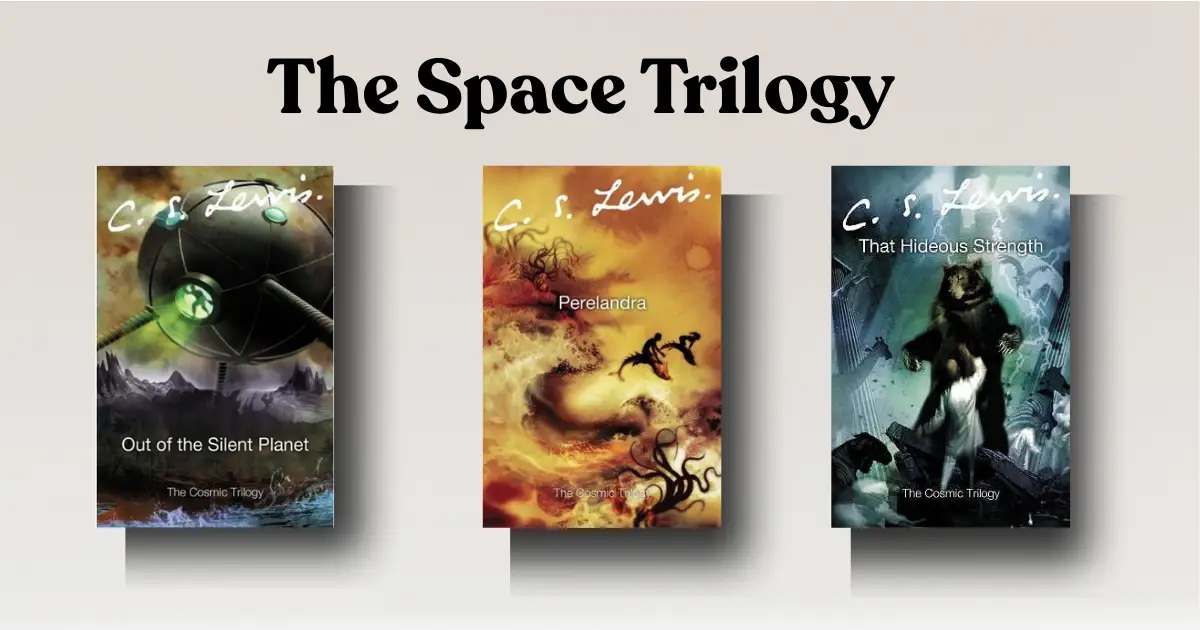
Ever wonder why you feel a strange, almost painful longing when you look up at the night sky—a feeling that’s part wonder, part sorrow? C.S. Lewis’s The Space Trilogy didn’t just satisfy that longing for me; it transformed it into a profound conversation about what it means to be human in a universe charged with meaning.
The Space Trilogy is a philosophically rich science-fantasy saga that uses interplanetary travel not to escape Earth, but to hold up a mirror to humanity’s spiritual sickness, contrasting our “bent” world with unfallen, mythically-ordered societies.
The Space Trilogy is best for readers of classic sci-fi and fantasy (Tolkien, Wells) seeking deeper philosophical and theological themes; Christians interested in imaginative apologetics; anyone weary of cynical sci-fi and craving stories where wonder, goodness, and objective morality are real.
And not for readers seeking hard sci-fi focused on technology and realism, those uncomfortable with overt Christian allegory and moral argument, or anyone wanting fast-paced, action-driven plots.
Table of Contents
Introduction
The Space Trilogy is a landmark work of science fiction and theological fantasy by Clive Staples Lewis (1898–1963), published between 1938 and 1945. The omnibus comprises three novels: Out of the Silent Planet (1938), Perelandra (1943), and That Hideous Strength (1945).
Lewis, an Oxford and Cambridge scholar famed for The Chronicles of Narnia and Mere Christianity, leverages his expertise in medieval literature, philosophy, and Christian theology to construct a universe where space travel becomes a vehicle for spiritual and ethical discovery.
Defying easy categorization, the trilogy blends early 20th-century planetary romance (think H.G. Wells) with deep-rooted medieval cosmology, mythological archetypes, and Christian apologetics.
It belongs to the rare genre of theological science fiction, where the conflicts are as much about ideas and souls as they are about aliens and rockets. Lewis himself, in the Foreword by J.R.R. Tolkien included in the omnibus, highlights this blend, calling it a “vera historia with mythos” where the “underlying myth is of course that of the Fall of Angels (and the fall of man on this our silent planet)” (p. 5).
Purpose and Central Thesis: The trilogy’s core argument is a direct rebuttal to the materialist and progressive ideologies Lewis saw ascending in his time—specifically what he termed “The Poison of Subjectivism.”
He counters with a vision of a Objective Universe, governed by divine law (Maleldil) and populated by rational species living in harmony with a created order. Earth (Thulcandra, “the silent planet”) is the anomaly, quarantined due to humanity’s rebellion.
Thus, the narrative thrust isn’t about conquering space, but about rediscovering, through cosmic perspective, what humanity has lost: its proper place in a moral and spiritual cosmos.
As Tolkien noted, the story contains “a spice of satire on other superficially similar works of ‘scientific’ fiction—such as the reference to the notion that higher intelligence will inevitably be combined with ruthlessness” (p. 5).
The Space Trilogy Summary
What follows is a comprehensive, spoiler-inclusive summary of the trilogy’s narrative and thematic arc. My aim is to provide such a detailed recounting that you grasp the full scope of Lewis’s vision without needing to turn a page.
1. Out of the Silent Planet (1938): Arrival on Unfallen Mars
The story begins not in space, but on a walking tour in the English countryside. Dr. Elwin Ransom, a Cambridge philologist (a point Tolkien enjoyed, as “the hero is a philologist”), is kidnapped by two ruthless men: Dick Devine, a crass opportunist, and Dr. Weston, a physicist embodying ruthless, evolutionary “scientific imperialism.” They drug Ransom and take him aboard a spherical spaceship to Malacandra (Mars).
Upon arrival, Ransom escapes into a stunningly beautiful, pastoral landscape. He first encounters the hrossa, otter-like beings who are poets, fishermen, and philosophers. They live in the handramits (low river valleys) and their culture is defined by communal living, art, and a profound connection to nature. Through them, Ransom learns the Malacandrian language and discovers that Mars is a tripartite society of rational species (hnau):
- The hrossa (artists and farmers).
- The séroni or sorns (scientists and thinkers), tall, slender beings living on the mountain edges (harandra).
- The pfifltriggi (artisans and miners), frog-like creatures who work with metals and stones.
All three species coexist peacefully under the rule of Oyarsa, a planetary intelligence or “angel.” Most shocking to Ransom is the revelation that Earth is known as Thulcandra, “the silent planet,” whose Oyarsa became “bent” (evil) and was sealed off from the rest of the solar system (the “Heavens”) after a great war. Humanity’s Fall has literally cut it off from cosmic communion.
Weston and Devine, seeking gold (“sun’s blood”), intend to offer Ransom as a sacrifice to the sorns, whom they mistakenly believe to be the dominant, savage species. Ransom, however, is called to Meldilorn, Oyarsa’s seat.
His journey involves a thrilling hnakra (a majestic, deadly aquatic monster) hunt with his hross friend Hyoi, which ends tragically when Weston, in fear and ignorance, shoots and kills Hyoi with a rifle. This act of “bent” violence on an unfallen world horrifies the Malacandrians.
At Meldilorn, before Oyarsa—an entity of light and reason—Ransom, Weston, and Devine are judged. In a brilliant rhetorical set-piece, Weston’s ideology of human survival and conquest at any cost is exposed as demonic hubris.
Oyarsa sees it as “the mind of the Bent One.” He sends the men back to Earth, warning that the spiritual quarantine holds. The novel ends with Ransom, now a changed man, returned to an Earth that feels suddenly small, dark, and spiritually deaf.
2. Perelandra (1943): Paradise Held
Years later, Ransom is summoned by the eldila (angels) and sent, via a mystical coffin-like vessel, to Perelandra (Venus), a planet covered in floating, undulating islands and golden seas. His mission: to oppose Weston, who has arrived, now visibly possessed by the “Bent Oyarsa” of Earth (Satan). Perelandra is a new, unfallen world, and its two human-like inhabitants, the Green Lady (Tinidril) and the King, are its Adam and Eve.
What follows is a cosmic retelling of the temptation of Eve. The Un-man (Weston’s possessed body) uses every intellectual, emotional, and psychological trick to persuade the Green Lady to disobey the one command given by Maleldil (God): not to sleep on the Fixed Land. His arguments are sophisticated, blending appeals to curiosity, compassion, and a desire for “self-actualization”—to step out from under divine protection into a “mature” freedom.
Ransom’s role shifts from observer to active participant. He cannot simply argue theology; he must physically embody the good, engaging in a relentless, days-long debate of cosmic stakes.
The climax is not a battle of armies, but a terrifying, visceral struggle. Realizing rational argument is failing, Ransom is guided to understand he must destroy the Tempter by force.
In a brutal, exhausting, and deeply symbolic fight, he hunts and finally kills the Un-man, himself suffering a near-fatal heel-wound. His victory ensures the Perelandrian Paradise remains unfallen.
He witnesses the joyous coronation of the King and Queen by planetary spirits and the Oyarsa of Mars, and glimpses the cosmic dance of a righteous creation. He returns to Earth wounded but sanctified, bearing a foretaste of redeemed humanity.
3. That Hideous Strength (1945): The Battle Comes Home
The final volume shifts to a near-future, post-war England at a university called Edgestow. The story follows Mark Studdock, a sociologist desperate for inclusion in the inner ring of academic prestige, and his wife Jane, who is troubled by prophetic, truthful dreams.
Their stories diverge: Mark is gradually ensnared by the National Institute for Coordinated Experiments (N.I.C.E.), a technocratic organization that promises social planning but masks a horrific agenda of stripping humanity of its soul, ethics, and individuality to achieve pure control. Its methods are eugenics, vivisection, and the creation of a disembodied, immortal “Head.”
Jane, meanwhile, is drawn to a small community at St. Anne’s led by the now-elderly and mystically empowered Dr. Ransom (called the Director). This group, including a bear named Mr. Bultitude and a reformed skeptic named MacPhee, is under the protection of the Oyarsa of Malacandra and Perelandra. They are preparing for a direct, supernatural intervention.
The novel is a stark contrast: the cold, sterile, manipulative evil of the N.I.C.E. (a manifestation of the Bent Oyarsa) versus the warm, organic, tradition-rooted good of St. Anne’s. The conflict culminates in a mythological siege. The dormant merlin of Arthurian legend is awakened and, his ancient pagan power baptized and directed by the planetary Oyarsa, calls down a celestial destruction upon the N.I.C.E.
The finale is apocalyptic, with the sanitized evil of the Institute being overthrown by a torrent of chaotic, natural, and divine forces. Mark and Jane are redeemed through suffering and humility, reunited not in a modern “partnership” but in a deeper, self-sacrificial marriage. The trilogy closes with the heavens open once more, and the spiritual quarantine of Earth beginning to crack.
The Space Trilogy Analysis
Evaluation of Content and Argument
Lewis’s argument is powerfully sustained through narrative. He doesn’t preach; he shows. The unfallen societies of Malacandra are his primary evidence for an Objective Good. The hrossa critique our materialism not through essays, but through their joy in song and ritualized hunt.
When Hyoi explains love and memory—“A pleasure is full grown only when it is remembered… What it will be when I remember it as I lie down to die, what it makes in me all my days till then—that is the real meeting” (pp. 77-78)—it’s a devastatingly beautiful counter to Earthly lust and disposability.
The temptation on Perelandra is one of the most psychologically astute in literature. The Un-man’s arguments are seductive because they contain half-truths, mirroring the sophisticated secularism of our age. Ransom’s ultimate, violent action is Lewis’s controversial but clear thesis: there is evil that cannot be reasoned with, only resisted and destroyed. It’s a theological argument made flesh.
Strengths and Weaknesses
My Pleasant/Positive Experience:
- The Re-enchantment of the Cosmos: After reading, I couldn’t look at the sky the same way. Lewis restored a sense of meaning to space. It’s not a void, but the “heaven,” a vibrant spiritual realm. As Ransom realizes, “Space was the wrong name. Older thinkers had been wiser when they named it simply the heavens” (p. 38).
- The Hrossa: They remain one of my favorite fictional species. Their blend of animality and profound rationality challenges anthropocentric bias. Their culture feels real and desirable.
- Ideas Made Flesh: Concepts like objective morality, demonic possession, and spiritual warfare are not abstract. They walk, talk, and fight on floating islands and in English laboratories.
- The Dated Prophecy of That Hideous Strength: Surprisingly, its critique of technocratic dehumanization feels more relevant than ever in the age of AI, big data, and ethical transhumanism. The N.I.C.E. is a chillingly accurate blueprint for a certain kind of bureaucratic evil.
My Unpleasant/Negative Experience:
- Pacing and Digressions: That Hideous Strength, in particular, can be a slog. The domestic and academic politicking of the first half is slow. Lewis’s authorial voice sometimes intrudes with lengthy philosophical asides that halt narrative momentum.
- Characterization Limitations: Aside from Ransom, Jane, and perhaps Mark, characters can feel like archetypes or mouthpieces for ideas. Weston/Un-man is a brilliant idea but not a nuanced person.
- Problematic Gender Elements: A modern reader will wince. Female characters, especially Jane, often operate within a framework of submission and “feminine” intuition that feels restrictive. The handling of Jane’s dreams and her relationship to the Director can be read as advocating a passive, receptive role for women.
- The Heavy Hand of Allegory: For some, the Christian framework will feel too prescriptive, leaving little room for alternative interpretation. The moral universe is starkly black and white.
Comparison with Similar Works
- The Space Trilogy Vs. H.G. Wells: Lewis directly confronts Wellsian evolutionism and utopianism. Where Wells’s Martians in The War of the Worlds are hyper-evolved monsters, Lewis’s are unfallen kin. It’s a conscious theological correction.
- The Space Trilogy Vs. J.R.R. Tolkien’s Legendarium: Both share a Catholic cosmology and love of language. However, Tolkien’s myth is historical and terrestrial, while Lewis’s is planetary and explicitly doctrinal. Tolkien’s evil is a corrosive shadow; Lewis’s is a possessed physicist.
- The Space Trilogy Vs. Modern “Hard” Sci-Fi (e.g., Arthur C. Clarke): Clarke explores transcendence through technology and evolution (2001, Childhood’s End). Lewis sees such transcendence without God as a horrific dead end, literally depicted in the “Head” of the N.I.C.E.
- The Space Trilogy Vs. Philip Pullman’s His Dark Materials: Pullman’s trilogy is often seen as the atheistic rebuttal to Lewis. Both feature parallel worlds and cosmic war, but where Lewis’s Authority is good, Pullman’s is a tyrant to be overthrown. They form a fascinating dialectic.
Conclusion and Recommendation
C.S. Lewis’s The Space Trilogy is not casual reading. It is a demanding, thought-provoking, and deeply idiosyncratic work that asks fundamental questions: What is man? What is our place in the cosmos? Is progress always good? Is there a moral law woven into reality itself?
I highly recommend it to readers hungry for substance over spectacle, who want their science fiction to engage the soul as well as the mind. It is essential for understanding 20th-century Christian intellectual history and the roots of modern mythopoeic fantasy.
While its mid-century sensibilities and theological certainty won’t resonate with all, its diagnosis of humanity’s spiritual “bentness” and its breathtaking vision of what we were meant to be continue to challenge and inspire. You may not agree with Lewis’s answers, but you cannot deny the power and grandeur of the questions he poses from the shores of Perelandra and the silent plains of Thulcandra.
