
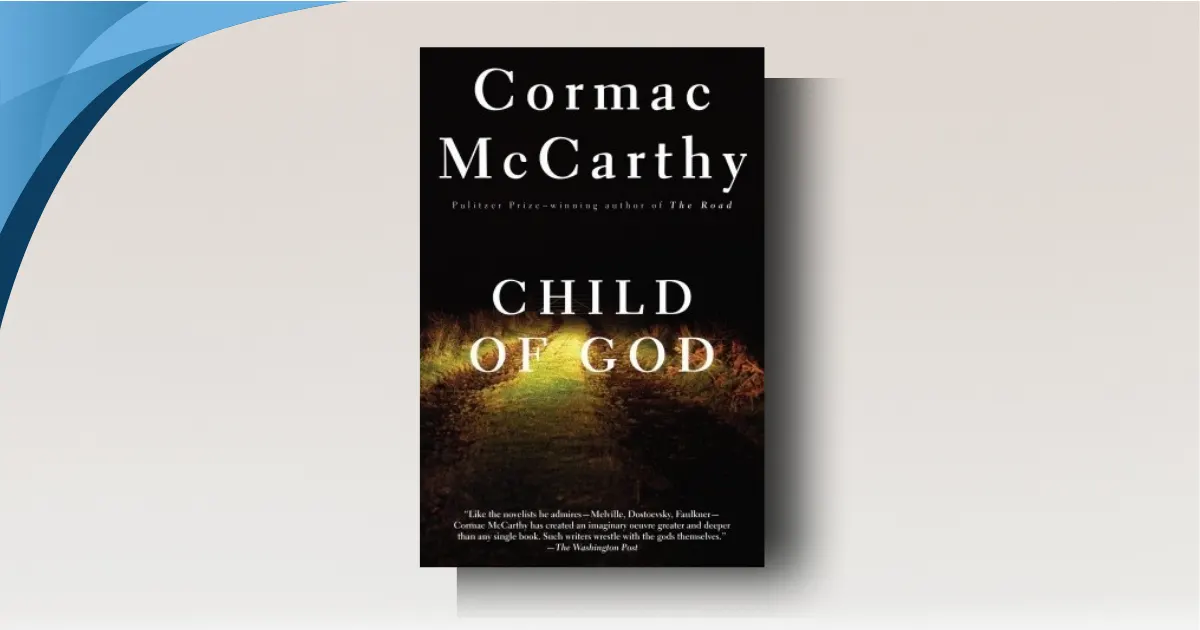
Child of God is the kind of novel you read when you’re tired of pretending “monsters” come from somewhere else.
McCarthy uses Lester Ballard’s collapse to force you to face how thin the wall is between community life and human ruin.
He doesn’t ask you to excuse Ballard.
He asks you to stop lying about what a society quietly permits.
Large meta-analyses link social isolation and loneliness with higher mortality risk (e.g., social isolation OR ≈ 1.29; loneliness OR ≈ 1.26).
A major National Academies report estimates about 24% of community-dwelling Americans 65+ are socially isolated.
Child of God is best for readers who like Southern Gothic/Appalachian Gothic, moral discomfort, and literary brutality that means something.
Not for anyone who wants a “safe” story, a clean hero, or violence kept politely offstage.
Table of Contents
1. Introduction
Cormac McCarthy’s Child of God was originally published in hardcover in 1973, and your PDF is the first Vintage International edition (June 1993).
From page one, the narrator frames Ballard with a line that feels like a dare: “A child of God…” and then the needle twists—“much like yourself perhaps.”
That “perhaps” is the whole book: a moral trapdoor you keep stepping on even when you swear you won’t.
McCarthy writes Ballard as small, dirty, watching, and already half-swallowed by the landscape around him.
And in McCarthy’s Tennessee, the hills don’t merely hold a person—they can erase one.
2. Background
The story sits in Sevier County hill country, where local memory includes public hangings, “White Caps,” floods, and a blunt belief that cruelty isn’t new—“people are the same.”
That matters, because Ballard isn’t dropped into a vacuum; he’s raised inside a culture that can normalize spectacle, gossip, and punishment as community entertainment.
McCarthy’s Appalachia here isn’t postcard-pretty.
It’s poor, suspicious, and intimate in the worst way—where everybody knows your name and still lets you rot.
3. Child of God Summary
McCarthy introduces Lester Ballard as an outsider before he’s done the worst things he will do, which is key: the community already sees him as something half-human.
He’s there at the margins—dump roads, church benches, cold cabins—while the rest of the county turns like one body to track him, judge him, and laugh at him.
A lot of Ballard’s early life is sketched through implication and local talk rather than tidy biography.
What you feel is the slow tightening of a noose: poverty, social exclusion, humiliation, and the kind of loneliness that turns feral.
When McCarthy says, “He’d grown lean and bitter,” it’s not a mood; it’s a diagnosis.
The book keeps showing Ballard alone in motion—rifle hanging, shoulders slouched—like even his body has given up on blending in.
Ballard still tries, in his broken way, to orbit normal life: he shows up around women, makes crude attempts at connection, and gets treated as a punchline.
One scene at a trailer-dump world turns sexuality into a kind of public cruelty, with Ballard paying to “see” and everyone laughing at him, not with him.
Church, which could have been refuge, becomes another place where bodies swivel and whispers travel.
McCarthy makes this rejection feel communal—like Ballard is being voted off the island one stare at a time.
Then comes the rape accusation thread: Ballard lands in jail, eating what he thinks is “not bad” food, talking across bars with another prisoner, and insisting the woman was “a whore.”
The sheriff’s questions—where she’s from, whether she’s local—turn the case into something uglier: less about truth, more about jurisdiction, reputation, and disposal.
Even early, McCarthy is careful: Ballard is guilty of plenty, but the legal system’s attention is inconsistent, sometimes lazy, sometimes eager, and often shaped by who matters.
That inconsistency becomes one of the novel’s quiet engines: Ballard is both hunted and ignored, feared and tolerated.
From here, Ballard’s slide accelerates into a private world—cabins, firelight, hidden corridors—where he no longer behaves like someone who expects a future among other people.
And McCarthy keeps returning to a nightmare idea: once a person crosses a certain line, they stop traveling roads and start traveling depths.
One of the most revealing micro-moments is the grotesque “bird” scene: a child chews the bird’s legs off, and Ballard smiles nervously, offering a warped logic—“He wanted it to where it couldn’t run off.”
It’s a small cruelty, but it echoes the whole book—possession replacing love, control replacing care.
At this stage, you can already feel what McCarthy is building: Ballard isn’t just committing acts; he’s building a new internal law where wanting equals taking, and taking equals keeping.
And the land—caves, sinkholes, woods—becomes a willing accomplice, a geography designed for hiding.
Ending explained
Ballard’s later life becomes an underground existence—literally—where he navigates caves and stone corridors as if he’s descending into his own conscience made physical.
McCarthy describes him moving deeper until he reaches a chamber where “dead people lay,” arranged in a way that’s both ritual-like and horrifying.
The community eventually names what has been happening, and the accusations land on Ballard in blunt language: he’s told he killed people “in them parked cars,” and he denies it—“I never done it.”
That denial isn’t persuasive; it’s revealing, because it shows how Ballard’s mind has split reality into what he admits versus what he’s done.
When he’s finally moved through institutional spaces—hospital corridors, trucks, watchers—he’s strangely diminished, almost childlike in the logistics of being handled.
It’s one of the book’s nastiest tricks: you’re forced to see his vulnerability without being allowed to forget his violence.
The ending turns coldly procedural.
Ballard dies after pneumonia, and the narration delivers a clinical, brutal afterlife: formalin, dissection, and medical students “bent over him.”
There’s no romantic punishment, no cinematic justice—just a human body reduced to parts, as if the world’s final response to Ballard is to treat him like he treated others.
Even his burial is minimal, almost administrative.
And then McCarthy seals the book with a discovery that reads like a dark folktale: a sinkhole swallows mules, boys descend, and lawmen find bodies arranged on ledges “in attitudes of repose.”
That image is the novel’s true last word: the land kept the secret until it couldn’t.
4.Child of God Analysis
4.1 Child of God Characters
Lester Ballard is written as both predator and product, and McCarthy never lets you rest in only one interpretation.
He is “lean and bitter,” possibly “mad,” and described as if something external “kept him,” which makes his violence feel like a fate and a choice at the same time.
The sheriff and deputies are not heroic foils; they’re local power with local boredom, sometimes casual, sometimes vicious.
Their questions aren’t “what happened,” but “who is she,” “is she from here,” as though moral urgency depends on county lines.
The community itself is practically a character: churchgoers who swivel as one, neighbors who trade stories, men who turn Ballard into entertainment.
McCarthy makes it hard to claim innocence when the crowd is always watching, always whispering, and always justifying.
4.2 Child of God Themes and Symbolism
The core theme is dehumanization—how easily “othering” becomes permission.
That’s why the narrator’s line “much like yourself perhaps” is so central: it denies the reader the comfort of distance.
Caves and sinkholes function like moral architecture: they are places where society’s unwanted truths get stored.
The corpses arranged underground are not only Ballard’s secret; they are the county’s repressed knowledge made visible.
McCarthy also threads a bleak statement about civilization’s obligations: “A race that gives suck to the maimed and the crazed” is a line that sounds compassionate until you realize it’s also accusing—who decides which “maimed” people get care, and which get exile.
The novel’s violence, then, isn’t random shock—it’s a referendum on belonging.
5. Evaluation
Strengths: The prose is mercilessly vivid, and McCarthy can turn a single sentence into a moral punch.
He writes landscape like theology—woods and weather as forces that don’t judge, they only continue.
Weaknesses: Some readers will find the book emotionally airless, because it refuses conventional interiority and rarely offers relief.
The ugliness can feel relentless, and that relentlessness is a deliberate aesthetic choice.
Impact: The novel lingers because it makes you recognize complicity in the act of looking—like the town, you’re watching Ballard.
It’s hard to finish and not hear that opening “perhaps” again.
Comparison with similar works: If Outer Dark is McCarthy’s fable-like nightmare and Blood Meridian is cosmic violence on an epic scale, Child of God is the small-county version—intimate, claustrophobic, and filthy.
It also sits near Flannery O’Connor’s Southern grotesque tradition, but with McCarthy’s signature refusal to moralize cleanly.
5. Adaptation
James Franco directed the film adaptation (Child of God, 2013), starring Scott Haze, and it screened in major festival contexts including Venice (per compiled production history).
The adaptation leans heavily on atmosphere and body-language because McCarthy’s narrative voice—so crucial on the page—doesn’t translate neatly to dialogue.
Box-office wise, the film’s theatrical footprint was tiny: Domestic box office ~$37,949, with additional estimated home video sales listed separately.
That limited reach fits the material: it’s not a mainstream story, and it resists mainstream catharsis.
6. Personal Insight
One reason Child of God still matters now is that it weaponizes a question we keep dodging in public life: what happens when isolation stops being a phase and becomes a habitat.
Modern research keeps underlining that isolation isn’t just “sad,” it’s medically consequential—meta-analytic evidence links loneliness and social isolation to increased mortality risk (e.g., ORs around 1.26–1.29 depending on measure).
And it’s not rare: the National Academies report flags about 24% of community-dwelling Americans aged 65+ as socially isolated.
McCarthy’s Ballard is not an elder, but the mechanism is eerily similar: once a person falls out of ordinary social circuits, they can become invisible in the exact spaces where they most need intervention.
On my site, I often frame books as solving a specific human problem—your Life of Pi deep dive explicitly works at the level of “what suffering means” rather than just plot mechanics.
Read through that lens, Child of God becomes a grim educational case: not “how a killer is born,” but how communities outsource responsibility until the only “solution” left is police, prison, or a morgue table.
If you teach with this book (or even just discuss it), the useful contemporary angle isn’t gore—it’s systems: isolation, humiliation, rural poverty, institutional neglect, and the dangerous romance of treating the outcast as entertainment.
That’s the real horror McCarthy documents: not that Ballard is different, but that the social world around him keeps deciding he doesn’t count.
7. Child of God Quotes
“A child of God… much like yourself perhaps.”
“He’d grown lean and bitter.”
“All the trouble… was caused by whiskey or women.”
“He wanted it to where it couldn’t run off.”
“I never done it.”
“He was never indicted.”
“…the bodies… arranged… in attitudes of repose.”
8. Conclusion
Child of God is a short novel with a long shadow, because it refuses to let evil stay comfortably “over there.”
It’s significant not because it’s shocking, but because it’s diagnostic: it studies how a person can be cut loose from human regard until he becomes something the community fears yet also, perversely, helps create.
Recommended for readers of McCarthy, Southern Gothic, dark literary fiction, and anyone interested in how narrative can interrogate social responsibility.
Avoid it if you’re looking for hope, softness, or redemption-on-rails.
