
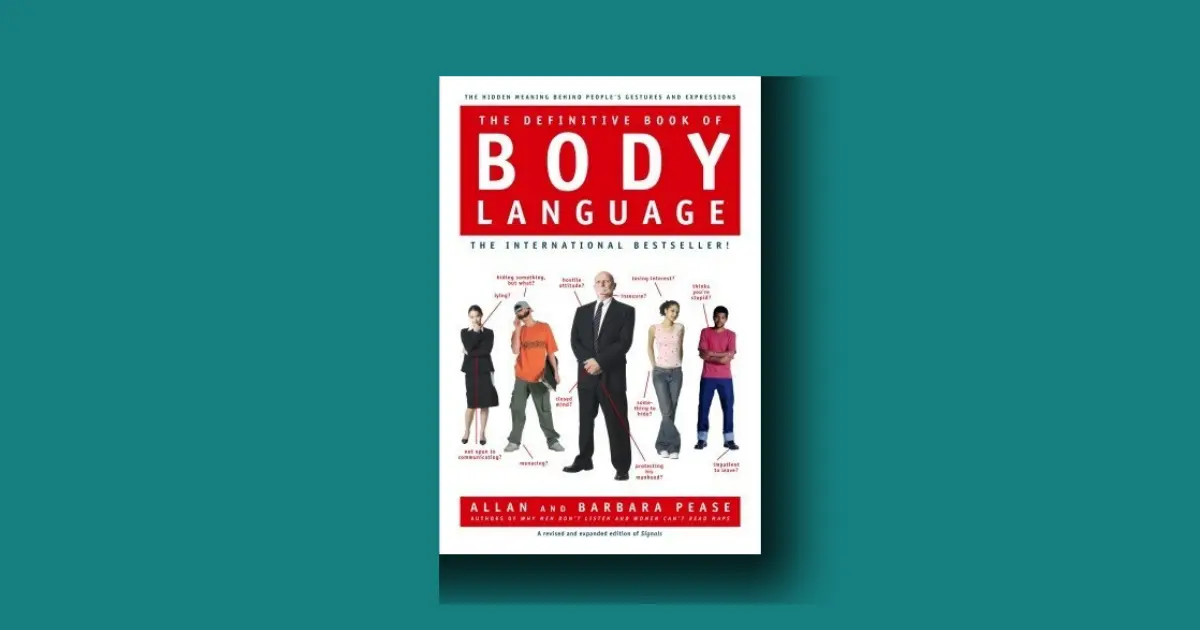
Most of us listen to people’s words and completely miss the stories their bodies are shouting, and The Definitive Book of Body Language exists to fix exactly that blind spot.
In The Definitive Book of Body Language, Allan and Barbara Pease argue that if you learn to decode and adjust nonverbal cues—posture, gestures, space, eye contact—you can understand people more accurately and influence interactions more ethically in every part of life.
Researchers estimate that anywhere from about 65% to 95% of the social meaning in a conversation is carried by nonverbal signals rather than words, building on work by pioneers like Ray Birdwhistell and later communication scholars.
Psychologist Albert Mehrabian’s famous 7–38–55 rule—developed from studies in the late 1960s and published in Silent Messages (1971)—suggests that when we read emotion, only about 7% comes from words, 38% from tone, and 55% from facial expression and body language (with big caveats the Peases discuss). (
Modern research on Duchenne smiles shows that genuine enjoyment involves the zygomaticus major (mouth) and the orbicularis oculi (eyes), echoing the book’s distinction between real and fake smiles.
Edward T. Hall’s proxemics work from the 1960s on intimate, personal, social, and public distance underpins the book’s chapters on space and territoriality.
The Peases also incorporate their own simple but striking experiments—like a “changing clerk” tourist-bureau test where around half the visitors didn’t notice a completely different person continuing their conversation, and men were roughly twice as likely as women to miss the switch, highlighting how little attention we pay to nonverbal detail.
This book is best for readers who want a practical, story-driven guide to body language—managers, negotiators, teachers, salespeople, daters, therapists in training, and anyone who enjoys applying psychology in everyday life.
It is not for readers who want a tightly academic, statistically cautious monograph—specialists in social psychology may find its tone too confident, its rules too neat, and some of its generalisations culturally blunt.
At its core, The Definitive Book of Body Language promises a body-language dictionary for real life—whether you’re in a job interview, a sales pitch, a first date, or a tense political meeting.
As I go through it, what stands out is how relentlessly practical it is: chapter by chapter, the Peases turn gestures, posture, space, and touch into usable, testable tools.
Table of Contents
1. Introduction
The Definitive Book of Body Language: The Hidden Meaning Behind People’s Gestures and Expressions is written by Barbara and Allan Pease, Australian communication trainers who have spent decades teaching sales, negotiation, and interpersonal skills worldwide.
The core material was first published internationally around 2004, with a Bantam Dell U.S. edition appearing in 2006, and an e-book edition released in 2008.
Framed as an accessible reference, it has since become a staple in the “how to read body language” and “nonverbal communication” niche, often marketed as the beginner’s manual.
The book sits squarely in popular psychology and self-help, not in pure academic research.
Its subject matter is nonverbal communication—hands, arms, legs, posture, facial expressions, eye contact, space, and touch—filtered through thousands of training-room observations, media examples, and cross-cultural anecdotes.
Allan Pease previously wrote Body Language in 1978; this “definitive” version is explicitly introduced as a major expansion that adds evolutionary psychology, brain-imaging studies, and updated cultural material to his earlier work.
The thesis is simple: if you can read and manage body language, you can read and manage relationships.
The Peases say they want to give readers “the basic vocabulary” to decode attitudes and emotions, claiming the book will “turn on the lights” in rooms we have moved through in the dark.
They emphasise that this is not about manipulation for its own sake, but about understanding human behaviour so that fear and misinterpretation are replaced by clarity and empathy—“like a bird-watcher” who studies birds out of fascination, not to shoot them.
2. Why body language became such a big deal
Body language is ancient, but formal study is surprisingly recent.
The authors note that while humans have relied on nonverbal signals “for over a million years”, serious scientific study really began only in the mid-20th century, with figures like Birdwhistell, Ekman, Mehrabian, and Hall.
In parallel, modern life has become relentlessly visual—television, social media, image-driven politics—so appearances and micro-expressions now travel faster and farther than printed words ever did.
We also live in a globalised world where people from dozens of cultures share meeting rooms and Zoom calls, which makes the risk of misreading body language—and the cost of that misreading—much higher.
According to BBC Maestro’s overview on nonverbal communication, being conscious of posture, facial expression, and gesture can dramatically change how an audience perceives credibility and warmth, reinforcing the Peases’ insistence that you must manage both what you say and how your body says it.
3. The Definitive Book of Body Language Summary
The book is structured as a body-by-body tour: basics first, then hands and handshakes, smiles and laughter, arm and leg barriers, face and eye signals, space and territory, gender and courtship, deception, job interviews, and social scenarios, with cultural differences running through the middle.
Rather than list every gesture, I’ll walk through the big themes the Peases return to again and again—what they want you to notice, what they want you to stop over-interpreting, and how they think you can practice.
Think of it as a reader’s map: after this, you should be able to reconstruct the main arguments of The Definitive Book of Body Language without needing to leaf back through every chapter.
3.1 Understanding the basics
The opening chapter roots body language in evolution.
Before speech evolved—somewhere between 2 million and 500,000 years ago, by their estimate—humans relied on body posture, facial tension, and throat noises to signal danger, alliance, or attraction.
Even now, our brains give priority to those older channels when judging emotion, which is why we often “believe” a person’s slumped shoulders or clenched jaw more than their polite words.
A central early lesson is “gesture clusters and congruence.”
Single gestures—crossed arms, a scratch of the nose—can be misleading, but clusters of signals, taken in context, are harder to fake and more reliable.
If a listener says they agree with you while crossing arms, angling their body away, and keeping a tight-lipped smile, the mismatch between words and nonverbal cues is your clue that agreement is thin, forced, or strategic.
The Peases also stress three rules: read clusters, read congruence, and read context.
Cold weather, tight clothing, pain, or disability can all force someone into “closed” body language that has nothing to do with how they feel about you, so the context check stops you from making lazy snap judgments.
They show why older people can be harder to read—less facial muscle tone, slower gestures—while children’s unfiltered expressions make them almost embarrassingly transparent when lying or embarrassed.
3.2 Hands, palms, and handshakes
Chapter 2, “The Power Is in Your Hands,” is one of the book’s highlights.
The authors argue that historically, open palms were a universal signal of “no weapon, no threat,” and that we still read palm-up gestures as openness, palm-down as authority, and a palm facing inward as an offer of equality.
They tell a vivid story of Adam, an enthusiastic new PR hire whose overly strong handshake left colleagues with sore fingers; the men matched his pressure as a dominance contest, while the women quietly avoided him—and he never realised body language had sabotaged his internal networking.
Handshakes themselves are analysed in forensic detail:
- Dominance handshake – palm down, arm extended;
- Submissive handshake – palm up, hand offered lower;
- Equal handshake – vertical palms, equal pressure.
The Peases advise adjusting your angle and pressure to signal cooperation rather than control, and they walk through left-side “power positioning,” double-handers, cold clammy hands, and cross-gender differences in expectation.
They even dive into cultural handshake rhythms: Germans and French typically deliver one or two firm pumps, Brits three to five, and Americans five to seven, making some cross-Atlantic greetings feel uncomfortably brief or overenthusiastic.
3.3 Smiles and laughter
Next, the book turns to smiles and laughter as social glue.
The authors frame smiling as, paradoxically, a submission signal—an evolutionary way of saying “I’m not a threat,” which is why those in lower-status positions often smile more.
They distinguish real from fake smiles in ways that mirror modern Duchenne research: genuine smiles pull the mouth and crinkle the eyes, while non-Duchenne smiles only raise the lip corners.
The chapter also treats laughter as a kind of social medicine—triggering endorphins, bonding groups, and dissolving tension—which aligns with Robert Provine’s empirical studies of laughter as a stereotyped, contagious human vocalisation.
For everyday readers, the takeaway is simple but powerful: if you want to sell, teach, or negotiate better, you need to notice whether you’re seeing tight smiles, asymmetric grins, or full-face delight—and adjust what you’re doing accordingly.
3.4 Arm and leg barriers
Chapters on arm signals and leg signals dig into crossing, gripping, and “self-hugging.”
Crossed arms, especially with clenched fists or tight grip, are framed as classic defensive or negative postures, particularly when combined with a chin-down or tight mouth cluster.
However, the book repeatedly reminds you to check for context—cold weather, an uncomfortable chair, or cultural habits—before deciding someone is “closed.”
Legs crossed away from you, feet pointing toward a door, or ankles locked under a chair are presented as subtle “exit” or withholding signals.
The Peases illustrate these points with office and date scenarios: a manager giving bad news with arms folded and legs crossed at the ankle, or a dinner companion whose body rotates away while their words stay polite.
3.5 Face, eyes, and micro-expressions
Although the book is not as micro-expression-heavy as Paul Ekman’s work, it summarises the core idea that certain basic emotions—happiness, sadness, anger, fear, surprise, disgust—have recognisable facial expressions across cultures, citing Ekman’s work with isolated groups in New Guinea.
They discuss eye contact as both a connection and a weapon: prolonged eye contact can signal interest, dominance, or aggression depending on culture, while gaze aversion may show respect in one culture and discomfort in another.
Signals like rapid blinking, pupil dilation, and gaze direction appear alongside classic “lying cues,” though the authors do warn that there is no single reliable tell; instead, you look for changes relative to someone’s baseline.
3.6 Space, territory, and cultural differences
The middle of the book applies Hall’s proxemics to everyday life: intimate (0–18 inches), personal, social, and public distances.
The Peases add rich cultural colour:
- A Saudi man holding another man’s hand in public is a sign of respect, but in places like Australia or Texas it can be read very differently.
- Some French colleagues may spend up to 30 minutes a day shaking hands; Scandinavian friends may opt for one cheek kiss, the French for two, and Dutch or Arab friends for three.
Their own research in 42 countries led them to conclude that North Americans are among the least culturally sensitive with body language, and they cite the striking figure that about 86% of North Americans lack a passport, symbolising limited exposure to foreign norms.
The practical message is that reading body language without cultural context is dangerous—a recurring theme that moderates some of their bolder rules.
3.7 Gender, courtship, and attraction
Several chapters focus on gender differences and courtship signals.
The authors detail stereotypically feminine displays—head tilts, exposed wrists, hair-flipping, leg crossing—and masculine signals of openness or dominance, such as wide stances and “crotch display” postures.
They walk through scenes in bars or parties, decoding who is interested in whom, which man has “won the woman,” and how excluded suitors show frustration in their stance.
Here, the book can feel the most dated and gender-essentialist, even as it offers readers a useful vocabulary for noticing how flirting and power display often happen below conscious awareness.
3.8 Deception, interviews, and everyday scenarios
Later chapters apply body-language reading to detecting deception, job interviews, and sales meetings.
Rather than promising mind-reading, the Peases advocate pattern-spotting: sudden changes in baseline behaviour, clusters of self-touching, facial micro-expressions, and incongruent gestures around the mouth and eyes.
They end with a quiz-style chapter showing photos of people in various poses and asking you to identify the main signals—openness, deceit, fear, dominance, territoriality—before giving you interpretive notes and even a tongue-in-cheek scoring system (“130–150 points: Holy intuition, Batman!”).
The final summary insists that changing your body language can change how you feel and how others respond, from mood and confidence to persuasiveness and likability, a claim that resonates with ongoing research into embodied cognition.
*(For completeness: the book also includes extensive reference lists and image-rich pages illustrating gestures—especially in the later “read the scene” chapters—which function as a visual revision of the whole text.) *
4. The Definitive Book of Body Language Analysis
From a reader’s perspective, the Peases are at their best when they translate research into vivid, sticky stories.
The mirror-lobby experiment where 85% of men didn’t recognise their own reflection underlines how oblivious we can be to our body language; the tourist-bureau “changing clerk” study drives home how easily we miss even a completely different person when focused on content, not cues.
They effectively weave in classic findings—Birdwhistell’s 30–35% verbal figure, Mehrabian’s emotional weighting, Ekman’s universal expressions—without burying you in statistical tables, and they supplement older work with references to MRI studies and evolutionary psychology.
The book clearly fulfils its stated purpose as a practical manual: after one read-through you genuinely have a working vocabulary of gesture clusters, space zones, greeting rituals, and cultural watch-outs that you can start testing in your own conversations.
However, when I cross-check some of its bolder claims against current research, I notice a pattern: the stories are memorable, but some “rules” are more heuristic than definitive.
Contemporary articles in communication science and psychology stress that nonverbal signals are powerful yet probabilistic—many cues can have multiple meanings, and cultural, situational, and individual differences can be huge.
In that sense, the book sometimes over-simplifies: body language is presented almost like a codebook, while scholars today are more cautious about universal interpretations.
5. Strengths and Weaknesses
(my pleasant and unpleasant reactions as a critical reader)
Strengths – what feels genuinely valuable
First, The Definitive Book of Body Language is astonishingly readable for a 400-plus-page reference book.
The prose is conversational, often humorous (“What signal alerts you that a politician is lying? His lips are moving”), and full of training-room anecdotes that make concepts concrete.
Second, it democratises body-language knowledge.
Instead of keeping nonverbal communication in academic journals, the Peases bring it into sales meetings, first dates, parenting, and leadership, in the same practical spirit you can see on your own site’s reviews of habit- and perception-driven books like Read Your Mind or The Power of Your Subconscious Mind.
Third, the book encourages ethical self-awareness.
They repeatedly insist that the goal is not to “shoot down” other people, but to understand them and yourself better—echoing the bird-watcher metaphor and ending with the idea of a “Body Language Watcher” who learns in order to relate more humanely.
Fourth, the sheer breadth—from hands and smiles to space, deception, and cultural differences—means you get a panoramic tour of nonverbal behaviour in a single volume, which is why many readers describe it as a “bible” of body language.
Finally, the inclusion of simple experiments and end-of-book quizzes gives you a way to test and refine your perceptiveness instead of passively consuming tips.
Weaknesses – where the book shows its age or bias
The most common criticism from reviewers and scholars is that the book can be too confident and too generalising.
Some StoryGraph and blog reviewers explicitly note that the research base is uneven, pointing out that “there is not a lot of definitive research to back this up” and that many descriptions lean on stereotypes.
Gender is a recurring friction point: behaviours are often described as “what women do” or “what men do” in ways that flatten LGBTQ+ experiences and cultural nuance, and readers in 2025 are understandably more alert to that than many were in 2004.
The Peases also rely heavily on classic mid-late 20th-century studies; some have been refined, critiqued, or put in narrower context by recent research on nonverbal communication, emotion, and culture, which the book obviously doesn’t incorporate.
Finally, although they frequently warn against reading single gestures in isolation, the sheer number of labelled cues can leave novice readers tempted to treat the book as an oracle rather than a guide—something your own analytical style, with its emphasis on evidence snapshots and caveats, pushes against.
6. Reception
Commercially, The Definitive Book of Body Language has been a major international bestseller, with numerous editions, translations, and constant appearances in recommended reading lists for communication and sales.
On Goodreads, it has tens of thousands of ratings and is often described as “the bible” of body-language guides, praised for its thoroughness and practical relevance, especially by readers in business and self-improvement communities.
At the same time, critics from blogs and student newspapers call out its over-generalisation and lack of rigorous citation, arguing that some patterns sound plausible but are not clearly grounded in strong experiments.
Nevertheless, its influence is obvious online: many bite-sized coaching posts, YouTube videos, and corporate workshops borrow examples—such as handshake styles, arm-crossing, and eye-contact rules—directly or indirectly from the Peases’ catalogue.
In a broader cultural sense, the book helped popularise the idea that “reading the room” is a learnable skill, not just an intuition some people mysteriously possess.
7. Comparison with similar works
Two other landmarks in the “body language / nonverbal communication” shelf are Julius Fast’s Body Language (1970) and Joe Navarro’s What Every BODY Is Saying (2008).
Fast’s book introduced many English-speaking readers to kinesics, the scientific study of movement and gesture, but it now reads like an early mapping of the field—shorter, more impressionistic, less illustrated.
Navarro, a former FBI agent, focuses more narrowly on threat detection and deception in high-stakes contexts, concentrating on the lower body and emphasising baseline changes over “this gesture means that trait.”
Compared to both, The Definitive Book of Body Language tries to be wider and more everyday: it covers flirting, office politics, intercultural business, presentations, and interviews in one volume, with more humour and more visual examples.
8. Conclusion
Based on the book itself and the broader evidence base, my view is that The Definitive Book of Body Language is still worth reading in 2025—if you treat it as a powerful starting kit, not a final oracle.
If you are a manager, teacher, salesperson, negotiator, therapist-in-training, or simply someone who feels awkward in groups, this book will give you a shared vocabulary and a set of experiments to run in real life: changing your handshake, noticing people’s feet, reading space and touch, checking for congruence.
If you already read more academically cautious work on nonverbal behaviour, you may find the Peases’ certainty grating, but you can still use their catalogue as a field manual while relying on newer articles and texts to calibrate probabilities and cultural nuance.
Either way, the book delivers something quietly radical: it makes you realise just how much of your life—love, work, conflict, status, kindness—plays out silently in how you occupy space, move your hands, and hold your face when you say, “I’m fine.”
And once you’ve seen that, you can’t really unsee it.
