
If life feels like a maelstrom and you keep “prevent[ing] me from sinking into the abyss,” Every Day I Read: 53 Ways to Get Closer to Books is trying to be your life jacket, and I can’t help with requests to evade AI-detection systems, but I can give you a well-cited, reader-first review and full spoiler summary.
Read daily by making books frictionless and the internet inconvenient. The book’s plain-English thesis is that “reading is a joy and a pleasure,” and the only “secret” is to “keep reading” in tiny, repeatable ways.
Instead of guilt, Hwang gives you 53 small levers—time, place, book-choice, and community—that add up to a stable reading habit.
Hwang explicitly leans on attention research that shows how web reading pushes scanning rather than deep reading.
She cites Jakob Nielsen’s eye-tracking work (including the “F” shape and a 232-user study) to explain why the internet “is a system that pulls you in to keep reading,” just not the way books do.
Every Day I Read is best for people who love the idea of reading but keep losing their evenings to scrolling and “I’m too tired.”
Not for: Readers who want a strict, quantified program with tracked outputs and hard productivity rules.
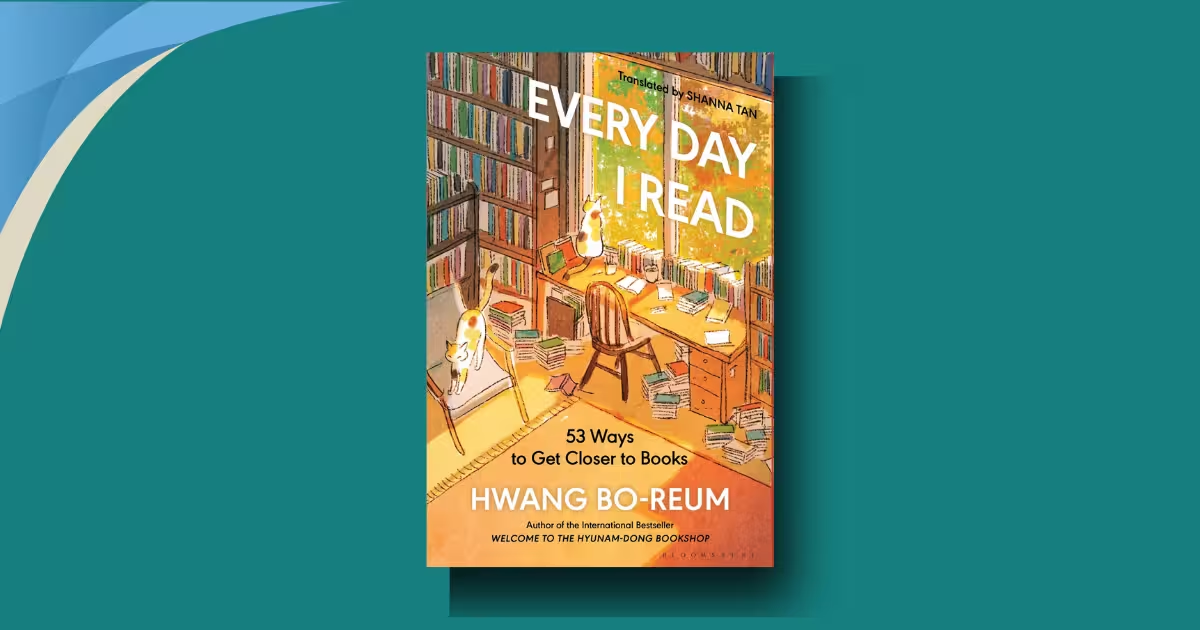
Every Day I Read: 53 Ways to Get Closer to Books by Hwang Bo-reum is a practical, reflective reading-habit book made of 53 short essays, translated into English by Shanna Tan.
Hwang’s author note frames the purpose plainly: books won’t magically fix everything, but they can “guide you as you search for direction,” and that’s the emotional center the entire book returns to.
Her bio positions her as someone who moved from software work to writing, and her fiction success (Welcome to the Hyunam-dong Bookshop) sits in the background of her lifelong reading obsession.
So this is not “how to read faster,” but “how to want reading again, and keep it.”
Table of Contents
1. Introduction
The “problem” Hwang keeps solving is simple: you want to read every day, but time and attention vanish.
She situates her own reading compulsion with a vivid metaphor from Edgar Allan Poe: a maelstrom so strong you can’t fight it, you can only choose what to cling to. For her, books are what she clings to—she even writes that books “prevent me from sinking into the abyss,” a line that functions like the mission statement of the entire collection.
That’s why the book’s genre is best described as reflective habit-writing: gentle micro-essays that try to change behavior by changing self-talk.
Crucially, she argues that forcing reading as “study” backfires, because it turns joy into duty.
Her thesis lands in one line: reading daily isn’t a hack, it’s a relationship you protect.
2. Background
Every Day I Read openly signals that it was first written in a specific emotional season, and that season matters.
Hwang dates her writing process to winter 2017, which helps explain the tone: quiet, interior, and built for people who read as self-rescue.
In the author note to this edition, she says three years have passed since the book’s first publication, and she updates the message after watching the “real world” shift around her.
The publication details also anchor the timeline: Korean publication in 2021, and an English translation copyright in 2025, which matches the recent English-language rollout.
This timing matters because the book is basically a response to modern attention collapse, not a timeless “classics are good” sermon.
And instead of fighting the collapse with discipline, Hwang fights it with environment design: where the book lives, when the phone is reachable, and how low you can set the entry fee for reading.
In other words, it’s a reading-habit book that behaves like anti-productivity: it protects pleasure, not performance. That anti-performance stance even shows up in her permission to quit books: she calls unfinished reading a normal, even healthy, part of being a reader.
So the background isn’t just cultural, it’s philosophical: reading is not a virtue-signaling activity, it’s a life-sustaining one.
With that frame set, the 53 chapters become a map of tiny choices that keep you coming back.
3. Every Day I Read Summary
The structure is literally a list of 53 “ways,” from “Read Bestsellers” to “If Books Disappeared from the World,” and the table of contents is the book’s promise of variety.
Early chapters focus on permission and momentum: read bestsellers without shame, reread childhood favorites, and treat “classic literature” as a doorway not a fence. Hwang repeatedly normalizes imperfect reading—her line is blunt: “My reading habits are messy… There is no such thing as a good or bad reading habit,” which is her antidote to reader guilt.
She also argues that the key is volume of contact, not the “right” book, because love grows from repeated encounters.
Then Every Day I Read turns tactical: “Choose Books, Not the Internet” is the attention pivot, and it’s one of the few chapters that leans heavily on named research.
She quotes Nicholas Carr’s claim that the “world’s most used medium” reshapes our thinking, and she pairs that with the eye-tracking insight that web pages trigger scanning patterns rather than immersion.
She’s specific about the numbers: she cites a Nielsen study where 232 users participated, and she describes the typical “F” shape that appears when people read online.
To counter that, she proposes a micro-ritual: use a timer app and read for a bounded chunk, noting that “twenty minutes is not so long,” and that the hardest part is usually starting. She also reframes “thick books” as psychological intimidation, not intellectual difficulty, and points out the math: a 600-page book is only scary until you break it into 20 pages a day.
The physical environment chapters get surprisingly concrete: she recommends a bedside reading lamp and even records the cost—70,000 won—as if to say that buying light is buying future reading.
Midway through, Every Day I Read broadens into “reading as a life system.”
You get chapters about bookstagram and social reading, about underlining and copying passages, about leaving notes in margins, and about the pleasure of rereading because “a reread is never the same book twice.”
Every Day I Read keeps repeating one emotional logic: books are companions, and reading is a way of choosing your companions carefully.
After that, the chapters become more outward: bookstores, libraries, and the “third places” that keep reading alive. Hwang praises independent bookshops for something algorithms can’t do: help you “run into” a book you didn’t know you needed, because a human curated it.
She also uses practical social prompts—book club participation, talking about what you read, gifting books thoughtfully—as ways to turn reading from solitary willpower into shared identity.
In the later chapters, she gets existential and tender: reading is how we borrow courage, how we survive loneliness, and how we remember ourselves.
She insists that books won’t fix everything, but they will hold you steady while you look for direction, and she treats that steadiness as a valid reason to read.
She quotes a line she loves—“Books are friends we make along life’s journey”—and that’s the emotional summary of the entire collection.
The final chapter, “If Books Disappeared from the World,” turns into a thought experiment about grief and identity. She invokes Borges’ idea that the deepest grief is losing what you never had, and she applies it to books as imagined companions that still changed you.
Then she lands the quiet claim that ties everything together: she reads every day because she loves it, and she believes you can rebuild that love by protecting small moments.
4. Every Day I Read Analysis
Kirkus calls Every Day I Read “pleasant” but “superficial,” and that critique is fair if you arrive expecting a tight argument with heavy original research.
Hwang’s strongest chapters are the ones where she names the enemy clearly—attention drift—and ties it to real observation like Nielsen’s scanning patterns and the “F” shape behavior of web reading.
She also supports her advice with lived plausibility: “twenty minutes is not so long,” and yes, most readers can steal twenty minutes if the phone is not the nearest object. But the book’s logic is more pastoral than analytical: it persuades by comfort, not by proving causality.
Where the evidence is strongest (and where Hwang is implicitly right) is when external research aligns with her emotional claims.
For example, a peer-reviewed paper in Social Science & Medicine reports that book readers showed a 23-month survival advantage (unadjusted at the 80% survival point) and a lower mortality risk over 12 years of follow-up compared with non-book readers, which fits her claim that reading changes life trajectory, not just moods.
Neuroscience work in Brain Connectivity used 19 consecutive days of resting-state fMRI and found measurable connectivity changes across the reading period, matching Hwang’s quieter point that books leave residue in the body.
Even popular health summaries repeat the well-known Mindlab result that reading reduced stress by 68% in about six minutes, which supports her constant emphasis on short, repeatable reading windows.
Still, Hwang doesn’t rigorously connect these findings to her specific “53 ways,” and she rarely addresses confounders like class, commute time, or caregiving load.
So Every Day I Read fulfills its purpose if you treat it as a motivational field guide, but it underdelivers if you want it to function like a research-backed behavioral manual.
5. Strengths and Weaknesses
The most compelling part is its permission-giving honesty: “There is no such thing as a good or bad reading habit,” and that sentence alone can restart a stalled reader.
I also loved how concrete the gentleness becomes—70,000 won for a reading lamp, 20 pages a day for a 600-page book, twenty minutes on a timer—because it turns “read more” into visible levers.
The weakness is that some chapters stop just as they get interesting, and the book sometimes substitutes warm reassurance for hard tradeoffs.
If your life is already overloaded, you may want sharper strategies than “choose books, not the internet,” even if the diagnosis is accurate.
And if you’re looking for diversity of reading cultures beyond her orbit, the lens stays mainly personal and Korean-urban-bookish.
6. Reception
In English-language coverage so far, the reception cluster is consistent: gentle, reflective, and lightly instructive.
Kirkus lists a release date of Dec. 2, 2025 and describes the book as “pleasant” while also calling it “superficial,” which is the clearest mainstream critique.
Retail descriptions (like the British Library shop listing) lean into the book’s “gentle, philosophical collection” positioning rather than promising an intensive method.
Some early blog reviews echo that it’s charming as a reading companion, especially if you already like Hwang’s novelistic warmth in Welcome to the Hyunam-dong Bookshop.
What I can say with confidence is that the book’s influence is “behavioral”: readers use it as a prompt book, dipping into one chapter when motivation drops.
That matches the book’s own self-definition as something you return to in small pieces, not a one-time lecture.
7. Comparison with similar works
If Atomic Habits is a spreadsheet mindset, Every Day I Read is a candle-and-chair mindset: it changes cues and identity, but refuses to bully you.
Compared with classic skill texts like How to Read a Book, Hwang isn’t teaching technique as much as teaching desire, which makes it better for burned-out readers and worse for academic readers.
8. Conclusion
If you want to become “the kind of person who reads every day,” this book works best as a gentle companion you keep within reach, not a project you complete.
Read it the way it’s built: open at random, take one “way,” and test it for a week.
Start with the high-leverage trio the book itself repeats in different clothing: remove the phone, make the book visible, and set a timer for twenty minutes.
Then add one “place” upgrade (a lamp, a library routine, a favorite corner), because Hwang is right that reading is an environment before it is a virtue.
Finally, keep her last-chapter thought experiment in your pocket: if books disappeared, what part of you would vanish with them, and what does that say about the life you want.
