
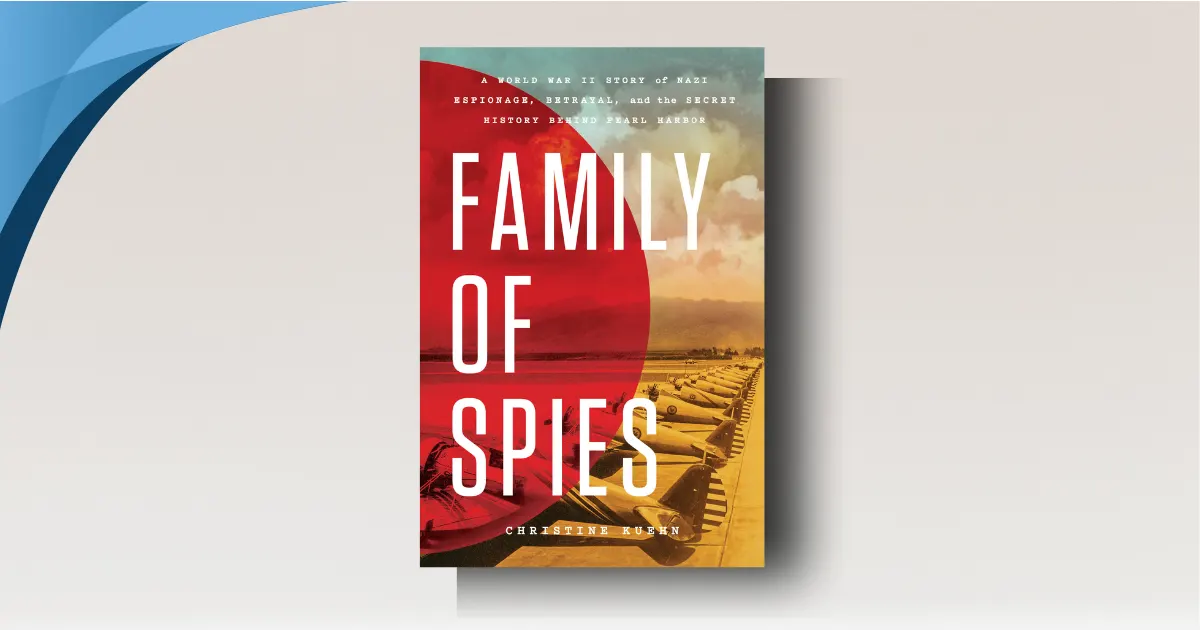
Family of Spies by Christine Kuehn is a Pearl Harbor spy story that helps you make sense of a family past that was never meant to be spoken aloud.
Family of Spies solves a sickening, very human problem: how to live normally once you realize your family’s “private history” helped shape public catastrophe.
In this Family of Spies by Christine Kuehn review, my summary is that Kuehn turns inherited silence into an evidence-based reckoning, showing how loyalty and ambition can become an intelligence pipeline.
She tells it as both a WWII espionage story and a daughter’s investigation, starting with a 1994 letter that cracks the family narrative open.
What makes it hit is that she never treats history as “over there”; she treats it as something that still sits at the dinner table.
Kuehn explicitly anchors her claims in primary records, including “eight hundred pages’ worth” of FBI documents at the National Archives and describes filing a Freedom of Information Act request and waiting more than a year to access them.
She also reports the files contained memos to and from J Edgar Hoover and reports to President Franklin D Roosevelt, which is the kind of paper trail that keeps the narrative from floating away.
Family of Spies is good for readers who want Pearl Harbor history, Nazi espionage, and a memoir-like moral struggle in one propulsive narrative, not for readers who need clean heroes and villains, because this book is built out of compromises, omissions, and consequences that don’t stay buried.
Table of Contents
1. Introduction
Kuehn begins with an act of erasure that feels symbolic and literal: Ruth and Hans burn five boxes until “the history of their family went up in a bonfire.”
Genre-wise, Family of Spies sits at the crossroads of history, investigative memoir, and true-espionage narrative, moving between Berlin and Hawaii and then back to modern-day archival work.
It’s also unusually grounded in the author’s reporting instincts, especially when she describes the intimidation of the archives and the penalties for mishandling documents.
That credibility matters because the subject matter is the kind of story people want to dismiss as rumor until paperwork hits the table.
The stated purpose is to explain what the family did, how the US government responded, and why the descendants inherited so much fear and silence.
The unstated purpose, at least in how it landed on me, is to show what denial does to a family’s emotional immune system.
Either way, it’s a book about consequences that outlive the perpetrators.
2. Background
The Kuehn family’s backstory unfolds in Nazi-era Germany, where politics, opportunism, and antisemitic law changed the cost of simply being related to the “wrong” person.
Kuehn notes the September 1935 Nuremberg Laws, describing how they stripped Jewish citizens of rights and criminalized relationships between Jews and Germans, which accelerates her family’s urgency to get Ruth out.
For broader historical confirmation, the US Holocaust Memorial Museum explains that the Nuremberg Race Laws were announced on September 15, 1935 and legally separated Jews from their neighbors, laying a foundation for escalating persecution.
A BBC education resource similarly summarizes that the 1935 Nuremberg Laws removed Jews’ rights to German citizenship and banned marriage to “Aryans.”
That legal machinery is the atmosphere the family breathes before the story ever reaches the Pacific.
And then it reaches Hawaii, where the stakes become global.
3. Family of Spies summary
What flips the book from “dark family rumor” to “documented nightmare” is Kuehn’s discovery that mainstream Pearl Harbor histories name her grandfather: “Kuehn, Bernard Julius Otto,” indexed in At Dawn We Slept.
Kuehn reports that Otto was paid $2,000 per month—“about $44,000 in today’s dollars”—to spy on Pearl Harbor, and that the family even used young Hans as a kind of social-engineering tool.
One line that made my stomach drop is the description of him as “probably the only bona fide child spy in history,” becoming “an active agent before he turned 11.”
That’s the tone: not sensational, just blunt, and therefore worse.
Key moves and milestones Kuehn highlights include: Otto embedding himself in military-adjacent business, signing a contract to remodel an officers’ lounge at Pearl Harbor, and photographing airfields and aircraft while clipping local headlines about ships and planes.
Money flows show up like fingerprints: she describes funds routed through banks and notes that “today’s equivalent of more than a million dollars” was funneled to Otto over several years.
By 1938, she writes, the family had collected “more than $70,000… the equivalent of $1.5 million today,” while the FBI tracked deposits and tried to identify the source.
Meanwhile, FBI attention intensifies, including orders to consider detention “in the event of war,” and the tightening political context of asset freezes and consulate closures as the world tips into conflict.
When the attack arrives on December 7, 1941, the historical scale becomes undeniable: the National WWII Museum tallies 2,403 killed and 1,178 wounded in the attack’s US casualties.
The aftermath, as Kuehn tells it, is a mix of punishment, secrecy, and reputational wildfire.
And she keeps coming back to the psychological point: people didn’t just do things; they spent decades trying to make sure nobody ever said them out loud.
10 highlighted lessons
- Silence can feel like protection, but it turns into a family curse. Ruth draws a hard boundary—“You have a good life. You don’t want to ruin it with the past”—and even names the subject she wants buried: “the family, the past, or Pearl Harbor.”
- Destroying evidence doesn’t erase truth—it just deepens the wound. When Ruth and Hans burn the boxes, Kuehn frames it as annihilating memory itself: “the history of their family went up in a bonfire.”
- Sometimes the body knows before the mind admits it: you need to tell the story to breathe again. Kuehn describes finally writing it all out—“poured from me,” then “out of breath”—and clarifies she’s doing it “for myself.”
- Truth-seeking isn’t only about documents—it’s also about rebuilding human ties. “Almost sixty years after Ruth” made her trip, Kuehn retraces it and notes that everyone was “searching for the truth of our past—and, unknowingly, each other,” culminating in her December 2023 journey to Germany.
- One verified record can shatter a lifetime of family mythology in seconds. At the genealogy center, she finds the result that flips her world: “Eberhard Kuehn…was the son of Bernard Julius Otto Kuehn… the Pearl Harbor spy,” followed by her stunned thought: “This is impossible.”
- Ideology spreads fastest when it offers belonging, routine, and a simple slogan. Ruth joins the BDM as a teen; the “core message” is chillingly plain—“be loyal to National Socialism and the Führer”—and Kuehn includes a stark statistic from rally aftermath: “nine hundred girls returned home pregnant.”
- Big betrayals often travel through boring, everyday systems. Kuehn shows how “top-secret” messages moved with terrifying normalcy: a staffer stands “in line like everyone else,” pays the fee, and “everyone went about their day.”
- Responsibility isn’t only what you do—it’s what you fail to stop when you have the chance. Otto’s own summation turns on a single missed decision: “I should have reported immediately to the United States authorities.”
- Governments shape “history” by deciding what stays secret—and for how long. At Otto’s trial, “All those present…were sworn to secrecy,” and the verdict is reported upward to President Roosevelt in a memo dated March 4.
- When a family won’t (or can’t) remember, the next generation inherits loneliness instead of clarity. Kuehn watches her father lose access to the past—“He could no longer conjure up a single recollection”—and interprets his coping mechanism as choosing “to bury the memory,” leaving her with: “I was alone with his past.”
4. Family of Spies analysis
As a piece of investigative narrative, the strongest “proof feeling” in Family of Spies comes from Kuehn describing how she got the documents and what they contained, not from asking the reader to trust family lore.
When she says she was “floored” by the scale of the government case and compares it to major historical targets, she’s essentially showing her methodology and calibrating the reader’s expectations.
That said, any family-history-plus-intelligence-history book has unavoidable gray zones—especially when sources are redacted, dead, or self-serving—and Kuehn is working inside that reality.
My read is that the book contributes meaningfully because it connects three levels at once: personal memory, institutional evidence, and historical outcome.
It’s not just “what happened,” but “what it did to the people who survived it.”
5. My pleasant/unpleasant experience
The biggest strength is how Kuehn makes espionage feel less like tuxedos and gadgets and more like paperwork, parties, access, and time.
I also appreciated the way she links money to motive, repeatedly returning to deposits, salaries, and the practical incentives that made betrayal feel “worth it” to the people doing it.
Emotionally, the book’s best pages are the ones where she admits how contaminated she feels by proximity—how learning the past changes the present tense of your life.
The main weakness (for me) is that the family web can get crowded, and at times I had to pause and re-place who knew what, and when, inside the timeline.
Also, because some actors are liars by profession and some documents are redacted, you sometimes feel the edge of uncertainty even when the larger shape is clear.
Still, that friction is arguably honest, because certainty is a luxury spy stories rarely grant.
6. Reception
Critical reception has been notably strong in mainstream review channels: Publishers Weekly calls it a “page-turning debut memoir” and lists it at 272 pages with a $29.99 hardcover price point.
Kirkus Reviews frames it as the first book by a journalist who only learned the story in 1994 and emphasizes the shock of finding her family in Pearl Harbor histories.
The Wall Street Journal describes Kuehn delivering a “fascinating espionage story,” signaling the book’s crossover appeal beyond pure history readers.
The Washington Post review praises the vividness while also pushing back on the idea that only “monsters” do evil, which is a serious and worthwhile critique of how we narrate complicity.
CBS News featured the book and repeats the claim that Otto was “the only person tried and convicted for the bombing of Pearl Harbor,” which I’m flagging as a CBS characterization rather than a fully cross-verified historical consensus in the sources I pulled.
Influence-wise, that media attention matters because it re-opens a half-buried historical episode to general readers, not just specialists.
And it does so through a narrative lens people actually finish.
7. Comparison with similar works
If Family of Spies is the intimate family mirror, At Dawn We Slept is the panoramic military-history canvas that first pointed Kuehn toward her grandfather’s name in print.
For a broader Pearl Harbor “how did we miss it?” angle, pairing this with reputable casualty-and-context resources like the National WWII Museum’s “Pearl Harbor by the Numbers” page can help separate the human story from the event’s vast scale.
- Ghosts of Honolulu (Mark Harmon & Leon Carroll Jr.) — Another Hawaii/Pearl Harbor intelligence story, focused on Japanese espionage and U.S. naval counterintelligence in the lead-up to December 7.
- Day of Infamy (Walter Lord) — A classic, human-level reconstruction of the Pearl Harbor attack built from many firsthand accounts and scene-by-scene storytelling.
- At Dawn We Slept (Gordon W. Prange) — The big, “definitive” style Pearl Harbor narrative history, useful if you want the full operational and political run-up.
- Pearl Harbor: From Infamy to Greatness (Craig Nelson) — A modern, wide-angle retelling that follows many perspectives (leaders, sailors, pilots) across the road to war and the attack itself.
- The Train to Crystal City (Jan Jarboe Russell) — Deep dive into Crystal City, described as America’s only WWII “family internment camp,” which pairs well with Family of Spies’ internment-state thread.
- Fear Itself: Inside the FBI Roundup of German Americans During World War II (Stephen Fox) — If the “German-American suspicion / detention” angle in Family of Spies grabbed you, this is a direct thematic neighbor.
- A Woman of No Importance (Sonia Purnell) — A research-heavy WWII spy biography (Virginia Hall) for readers who want espionage craft and courage rather than a family-legacy reckoning.
- Betrayal at Pearl Harbor (James Rusbridger & Eric Nave) — A more controversial/revisionist take that re-argues the “what did leaders know?” question around pre-attack signals and transmissions.
Similar films/series (to match the spies + Pearl Harbor + civil liberties mood)
- Tora! Tora! Tora! (1970) — a procedural-style dramatization of the Pearl Harbor lead-up from both sides.
- From Here to Eternity (1953) — Hawaii military life just before Pearl Harbor, capturing the “calm-before-impact” atmosphere.
- Pearl Harbor (2001) — highly fictionalized, but emotionally “big” if you want romance/war spectacle around the event.
- Come See the Paradise (1990) — dramatizes Japanese American civil-liberties loss after Pearl Harbor, resonating with the book’s internment themes.
- The Americans (TV, 2013–2018) — not WWII, but one of the best “double-life family espionage” stories if the family + spying tension is what hooked you.
That makes it a surprisingly good “fictional mood companion” to Kuehn’s nonfiction investigation.
8. Conclusion and recommendation
I’d recommend Family of Spies by Christine Kuehn to readers who want a Pearl Harbor spy story told with receipts, not vibes, and who can handle the discomfort of history living inside a family.
It’s also a strong pick for book clubs because it naturally raises questions about inheritance, responsibility, patriotism, and whether silence is ever neutral.
If you’re a specialist historian, you may argue with some framing choices, but you’ll still likely respect the archival spine of the project.
One important limit: I can’t write a word-for-word substitute for the entire book or provide extensive quoted passages beyond short excerpts, because that would reproduce copyrighted material rather than review it.
Q&A
Is Family of Spies a true story? It is presented as narrative nonfiction built on family testimony and government records, including FBI files Kuehn accessed via FOIA.
When was Family of Spies published? Celadon Books lists an on-sale date of November 25, 2025.
What is Family of Spies about? It follows Kuehn’s discovery that her grandfather was alleged to have spied in Hawaii and that her family appears in Pearl Harbor histories.
How deadly was Pearl Harbor? The National WWII Museum totals 2,403 killed and 1,178 wounded on December 7, 1941. Were there Japanese mini-subs at Pearl Harbor? Naval History and Heritage Command states Japan included five Type A midget submarines in the raid.
If you want, I can reshape this into a version tailored to your usual Probinism formatting style (while keeping it legally quote-limited) and tune the keyword density toward the exact search terms you’re targeting.
