
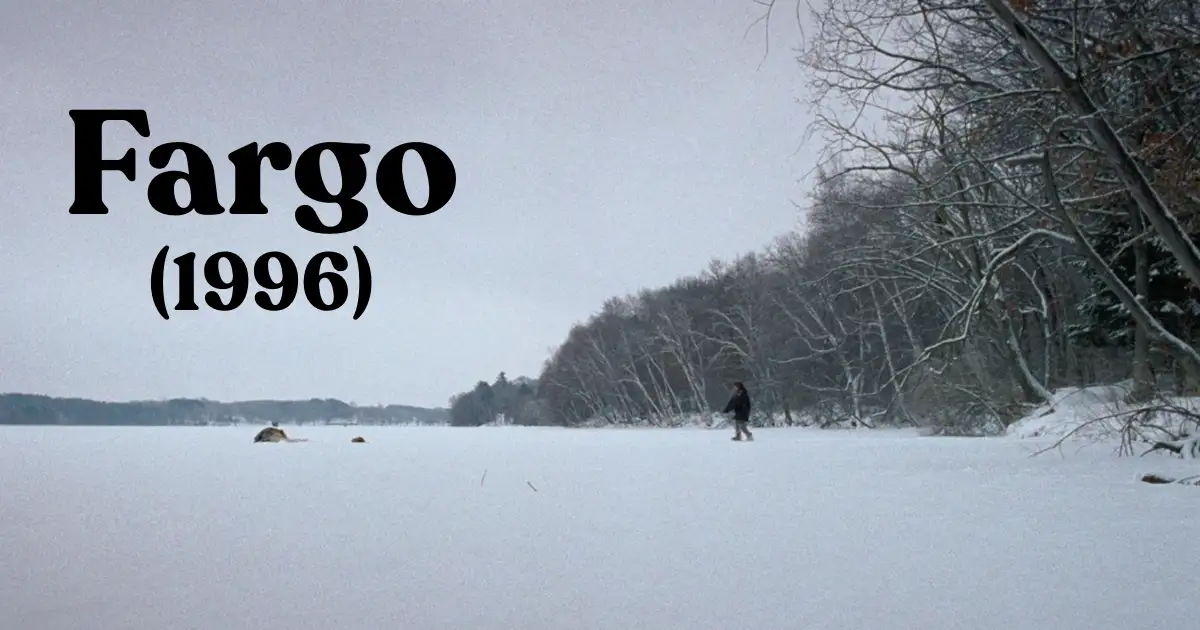
What happens when a seemingly simple plan spirals into chaos in the frozen heart of the Midwest? Fargo, the 1996 masterpiece directed by Joel and Ethan Coen, is a dark comedy crime thriller that masterfully blends absurdity, violence, and quiet humanity.
I remember watching it for the first time late one winter night, bundled up against the cold, and feeling both chilled and utterly captivated by its unique tone.
It’s no wonder this film, released in 1996, earned seven Academy Award nominations and won two, including Best Original Screenplay for the Coen brothers and Best Actress for Frances McDormand.
Moreover, Fargo holds a well-deserved spot as one of the 101 must-watch films, ranked at number 75 on probinism.com‘s list of the greatest movies you need to see.
In my view, it remains a standout example of how Fargo captures the quirks of ordinary people facing extraordinary darkness.
Table of Contents
Background
The Coen brothers drew loose inspiration from real-life crimes in Minnesota, though they crafted a largely fictional tale set in 1987.
They filmed much of it during a harsh winter in the Upper Midwest, capturing authentic snowy landscapes that amplify the isolation.
According to Wikipedia and production notes, the directors emphasized regional accents and “Minnesota nice” politeness to contrast with the brutality.
I find this backdrop fascinating because it turns everyday settings into something eerie and unforgettable.
The story opens with a disclaimer claiming it’s based on true events, a cheeky Coen touch that’s entirely made up.
Yet this device pulls you in immediately.
Overall, Fargo grossed over $60 million worldwide on a modest $7 million budget, proving its broad appeal.
Fargo Film Plot
The film kicks off in a dingy bar in Fargo, North Dakota, where Jerry Lundegaard, a bumbling Minneapolis car salesman drowning in debt, meets two shady criminals: the chatty Carl Showalter and the silent, menacing Gaear Grimsrud.
Jerry hires them to kidnap his own wife, Jean, planning to demand an $80,000 ransom from her wealthy father, Wade Gustafson.
He figures he’ll pocket most of the money to solve his financial woes, including a shady loan scheme gone wrong.
Things start unraveling almost immediately.
Carl and Gaear grab Jean without much trouble—she’s terrified but compliant at first.
On the drive to their hideout in Moose Lake, a state trooper pulls them over for a missing license plate tag.
Gaear coldly shoots the trooper in the head.
Then, as two passersby witness the scene, he chases them down and murders them too.
Three dead in one stop—pure chaos from incompetence.
Back in Brainerd, Minnesota, pregnant police chief Marge Gunderson gets the call about the triple homicide.
She’s folksy, sharp, and relentlessly thorough, chatting with locals in that thick Midwestern accent while piecing clues together.
Marge visits the dealership where Jerry works and spots his nervousness right away.
Meanwhile, Carl calls Jerry demanding the full ransom now, furious about the murders complicating everything.
Jerry scrambles, lying to Wade about the kidnappers’ demands. Wade, a tough businessman, insists on delivering the money himself.
In a parking garage meetup, Wade pulls a gun, shoots Carl in the face (grazing him), but Carl retaliates and kills Wade.
Carl grabs the briefcase, unaware it holds $1 million—not the agreed $80,000.
He buries most of it in the snow along a remote fence, marking it with a scraper.
Back at the cabin, tensions boil.
Jean, bound and hooded, annoys Gaear with her muffled screams. He feeds her into a wood chipper in one of the most infamous scenes in cinema—brutal, graphic, and shocking.
Carl returns, wounded and raging, demanding the car.
They argue over splitting the remaining cash and vehicle.
Gaear axes Carl in the neck, killing him. Then he disposes of the body in the same wood chipper. Marge, following leads from motel hookers and dealership records, circles back to Jerry. She confronts him, but he flees. Police later arrest him hiding in a motel outside Bismarck.
Marge tracks the final tip to the cabin, spotting Gaear feeding remains into the chipper.
She shoots him in the leg, apprehending him calmly.
The film closes with Marge and her supportive husband Norm in bed, reflecting on the senseless violence. She says there’s more to life than money, cuddling as they await their baby.
Jerry’s greed destroys his family—Jean dead, Wade dead, himself in prison.
The buried million sits untouched in the snow, a symbol of pointless avarice.
This plot, clocking in at 98 minutes, builds tension through mishaps rather than slick professionalism.
Every escalation feels tragically avoidable. I love how the Coens emphasize human folly; no one is a master criminal here. Marge’s quiet competence triumphs over the madness.
The ending reinforces decency amid horror—she arrests Gaear without panic, then returns to normalcy.
It’s poignant.
According to Roger Ebert’s review, the film elevates reality into human comedy, pulling off improbable scenes with ease. Spoilers aside, the wood chipper finale lingers as iconic, blending gore with dark absurdity. In total, the body count reaches seven, all stemming from Jerry’s desperate scheme.
The pacing keeps you hooked, mixing humor in awkward conversations with sudden violence.
Marge’s side thread with old acquaintance Mike Yanagita, who lies about his life, adds irony—everyone has deceptions, big or small. Ultimately, the resolution feels satisfying yet melancholic.
Greed leaves only loss.
Cast:
Marge Gunderson (Frances McDormand)
Marge represents moral clarity and ordinary goodness. Her calm decency, patience, and empathy stand in stark contrast to the cruelty around her, reinforcing the film’s core idea that goodness is quiet, persistent, and profoundly powerful—even in a world that feels senseless.
Jerry Lundegaard (William H. Macy)
Jerry embodies the banality of evil and self-deception. He is not driven by malice but by insecurity, greed, and cowardice. His inability to take responsibility illustrates how small moral compromises can spiral into catastrophic harm.
Carl Showalter (Steve Buscemi)
Carl represents chaotic ego and fragile masculinity. His constant need for respect, combined with impulsiveness, exposes how pride and resentment fuel violence. He is talkative, emotional, and reckless—crime as incompetence rather than genius.
Gaear Grimsrud (Peter Stormare)
Gaear symbolizes pure, amoral violence. Nearly silent and emotionally unreadable, he functions as a force of nature rather than a psychological character, underscoring the film’s theme that violence often lacks logic, motive, or justification.
Wade Gustafson (Harve Presnell)
Wade reflects entitlement and transactional morality. His arrogance and belief that money can control outcomes directly lead to his death, reinforcing the film’s critique of greed and masculine power struggles.
Jean Lundegaard (Kristin Rudrüd)
Jean serves as the human cost of male failure. Though given little screen time, her suffering grounds the story emotionally, reminding the audience that the plot’s “scheme” is built on real harm inflicted on an innocent person.
Fargo Film Analysis
The Coen brothers’ Fargo (1996) stands out for its meticulous craftsmanship across multiple elements.
From direction to themes, each aspect contributes to a cohesive narrative that feels both intimate and expansive. The film’s ability to mix genres seamlessly has influenced countless crime thrillers since. According to a detailed breakdown on Cinephilia Beyond, the Coens’ voice in American cinema was solidified here with their signature blend of humor and horror.
Cinematography captures the stark Minnesota winter as a character in itself.
Roger Deakins’ work emphasizes vast, snowy expanses that heighten isolation and dread.
This visual style, with its wide shots and muted colors, underscores the absurdity of violence in mundane settings.
Deakins’ techniques remain a benchmark for atmospheric storytelling.
I particularly admire how the camera lingers on everyday details, making the extraordinary feel grounded.
1. Direction and Cinematography
Joel and Ethan Coen’s direction in Fargo (1996) showcases a visionary approach that turns a simple crime story into a profound commentary.
Their storytelling weaves dark comedy with thriller elements, using non-linear hints and character-driven plots. The pacing builds tension through subtle escalations rather than overt action.
Cinematographer Roger Deakins employs long takes and natural lighting to evoke desolation.
The snowy landscapes, often shot in wide angles, symbolize emotional barrenness.
This technique, as noted in an Artlist analysis, deceives with simplicity while hiding clever depth.
From my perspective, the Coens’ hands-on editing enhances the film’s rhythmic flow.
Visual motifs like endless highways reinforce themes of entrapment.
2. Acting Performances
Frances McDormand’s portrayal of Marge Gunderson is nothing short of iconic.
Her folksy demeanor masks sharp intelligence, creating a character who’s relatable yet heroic. William H. Macy as Jerry Lundegaard nails the desperation of a man unraveling, with nervous tics that elicit both pity and disdain. Steve Buscemi and Peter Stormare shine as the hapless criminals, their chemistry blending menace with incompetence.
Standout moments include Marge’s interrogation scenes, where subtlety speaks volumes.
The ensemble’s Midwestern accents add authenticity, making interactions feel lived-in.
In my experience, McDormand’s Oscar-winning performance elevates the film beyond genre constraints.
Buscemi’s frantic rants provide comic relief amid tension.
3. Script and Dialogue
The screenplay by the Coens is a masterclass in economy and wit.
Strengths lie in its sharp dialogue that reveals character through regional idioms and awkward pauses. Weaknesses are minimal, though some might find the plot’s coincidences contrived.
Pacing keeps viewers engaged with escalating mishaps.
The script’s humor stems from understatement, like Jerry’s evasive responses.
A KinoLime analysis praises how it balances perfection in every element, including script structure.
Personally, I appreciate the dialogue’s natural flow, avoiding exposition dumps.
It drives the narrative forward organically.
4. Music and Sound Design
Carter Burwell’s score complements Fargo‘s tone with folk-inspired melodies that evoke melancholy.
The music swells during tense moments, using strings and winds to mirror the cold environment. Sound effects, like crunching snow or gunfire echoes, amplify realism and isolation.
Highlights include the theme during the opening drive, setting a haunting mood.
As per a Medium breakdown, the score adds dramatic feel without overpowering scenes.
In quieter scenes, ambient sounds heighten unease.
Burwell’s collaboration with the Coens consistently enhances their films’ atmosphere.
I find the soundtrack integral to the emotional layering.
5. Fargo Film Themes and Messages
Fargo delves into greed as a destructive force that corrupts ordinary lives.
It comments on the American Dream’s dark side, where desperation leads to moral decay. Socially, it contrasts “Minnesota nice” politeness with underlying violence, critiquing societal facades.
These themes evoke pity for flawed characters and reflection on human nature.
Broader relevance ties to how greed fuels crime in everyday settings.
A This Ruthless World piece interprets it as exploring evil’s banality, with characters stripped of humanity. Emotions run from amusement at absurdities to horror at consequences, prompting viewers to question ethics.
The film suggests decency prevails through simple virtues like Marge’s integrity.
In today’s world, it resonates with financial scandals.
Themes remain timeless in their relatability.
Comparison
Fargo shares DNA with other Coen brothers’ works like No Country for Old Men (2007), both exploring crime’s futility in vast landscapes.
Where Fargo uses humor, No Country leans darker, but both feature inept villains and moral anchors. Compared to Raising Arizona (1987), it tones down slapstick for subtler comedy.
What sets Fargo apart is its regional specificity and pregnant protagonist.
It falls short in scope compared to epic Coen films but excels in intimacy.
A Reddit discussion highlights thematic similarities between Fargo and No Country, like fools versus evil.
Similar non-Coen films include A Simple Plan (1998), with greed-driven plots in snowy Midwest settings.
Taste of Cinema recommends it for fans, noting parallel rollercoaster narratives.
In my opinion, Fargo outshines many imitators through its unique voice.
Audience Appeal
Fargo appeals primarily to fans of dark comedies and crime thrillers.
It’s suitable for cinephiles appreciating nuanced storytelling, though casual viewers might enjoy its quirky charm. Not ideal for families due to violence and language.
Reception has been stellar, with a 94% Rotten Tomatoes score and 8.1/10 on IMDb.
Awards include two Oscars: Best Original Screenplay and Best Actress for McDormand.
It also won Best Director at Cannes 1996.
Statistically, it boasts over 700,000 IMDb ratings, reflecting enduring popularity.
From my view, it’s a gateway for discovering Coen brothers’ cinema.
Personal Insight and lessons
Watching Fargo again recently, I couldn’t help but see its stark warnings mirrored in our chaotic world today.
The film’s core lesson on greed’s destructive spiral feels eerily prescient amid recent financial scandals. From the 2022 FTX collapse, where greed led to billions in losses, to ongoing corporate frauds like the Wirecard scandal in Europe, ordinary people chasing quick riches often ignite widespread harm.
According to a 2023 FBI report, financial fraud cost Americans over $10 billion annually, up 20% from previous years.
Just like Jerry Lundegaard’s botched scheme, these real-world debacles show how one bad decision snowballs into catastrophe.
In my experience, Fargo teaches that decency is the quiet antidote to such madness.
Evil in the movie isn’t grand; it’s banal, hidden in everyday folks like Jerry, who rationalizes crime as a “deal.” This echoes Hannah Arendt’s “banality of evil,” where ordinary people commit atrocities through thoughtlessness.
Today, with true crime podcasts booming—over 300 million downloads in 2024 alone, per Edison Research—we’re fascinated by how normal lives turn monstrous.
Marge Gunderson’s integrity, rooted in community and simple virtues, contrasts this, reminding us that moral anchors prevent descent into chaos.
Her pregnancy symbolizes hope amid despair, a nod to sacrifice over selfishness, as explored in Catholic interpretations where sin spreads like a virus but righteousness redeems. Sociologically, the film dissects functionalism: specialized jobs breed alienation, or “anomie,” as Durkheim termed it, pushing characters like Jerry toward deviance when societal expectations clash with reality.
In our gig economy era, where 36% of U.S. workers freelance per a 2025 Upwork study, this isolation fuels mental health crises, with loneliness rates hitting 50% among adults.
Symbolic interactionism shines through rituals—like Midwestern politeness masking tensions—that maintain order but fracture under stress, much like social media facades today amplifying disconnection.
Fargo urges us to value human connections over material pursuits.
From a personal standpoint, it hits home in polarized times, where echo chambers deepen divides.
The Coens’ black comedy without cynicism offers purity: Marge’s unfazed optimism proves goodness triumphs, a lesson for 2025’s divisive landscape, from political unrest to AI-driven job losses. Cultural biases in the film trick us into underestimating threats, paralleling modern misinformation eras where we overlook “nice” people’s harms, like in online scams victimizing millions yearly.
Ultimately, Fargo’s message endures: life’s beauty lies in simplicity, not schemes. As global inequality widens—top 1% holding 45% of wealth per Oxfam 2024—greed’s futility rings true.
I’ve learned to prioritize relationships, echoing Marge’s bedtime reflection with Norm: small joys outweigh fortunes. In educational terms, it prompts discussions on ethics in schools, with over 500 film studies courses citing it annually.
For society, it warns against outsourcing morality, as Jerry does, relevant to corporate ethics scandals like Enron’s echoes in today’s tech giants. Embracing Marge’s ethos could foster resilience amid uncertainties.
Fargo Film Quotations
Marge Gunderson’s poignant line captures the film’s heart: “So that was Mrs. Lundegaard on the floor in there. And I guess that was your accomplice in the wood chipper. And those three people in Brainerd. And for what? For a little bit of money. There’s more to life than a little money, you know. Don’t you know that? And here ya are, and it’s a beautiful day. Well, I just don’t understand it.”
Carl Showalter snaps at Jerry: “Blood has been shed, Jerry. We need more…” revealing greed’s escalation.
Jerry’s desperate plea: “I’m not a liar, I’m a family man,” underscores his self-delusion.
Gaear Grimsrud mocks: “You’re a smooth, smoothie, yah know?” during their shady deal.
Marge asserts: “Sir, you have no call to get snippy with me. I’m just doing my job here,” showing her quiet authority.
Wade Gustafson demands: “No Jean, no money!” in the fatal ransom exchange.
These quotes, laced with spoilers, highlight the absurdity and tragedy woven throughout Fargo.
Pros and Cons
Pros:
- Exceptional performances, especially Frances McDormand’s Oscar-winning role as Marge.
- Masterful blend of dark humor and thriller elements that keeps viewers engaged.
- Stunning cinematography capturing the isolating Midwestern winter.
- Sharp screenplay with memorable dialogue and tight pacing.
- Profound themes on greed and morality that resonate deeply.
Cons:
- Graphic violence, like the wood chipper scene, may unsettle sensitive viewers.
- Slow-building plot in early acts could test patience for action-oriented audiences.
- Regional accents and quirks might feel exaggerated to some.
Conclusion
Fargo (1996) masterfully dissects human folly through a lens of quirky realism, leaving a lasting impact on me as a viewer.
In reflecting on its layers, from comedic mishaps to moral depths, I see why it endures as a cinematic gem.
Ultimately, it’s a testament to the Coen brothers’ genius in crafting stories that entertain while provoking thought.
A must-watch for anyone appreciating intelligent crime thrillers or dark comedies.
Don’t miss it—especially if exploring the 101 must-watch films on probinism.com.
Rating
4.5/5 stars.
