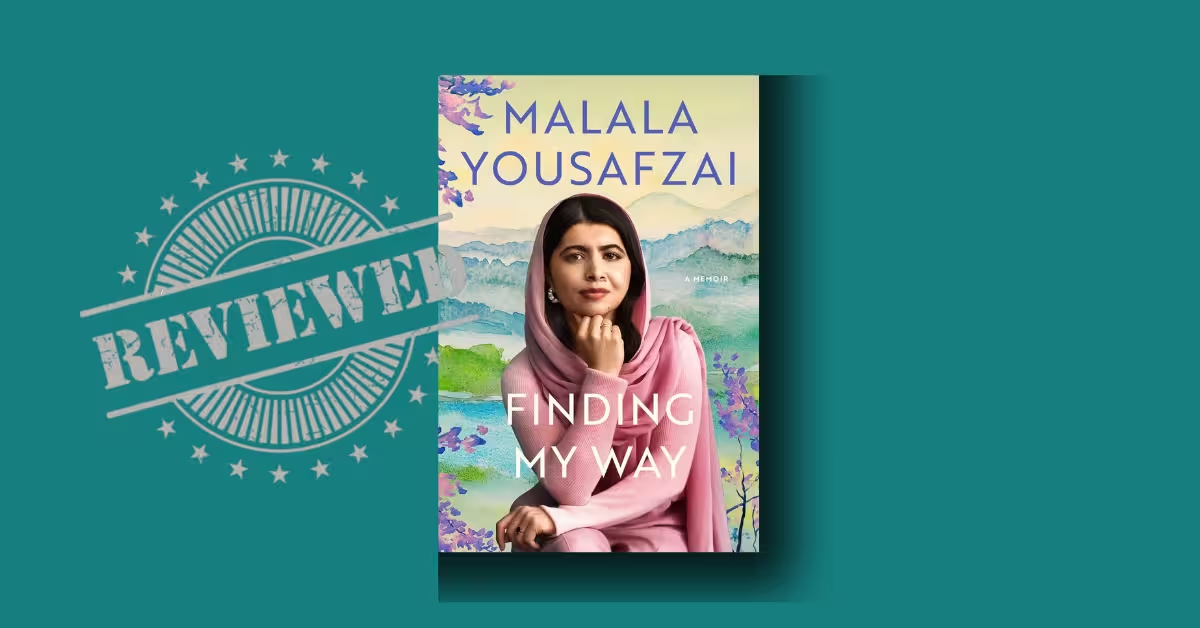
A book about fame, fear and finding a life you choose—Finding My Way: A Memoir shows how Malala Yousafzai solved a problem most “symbols” never admit: how to be a whole human again.
Malala’s best idea is that surviving violence isn’t the end of a story but the start of a long, messy, hopeful practice of choosing—choosing your voice, your work, your loves, your home, and your way. As a reader, I felt her insistence that ordinary days and private doubts are part of activism’s truth. And crucially, she argues that girls’ education is not charity but power, proven in classrooms from Swat to Shangla and defended in parliaments from London to Kabul.
Snapshot
Malala documents Taliban-era Swat with dates, numbers and scars—“1,600 schools… some 400 were destroyed; 70% were girls’ schools,” she writes of her valley’s terror years (see Finding My Way, p. 219; quoted below). In parallel, global data show 272 million children out of school in 2023—133 million girls—a rise since 2024, according to UNESCO’s 2025 dashboard.
Finding My Way is best for readers who want a Malala Yousafzai memoir review that treats the icon as a person and shows the system she fights; not for those seeking celebrity gossip or a tidy inspirational parable.
Table of Contents
1. Introduction
Malala Yousafzai, Finding My Way: A Memoir (New York: Atria Books/Simon & Schuster, first hardcover edition October 2025.
Across the front matter and the publisher’s page, Simon & Schuster list Atria as the imprint and confirm the 2025 publication; the Simon & Schuster catalogue and Google Books corroborate the date and metadata.
Malala’s brief author bio Finding My Way reminds us she is “the youngest-ever Nobel laureate… born in Mingora, Pakistan in 1997 and graduated from Oxford University in 2020.” This is her most intimate book since I Am Malala, and it is deliberately post-mythology: university anxieties, the pressure of being a global symbol, a private courtship, and a return to Pakistan to see a school she built with her Nobel Prize money.
The memoir’s very first page sets her thesis with a line that catches in the throat: “On a mild October afternoon, a bullet changed the trajectory of my life,” she writes in the Introduction (p. 5).
Context: genre, subject, credentials.
This is narrative nonfiction—part coming-of-age, part movement memoir, part political witness. As a Nobel Peace Prize co-laureate (2014) with Kailash Satyarthi “for the right of all children to education,” Malala has the lived standing to write it, and Nobel’s official record and museum pages are primary confirmation.
At 28, she has been a BBC blogger under fire, a patient in a Birmingham ICU, a foundation leader, and an investor in women’s sports; the “About the Author” page and new press interviews sketch that arc.
Purpose: Finding My Way’s central thesis.
“I tried to… hear my own voice… to make sense of my story,” she explains of her early twenties (Introduction, p. 5).
Malala advances two claims: personal—healing requires agency, boundaries, and ordinary joys; political—girls’ education remains the sharpest tool against extremism, and the world’s will faltered in Afghanistan.
How the book states it.
She revisits the origin scene when “a gunman boarded my school bus and asked, ‘Who is Malala?’” before shooting her “at point-blank range” (pp. 8–9). That wound, she argues, became a camera lens others controlled; Finding My Way takes the lens back.
2. Background
Swat to Birmingham—what happened, in dates and numbers.
When she was “eleven,” the Taliban announced girls would be banned from school “in three weeks’ time” (p. 8). She blogged anonymously for the BBC, went public on Pakistani TV, and lived under rules broadcast by militants—no music, no women outdoors; “as the bombs and gunfire got louder, our lives got smaller” (pp. 7–8). She was shot on 9 October 2012, an event reported the same day worldwide and reconstructed by major outlets.
After surgeries in Birmingham, she built her second life: school, speeches that paid the family mortgage and supported Malala Fund, and, behind it, the survivor’s problem of being seen only as a parable. “They made me into a mythical heroine,” she writes, “virtuous and dutiful,” though she was a “troublemaker” who loved John Cena and cried when someone beat her on exams (p. 9).
By seventeen she received the 2014 Nobel Peace Prize, the youngest ever, a fact the Nobel Foundation confirms.
Finding My Way’s Introduction compresses this history into an emotional premise: the hero everyone knows and the young woman few do.
A note on the global stakes.
UNESCO’s most recent figures show 272 million children out of school in 2023, of whom roughly 133 million are girls; progress has stalled, even reversed.
What changed between I Am Malala (2013) and Finding My Way (2025).
The difference is not just age but angle. She now interrogates the international stage that embraced her: “To the men who ran the world, I was just a photo op,” she says in one 2025 interview, summarizing a core thread of the memoir’s later chapters. Finding My Way is warmer, messier, and more politically pointed—especially on Afghanistan, whose collapse in 2021 shattered her faith in “photo-op” progress.
3. Finding My Way: A Memoir by Malala Yousafzai Summary
Malala Yousafzai’s Finding My Way is a memoir of her early twenties—Oxford lectures and late‑night clubbing folded into global advocacy, family, love, trauma recovery, and the unglamorous, patient work of building a girls’ high school in the highlands of Pakistan.
It opens with the sentence‑that‑became‑a‑thesis: “On a mild October afternoon, a bullet changed the trajectory of my life,” a frank reminder that the adult she is narrating has been living ever since in the wide wake of that 2012 act of violence (Introduction, p. 5).
The shape of the story
Malala structures Finding My Way as a coming‑of‑age arc set after international fame. We do revisit what came before—her childhood in the Swat Valley, the Taliban’s takeover, the BBC blog, the bus attack—but primarily as memory that keeps intruding on the present.
The present is full of ordinary young‑adult questions (What do I study? Who are my friends? What do I wear? Can I fall in love? Do I want to marry?) lived under extraordinary conditions: a security detail in student dorms, an internet that will not stop arguing with her body, and a planet where one regime change can end the future for millions of girls in a single month.
When Afghanistan fell in 2021, she writes, “Change was slow but steady. Afghanistan shattered the promise of progress for me,” and records the night in Boston when panic finally broke over her body (p. 219).
What happened before Oxford still decides the stakes
The book’s early chapters compress her backstory with economical, scene‑rich paragraphs. We see her valley “surrounded by forests, wildflower meadows, and colossal, snowcapped mountains,” then shrinking under Taliban rule: radios spitting new prohibitions, public executions, and the chilling decree that “in three weeks’ time, girls would be banned from going to school” (pp. 8–9).
Malala recounts starting an anonymous BBC diary, removing school uniforms to avoid being targeted, then going public on national television to assert a simple right: education (pp. 8–9). The gunman’s question—“Who is Malala?”—and the shot that followed are retold with restraint; the emphasis is on the aftermath: waking up in Birmingham, relearning how to walk and speak, and the surreal feeling of being turned into a “mythical heroine” by strangers (p. 9).
The numbers that framed her girlhood remain sharp: when the militants bombed schools in Swat, “Of the 1,600 schools that existed… some 400 were destroyed,” and “70% were girls’ schools” (p. 219). Those figures become a touchstone later when Afghanistan’s new rulers forbid girls beyond grade six, bar women from universities and work, and even ban them from parks and pools (pp. 219–220).
Oxford: friendship, freedom, and a complicated normal
The Oxford sections are the memoir’s beating heart.
They’re vivid, funny, and sometimes painful, tracing her attempt to live a “normal” student life with decidedly un‑normal constraints. On the first morning of orientation, two Metropolitan Police officers—all part of Britain’s Specialist Protection unit—remind her to wait; their plan is to “bunk in the dorms… drive me in a bulletproof car,” and shadow her everywhere (p. 17).
She meets Cora at registration and the two stumble through Freshers’ Fair together until Malala sees a giant banner of past Oxford Union speakers—Einstein, Malcolm X, Queen Elizabeth II… and herself, from a teenage talk—exactly the opposite of blending in (pp. 19–20).
She signs up for everything from cricket to the Islamic, Christian, and Hindu societies; Cora keeps it lean—Conservative Association and pub quiz—and the pair swap teasing commentary about posh cheese clubs and mocktails (p. 18). There are fizzing scenes of dancing until 4 a.m. at “Club Night”—“Malala Yousafzai at Club Night… I’m literally deceased right now,” one classmate gasps—and of near‑silly escapades like midnight climbs to the bell tower (pp. 91, 36–37).
Study is hard. Political theory and economics feel abstract; she tries study hacks and writes motivational Post‑its; a professor calls her Kant essay “not so good, I’m afraid,” which finally sends her to the Study Skills Center (pp. 115–116). The point is not failure but craft: how to think and write clearly without the scaffolding of a podium and a cause.
Public life intrudes: the “jeans” storm and the ethics of being looked at
One of the most bracing sequences covers a global tabloid flap over a candid photo of Malala in jeans in 2017. The hit‑and‑run judgment is instant; in Pakistan, trolls scold; a Czech reader tells the Daily Mail she should dress “acceptable to her critics” if she wants “positive attention.”
Malala’s analysis is lancing: “I could stand behind a podium all day… and it would never stir up the level of media attention that wearing jeans did,” so why keep placating people who want to control her? (pp. 35–36).
She names both fronts policing her body—“I wouldn’t justify my choices to the secular mob any more than I would to the denim police” (p. 36)—and roots the argument in lived experience: at eight, a cousin slapped her for coming home soaked from a stream, a textbook lesson in how “honor” is enforced through girls’ bodies (pp. 34–35).
The trolling is not abstract. She once creates a burner Instagram to ask a would‑be murderer why he hates her—his reply: “We will send her to hell” (p. 63). The scene ends with a friend scolding her to block and move on; the larger lesson is about survival online and the discipline of refusing to be baited.
“If I can make this school successful…” — how the Shangla project took shape
For years, she kept quiet about the biggest project in her homeland precisely because it was tender: with her 2014 Nobel Prize money, she bought land in Shangla—her family’s mountain district where “83% of the women… were illiterate”—because there wasn’t “a single high school for girls” (p. 64).
Construction on a four‑story school was nearly complete when she arrived at Oxford. The idea was simple and radical: open kindergarten through middle school immediately, then add a grade each year, holding the line against early marriage—“thirteen and fourteen… when fathers start to negotiate marriages”—by buying time with a school day (pp. 64–65).
The late chapters deliver the payoff.
She helicopters in with Asser to a walled campus that, after seven years, serves 700 students taught by 40 teachers; she cries “surprised and happy tears” because the place is exactly what she dreamed—a “palace of learning” (pp. 241–243).
She inventories the assets like a proud headteacher: a sunny library; separate labs for biology, chemistry, and physics; an art studio; a basketball court; free breakfast in the assembly hall; on‑site daycare to recruit excellent women teachers; and the first school counseling program of its kind in the entire province of Khyber Pakhtunkhwa (pp. 242–243).
Sitting in a circle with the “pioneer batch” of 25 girls about to become the first female high‑school graduates from their villages, she nudges them past the narrow career menu (“doctor, doctor, army doctor… programmer”) and says out loud what the book has been practicing: you can be more than the script you inherited (p. 243).
Love, family, and deciding about marriage without giving up on yourself
The memoir’s most intimate through‑line is her relationship with Asser Malik.
They meet in 2019, talk cricket and Shangla (“No cricket? You have to have cricket!”), wander the Birmingham Botanical Gardens, and begin a slow, careful courtship that has to be managed around security logistics and family expectations (pp. 104–105).
There is the necessary Oxford messiness—mixed signals, giddy texting, the friend‑gossip economy—and a last‑minute declaration before a flight: “Okay, I think I’m ready… Asser, I’m ready to marry you” (p. 211).
She does not romanticize the family navigation. The haan—the formal proposal—leaves her mother upset; the nikah is deliberately small; even a spat over whether Asser’s shoes are new on the eve of the ceremony becomes an occasion to explain custom and pressure (pp. 212–223).
The marriage itself is defined with precision: a five‑minute Islamic contract in her parents’ living room in Birmingham, “after that, the union is legal under Islamic law” (p. 221).
Crucially, Finding My Way documents the months of reading and thinking that preceded the decision—she and a friend build a feminist syllabus (“bell hooks to Dolly Alderton” and Amia Srinivasan’s The Right to Sex) and tally the arguments that “marriage supports patriarchy,” even as she insists she wants what Chimamanda Ngozi Adichie calls “a source of joy and love and mutual support.”
What she cannot find in print is “how to choose between an institution I didn’t believe in and a life without the person I loved” (pp. 190–191).
Afghanistan: when world events re‑open old wounds
The fall of Kabul in August 2021 triggers some of Finding My Way’s most searing pages.
Less than a month after the takeover, the Taliban ban girls beyond grade six and then bar women from work, parks, gyms, and universities; require full coverage and male chaperones; forbid speaking or singing in public; and enforce a life that looks like “a lifetime lockdown” (pp. 219–220).
She has a full‑body panic attack while trying to celebrate the end of a nine‑year medical odyssey to repair her facial paralysis. The juxtaposition is deliberate: “So we had repaired some of the damage from one Taliban bullet—what was that compared to the thousands of bullets raining down on Afghanistan?” (p. 219).
The chapter ends with a mission statement: “My purpose is the same today as it has always been—I will continue to advocate for girls… For me, there is no career path, no ladder to climb” (p. 221).
Healing is work, too
The memoir keeps returning to bodies and what they remember. She runs and learns to trust her strength; she tries to float in a pool—“You won’t be able to float until you believe that the water will hold you,” the instructor says, a metaphor that the narrative quietly adopts (pp. 239–240). The counsel becomes a practice: notice your panic early; be gentler with yourself; share the weight. The acknowledgments close with a direct address to the girls she writes for—“You are never alone… Do not lose hope” (p. 249).
Highlighted chronology
- 10–11 years old (2007–2008, Swat Valley). Taliban militants seize Mingora; bomb hotels and hospitals; announce “in three weeks’ time, girls would be banned from going to school.” Malala begins an anonymous BBC blog; then speaks publicly for education (pp. 8–9). Theme: fear giving way to voice.
- October 2012. A gunman boards her school bus, asks “Who is Malala?,” and shoots her in the head; she wakes a week later in a Birmingham trauma center, starting months of surgeries and rehab (p. 9). Theme: survival and being made into a symbol.
- 2014 (age 17): Wins the Nobel Peace Prize; uses the prize money to buy land in Shangla to build a girls’ school; 83% of women there are illiterate; there is no high school for girls (p. 64). Theme: philanthropy with roots.
- 2017 (first Oxford term). Orientation under a Specialist Protection team; bulletproof car; trying to blend in; Freshers’ Fair selfie‑lines under a banner with her teenage face (pp. 17–20). Theme: normalcy under surveillance.
- 2017 (autumn). “Jeans” controversy explodes online; she refuses both misogynist and Islamophobic policing—“secular mob” vs. “denim police”—and narrates the earlier slap that taught her how “honor” is policed (pp. 34–36). Theme: the politics of seeing.
- 2017–2020. Oxford years deepen: dancing until 4 a.m., failing a Kant essay, going to the Study Skills Center, making a chosen family, night‑climbing and rowing and cricket (pp. 91, 115–116, 18). Theme: craft, joy, and the slow build of confidence.
- 2019–2021. Courtship with Asser Malik: butterfly gardens, shared cricket fandom, careful family choreography; she thinks hard about marriage (bell hooks to Srinivasan to Adichie) before deciding; “I’m ready to marry you” (pp. 104–105, 190–191, 211). Theme: choosing an institution while resisting its worst scripts.
- Nikah (2021). A small five‑minute legal ceremony at her parents’ home; family tensions surface (pp. 221–223). Theme: love negotiated within culture.
- August–September 2021. Afghanistan falls: within <1 month girls are barred beyond grade six; women are expelled from public life; she has a panic attack and re‑states her mission (pp. 219–221). Theme: a purpose that outlasts titles.
- Seven years after opening (by mid‑2020s). Shangla school now enrolls 700 girls with 40 teachers; features include a library, three science labs, mental‑health counseling (first in Khyber Pakhtunkhwa), daycare, and free breakfast (pp. 241–243). Theme: build institutions, not just headlines.
- Publication detail. The memoir is first published by Atria Books in October 2025; the author bio notes she was born in 1997 and graduated from Oxford in 2020 (pp. 255, 250).
Finding My Way‘s main ideas
- Normalcy is its own kind of courage. The memoir insists that laughing with friends, rowing on a sleepy river, or learning to write a better ethics essay are not indulgences; they are a politics of refusing to be reduced to a symbol. When tabloids try to make trousers the story, she answers with a campus life large enough to drown out voyeurism (pp. 34–37).
- The body keeps the score, and healing is iterative. The Boston panic attack after Afghanistan’s fall is not a regression but information—“a beacon, a reminder to be gentle with myself,” she writes, echoing the swimming teacher’s lesson about believing water will hold you (pp. 239–240).
- Institutions outlast outrage. Figures like 1,600/400/70% (Swat’s school destructions) and 700/40 (the Shangla school’s growth) anchor the polemic in brick, mortar, and timetables. The school’s first‑in‑province counseling program names mental health as part of education (pp. 219, 241–243).
- Purpose is chosen (again and again). “My purpose is the same today as it has always been… For me, there is no career path, no ladder to climb,” she writes after Kabul; the line rebukes the careerist impulse to turn advocacy into rungs (p. 221).
- Love is not capitulation if you define the terms. Finding My Way refuses a binary between rejecting marriage in the name of feminism and accepting it uncritically. By reading widely, talking frankly, and designing a small, values‑true ceremony, she locates a position that honors commitment without surrender (pp. 190–191, 221–223).
Representative Quotes
- “On a mild October afternoon, a bullet changed the trajectory of my life” (Intro, p. 5).
- “Of the 1,600 schools… some 400 were destroyed; 70% were girls’ schools” (p. 219).
- “They would bunk in the dorms… and drive me in a bulletproof car” (p. 17).
- “I wouldn’t justify my choices to the secular mob any more than I would to the denim police” (p. 36).
- “83% of the women… were illiterate… There wasn’t a single high school for girls” (p. 64).
- “I wanted it to be a palace of learning, worthy of the girls’ wildest dreams” (p. 242).
- “It is the first… counseling program of its kind in the entire province of Khyber Pakhtunkhwa” (p. 243).
- “My purpose is the same today as it has always been…” (p. 221).
- “You are never alone… Do not lose hope” (p. 249).
What you come away knowing
- Identity under surveillance. She learns to make room for joy—even for silliness—in a life watched by armed officers and the internet’s unblinking eye; the trick is to remain legibly herself rather than merely “the youngest Nobel laureate.”
- Feminism in practice. Clothing becomes a recurring site of power—first policed by kin, then the commentariat, then secular purists. Her answer is not to choose one audience to appease, but to stop ceding sovereignty altogether.
- Education as ecosystem. The Shangla school is an argument that real girls need more than classrooms: breakfast, daycare, mental‑health services, labs, sports, art, and teachers who are paid and respected. It is both a school and a counter‑culture.
- Trauma isn’t the end of the plot. Afghanistan’s fall confirms that progress is reversible; the body remembers; but the memoir refuses despair, converting panic into a renewed pledge.
- Love as collaborative design. The romance threads model how to argue without rupture, how to respect parents without surrender, and how to weigh tradition against autonomy—right down to a five‑minute nikah with a dress rehearsal over shoes.
Read as a whole, Finding My Way is less a victory lap than a field manual for purposeful adulthood after catastrophe. It teaches how to keep a private self while living a public life; how to build an institution where there was none; how to let friendship and love enlarge, rather than eclipse, your work; and how to keep choosing the same mission when the news lurches backward.
As Malala writes near the end, counting what Afghanistan lost and what she can still do: “For every day that God gives me, you will find me working in service of that dream” (p. 221).
4. Finding My Way Analysis
Evaluation of Content — Does the evidence carry the argument?
Yes—because Malala grounds claims in both memory and measurable world facts, and the memoir’s most persuasive data point is one she funded with her own prize: a school.
Consider the crisp, sourced numbers embedded in the narrative. “Of the 1,600 schools that existed [in Swat], some 400 were destroyed… 70% were girls’ schools,” she writes while reliving Afghanistan’s fall and the return of a nightmare (p. 219).
That sentence links the memoir’s personal story to a structural one—how extremists target education to erase women from public life—and the book widens the lens to Afghanistan’s current bans on girls’ secondary and university education, which UNESCO and news agencies document.
She also supplies a longitudinal case: Shangla. “When I won the Nobel at seventeen, I used the prize money to purchase land in Shangla,” she writes, where “83% of the women… were illiterate… There wasn’t a single high school for girls… so I decided to build one” (pp. 63–64). A decade later she walks the campus: “seven hundred students and forty teachers,” separate science labs, chess tournaments, sports, and a library (pp. 241–242). Built on “the craggy shoulders of the Hindu Kush,” that school is a refutation with bricks and timetables.
Evaluation of Reasoning — Is the logic clear, fair, and self-critical? (h4)
The memoir’s power is that Malala questions herself at every turn: her youthful wish to “reason” with the Taliban—she once kept a notebook of Qur’anic verses to argue for girls’ schooling—now reads as “naïve,” a growth she records with tenderness (pp. 220–221). She explores how an Instagram rumor about “jeans” can metastasize into misogyny—an episode external media documented at the time—and lets readers feel both the farce and harm of that policing.
She admits panic and grief when Kabul fell; she also names who helped and who ghosted.
Contribution to its field — Does the book move the conversation?
It does, in three ways.
First, it corrects the record on celebrity activism: “Change was slow but steady,” she once believed, until Afghanistan; now she distinguishes performative sympathy from policy, a critique echoed in human-rights reporting.
Second, it offers a cross-verified narrative about how education bans metastasize into bans on movement, work, and speech, which Afghan civil society and international monitors keep tallying.
Third, it documents a working model—local schools with science labs, sports, and reproductive-health content—in one of the hardest geographies on earth, evidence that “impossible” reform can begin with one campus (pp. 241–242).
Quotations that embody the book’s voice.
“What I wanted, more than anything, was to make sense of my story” (Introduction, p. 5).
“If I didn’t [go to class], my life was over anyway” (recounting the 2009 school ban, p. 8).
“If I can make this school successful… girls’ education is possible anywhere in the world” (on Shangla, p. 64).
“No… I wouldn’t go back to my old life… the path that led me here is the one where I belong” (p. 246).
Does the book fulfill its purpose?
Yes—because it lets Malala be mortal: a student missing deadlines, a friend losing at chess to a twelve-year-old, a daughter negotiating with tradition, and a woman who still believes in classrooms more than cameras.
5. Reception
Early reviews and media.
Kirkus calls it “earnest, charming, and empathetic,” a coming-of-age that entwines the public and the personal. The Guardian’s review and interview stress how the book marks a shift—from a faith in handshakes to a fiercer skepticism about “photo-op” politics and a clearer sense of her own boundaries.
U.S. public radio features ran excerpts and emphasized the PTSD, the Oxford years under security, and the way the memoir invites readers to hold both her trauma and her ordinary experiences in one view. Goodreads chatter so far mirrors that frame: readers wanted the “real Malala” and find plenty of her here.
Constructive criticisms.
Some commentators wish for more granular policy analysis; others balk at sections on love or fashion, as if those were trivial beside geopolitics—an expectation the memoir itself interrogates in its “jeans” chapter and in Malala’s later reflections on marriage and agency.
Influence in policy and philanthropy.
Beyond pages, the work intersects with real budgets: in 2018, G7 leaders announced C$3.8 billion (US$3.1B) for girls’ and women’s education in crises, part of the Charlevoix initiative Canada steered. That same year Apple became Malala Fund’s first “Laureate partner,” expanding programs that, according to press coverage, aimed to reach 100,000+ girls.
These are not abstracts; they are the pipeline that can turn a line in a memoir into a seat at a desk.
Why the Afghanistan chapters matter now.
Afghanistan remains the only country to ban girls past grade six and to bar women from universities, a regression documented repeatedly since 2021–2022. Malala’s recalled numbers from Swat and her on-the-ground partners’ accounts align with current reporting about Taliban restrictions, even extending to curbs on internet access that sabotage remote learning.
Cultural backlash as data, not drama.
The “jeans” trolling she recounts is not a footnote; it’s a case of how patriarchal policing follows girls from streets to feeds, covered in mainstream papers at the time, and reframed here as part of a larger story about who decides what a “good” activist looks like.
6. Comparison with similar other works
With her own earlier books.
Compared with I Am Malala (2013), which fixed the pre- and immediate post-attack years into a single arc, Finding My Way feels like its necessary sequel: less explanatory, more exploratory. The voice is looser, sometimes funnier, and more willing to indict the world’s habit of applauding girls while abandoning women.
If We Are Displaced (2019) centered other girls’ voices in displacement, the new memoir’s center of gravity is selfhood under scrutiny—how to be “Malala” when you also want to be a private person who can lose at chess, binge a show, or protect a relationship from clickbait until you decide.
And if Ziauddin Yousafzai’s Let Her Fly argued from the father’s vantage that he “did not clip her wings,” Malala’s own text is about learning to fly without a whole crowd tugging at the fuselage.
With other education-rights memoirs.
Readers of Adichie or Elnathan John for Nigeria, of Ishmael Beah for Sierra Leone, or of Nadia Murad for Iraq will recognize the move from catastrophe to public life and the later need to reclaim privacy; Malala’s distinct thread is the school as institution—labs, syllabi, sports—tested against militants and mountains alike.
For classroom and book-club purposes, the Shangla chapters might pair with policy articles on Charlevoix funding, making a practical bridge between narrative and budgets.
The careful fact-checking on dates and places aligns with long-form profiles and interviews, including 2025 features that quote her franker, sometimes angrier voice post-Afghanistan.
If I Am Malala was the origin story everybody needed, Finding My Way is the adulthood that activism deserves.
7. Practical takeaways for educators, parents, policymakers
For educators.
Use the Shangla chapter as a case study: note the multi-language instruction (Pashto, Urdu, English), separate science labs, arts, sports, and gardening for reforestation (pp. 241–242). Pair it with UNESCO’s 2025 out-of-school dashboard to discuss systemic barriers and local design.
For parents and mentors.
The Birmingham and Oxford sections are a manual for loving a teenager under pressure: normalize failure, protect privacy, get therapy, and know that “resume virtue” can’t save you if your days have no joy. The memoir’s honesty about panic and the need for boundaries may be the most life-giving part for young readers.
For policymakers and donors.
Cross-check your applause with your appropriations, because bans outlast hashtags. Consider how G7 money, corporate partnerships, and local leadership intersect—and how fragile that web becomes when regimes shut classrooms or even cut internet connectivity.
Read Finding My Way to see how a life can contain both a Nobel podium and a chess loss to a twelve-year-old, both a mountain walk and a spreadsheet for a school budget, both terror’s memory and the laughter of girls spilling out of a gate at dismissal.
The world does not deserve Malala’s hope; but the book shows why her hope keeps building classrooms anyway.
8. Conclusion
My recommendation.
If you care about girls’ education, read this; if you are tired of perfect-parable activism, read this; if you are a teenager in the glare or a parent trying to give a child room to grow, read this.
The memoir is accessible to general audiences—undergraduates will quote it, book clubs will argue with it, and specialists will mine its Afghanistan chapters and the Shangla case study. It also doubles as a civics lesson in how global promises translate (or don’t) into classrooms: 2018 pledges, 2021 reversals, 2025 stubborn hope.
And it’s beautifully human; the line that lingers for me comes at the close, after the mountain walk to her grandmother’s meadow, when she listens to girls “singing and laughing” and says, “I would not trade this life for anything” (p. 246).
Who benefits most.
Teachers, policy students, youth organizers, diaspora readers, parents of first-generation college students, and anyone who wants a Finding My Way review that shows both the story and the scaffolding behind it.
Related