
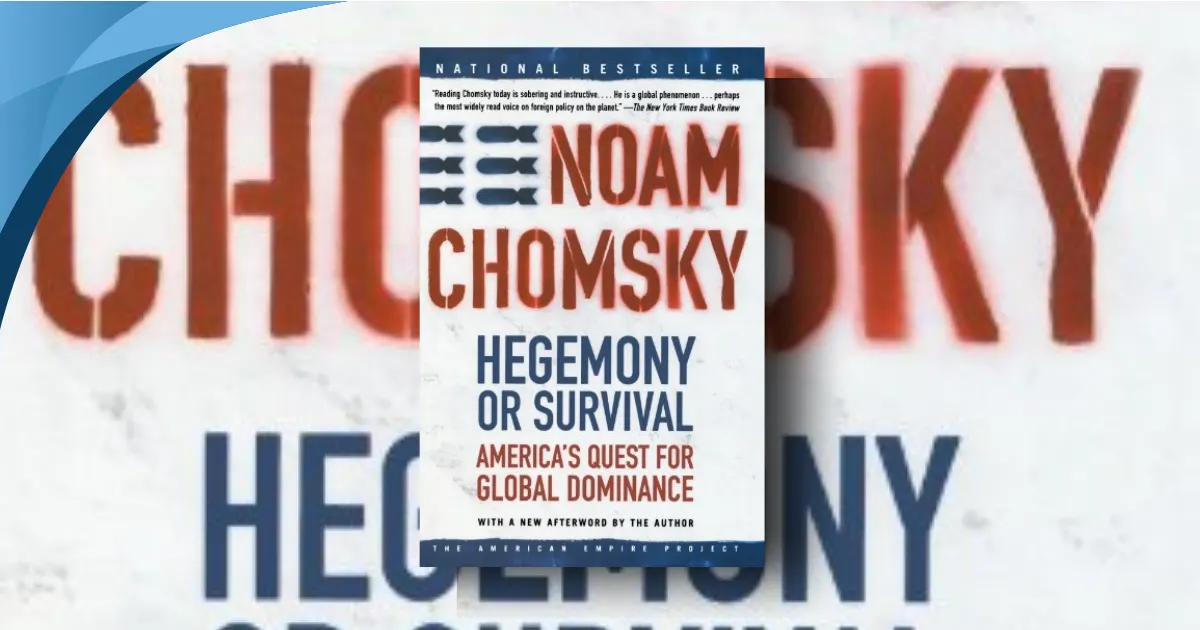
Hegemony or Survival: America’s Quest for Global Dominance is the kind of book you reach for when “US foreign policy” feels like a blur of slogans, wars, and headlines—and you want the connecting logic laid bare.
Noam Chomsky’s Hegemony or Survival: America’s Quest for Global Dominance (first published 2003; afterword 2004) frames modern U.S. grand strategy as a civilizational fork in the road: the pursuit of global dominance versus the conditions for long-term human survival.
Chomsky’s core challenge is simple and unsettling: a superpower can chase global dominance, or it can choose long-term survival, but it cannot treat those as the same project. He frames that dilemma in unusually stark human terms, warning that our species may prove a “biological error” if we use our “allotted 100,000 years” to destroy ourselves.
He backs the argument by walking through primary documents (especially post-9/11 strategy), historical case studies, and what he portrays as consistent patterns in how power justifies violence. His opening context is 2003—the Iraq invasion build-up, worldwide opposition, and the Bush administration’s 2002 National Security Strategy setting the tone.
Hegemony or Survival is best for readers searching “Hegemony or Survival summary,” “Noam Chomsky American empire,” “US global dominance critique,” or “National Security Strategy 2002 analysis,” and who want a dense but coherent map of the argument.
Not for: readers who want a neutral, middle-of-the-road tour of US foreign policy without a strong thesis or moral verdict.
Chomsky’s best idea is that US elites have pursued an “imperial grand strategy” to lock in global hegemony—and that the cost of that strategy, in an age of WMD (weapon of mass destruction) and climate risk, is that it may collide with survival itself.
Evidence snapshot
A pillar of his evidence is the post-9/11 strategy turn: the White House released the National Security Strategy in September 2002.
Chomsky reads that moment as more than rhetoric, because the NSS explicitly claims the aim to “dissuade potential adversaries” from building forces that could rival US power.
He also anchors the mood of the era in mass politics: by February 2003, huge global protests against the Iraq War were widely reported as historic in scale, with some accounts describing millions marching worldwide.
Table of Contents
1. Introduction
Hegemony or Survival: America’s Quest for Global Dominance by Noam Chomsky, first published in the US in 2003 by Metropolitan Books.
Chomsky’s credentials matter here mainly because his method is consistent: he treats official statements, strategy documents, and elite commentary as a kind of “confession,” then checks whether actions follow. Even the book’s framing copy signals the through-line: “full spectrum dominance” and “a drive for hegemony that ultimately threatens our existence.”
Purpose/thesis: he argues that maintaining hegemony is not an accidental drift but a long-running strategic project—and in the modern era that project heightens the risk of catastrophe, especially through nuclear posture, arms racing, and normalized preventive war.
2. Background
Chomsky plants his flag in early 2003: he describes a moment where the Iraq invasion is being made “inevitable,” and where warnings about blowback, WMD, and humanitarian catastrophe are brushed aside.
From there he introduces what may be the most familiar phrase Hegemony or Survival gave the world: the “second superpower,” meaning global public opinion and popular movements.
His claim is not that this “second superpower” always wins, but that elites work to “intimidate and contain” it—because consent is a constraint that hegemony tries to remove.
3. Hegemony or Survival summary
The core thesis and “operating concepts”
- Existential risk lens: The opening chapter uses biologist Ernst Mayr to frame “higher intelligence” as potentially self-destructive, then applies that lens to modern policy choices.
- Two superpowers: the U.S. state versus “world public opinion” (the “second superpower”) and whether it can be “intimidated and contained.”
- Imperial grand strategy: a critique of the 2002 National Security Strategy and a doctrine that, as quoted in the book via John Ikenberry, seeks a “permanent” unipolar order and weakens UN Charter self-defense constraints.
- Selective “humanitarian intervention”: norms are treated as made by power—especially illustrated through Kosovo vs. other cases.
- WMD (weapon of mass destruction) feedback loop: U.S. military posture + preemption logic can encourage proliferation incentives.
- Middle East blowback: public attitudes, mistrust, and radicalization pressures are linked to long-running policy patterns.
- Terrorism + universality: moral evaluation requires applying the same standards to “us” as to “them,” a principle Chomsky argues is routinely rejected.
Highlighted summary
Chapter 1 : Priorities and Prospects
- The chapter uses the German-American evolutionary biologist Ernst Mayr’s reflections to pose the possibility that human “higher intelligence” could be a “biological error” if it culminates in self-destruction.
- Links modern history to an “assault on the environment” and to “cold and calculated savagery” among humans—setting the survival frame for later chapters.
- Introduces “two superpowers” and ties 2003’s global context to survival risks (including nuclear near-miss revelations and fears of space militarization).
- Presents the book’s political focus: the 2002 National Security Strategy as asserting force to protect global hegemony and shaping public attitudes through propaganda around Iraq.
Chapter 2 : Imperial Grand Strategy
- Defines the central issue as the intent of “the most powerful state in history” to maintain hegemony through force, with the NSS language about being strong enough to “dissuade” adversaries from matching U.S. power.
- In the chapter he quotes the American political scientist John Ikenberry’s reading: a “fundamental commitment” to a “permanent” unipolar world, which renders UN Charter self-defense norms “almost meaningless,” and recasts the U.S. as a “revisionist state.”
- Argues (via cited commentary) that the strategy sidelines international law and institutions, with implications domestically as well (expanded executive detention powers, citizenship risks, surveillance, and secret arrests are discussed in this section of the book’s argument).
- Re-emphasizes containment of the “second superpower” (global public opinion) as a political condition for executing the strategy.
Chapter 3 : The New Era of Enlightenment
- Critiques the “decade of humanitarian intervention” framing, arguing that norms are defined by those “with the guns” and showcased through Kosovo/East Timor as “jewels” in the narrative.
- Challenges why earlier interventions that ended mass atrocities (India in East Pakistan; Vietnam in Cambodia) weren’t canonized as “humanitarian intervention,” arguing it’s because they were done by the “wrong people.”
- Uses East Timor to argue a key mechanism of power: atrocities could be halted by withdrawing U.S. support; the Indonesia withdrawal is described as immediate once support ended.
- Anchors the critique in international law by quoting the ICJ’s warning (1949) that a “right of intervention” manifests force-policy and would be “reserved for the most powerful states.”
Chapter 4 : Dangerous Times
- Uses Cold War crisis history to stress how close nuclear escalation came even under less aggressive choices (Cuban missile crisis discussion, including the Arkhipov intervention).
- Introduces a “Martian” thought experiment to challenge how official historical memory is constructed (e.g., the “Stevenson moment”).
- Develops a detailed WMD risk argument using planning documents and threat-reduction issues, including launch-on-warning dangers and the risks of “loose nukes.”
- Argues missile defense and space programs can increase proliferation pressures (China’s projected arsenal expansion; ripple effects to India/Pakistan; potential “countermeasures” markets).
- Connects arms control breakdowns (bioweapons verification, chemical weapons enforcement, and NPT commitments) to a hegemony-first value system.
Chapter 5 : The Iraq Connection
- Frames the post-9/11 period as an “opportunity” for long-standing goals and immediately asks a definitional question: “What constitutes terrorism?”
- Argues “blowback” dynamics using Afghanistan as an example: arming/training “terror organizations” and later consequences.
- Documents U.S. normalization and material support for Saddam Hussein even after the Iran-Iraq war and after the gassing of the Kurds, including directives, loans, supplies, and delegations (as presented in the book).
- Uses Osirak (1981) to argue “norms” shift with power: what is condemned as illegal at one moment can become a praised precedent later; also argues the bombing accelerated weaponization incentives (per cited experts).
- Emphasizes the broader point: force in violation of international law can create self-fulfilling proliferation dynamics and future justifications for more force.
Chapter 6 : Dilemmas of Dominance
- Connects foreign-policy dominance to domestic political economy: nationalism and “national security” messaging are described as tools to divert mass discontent and sustain power.
- Argues the Iraq war’s timing and “imminent threat” narrative served political strategy alongside foreign-policy aims.
- Defines the “insignificant risks” logic: WMD proliferation and terror risks are treated as secondary to establishing preventive war norms and securing control.
- Broadens “dominance” to include neoliberal discipline mechanisms—privatization and dependence on markets as a political control system (as described in the book’s discussion of social policy and incentives).
Chapter 7 : Cauldron of Animosities
- Explains the rise of anti-U.S. anger and mistrust through opinion data and reporting: large majorities doubt U.S. democratization motives and expect terrorism to increase after the Iraq invasion (as presented in the text).
- Warns that if popular voice is allowed, outcomes may include radical Islamist calls for jihad or secular nationalist reactions not aligned with Anglo-American elites.
- Argues that U.S. stance on Israel/Palestine—Geneva Convention applicability and treaty obligations—combined with selective enforcement “enhances” terror dynamics (in the book’s framing).
- Details U.S. diplomatic behavior described as enabling Israeli offensives and blocking broad international efforts (e.g., UN votes and timing of Powell’s mission as portrayed).
Chapter 8 : Terrorism and Justice: Some Useful Truisms
- Starts with “simple truths”: moral evaluation considers likely consequences; universality requires applying the same standards to ourselves as to others; these ground just war theory.
- Argues these truisms are “rejected almost without exception,” especially when applied inward.
- Uses “terror in the wrong hands” logic to critique double standards—e.g., targeted killings and norm-setting through force.
- Extends the critique into rights and law under “war on terror” governance (detention categories, Geneva concerns, and civil liberties expansions described in the book).
Chapter 9 : A Passing Nightmare?
- Contrasts the immediacy of 9/11’s “instant” toll with the broader claim that WMD (weapon of mass destruction) poses a “much more grave threat” to humanity’s future.
- Cites STRATCOM deterrence logic in which nuclear weapons cast a constant “shadow,” and the posture recommends visible readiness and even a projected irrational persona.
- Argues U.S. strategy “invites” adversaries to seek deterrence via mass-casualty weapons, feeding proliferation; also stresses budget priorities (missile defense vs. threat reduction).
- Warns that lowering the “nuclear threshold” and normalizing nuclear warfighting erodes the WMD (weapon of mass destruction) firewall and can spark arms-race dynamics (as described via cited analysts).
Afterword
- Uses Baghdad polling to argue Iraqis widely rejected U.S. stated motives; the book interprets this as “democracy is fine, but only if you do what we say.”
- Draws parallels between imposed neoliberal programs in Haiti and Paul Bremer’s economic approach for Iraq, arguing such programs undermine economic sovereignty and reduce political democracy.
4. Hegemony or Survival analysis
Chomsky is strongest when he uses institutions’ own language against them, because it reduces the debate to “did they say this, and did they do that,” rather than vibes. The NSS line about dissuading rivals is a good example: if you read it plainly, it does sound like supremacy as policy, not just defense.
He’s also effective when he shows how “humanitarian intervention” can become a branding device, especially when international law itself warns that intervention tends to be “reserved for the most powerful states.”
Where some readers bounce is not the lack of sources—he’s heavily footnoted—but the interpretive leap from pattern to inevitability, because the book often treats continuity across administrations as more important than differences. That critique shows up in academic reception too: reviewers have argued he sometimes underplays what is unique about particular administrations or moments.
Still, the book fulfills its purpose: it gives you a coherent model (hegemony-seeking behavior) that can explain a wide range of cases without changing the model every chapter. Even if you reject his conclusions, you end up forced to answer his central question: if power is benign, why does it so often require bypassing the public?
5. What makes this book rank-worthy for “U.S. hegemony”
1) It ties strategy to survival risks (not just geopolitics)
Chomsky’s organizing move is to treat nuclear posture, bioweapons verification, and arms control breakdowns as systemic outcomes of a hegemony-first value ranking—not accidental policy mistakes.
2) It’s an argument about norm creation
A recurring idea is that “norms” (humanitarian intervention, preventive war, targeted killing) are normalized by power and later used as precedent—often after selective reinterpretation of past acts.
3) It makes “universality” the moral test
The book isn’t only descriptive; it insists that moral reasoning collapses if standards aren’t applied consist
6. My pleasant and unpleasant experience
What worked for me: the book’s most compelling move is how it connects high strategy to human fragility—nuclear posture, arms racing, and “accident” risk, not just battlefield horror.
Another strength is the moral clarity of his “useful truisms,” especially universality; it’s hard to unsee that lens once he installs it.
What didn’t work for me: the density can feel like being handed a library when you asked for a map, and some passages assume you already know the names, coups, and timelines. The tone can also feel like it’s daring the reader to disagree, which is energizing if you’re aligned and exhausting if you’re undecided.
That said, the density is also the point: he’s trying to make “I didn’t know” less available as an excuse.
7. Reception
The book was widely reviewed; Publishers Weekly called it “highly readable” and “heavily footnoted,” positioning it as a broad critique of US policy across decades.
Academic commentary emphasized polarization: for example, David Blackall’s review notes it will likely split readers between reinforcement and dismissal as conspiracy—while still treating it as significant for media and politics education.
It also had visible political afterlife: in a 2006 UN General Assembly address, Hugo Chávez urged people to read Chomsky’s Hegemony or Survival, explicitly recommending it from the podium.
The influence isn’t only “who praised it,” but how its phrases traveled: “second superpower” became shorthand for global public opinion and mass movements.
8. Comparison with similar works
If Hegemony or Survival is your “imperial strategy” lens, Immanuel Wallerstein’s The Decline of American Power (2003) is a complementary “system and trajectory” lens—less document-driven, more world-systems framing.
Chalmers Johnson’s Blowback (2000) and the later trilogy volumes (The Sorrows of Empire 2004; Nemesis 2006) overlap with Chomsky’s argument about unintended consequences and militarism, but often read more like a warning from inside the national-security universe.
Andrew Bacevich’s American Empire (2002) is another close neighbor—more conservative in tone than Chomsky, but similarly focused on the costs of global imperium.
And if you want the political economy mirror of the same era, Naomi Klein’s The Shock Doctrine (published in 2007) tracks how crisis can be used to reshape societies—an adjacent mechanism to the “manufactured fear” Chomsky describes around Iraq.
9. Conclusion
I’d recommend Hegemony or Survival to readers who want a comprehensive, source-forward explanation of how “global dominance” gets justified, operationalized, and normalized—especially in the post-9/11 policy climate.
It’s also especially useful if you care about the junction of war policy and existential risk, because Chomsky keeps returning to nuclear danger, arms racing incentives, and the fragility of restraint.
If you want a gentle intro, start elsewhere; if you want a full-body argument that tries to leave you with no place to hide, this is that book.
