
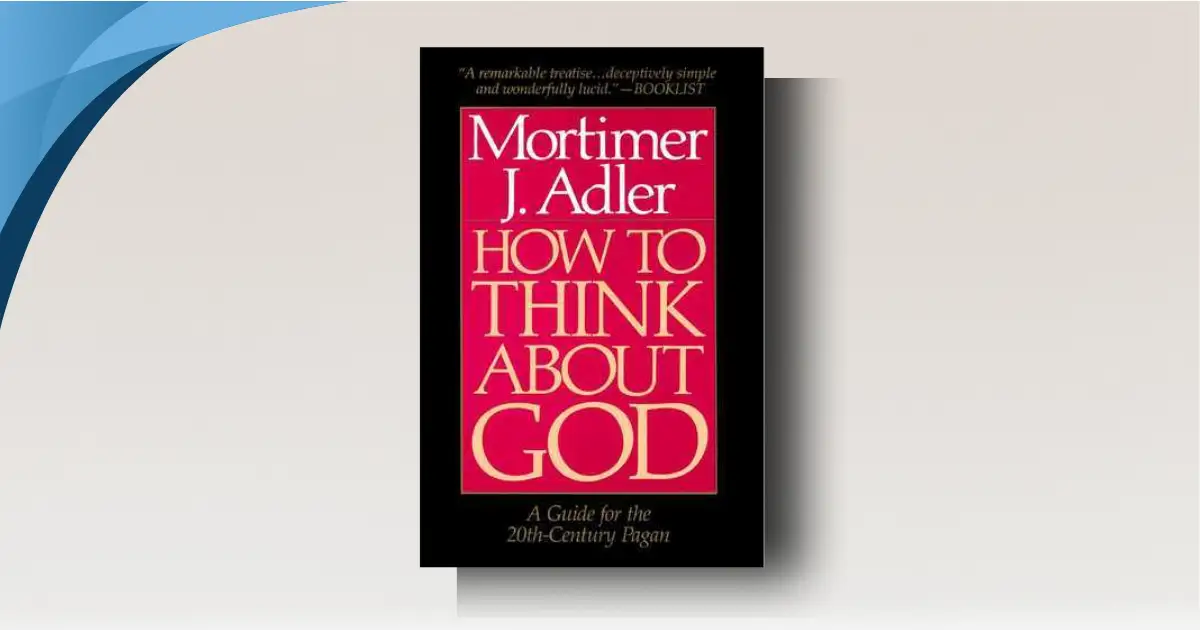
How to Think About God by Mortimer J. Adler is the rare philosophy of religion book that treats a modern skeptic like an adult instead of a target.
This is my long and full, reader-to-reader review of How to Think About God: A Guide for the 20th-Century Pagan—and I’m writing it so you won’t need to flip back through the book afterward, because I’m going to walk you through the whole arc, the key arguments, and the exact phrases that make Adler’s approach land.
Adler’s “20th-century pagan” isn’t an insult; it’s a profile of the modern person who does not begin with faith, and may not even want faith, but still wants intellectual honesty about the God question (Adler, How to Think About God, p. 13–14).
He does something I genuinely respect: he refuses to smuggle religion in through the back door of science, and he refuses to pretend science can do theology’s job either.
And if you’re the kind of reader who wants a clean map—what How to Think About God claims, how it builds, and where it’s strongest and weakest—I’ll give you that too.
If you’ve ever felt that the God debate is either emotional bullying or cold laboratory talk, this book is the bridge I wish someone had handed me earlier—because it shows how to think before it tells you what to think.
Adler’s best idea is that you can investigate the existence of God with disciplined reasoning—without faith, without mysticism, and without pretending cosmology is a substitute for philosophy.
Adler’s core “evidence” is philosophical rather than experimental, but his framing fits modern reality: today’s belief landscape really is full of “pagans” in his sense—people living post-institutionally, suspicious of dogma, yet still asking ultimate questions.
In the United States, Pew Research Center’s 2023–24 Religious Landscape Study reports long-term decline in Christian identification since 2007 and a large religiously unaffiliated share, with generational gaps that map to exactly the kind of reader Adler is addressing.
And when Adler talks about cosmology, you can see how he’s trying to keep language honest: he notes how scientists can be precise with measurements while being sloppy with loaded words like “beginning”.
Modern astronomy still agrees with the broad picture that the universe is ancient—NASA explains that we do not know the exact age but estimate around “thirteen billion” years (give or take), which is close to the mainstream “thirteen point eight billion” framing often used in Big Bang explanations.
In other words, Adler’s insistence on conceptual clarity is not academic fussiness; it’s a practical survival skill in a world where scientific facts and metaphysical meanings constantly get tangled.
How to Think About God is best for readers who want a rational, structured, non-preachy walk through “God exists” as a serious philosophical claim, including the ways traditional arguments fail and how to reformulate them.
It’s not for readers who want devotional warmth, scripture-centered faith-building, or a quick “gotcha” debate book aimed at humiliating atheists or believers. And it’s also not for anyone who hates slow, careful definition-building—because Adler will make you do conceptual housekeeping before he lets you touch the main argument.
I read How to Think About God as a person who’s tired of the two lazy extremes: “science disproves God” on one side, and “just believe” on the other.
Adler doesn’t let either side cheat, and that’s why the book feels oddly fresh even decades after publication.
The result is not a sermon but a disciplined inquiry—part tutorial in thinking, part critique of bad arguments, and part reconstruction of what might still count as a rational route to God.
Table of Contents
1. Introduction
How to Think About God: A Guide for the 20th-Century Pagan is written by Mortimer J. Adler and copyrighted in 1980, with a first Collier Books edition noted in the front matter of the copy I analyzed (Adler, p. 6). Public library catalog records also list 1980 as the publication year for the Macmillan edition.
Genre-wise, it sits in philosophical theology / philosophy of religion, and it reads like a guided argument rather than a memoir or a religious testimony.
Its subject is blunt: what it could mean to argue—rationally—for God’s existence without leaning on revelation.
Adler’s credentials matter here because he’s not writing as a pulpit voice. He is widely known as an American philosopher and educator associated with Aristotelian and Thomistic traditions, and major references document his long career in “Great Books” education and philosophy.
The central thesis, as I experienced it, is that modern people can be intellectually justified in affirming God’s existence, but only after stripping away verbal confusion and repairing broken arguments.
He frames the project as a path a pagan can walk—step by step—without being asked to pretend certainty.
Importantly, he also signals an honest limit: the “God of the philosophers” and the “God of religious faith” are not automatically the same object, and bridging that gap is its own problem (Adler, p. 166).
That distinction, to me, is one of the book’s most emotionally mature moves.
2. Background
Adler is writing into a twentieth-century atmosphere where the educated person often thinks religion is either scientifically obsolete or psychologically suspect. That mood is even more intense now, but the shape is similar: many people drift away from inherited religion while still reporting spiritual belief or metaphysical curiosity.
In the United Kingdom, for example, official census analysis for England and Wales shows major changes over a decade, including sharp rises in “No religion” in certain regions (like Wales) between 2011 and 2021.
That’s basically Adler’s “pagan” world: not necessarily militant atheism, but widespread disconnection from dogmatic faith.
Adler’s opening chapters make it explicit that his intended reader is not the believer looking for reinforcement, but the modern nonbeliever who still wants the question treated with seriousness (Adler, p. 13–14).
He even uses Pascal’s famous framing—three kinds of people in relation to God—as a way to situate the book’s audience (Adler, p. 19).
And he’s careful about the temptation to recruit science as theology.
When he describes twentieth-century cosmology—steady state versus Big Bang—he praises scientific precision with measurements but warns that scientists often mishandle philosophical words like “beginning” and “end” (Adler, p. 42).
That background matters because Adler’s whole method depends on refusing category mistakes. Science describes phenomena; philosophy clarifies what claims mean; religion (as lived faith) goes beyond what reason can prove (Adler, p. 166).
3. How to Think About God Summary
The structure is deliberate: Prologue, then four main Parts, then an Epilogue.
The table of contents lays it out as Prologue “Setting the Stage,” Part Two “Errors to Be Avoided,” Part Three “Making Ready,” Part Four “Attempting to Prove That God Exists,” and an Epilogue focused on the “chasm” between philosophical and religious conceptions of God (Adler, p. 9–10).
This matters because Adler isn’t just giving you an argument; he’s training your mind to avoid traps first.
He wants you to feel why bad reasoning is seductive—because it sounds like certainty—and why that’s exactly why it fails.
Now I’ll walk through what each stage actually does.
Prologue: Setting the Stage (Chapters 1–3)
Adler begins by defining the kind of reader he’s addressing.
His “20th-century pagan” is not a toga-wearing ancient polytheist; it’s the modern person who has “no faith in God” and is not anchored in religious doctrine, yet may still have intellectual curiosity about whether God exists (Adler, p. 13–14).
Then he makes a move that feels psychologically sharp: he frames the landscape using Pascal’s division—those who know God and love Him, those who do not know but seek, and those who do not know and do not seek (Adler, p. 19).
This is not a threat; it’s a mirror.
Chapter 2 is basically Adler telling you what the book is and what it is not. He says he’s not writing scripture commentary or an appeal to conversion-by-emotion; he’s trying to make an inquiry possible for someone who begins outside faith.
Chapter 3 is Adler being unusually transparent about himself—his intellectual journey, why he cares about these questions, and why he thinks philosophy still matters when both religion and science can be misused.
It’s subtle, but it builds trust: he’s not pretending neutrality, but he is promising method.
Part Two: Errors to Be Avoided (Chapters 4–5)
This section is one of the most valuable parts of the whole How to Think About God because it addresses the modern reflex: “Cosmology solved God.”
Adler takes the reader into twentieth-century astronomy, describing the competing “steady state” and “big bang” cosmological theories (Adler, p. 42). He notes that steady state has been “generally discredited” by evidence of an expanding universe, while Big Bang discussions often talk about a cosmic beginning “somewhere between fifteen and twenty billion years ago” in the scientific literature of his time (Adler, p. 42).
Then comes one of his most important conceptual inventions: his discussion of “exnihilation.” He introduces “exnihilation” as the opposite of annihilation—something is exnihilated if it “comes into existence out of nothing,” and he insists we should not casually treat ordinary birth or change as creation-from-nothing (Adler, p. 44).
This is where Adler earns my attention, because he’s not arguing God from scientific ignorance; he’s arguing that even if science talked about matter appearing out of nothing, that would be a philosophical claim requiring a creator, which religions call God (Adler, p. 46).
He even uses the term “exnihilator” to name that agency, which is his way of showing the logic without forcing doctrine (Adler, p. 46).
The deeper point: “beginning” in physics is not automatically “creation” in metaphysics. Scientists can talk about the beginning of the observable universe’s current state, but that does not logically imply that “nothing” existed before (Adler, p. 44).
So Part Two is Adler clearing the field. He’s telling the reader: if you want to think about God honestly, you must not let cosmological vocabulary do metaphysical work it cannot justify.
Part Three: Making Ready (Chapters 6–11)
This is the part many impatient readers skip, and I think that’s a mistake. Adler believes most God arguments fail because they do not define the target properly.
He begins with language itself: the uniqueness of the word “God.”
He points out that believers attach doctrine-based meaning, while pagans may attach vague connotations learned culturally, and yet the word still has enough shared thread that atheists, agnostics, theists, and even pantheists can argue about it at all (Adler, p. 49–50).
Then he makes a key demand: we cannot treat “God” as a vague class term. Adler insists we must substitute a definite description for “God,” because a definite description identifies one unique object the way a proper name does (Adler, p. 60).
This sounds technical, but it’s actually practical.
If you don’t know what you mean by “God,” you can’t responsibly say “God exists” any more than you can responsibly say “X exists” when you refuse to say what X is.
So Adler’s next move is to show how a definite description can be formed without relying on an empirical concept (Adler, p. 69). He admits he once thought Anselm’s “ontological argument” was the solution here, but he now thinks it’s widely misread as a proof of existence rather than a tool for clarifying meaning (Adler, p. 69).
This is important: Adler isn’t trying to rehash medieval arguments as museum pieces. He’s trying to rebuild the intellectual conditions under which “God exists” could even be argued without cheating.
And he keeps warning: logical validity is not truth. An argument can be logically valid and still prove nothing if its premises are not true in fact (Adler, p. 123).
That warning sets up the dramatic tension of the whole book: can we find premises strong enough to support a conclusion about God? Or are we going to keep producing beautifully valid nonsense?
Part Four: Attempting to Prove That God Exists (Chapters 12–16)
This is where Adler finally “does the thing,” but he does it like a surgeon, not a salesman.
He introduces what he calls the best traditional argument—often miscalled “the cosmological argument,” but better named “the argument from contingency” (Adler, p. 121). He refines it to avoid begging the question: it must not assume the cosmos had a beginning, and it must not argue to God as “first” in a chain of causes the way simplistic popular versions do (Adler, p. 121).
Then he explains why it fails.
This is one of the most intellectually honest sections I’ve read in any God-existence book.
He walks through the premises, agrees that several are sound, and then says the trouble is the third premise—he calls it “faulty” and “untenable,” and says that even a logically sound reasoning becomes inconclusive if a key premise collapses (Adler, p. 132).
Specifically, the problem is the claim that contingent beings need an efficient cause of their continuing existence at every moment, and Adler argues that we cannot simply assume that (Adler, p. 132). So the traditional form doesn’t deliver what it promises.
At this point, you might expect him to stop or pivot into faith.
Instead, he rebuilds.
He offers what he calls “a truly cosmological argument,” one that treats the effect to be explained as the existence of the cosmos as a whole, not just contingent parts within it (Adler, p. 141). He states it in brief: if the cosmos needs explanation and cannot be explained by natural causes, then we must look to a supernatural cause (Adler, p. 141).
This is Adler’s most daring move, because it shifts the debate from “this thing needs a cause” to “why is there a cosmos at all.” It’s also where the reader has to decide whether “needs explanation” is a rational demand or an emotional itch.
From there, Adler moves into remaining questions—what we can reasonably claim, what certainty means, and what is still left open. He does not present a magic proof; he presents a rational path to “reasonable grounds.”
Epilogue: The chasm (Chapters 17–19)
The epilogue is where Adler stops pretending philosophy can replace religion.
He describes a “chasm” between the God we can reach by philosophical reasoning and the God of religious faith. He says philosophy can go far—establishing differences between humans and animals, discussing evidence, clarifying concepts—but it cannot establish doctrines like immortality and personal life hereafter with the same rational force (Adler, p. 166).
Then comes the line that landed on me emotionally: Adler says there is “point and value” in pushing rational inquiry as far as it can go to “bridge the chasm between the God of the philosophers and the God of religious faith” (Adler, p. 166).
He is not mocking faith; he’s marking the boundary of reason with respect.
That ending is why this book feels like a guide rather than an argument grenade. It doesn’t force your conscience; it asks you to think clearly.
4. Strengths and Weaknesses
How to Think About God’s greatest strength is Adler’s refusal to let either side cheat.
When he sees science being used as a substitute for metaphysics, he slows down and shows why words like “beginning” get philosophically dangerous (Adler, p. 42).
I also loved his courage in admitting failure.
A lot of apologetics books pretend every traditional argument is airtight, but Adler openly says the “best traditional argument” fails because a premise is “faulty,” which is almost the opposite of salesmanship (Adler, p. 132).
The educational strength is that Adler teaches you a thinking style.
He makes you define terms, distinguish types of causes, and separate logical validity from factual truth (Adler, p. 123), and that’s useful even if you end up unconvinced.
But the weakness is real: the book can feel slow and technical, especially in the “definite description” chapters.
If you’re a reader who wants narrative momentum or emotional warmth, you may feel like you’re doing mental paperwork.
Another weakness is historical drift.
Adler cites cosmology language of his time—like “between fifteen and twenty billion years ago” for the Big Bang framing (Adler, p. 42)—and modern popular accounts tend to use more standardized numbers; NASA, for instance, describes the age estimate as around “thirteen billion” years, give or take. That doesn’t refute Adler’s point, but it reminds you this is a twentieth-century book.
Finally, his restraint might frustrate readers who want certainty.
Even Kirkus Reviews highlights that he does not offer apodictic demonstration, and that’s accurate: this is a case for rational warrant, not a final verdict.
5. Comparison with similar works
If you’ve read Bertrand Russell’s famous critique of Christianity, Adler feels like the intellectual counterweight—not because he “defeats” Russell with a zinger, but because he insists the God question must be formulated carefully before it’s denied or affirmed. That contrast is vivid for me because I’ve also seen Russell-style skepticism discussed in modern popular writing.
If you’ve read C S Lewis’s Mere Christianity, Adler is less pastoral and more architectural.
Lewis tries to move the heart and conscience; Adler tries to clean the intellectual room so the debate isn’t conducted in smoke.
If you’re coming from contemporary cosmology-pop books like Steven Weinberg’s The First Three Minutes (published 1977) or Robert Jastrow’s God and the Astronomers (published 1978), Adler is basically saying: enjoy the science, but don’t let science words become metaphysical conclusions by accident.
That’s exactly why his discussion of “exnihilation” hits so hard (Adler, p. 44).
6. Conclusion
I would recommend How to Think About God to the reader who wants a careful, rational, non-preachy guide to the God question—a book that is willing to say “this argument fails” and then keep thinking anyway.
It’s especially suitable for secular readers who are tired of shallow internet debates and want a disciplined walk through concepts like contingency, causality, and what “God” can even mean in a sentence.
And it’s also useful for believers who want to understand what reason can do without pretending reason can do everything.
If you want emotional testimony, scripture, or religious comfort, this is not your book. But if you want intellectual honesty that respects both skepticism and faith’s boundaries, Adler is the guide I’d hand you.
