
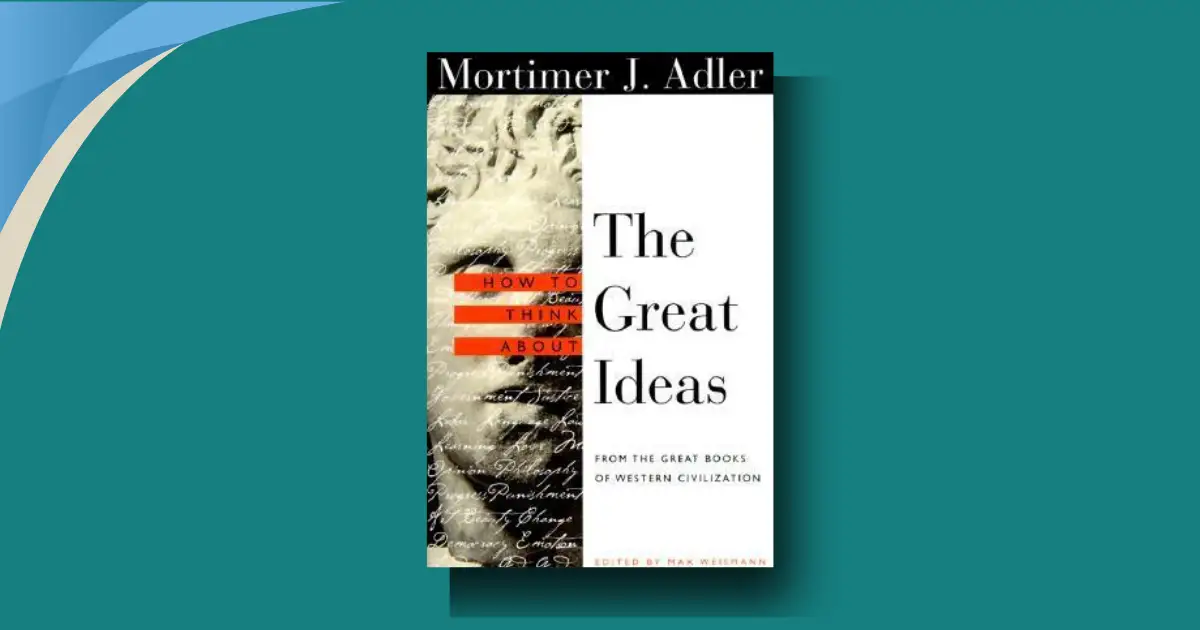
My struggled with the same modern problem—lots of “hot takes,” not much thinking about great ideas was real—and How to Think about the Great Ideas is basically a practical cure for that confusion.
It teaches you how to stop living on borrowed opinions and start handling truth, freedom, democracy, education, love, work, and war like real ideas with definitions, opposites, and consequences.
You can feel Adler’s urgency because he warns that skipping ideas is “to live like ants instead of humans,” since humans must choose “in terms of ideas.”
Adler’s best is to clarify the meaning of a great idea, compare it to its opposite, then test how it changes your decisions in real life.
What research says
Adler’s method leans hard on active learning—asking questions, making notes, and discussing—which he treats as the difference between real learning and passive “gazing.”
That teaching instinct lines up with modern education research: Freeman et al. (2014) meta-analyzed 225 studies and found active learning improves performance in STEM compared to traditional lecturing.
It also matches cognitive-science guidance that practice testing and distributed practice are among the most effective learning techniques across contexts (Dunlosky et al., 2013).
How to Think about the Great Ideas is best for readers who want a Mortimer J. Adler-style, no-fluff way to think about great ideas without needing a philosophy degree, because Adler insists “any one of us can” pioneer in ideas using our minds.
How to Think about the Great Ideas is not for readers who want a quiet, linear treatise, because the book preserves the “live TV broadcasts” feel—questions, interruptions, and a conversational rhythm with Lloyd Luckman.
Some people will bounce if they dislike “definition work,” because Adler repeatedly slows down to precision (for example, he says democracy needs clarity because we use the word “loosely”).
Brief introduction
When people search How to Think About the Great Ideas review, what they usually want is: What’s inside, what’s the thesis, and will it actually make me think better?
I’m writing this from a reader’s seat—someone who’s tired of the internet’s constant certainty—because Adler’s whole point is that thinking gets better when your words get sharper.
So this post reviews the actual book that exists in catalogs and in the PDF you provided: How to Think about the Great Ideas: From the Great Books of Western Civilization.
And yes, I’m going to “spoil” it—because Adler’s value is not plot, it’s the mental toolkit you walk away with.
Table of Contents
1. Introduction
How to Think about the Great Ideas: From the Great Books of Western Civilization is by Mortimer J. Adler and published by Open Court (Carus Publishing), with printings listed from 2000–2001.
Genre-wise, it’s philosophy-for-adults, but not in a dreamy quote-book way; it’s more like a disciplined conversation that keeps dragging you back to definitions and consequences.
Adler’s credibility isn’t marketing fluff: the “About the Author” section notes he was born in 1902, got a PhD in 1928, and became a University of Chicago professor in 1929 alongside Robert Maynard Hutchins.
It also highlights that Adler popularized the phrases “Great Books” and “Great Ideas,” and emphasized that there are “a limited, objectively identifiable number of Great Ideas and Great Books.”
The thesis, as I experienced it, is that the modern mind gets lost not because it lacks information but because it lacks clarity about the few ideas that secretly run everything.
Adler states the democratic version of this thesis outright: “In the world of ideas, there is always pioneering to be done… The Great Ideas belong to everyone.”
And the book’s profits even get routed back into the mission—royalties go to the Center for the Study of the Great Ideas—so the whole project reads like a civic act, not just a product.
2. Background
This book is built from a TV lecture series Adler recorded with Lloyd Luckman, broadcast in the San Francisco Bay Area in 1953 and 1954.
The editor explains the shows were recorded on film, later rescued, transferred to tape, and then transcribed into book form.
So you’re not reading a conventional “philosophy treatise”; you’re reading cleaned-up transcripts where the conversational flavor is “largely untouched.”
That background matters because it explains the book’s weird strength: it feels like thinking out loud, but it’s still structured like a curriculum.
The editor even notes that chapters can be read in any order, as long as the grouped chapters for a single Great Idea are read in order.
To me, that turns the book into something like a “mental gym”—you drop into the Great Idea you need (truth, love, law), work it, then leave stronger.
And because the source is TV, Adler keeps returning to active learning—he wants viewers and readers to ask questions, take notes, and discuss immediately afterward.
It’s almost eerie how modern that is, because today we’re drowning in screens, and Adler was already pushing people to refuse passive consumption.
3. How to Think about the Great Ideas summary
What’s inside (structure you can actually use)
The table of contents shows 52 chapters, each focused on one Great Idea or a paired concept (like War and Peace).
It begins with Truth, Opinion, and Knowledge—exactly where a confused modern mind should start—then moves through Emotion, Love, Good and Evil, Beauty, Freedom, Human Nature, Learning, Art, Happiness, Religion, and onward into social life: Work/Leisure, Family, Education, Justice, Law, Government, Democracy, War/Peace, History, and Philosophy.
Even if you disagree with Adler’s framing, you can’t accuse him of randomness: the chapters track the arc of a human life—from knowing, to loving, to working, to governing, to dying under history.
And because it’s Adler, the method is consistent: he defines, contrasts, shows historical arguments, then asks what that meaning does to your daily choices.
The philosophical heartbeat is that humans have “freedom—and therefore the necessity—to choose,” and choice is impossible without ideas.
So the entire book becomes a fight against living by unexamined slogans—especially political slogans—because Adler treats sloppy words as sloppy lives.
And he uses the oldest trick in the Great Books: opposites clarify each other (knowledge vs opinion, work vs leisure, democracy vs tyranny).
That’s the skeleton; now here’s the flesh—what each major cluster is trying to do to your mind.
Cluster 1: Truth, opinion, knowledge (how to stop being manipulated)
Adler opens with Truth and pushes one of the most sanity-restoring points I’ve read in years: the world changes, minds change, but truth itself doesn’t “mutate” just because humans flip beliefs.
He gives a blunt example: if “the earth was flat” was false, it’s always false; if it was true that the earth is round, it stays true, and our changing opinions don’t change the fact.
This matters because it quietly attacks both cynicism (“everything is opinion”) and dogmatism (“my opinion is automatically truth”) in one move.
Then he turns to Opinion and immediately says Great Ideas are best seen “in relation to” their opposites, like opinion in relation to knowledge.
Here’s why I found this section personally useful: Adler doesn’t shame opinion; he explains why opinion exists (uncertainty, probability, limited evidence), and he frames the real moral job as learning how to rank opinions responsibly.
When he later connects opinion to majority rule, it becomes a civic warning: if citizens can’t tell knowledge from opinion, democracy becomes a loud contest of confidence.
So the book’s first gift is practical: it hands you a way to interrogate a statement—what kind of claim is this, what evidence would settle it, and what is the level of certainty here.
And the deeper gift is emotional: it makes you less panicky in disagreement, because disagreement often isn’t about values—it’s about unclear terms.
Cluster 2: Emotion, love, good/evil, beauty (how to be human without being childish)
From Emotion and Love onward, Adler treats inner life as a territory of ideas, not just vibes.
That matters today because so much online “self help” treats feelings as final verdicts, while Adler treats them as data that still needs interpretation.
Love gets multiple chapters (including sexual love and the morality of love), and that alone tells you Adler thinks it’s too important to leave as a Hallmark word.
In the Good and Evil chapters, what I felt (and I mean this honestly) was relief: Adler refuses the lazy modern collapse where “good” means “what I like” and “evil” means “what I hate.”
When he shifts to Beauty, he’s not just talking museums; he’s building a bridge between pleasure, judgment, and the way societies decide what deserves reverence.
This is where the TV format helps: it keeps the ideas grounded in everyday language rather than academic fog.
And Adler’s recurring technique—define, contrast, test—prevents these chapters from floating away into inspirational quotes.
In my reading, the takeaway is almost uncomfortable: if you can’t define love, you’ll mistake appetite for devotion; if you can’t define good, you’ll confuse convenience with virtue; if you can’t define beauty, you’ll be ruled by fashion.
Cluster 3: Freedom, human nature, learning (how to grow up intellectually)
Freedom is one of Adler’s anchor ideas, but he keeps tying it back to responsibility, because freedom without thinking is just impulse with a marketing budget.
Then he tackles “How Different Are Humans?” and “The Darwinian Theory of Man’s Origin,” which reads today like a rehearsal for modern debates about what’s “biological” and what’s “cultural.”
What I liked is that he doesn’t treat science as an enemy; he treats it as one voice in the argument about human uniqueness.
But the section that hit me hardest—because it changed how I read everything—was Learning and “How to Read a Book.”
Adler says learning that matters for adults is gaining insight and deepening understanding, and he uses the image of “climb up, hand-over-hand” on “the ropes of learning.”
Then he drops the rule that should be tattooed on every reader’s wrist: reading must be active, and staying awake means asking questions, not just keeping your eyes open.
He even gives the gritty test of whether you’re reading actively: you get tired, because work is involved, and you end up with pencil marks and notes in the margins.
This is exactly where the “evidence snapshot” connects, because modern research repeatedly finds that active engagement beats passive exposure (Freeman et al., 2014).
So, in plain words, Adler’s learning section makes you stop pretending you “read” when you really just looked at words.
Cluster 4: Art, happiness, religion (how words distort big ideas)
When Adler begins Art, he confesses something I’ve felt but never articulated: “words often get in the way,” and with Great Ideas, they create “great difficulties.”
He points out that people reduce “art” to fine art (painting/sculpture), but says that meaning is “very recent,” appearing only in the last hundred years or less, and it conflicts with older, broader meanings.
This is not trivia; it’s a lesson in semantic drift—how a civilization can lose part of an idea just by narrowing the word.
Happiness, in Adler’s hands, isn’t just “feeling good”; it becomes a question of what kind of life is worth choosing, and what kind of goods are truly human goods.
Religion enters not as an argument-stopper but as one of the permanent Great Ideas that Western thinkers wrestle with, whether believers like it or not.
What surprised me is how often Adler refuses extremes: he won’t let you reduce religion to superstition or reduce reason to coldness, because he wants the whole human range.
By the time you finish this cluster, you realize the book is not just philosophy; it’s a defense against the way modern language shrinks reality.
Cluster 5: Work, leisure, play, education (how modern life rearranged the human day)
Adler’s chapters on Work and Leisure are secretly a history lesson about what industrial democracy did to time.
He describes the “standard answer” of the average American: a 24-hour day split into equal thirds—8 sleep, 8 work, 8 free time—and he warns that this is a historically new arrangement.
Then he contrasts it with preindustrial societies where the working class had basically two parts: work and sleep.
This isn’t nostalgia; it’s conceptual framing—if your society changes the structure of time, you need new definitions of leisure, play, rest, and education.
And Adler’s larger educational argument is that “free time” can become either a sinkhole of distraction or a space for genuine human development.
Here, the book’s relevance gets painfully current: in 2022, only 48.5% of U.S. adults reported reading at least one book in the past year, per NEA analysis of federal survey data.
So Adler’s push toward active reading and discussion doesn’t feel quaint; it feels like a rescue mission.
Cluster 6: Justice, law, government, democracy (how political words get weaponized)
When Adler reaches Democracy, he says straight out that the word is overused and often used with “almost no definite meaning,” so clarity is needed.
Then he makes a bold definitional move: “The essence of democracy is simply equality,” and he ties democracy to universal suffrage added to republican constitutional government.
Whether you agree or not, the method matters—Adler forces you to ask what democracy is, what it is not, and what it is opposed to (despotism, oligarchy).
In Government discussions, the book can get surprisingly specific, even moral: in a segment about accusing without proof, Adler cites the Ninth Commandment and expands it into a broader rule against defamation and slander.
This isn’t just religion-talk; it’s about the ethical infrastructure required for a society to keep truth from collapsing into rumor.
Then he does something rare for popular political commentary: he admits his mind changed about political parties and the common good, modeling the humility he demands of readers.
If you read these chapters seriously, you stop treating politics as entertainment, because Adler keeps revealing the moral assumptions inside every political slogan.
Cluster 7: War/peace, history, progress, philosophy (how to think at civilizational scale)
War and Peace, Adler says, may be “the most important and the most urgent problem of our time,” but he insists right action requires right thinking.
He emphasizes that a “sound understanding” exists in the Great Books tradition, yet it hasn’t been taught widely, which is basically an indictment of education systems that teach skills but skip wisdom.
In Progress, Adler challenges naive perfectibility: he says there’s “no clear evidence” that human intelligence has increased historically, and he doubts moral improvement century after century.
His conclusion is stark: progress happens mainly in institutions, laws, and customs—men “can change other things, but not men themselves.”
That view may irritate optimists, but it forces a hard question: if human nature is constant, why do we keep acting surprised by recurring patterns of cruelty, propaganda, and war.
Finally, Philosophy becomes the capstone, and Adler confronts the famous problem: philosophers disagree, so is philosophy “progressing”?
His answer includes a genuinely modern proposal: philosophers should collaborate like scientists do—“teamwork”—and he says that’s what his Institute was trying to do.
So the book ends not with a tidy doctrine, but with an invitation: think together, define together, argue cleanly, and make progress possible.
Does the book fulfill its purpose?
Yes, because it does exactly what it promises: it helps ordinary readers “pioneer” in the world of ideas and treat Great Ideas as something you can actually use.
It also fulfills its educational mission by hammering active learning—questions, notes, discussion—rather than pretending insight can be passively absorbed.
And in a time when reading for pleasure is measurably slumping (NEA data), Adler’s insistence on active, effortful reading feels like a necessary push, not a scold. \
4. 52 “How to think about…” lessons
- How to Think about Truth: Treat truth as something you can aim at—then test claims against reality, not crowd approval.
- How to Think about Opinion: Separate what you think from what you know and label uncertainty honestly.
- The Difference between Knowledge and Opinion: Ask what would prove or disprove the claim—if nothing can, it’s likely only opinion.
- Opinion and Human Freedom: Use freedom to examine your opinions instead of letting opinions quietly run your freedom.
- Opinion and Majority Rule: Don’t confuse “most people think so” with “it’s true”—majorities can be wrong.
- How to Think about Man: Define what a human being is before you debate what humans should do.
- How Different Are Humans?: Identify what is uniquely human versus what we share with animals.
- The Darwinian Theory of Man’s Origin: Understand evolutionary explanations clearly before treating them as total explanations.
- The Answer to Darwin: Weigh counterarguments and limits—don’t accept or reject a theory by vibe.
- The Uniqueness of Man: Locate the feature(s) that make human life morally and intellectually distinct.
- How to Think about Emotion: Name emotions precisely so they inform judgment instead of hijacking it.
- How to Think about Love: Define what kind of love you mean before you decide what love demands.
- Love as Friendship: A World Without Sex: Imagine love without sex to understand companionship, loyalty, and shared good.
- Sexual Love: Treat sexual love as a serious idea with consequences, not only an appetite.
- The Morality of Love: Judge love by whether it tends toward good or harm—not only intensity.
- How to Think about Good and Evil: Don’t use “good/evil” as insults—use them as concepts that require reasons.
- How to Think about Beauty: Ask what beauty means in experience and judgment, not just in decoration.
- How to Think about Freedom: Clarify what freedom is (and isn’t) before demanding more of it or blaming it.
- How to Think about Learning: Treat learning as a lifelong discipline—understanding is earned, not absorbed.
- Youth Is a Barrier to Learning: Recognize how immaturity can block learning, and build habits that compensate.
- How to Read a Book: Read actively—question, outline, and argue with the text until it yields meaning.
- How to Talk: Use conversation to clarify ideas—speak to test thoughts, not to perform certainty.
- How to Watch TV: Consume media with judgment—ask what it assumes, what it sells, and what it omits.
- How to Think about Art: Define art broadly before narrowing it to “fine art,” and ask what it does for humans.
- The Kinds of Art: Distinguish kinds of art so you don’t judge all art by one standard.
- The Fine Arts: Understand what makes fine arts “fine” and where that category misleads.
- The Goodness of Art: Ask how art can be “good”—morally, aesthetically, socially, or personally.
- How to Think about Justice: Define justice clearly before you demand it—otherwise you’re only demanding preference.
- How to Think about Punishment: Judge punishment by what it’s for (deterrence, reform, restitution, retribution).
- How to Think about Language: Treat language as a tool that can clarify or confuse—choose words like instruments.
- How to Think about Work: Define work beyond jobs—ask what work is for and what it costs a human life.
- Work, Play, and Leisure: Separate work, play, and leisure so your “rest” doesn’t become another grind.
- The Dignity of All Kinds of Work: Treat all honest work as worthy of dignity, not only high-status professions.
- Work and Leisure Then and Now: Compare eras to see how modern time-shapes change human character and culture.
- Work, Leisure, and Liberal Education: Use education to make leisure meaningful rather than merely escapist.
- How to Think about Law: Define law and its purpose before you treat legality as morality (or morality as legality).
- The Kinds of Law: Distinguish kinds of law so you know what can be changed and what should be stable.
- The Making of Law: Understand how laws are made to judge legitimacy, accountability, and reform.
- The Justice of Law: Test whether laws are just—not merely whether they exist or are enforced.
- How to Think about Government: Define government by what it must do—order, rights, power—before praising or hating it.
- The Nature of Government: Ask what government is essentially, not only which party currently holds it.
- The Powers of Government: Map the powers government has so you can limit abuse and demand responsibility.
- The Best Form of Government: Compare forms of government by ends and outcomes, not by slogans.
- How to Think about Democracy: Define democracy carefully and test whether your society’s practices match the definition.
- How to Think about Change: Separate change that is mere movement from change that is real improvement.
- How to Think about Progress: Demand a clear standard for “progress” and ask: progress in what, for whom, at what cost.
- How to Think about War and Peace: Treat war and peace as ideas with causes and conditions, not as unavoidable weather.
- How to Think about Philosophy: Use philosophy to pursue clarity on ultimate questions, not just to collect opinions.
- How Philosophy Differs from Science and Religion: Know which questions belong to philosophy versus science or religion so arguments stay honest.
- Unsolved Problems of Philosophy: Accept that some philosophical problems remain open—and learn to think without final closure.
- How Can Philosophy Progress?: Look for philosophical progress in clearer questions, better distinctions, and stronger reasoning.
- How to Think about God: Define what you mean by “God” and examine the kinds of reasons offered for and against that idea.
5. Strengths and Weaknesses
The biggest strength is that the book is not trying to impress you—it’s trying to train you, and those are different vibes.
I loved how Adler makes you earn understanding: he basically says books don’t lift you “by capillary attraction,” and that line alone changed how I approach reading.
I also loved the moral seriousness: even when topics get political, Adler yanks them back to ethical foundations, like truth-telling and harm to reputation.
Another strength is the structure—52 chapters means you can reread it like a reference manual for life decisions.
And the TV-transcript style is oddly intimate; Lloyd Luckman’s questions feel like the reader’s questions, which keeps philosophy from becoming performance.
Now the weaknesses, from my own reading: sometimes the conversational format repeats itself, and if you prefer dense, compact argumentation, you may get impatient.
Also, because these were mid-century broadcasts, certain examples and cultural references feel dated even when the idea remains timeless (the editor explicitly notes the “TV presentation techniques of the 1950s”).
Finally, Adler’s confidence can feel heavy: he often speaks as if the “right” definitions are discoverable, and readers who lean strongly relativist may resist that whole project.
6. Comparison with similar works
If you’ve read Adler’s How to Read a Book, this feels like the grown-up sequel in spirit: the same insistence on active reading, questions, and marginal notes.
But unlike How to Read a Book, this one isn’t mainly method—it’s method applied to the “permanent questions” (truth, love, law, democracy). And there is also The Greatest Minds and Ideas of All Time by Will Duran.
Compared to an encyclopedia-style philosophy primer, Adler is less neutral and more training-oriented, because he keeps pushing you to decide what words mean and what follows from them.
Compared to modern “life advice” books, Adler offers fewer hacks but deeper roots: he wants you to examine the assumptions behind your decisions, not just optimize outcomes.
And compared to listicles or quote collections, this book is slower but more durable—because it’s building conceptual muscles, not giving you motivational sugar.
On Probinism, I have already written about the books on “big-idea”—there’s a “Top 20 Philosophy Books” feature and classics-heavy coverage that fits naturally with Adler’s Great Books spirit.
7. Recommendation
I’d recommend How to Think about the Great Ideas to readers who feel surrounded by opinions and want a calmer, sharper way to decide what they believe and why.
It’s suitable for general audiences—Adler’s own life aim was addressing the “intelligent layperson”—but it demands effort, because active reading is the price of insight.
If you’re willing to do that work, the book earns its place as a personal reference guide: not because you’ll memorize answers, but because you’ll learn how to ask better questions.
And in a decade where fewer adults even finish a single book in a year, reading Adler carefully feels almost rebellious—in the best, most human way.
