
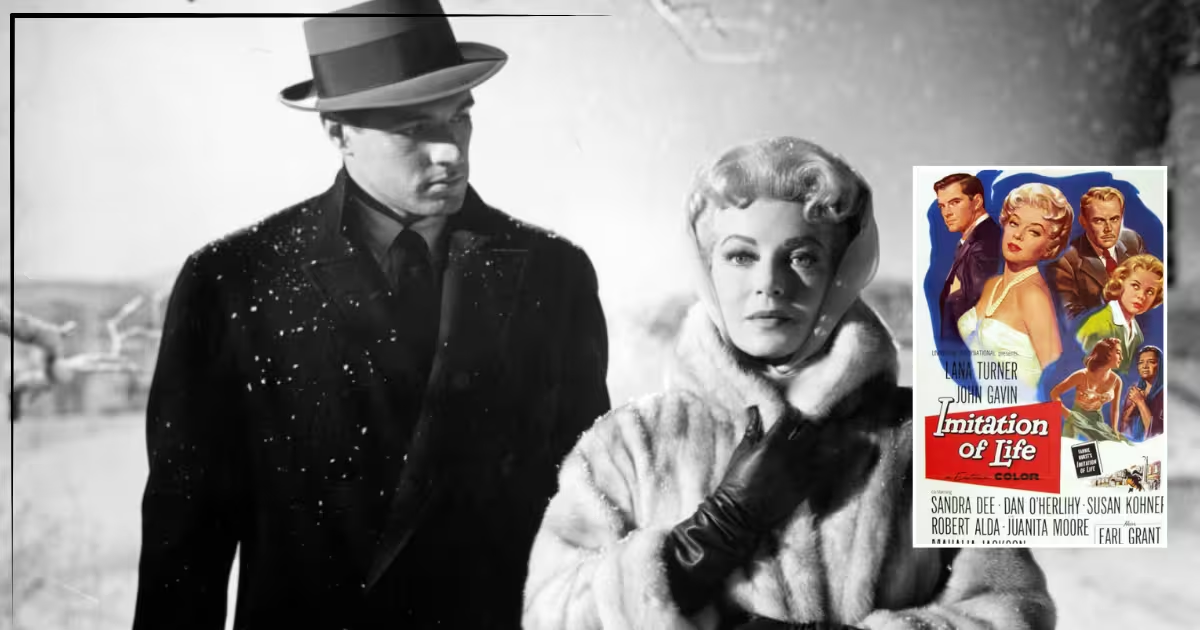
I still think Imitation of Life (1959) is one of those films that doesn’t just make you cry, it makes you question what you were crying for.
Imitation of Life (1959), directed by Douglas Sirk, is a glossy Hollywood melodrama that premiered in 1959 and refuses to stay politely in its era. It’s a remake of the 1934 adaptation of Fannie Hurst’s novel, but Sirk turns it into something sharper, almost accusatory, beneath the satin surface.
Imitation of Life (1959) is also one of the 101 must-watch films on my “101 Best Films You Need to See” list on probinism.com, where it appears as the 1959 entry in that chronological run.
My overall impression of Imitation of Life (1959) is that it is both a crowd-pleaser and a quiet indictment.
And that double-life quality is exactly why I keep returning to it.
Imitation of Life (1959) was produced inside a studio system that loved emotional spectacle, and Sirk knew how to weaponise that love. The story was reshaped from the earlier “business success” plot into an entertainment-industry rise, which lets the film talk about performance in every sense of the word.
I find that shift crucial, because when a film is about acting, it can smuggle truths past the audience’s guard. Imitation of Life (1959) repeatedly asks who gets to “play” which role in America, and who gets punished for improvising. That’s why it lands as more than a tearjerker when you watch it today.
In terms of cultural status, Imitation of Life (1959) was added to the United States National Film Registry in 2015. It’s also frequently cited as a BBC Culture selection from their American-films poll, with multiple secondary sources repeating that it placed 37th in that 2015 ranking, although I cannot directly open BBC’s page in this environment to verify it firsthand.
Table of Contents
Background
Imitation of Life (1959) is Sirk’s last major Hollywood film, and it has the feeling of a final statement.
Douglas Sirk’s signature in Imitation of Life (1959) is a kind of polished intensity, where colour and composition do emotional work before dialogue even arrives. It is based on a novel by Fannie Hurst that had already been filmed in 1934, which makes this version feel like a second argument rather than a simple retelling.
The remake choice matters because America in the late 1950s was not America in the early 1930s, even when it pretended otherwise. The AFI Catalog notes the studio encountered resistance in promotion and even tailored advertising for the South, suggesting how nervous the marketplace was about race on screen.
Imitation of Life (1959) also leans into music as a public language of grief.
Mahalia Jackson appears for a single scene, and the AFI Catalog lists “Trouble of the World” as one of the notable songs performed in the film. That detail might sound small, but in Imitation of Life (1959) it becomes the emotional hinge that redefines what the story has been doing all along.
Even the film’s glamour is part of the point, not a distraction.
Some sources report Imitation of Life (1959) had a budget around 1.2 million dollars and earned 6.4 million dollars in United States and Canada rentals, and at minimum it clearly performed strongly for Universal in its year.
Also, industry reporting and later summaries emphasise how central wardrobe spectacle was to its marketing, including the oft-repeated claim that Lana Turner’s costumes were extraordinarily expensive for the time, which fits the film’s obsession with surfaces.
With that context in mind, the plot of Imitation of Life (1959) hits harder, because you can feel the studio sheen fighting with the story’s bruises.
Cast:
- Lana Turner as Lora Meredith – The ambitious white actress whose relentless pursuit of Broadway stardom serves as a glittering, yet emotionally hollow, “imitation” of a fulfilled life, leading her to neglect her daughter.
- Juanita Moore as Annie Johnson – Lora’s Black friend and housekeeper, whose profound, tragic storyline concerning her light-skinned daughter provides the film’s emotional core and its powerful critique of racial prejudice.
- Sandra Dee as Susie Meredith (age 16) – Lora’s daughter, who grows up feeling emotionally abandoned by her mother, a neglect that fuels a misplaced romantic rivalry and forces her to seek maternal comfort elsewhere.
- Susan Kohner as Sarah Jane Johnson (age 18) – Annie’s daughter, who can “pass” as white; her desperate and painful rejection of her mother and heritage drives the film’s most devastating drama about internalized racism and identity.
- John Gavin as Steve Archer – The steadfast photographer in love with Lora; he represents the authentic personal life and love she continually sacrifices for her career, acting as the film’s moral anchor.
Imitation of Life Plot
Imitation of Life (1959) opens at a crowded beach, where the noise and sunlight feel almost cruel.
Lora Meredith, a white widowed mother with an actress’s hunger, loses sight of her little daughter Susie in the crush of people.
In her panic, she meets Steve Archer, a photographer whose calm competence seems to promise stability. When Susie is found, she is safe with Annie Johnson, a Black single mother, and with Annie’s light-skinned daughter Sarah Jane, who is about Susie’s age.
Imitation of Life (1959) quickly turns this chance encounter into an uneasy domestic arrangement. Annie and Sarah Jane have nowhere to go, and Lora has very little money, so Lora offers them temporary shelter in her small New York apartment. Annie, practical and gentle, offers in return to cook, clean, and watch Susie so Lora can chase auditions.
From the start, Imitation of Life (1959) frames the relationship as friendship in one direction and employment in another, even when everyone is trying to be kind.
Lora’s ambition moves faster than her emotional awareness. She forces her way into the office of theatrical agent Allen Loomis, and his behaviour makes clear what “opportunity” can cost a woman in that world.
Steve, seeing the danger, tries to protect her, but Lora refuses to be managed, even by someone who loves her. She breaks with Steve when he tries to forbid her from meeting Loomis again, because Lora would rather risk humiliation than surrender control.
Imitation of Life (1959) then gives Lora the kind of break Hollywood loves to celebrate. Loomis connects her to playwright David Edwards, and Lora lands a role that begins to transform her from desperate striver into recognisable star.
As Lora’s professional life expands, Annie becomes the steady centre of the home, raising Susie with tenderness while trying to guide Sarah Jane through a world that keeps telling her she is wrong to exist as she is. This is where Imitation of Life (1959) starts to tighten its grip, because the “success story” is visibly built on someone else’s unpaid emotional labour.
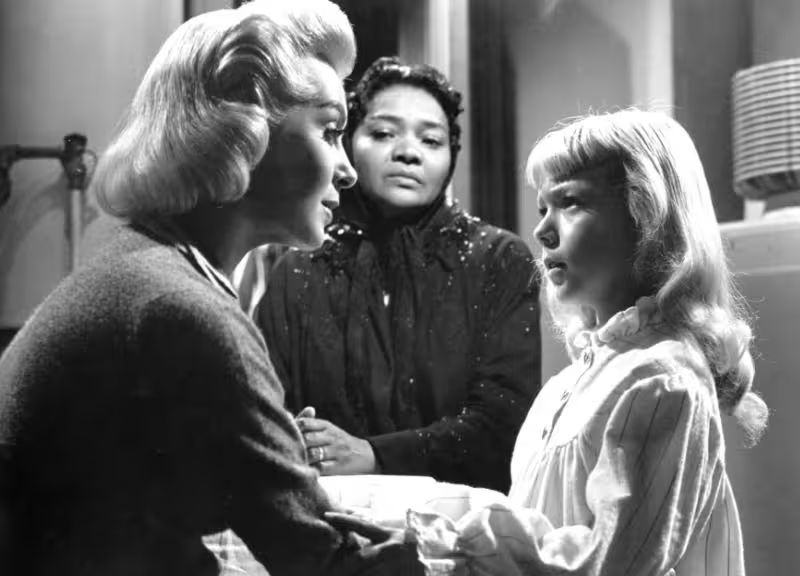
Time passes, and the girls grow into teenagers with different kinds of hunger.
Susie becomes openly devoted to Lora, but she is also lonely, because fame makes a parent physically present yet spiritually absent.
Sarah Jane becomes increasingly angry, not at Annie’s love, but at what society does to that love when it stamps “inferior” on the mother and “tainted” on the daughter. Imitation of Life (1959) makes Sarah Jane’s pain volatile, because the film understands that shame is not a quiet emotion.
Sarah Jane begins to “pass” as white in Imitation of Life (1959), and every scene around that choice feels like walking on broken glass. She tells classmates she is white, she avoids being seen with Annie, and she reacts with cruelty whenever Annie’s presence threatens to reveal the truth.
Annie keeps trying to reach her daughter with patience, which only deepens Sarah Jane’s panic, because Annie’s love is tied to the identity Sarah Jane is trying to escape. The tragedy in Imitation of Life (1959) is that Sarah Jane is not chasing whiteness as beauty, but as safety.
Lora’s world in Imitation of Life (1959) becomes more luxurious, and the home becomes stranger.
Her career rises until she is a Broadway headliner, and invitations and parties begin to replace ordinary family evenings.
Steve re-enters her life at points, still offering marriage and a kind of grounded partnership, but Lora keeps postponing the decision, as if love is something she can schedule after the next opening night. Imitation of Life (1959) never pretends she is evil, but it shows how easily charm becomes selfishness when the world applauds you for it.
Susie’s emotional conflict in Imitation of Life (1959) blooms as she grows older, and it takes a particularly painful shape. She forms a bond with Steve, who has remained close to the family, and she begins to interpret his warmth as the kind of attention she is starving for.
That misunderstanding becomes a private obsession, because Susie cannot admit to herself that she is falling for the man who is emotionally paired with her mother. Imitation of Life (1959) lets this storyline simmer in embarrassment and longing, the way real inappropriate crushes often do.
Meanwhile, Sarah Jane’s life in Imitation of Life (1959) becomes a series of exits.
She runs away more than once, and each time Annie tracks her down, pleading for the smallest acknowledgement: a conversation, a visit, a sign that their bond is still real. Sarah Jane, terrified of being pulled back into a racial category that could get her harmed, responds with rejection so extreme it looks like hatred.
The film’s cruelty here is deliberate, because Imitation of Life (1959) wants the audience to feel how racism forces love into impossible positions.
One of the most shocking sequences in Imitation of Life (1959) is when Annie finds Sarah Jane working as a dancer at a club.
The setting is loud, sexualised, and risky, and Annie’s presence there is both maternal and dangerously vulnerable. When Annie tries to speak to her, Sarah Jane reacts not with gratitude but with violent denial, because being seen with Annie risks exposing her. Imitation of Life (1959) makes the moment sting by showing how Sarah Jane’s survival strategy has turned her into someone who injures the person who loves her most.
The film then turns that denial into physical harm in Imitation of Life (1959). A white boyfriend or patron, discovering Sarah Jane’s racial background, lashes out, and Sarah Jane is beaten.
Annie witnesses the aftermath, and the film refuses to romanticise it, because this is what “passing” can cost when the world is eager to punish boundary-crossing. Imitation of Life (1959) frames the violence not as a random event, but as the logical enforcement mechanism of a racist social order.
As these crises unfold, Lora’s domestic life in Imitation of Life (1959) starts to buckle.
Susie becomes more openly resentful of Lora’s absence, and she interprets Annie’s steady presence as both comfort and indictment.
Lora, used to controlling rooms and rehearsals, struggles to control the emotional reality of her own house. When Susie’s feelings for Steve intensify, she turns that confusion into anger at her mother, and Imitation of Life (1959) shows how easily a child can weaponise morality when they are really just pleading for attention.
Eventually, Susie confesses in Imitation of Life (1959) that she loves Steve, and the confession is humiliating because it is sincere.
Steve responds with gentleness but firmness, making clear that his relationship is with Lora, not Susie, and Susie is forced to confront the difference between desire and possibility.
Lora, hearing this, is rattled, not only by Susie’s feelings but by what they reveal about her own neglect. Imitation of Life (1959) uses this moment to expose a central irony: Lora has been performing motherhood without always inhabiting it.
The film’s emotional centre in Imitation of Life (1959), however, remains Annie.
Annie’s health declines, and even as she grows weaker, she continues to speak about Sarah Jane with hope, as if hope itself is a duty.
Lora offers Annie affection and security, but Annie’s deepest need is not comfort, it is reconciliation. Imitation of Life (1959) treats this longing with reverence, because Annie’s love is depicted as the most durable force in the story.
When Annie dies in Imitation of Life (1959), the film turns grief into spectacle, and it is the kind of spectacle that makes you feel complicit for watching.
The funeral is grand, crowded, and saturated with music, and Mahalia Jackson’s presence transforms it into something close to a communal lament.
The camera lingers on the scale of the ceremony, and the effect is both beautiful and bitter, because Annie receives this “honour” only after a lifetime of being treated as secondary. Imitation of Life (1959) makes the funeral feel like America praising the saint it refused to pay properly while she was alive.
Sarah Jane returns for the funeral, and this return is the film’s final knife twist.
She throws herself onto the coffin, sobbing, pleading, and finally admitting what she has denied: that Annie was her mother, and that she loved her. The scene is overwhelming because it refuses neat closure; Sarah Jane’s grief does not erase what she did, and it does not undo the world that shaped her desperation. Imitation of Life (1959) ends not with a tidy moral, but with the echo of a question: what kind of society teaches a daughter to be ashamed of the mother who kept her alive.
In the aftermath, Imitation of Life (1959) suggests a fragile possibility of honesty.
Lora and Susie, shaken by what they have witnessed, move toward a more truthful relationship, and Lora’s priorities appear altered by the weight of Annie’s absence. Steve remains present as a stabilising figure, but the film does not pretend romance can solve what has been revealed.
Imitation of Life (1959) closes with the sense that some wounds can be recognised, even if they cannot be fully healed.
That, to me, is why Imitation of Life (1959) still works: it lets the tears come, but it makes sure the tears carry meaning.
Imitation of Life Analysis
When I think about why Imitation of Life (1959) still stings, I come back to how it makes ordinary love feel like a public trial.
Douglas Sirk directs Imitation of Life (1959) with the calm confidence of someone staging a tragedy in bright daylight. According to Britannica, it’s one of his last Hollywood “expressionist” showpieces, and you can feel that in the controlled color, the polished surfaces, and the way rooms seem to press in on people.
Cinematographer Russell Metty’s compositions keep the women framed like they’re on display—fitting for a film where everyone is performing a role, even at home.
Lana Turner plays Lora with a glamorous armor that slowly cracks, while Juanita Moore and Susan Kohner bring the film’s most raw, unignorable pain.
It’s no accident that Kohner and Moore were both Oscar-nominated for supporting actress, with Kohner also winning the Golden Globe in that category.
The screenplay by Eleanore Griffin and Allan Scott keeps the melodrama moving, but it also builds in sharp little humiliations that accumulate like interest.
Frank Skinner’s score, punctuated by Mahalia Jackson’s gospel presence, turns grief into something communal rather than merely private.
The deepest theme in Imitation of Life (1959) is that identity can be both refuge and prison, especially when society rewards the mask more than the face.
BFI describes the film as a mirror to the hypocrisies of 1950s America, and that feels right because the story keeps pairing mothers and daughters across class and racial divides until the comparisons become unbearable.
Annie’s tenderness is treated as labor—constant, undervalued, and expected—while Lora’s ambition is treated as glamorous risk, even when it costs her child. Sarah Jane’s passing is not framed as a clever trick but as a desperate attempt to escape a racist accounting system that tallies people before it knows them.
Maybe that’s why the Library of Congress added Imitation of Life (1959) to the National Film Registry in 2015.
Now, the more I compare Imitation of Life (1959) to other melodramas, the more singular it becomes.
Comparison
As a remake of the 1934 Imitation of Life, Imitation of Life (1959) announces its differences in what it chooses to glamorize.
Where the earlier story revolves around domestic entrepreneurship, the 1959 film shifts Lora’s rise into show business, letting fame itself become the family’s third parent.
That choice also ties it neatly to Sirk’s other 1950s melodramas, where décor becomes emotional pressure rather than background. Britannica notes the stir caused by Imitation of Life (1959) as Sirk’s final Hollywood film, and it does feel like a culmination—lush, ironic, and ferociously controlled.
What truly sets Imitation of Life (1959) apart is how it refuses to treat racism as a subplot; it’s braided into romance, work, parenting, and even the way people enter a room.
A film-studies factsheet used in WJEC teaching explicitly points to its exploration of Black American identity and systemic racism as part of why it’s studied today.
If it falls short anywhere, it’s in how some plot turns lean on coincidence, as if melodrama needed extra force to reach the heart.
Reception-wise, Imitation of Life (1959) has lived two lives: an initially contested tearjerker and a later-critical touchstone.
Today’s aggregated reception is strikingly strong: Rotten Tomatoes lists Imitation of Life with an 82% critics’ score from 33 reviews and a 91% audience score from 5,000+ ratings.
Metacritic goes further into “universal acclaim” territory with a metascore of 87 based on 16 critic reviews. Rotten Tomatoes’ consensus says Sirk “enriches this lush remake… with racial commentary and a sharp edge,” which is about as precise as a one-sentence diagnosis can get.
A BBC Culture critics’ poll is often cited as ranking it highly too, but I couldn’t access the original BBC page to verify it directly while writing this.
It helps that the emotions are not abstract: when the film collapses into grief, it does it with a bluntness that leaves almost no distance for a viewer to hide.
Awards history backs up the performances: the Academy’s own record lists Susan Kohner and Juanita Moore as supporting actress nominees for films released in 1959. The Golden Globes page for Imitation of Life records Kohner as the 1960 winner for supporting actress, with Moore also nominated.
All of that context is useful, but what stays with me is what the film teaches me about living now.
Personal Insight and Lessons Today
Watching Imitation of Life (1959) in 2025, I feel as if it’s talking directly to the part of my life that is split between public presentation and private need.
Lora’s success story lands differently in an age where visibility can be monetized, because her hunger for status looks uncannily like today’s pressure to brand the self. I don’t judge her ambition—I recognize it—yet I also recognize how easily ambition becomes a language you use to postpone intimacy.
Imitation of Life (1959) keeps asking a question that social media rarely does: what does your child experience while you are “building” your dream.
Annie’s work is the emotional infrastructure of the film, and it reminds me how often care is treated as background music rather than the main melody.
In my own life, the people who make things run smoothly can become invisible exactly because they are reliable, and Imitation of Life (1959) makes that invisibility feel like a moral failure.
Sarah Jane’s story, meanwhile, feels like the most painful tutorial on how racism forces people into impossible bargains.
Even when we talk about “choice” today, the film shows how limited choice becomes when acceptance is conditional.
In 1959, Sarah Jane’s passing is framed through neighborhoods, schools, and lovers; in 2025, the same dynamic can appear through algorithms, hiring filters, beauty standards, and the quiet politics of who gets read as “safe” or “professional.”
Colorism and class still distort the promise of merit, and the film’s insistence on that distortion is why it feels educational rather than merely historical.
What Imitation of Life (1959) adds to modern conversations is the emotional cost: the moment you deny a part of yourself to survive, you also deny the people who love that part of you. That’s why the film’s clashes are not just about race; they’re about the loneliness you create when your safety depends on being misrecognized.
I come away thinking dignity is not only an internal feeling but also a social condition—something a society either grants broadly or hoards cruelly.
As a writer, I notice how Imitation of Life (1959) makes me less interested in hot takes and more interested in the slow ethics of everyday decisions. It makes me want my work on probinism.com to hold space for contradiction: love mixed with resentment, gratitude mixed with rage, and the messy truth that people can harm you while meaning well.
If you like learning through cinema, a few outside voices sharpen what the film is already doing on screen.
Imitation of Life Quotes
Here are some of the most memorable and quotable lines from Douglas Sirk’s Imitation of Life (1959), the more widely referenced and iconic version of the film.
These come from key dramatic scenes addressing themes of race, identity, motherhood, ambition, and regret (with full context for spoilers: the story follows aspiring actress Lora Meredith, who builds a successful career while neglecting personal relationships; her live-in housekeeper Annie Johnson sacrifices everything for others; and Annie’s light-skinned daughter Sarah Jane painfully rejects her Black heritage to “pass” as white, leading to heartbreak and Annie’s death).
- Showgirl: “So, honeychile, you had a mammy?”
Sarah Jane: “Yes. All my life.”
(Sarah Jane, passing as white in her new life, casually affirms the stereotype when questioned about her background.) - Sarah Jane: “I’m white… white… WHITE!”
(In a heated confrontation, Sarah Jane desperately asserts her desire to deny her Black heritage.) - Sarah Jane: “If we should ever pass on the street, please don’t recognize me.”
(Sarah Jane cruelly rejects Annie, begging her mother to pretend they are strangers to protect her passing.) - Annie: “How do you tell a child that she was born to be hurt?”
(Annie reflects on the pain of watching Sarah Jane suffer from internalised racism and self-denial.) - Lora Meredith: “I’m going up and up and up—and nobody’s going to pull me down!”
(Lora declares her ruthless ambition for stardom, foreshadowing how it costs her relationships with her daughter and loved ones.) - Sarah Jane (at Annie’s funeral): “Mama… Mama, I did it! I did everything you wanted! Mama, please come back… I was going to come home and be your little girl again!”
(In the devastating climax, Sarah Jane breaks down at her mother’s elaborate funeral procession, collapsing on the casket in regret after Annie dies of a broken heart from Sarah Jane’s rejection.) - Mahalia Jackson (singing at the funeral): “Trouble of the world… Soon it will be done…”
(From the gospel song performed in the emotional funeral scene, symbolising release from earthly suffering.)
Pros and Cons
Pros and cons help if you’re deciding whether Imitation of Life (1959) is your kind of evening.
Here’s my honest balance sheet after multiple viewings of Imitation of Life (1959).
Pros:
- Stunning visuals
- Gripping performances
- Devastating emotional climax that earns its tears
- Rarely this direct about race, passing, and motherhood in a studio melodrama
Cons:
- Slow pacing in parts
- A few coincidences that feel mechanically “melodramatic” rather than inevitable
- Some character beats can feel deliberately heightened (which won’t work for every viewer)
Conclusion
In the end, Imitation of Life (1959) is not a comfort movie for me, but it is a clarifying one. It uses melodrama to make structural cruelty visible, and then it dares you to sit with the discomfort instead of turning away.
If you care about American cinema, motherhood on film, or the psychology of passing and belonging, this is a must-watch—one of those rare classics that still argues with the present. My recommendation is simple: watch Imitation of Life (1959) when you’re ready to feel something big and then think about why you felt it.
Rating: 4.5/5 (because the emotional and formal precision outweighs the occasional narrative convenience). If you want an external benchmark, both Rotten Tomatoes and Metacritic place Imitation of Life (1959) in the high-acclaim range today.
