
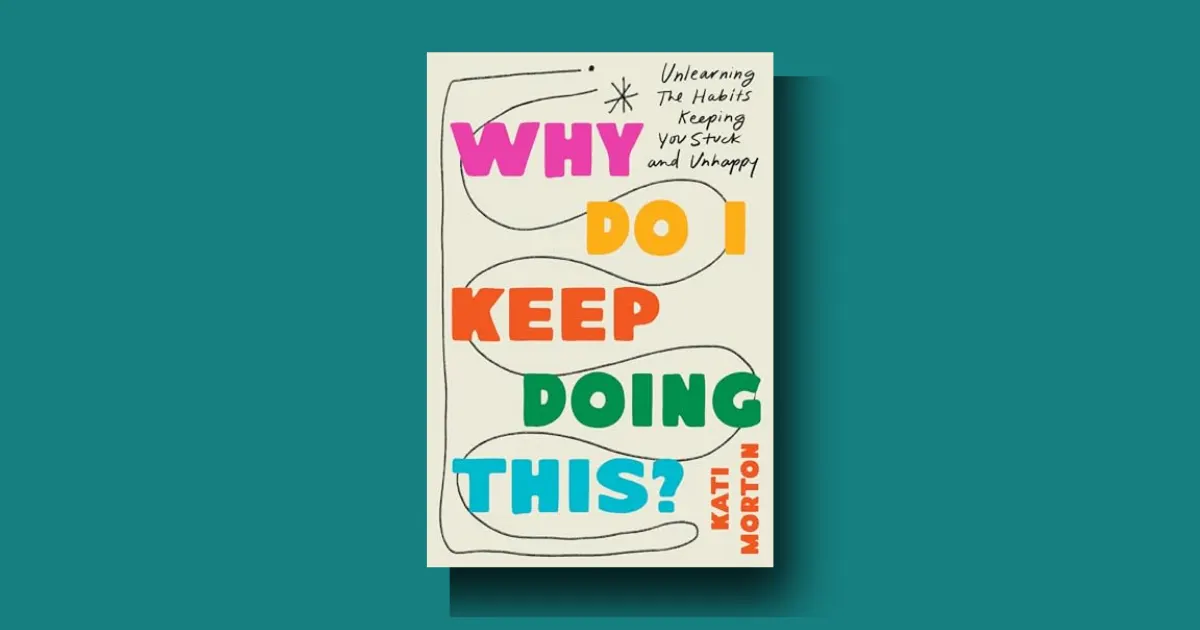
If you’ve ever felt trapped in cycles of perfectionism, people-pleasing, or self-sabotage, asking yourself “Why do I keep doing this?” you’re not alone. Kati Morton’s 2025 book, Why Do I Keep Doing This?: Unlearn the Habits Keeping You Stuck and Unhappy, offers a compassionate, therapist-backed roadmap out of these exhausting patterns.
This article provides a comprehensive deep dive into the book’s core concepts, evidence, and practical tools, analyzing its strengths and its place within the self-help genre.
By synthesizing Morton’s personal stories, client case studies, and psychological frameworks, we aim to give you all the necessary insights so you can understand the book’s transformative potential without needing to search further.
This book tackles the exhausting cycle of self-sabotage where, despite knowing better, we repeat patterns of perfectionism, overwork, and people-pleasing that leave us burned out and unhappy.
It answers the core question: why do we cling to controlling behaviors that ultimately break us?
The central idea is that our urge to control—our emotions, others, and outcomes—is a safety-seeking behavior often rooted in childhood dynamics, and breaking free requires understanding this “blueprint” and practicing compassionate self-awareness instead of self-judgment.
What research or case studies back it.
Morton supports her thesis with a blend of personal narrative, anonymized client stories from her therapy practice, and references to established psychological theories.
For instance, she uses Stephen Porges’s polyvagal theory to explain our biological need for connection (p. 19) and Internal Family Systems (IFS) therapy to illustrate how we exile parts of ourselves we deem “too much” (pp. 60-62).
A poignant case study involves “Ruby,” who tied her self-worth to achievement after only receiving parental attention for successes (p. 17), a clear example of conditioned control.
Furthermore, Morton cites brain scientist Dr. Jill Bolte Taylor’s “90-second rule” (p. 100) to provide a neurological basis for emotional processing, arguing that prolonged emotional suffering is often a choice to re-engage with the triggering thought.
Why Do I Keep Doing This? is best for individuals who are self-reflective, recognize their patterns of anxiety, perfectionism, or people-pleasing, and are ready for a compassionate, clinically-informed guide to unpacking their origins.
It’s ideal for those who appreciate a therapist’s blend of professional knowledge and vulnerable personal sharing, as Morton frequently uses her own struggles with burnout and people-pleasing as primary examples (pp. 12-14).
It is not for readers seeking a quick-fix, step-by-step program or rigid behavioral modifications. Those uncomfortable with exploring childhood influences or who prefer a purely cognitive-behavioral approach without therapeutic narrative might find the introspective depth challenging.
According to a 2023 survey by the American Psychological Association, while 34% of adults sought therapy, a significant portion still prefers actionable worksheets over narrative exploration, a preference this book does not prioritize.
Table of Contents
1. Introduction: Why Do I Keep Doing This? by Kati Morton
Why Do I Keep Doing This? is a self-help psychology book authored by Kati Morton, a licensed marriage and family therapist (LMFT) and popular mental health educator.
Published in December 2025 by Balance, an imprint of Hachette Book Group, the book enters a crowded genre but carves a distinct niche through its intimate, confessional tone.
Morton’s credibility stems not only from her professional credentials but from her willingness to position herself as a fellow struggler, openly sharing her 2023 burnout and therapeutic journey (pp. 12-14).
The book’s central thesis is that our most self-defeating habits—perfectionism, emotional numbing, toxic independence—are misguided attempts at control, developed as coping mechanisms in childhood, and that sustainable change comes from understanding and recalibrating this internal “blueprint” rather than through sheer willpower.
2. Background: The Cultural Context of Control
We live in a society that often conflates self-control with virtue and busyness with worth. A 2024 study published in the Journal of Behavioral Addictions found that “hustle culture” contributes to a 40% increase in reported burnout symptoms among professionals aged 25-44.
Morton’s book directly challenges this ethos, arguing that what looks like discipline is often fear-driven control. Her work aligns with a growing therapeutic trend, noted in publications like The Atlantic, toward exploring childhood emotional neglect and complex PTSD, moving beyond a focus on major trauma to understand how subtler relational patterns shape adult behavior.
Morton taps into this zeitgeist, providing a framework for readers who feel chronically “stuck and unhappy” but cannot pinpoint a single catastrophic cause.
3. Why Do I Keep Doing This? Summary
Highlights Summary of Why Do I Keep Doing This? (Kati Morton)
What the book is really about
- The book treats a wide range of “self-sabotaging” or exhausting patterns (perfectionism, people-pleasing, numbing out, withdrawing, etc.) as different costumes of the same underlying strategy: control—a learned attempt to feel safe, steady, and accepted.
- Morton frames the reader as someone worn out from trying to hold everything together and believing it would finally feel okay “if we just worked harder.”
- She’s explicit that the book is meant to support and empower you, not replace professional mental health treatment.
The core thesis (the “why” behind “why do I keep doing this?”)
Control isn’t your personality—it’s your protection
Across all chapters, the book argues:
- Many behaviors we dislike about ourselves were once adaptive: they reduced anxiety, prevented conflict, helped us earn approval, or kept us emotionally safer in the relationships we had. (The problem is they often become rigid defaults long after the original danger is gone.)
- A lot of control tactics are built on a core belief of “not being enough” (or being too much), and then trying to manage ourselves/others to avoid shame, rejection, or uncertainty.
- The book repeatedly brings you back to a practical stance: no shame, no self-attack—observe the pattern, understand what it protects, then practice small changes (“baby steps” rather than grand reinventions).
A consistent method the book uses
The chapters share a rhythm:
- Name the control strategy (what it looks like day-to-day).
- Trace where it came from (family dynamics, learned roles, fear of rejection, trauma responses, etc.).
- Identify what you get out of it (how it calms anxiety or creates certainty).
- Face the cost (burnout, emptiness, shallow connection, resentment, stuckness).
- Practice a targeted experiment (“Why do I keep doing this?” questions + a weekly “control challenge”).
Chapter 1 : Control and Our Upbringing: how the tone gets set
Main idea: Your earliest relationships teach your nervous system what “safe” looks like. If safety felt unpredictable, conditional, or earned, control becomes a substitute for stability.
What this chapter tries to “give away”:
- Many adult patterns aren’t random—they’re repeats. The book pushes you to spot relationship themes: who you’re drawn to, how things tend to end, what happens when you feel unaccepted.
- Instead of blaming yourself, you treat your behavior like learned wiring: “we took what we saw and learned from it,” and now you can choose differently.
Core exercise focus: structured reflection on parents, patterns, love/attention beliefs.
Chapter 2: Perfectionism and Feeling Like You’re Not Enough: when love has to be earned
Main idea: Perfectionism is control dressed up as “high standards.” It tries to guarantee worth, love, and safety by never giving anyone a reason to criticize or leave.
Key arguments:
- “Perfection” is a trap because it’s not truly reachable, yet it promises relief “once we finally reach it.”
- The chapter connects perfectionism to the belief that love/attention must be earned, and even points out how culture/marketing exploits our sense of deficiency.
What healing looks like here:
- Shift from perfect → good enough, and prove you can tolerate the discomfort of stopping.
- Practice receiving: accepting support, celebrating wins, taking compliments without deflecting.
Chapter 3 : People-Pleasing, Anxiety, and Manipulation: why you can’t calm down until everyone is happy
Main idea: People-pleasing is often anxiety management, not kindness. It tries to control others’ reactions so you can feel safe.
Key arguments & patterns:
- Many people learn early that being “easy,” compliant, apologetic, and agreeable gets rewarded—until it becomes the only mode they know.
- The chapter links intense people-pleasing to survival responses like fawning—self-suppression to reduce conflict, rejection, or abandonment.
- It covers relationship systems where boundaries blur:
- Codependency (your worth tied to being needed; suppressing your needs).
- Enmeshment (Minuchin, 1974): weak boundaries where others’ emotions become yours; sometimes framed as “emotional incest.”
The big “aha” the chapter pushes:
- People-pleasing can function like “managing” someone else so you can calm your own anxiety—Morton includes a therapist’s blunt framing: it’s a form of manipulation aimed at feeling okay.
What healing looks like here:
- Stop trying to control other people’s feelings (you can’t), and return to what you can control: your boundaries, your truth, your choices.
- Learn to tolerate the discomfort of someone being disappointed without sprinting to “fix it.”
Chapter 4: Taking Up Space and Feeling Like Too Much: why we shrink ourselves to gain connection
Main idea: If you learned that your emotions/needs were inconvenient, unsafe, or “too much,” you may control yourself by shrinking—becoming smaller to keep connection.
Core patterns the chapter highlights:
- “Taking up space” can feel dangerous, so you manage it by:
- minimizing needs,
- dampening emotions,
- staying quiet,
- being low-maintenance,
- prioritizing others so no one leaves.
The real cost:
- You may get “approval,” but it’s not real closeness—because closeness requires you to be seen.
What healing looks like here:
- Practice being visible in small, safe ways: naming preferences, saying no, letting needs exist without apologizing for them.
Chapter 5 : Empathy and Being Overly Sensitive: when feeling for others leaves no room for yourself
Main idea: Empathy becomes a control strategy when it turns into self-erasure—you manage your own feelings/needs to maintain harmony and avoid guilt.
Key arguments:
- Morton names “toxic empathy” as what happens when boundaries collapse: you lose the line between where you end and others begin, and start controlling yourself (not them) to keep everyone okay.
- She also describes how some people can exploit empathic traits (your kindness becomes an “entry point” for control).
Highly Sensitive Person (HSP) lens:
- The chapter references Elaine Aron’s HSP framework (introduced in 1997) and the DOES traits (Depth of processing, Overstimulation, Emotional responsiveness, Empathy).
What healing looks like here:
- Re-learn boundaries as self-care that makes real care possible: boundaries aren’t demands you place on others—they’re actions you take to protect healthy space.
- A major growth edge is allowing reciprocity—letting people show up for you and tolerating the vulnerability/guilt of receiving.
Chapter 6 : Numbing Out and Disconnecting: the endless things we do to not feel uncomfortable
Main idea: Numbing is control through disconnection: if feelings are messy or overwhelming, you try not to feel them at all—often through habits that steal attention (phone, scrolling, food, work, etc.).
Key arguments:
- A critical move is to treat numb-out behaviors as clues: if you’re disconnecting, you’re probably feeling something—so you “break in through the back door” by noticing the behavior first.
- The chapter makes the uncomfortable point: feeling your feelings can feel awful, but avoiding them keeps you stuck.
- Morton includes the “ninety-second rule” (Jill Bolte Taylor): the initial chemical surge of an emotion is brief; what lingers is often the loop we keep re-running.
What healing looks like here:
- Build capacity for emotion in safer doses:
- identify the numb-out,
- name the likely emotion,
- let the wave pass somewhere safe,
- use media (music/film/books) to help access emotion when you’re shut down.
Chapter 7 : Anger and Discomfort with Strong Emotions: when we avoid feelings that are out of control
Main idea: Anger is often the “manageable” emotion that shows up when other feelings (fear, hurt, shame, grief) feel too vulnerable or chaotic—so anger becomes control.
What this chapter emphasizes:
- Strong emotions can feel like losing control, so we either avoid them—or we clamp down until anger erupts.
- The goal isn’t to delete anger; it’s to listen for what it’s protecting and develop safer expression.
Chapter 8 : Puffer Fishing and Protecting Ourselves: why we push people away
Main idea: “Puffer fishing” is a defensive control strategy: when closeness feels risky, you inflate—get spiky, distant, critical, unavailable, or self-sufficient—to prevent being hurt.
Key arguments:
- This strategy often looks like “strength” from the outside but acts like armor that blocks intimacy.
- The chapter treats defensiveness as a sign you’re protecting something tender underneath.
Practical change the chapter asks for:
- Notice the pattern in real time and practice a short experiment (a multi-day “defensiveness” challenge) to interrupt automatic pushing-away responses.
Chapter 9 : Fitting In and Feeling Left Out: why belonging is vitally important
Main idea: Belonging is a real human need, but “fitting in” can become control when you shape-shift into what others want so you won’t be rejected.
Key arguments:
- When you chase validation, you can lose your intuition and start living by other people’s rules—creating internal conflict, anxiety, emptiness, and resentment.
- The cruel irony: to avoid rejection, you may reject yourself first—building relationships around a persona.
- Morton contrasts being liked vs belonging, and points out that “fitting in” without authenticity can feel hollow.
What healing looks like here:
- “Build a home within yourself”: clarify values, strengthen self-knowledge, and use that to choose relationships rather than audition for them.
- A weekly challenge: pick one interaction where you usually control yourself, and practice vulnerability—then journal what happened.
Chapter 10 : Depression and Feeling Stuck: when we struggle to find a reason to try
Main idea: When depression (and deep discouragement) is present, control can show up as freezing, quitting, or believing effort is pointless—because trying and failing is too painful.
Key arguments:
- Change isn’t linear; trying harder can paradoxically make you feel more trapped (the “finger trap” metaphor).
- The chapter frames stuckness as shaped by long conditioning and often trauma—not laziness.
What healing looks like here:
- Reduce shame, reduce the size of the next step, and stop interpreting setbacks as proof that you’re broken.
Chapter 11 : Learning to Let Go: making the decision to stop fighting ourselves
Main idea: Letting go is not surrender—it’s a shift from gripping control to tolerating reality, emotion, and uncertainty with more flexibility.
Key arguments:
- The chapter treats “letting go” as a decision you practice, not a one-time epiphany.
- Growth shows up as small repeated returns—loosening the tether “by an inch,” trying again, realigning after setbacks.
The book’s practical “toolbox” (recurring skills you’re meant to practice)
- Internal research questions to uncover your patterns, beliefs about love/attention, and how you react to rejection.
- Good-enough reps: intentionally stop before perfect and sit with the discomfort.
- Boundaries as actions: you protect space by what you do, not by trying to control others.
- Receiving practice: accept care/compliments without immediate repayment; notice guilt and challenge mind-reading.
- Numb-out awareness: treat disconnection habits as signals; name the emotion underneath; allow the wave to pass.
- Connection experiments: practice vulnerability in one small interaction and reflect on what it changes.
4. Why Do I Keep Doing This? Analysis
Morton effectively supports her arguments by weaving consistent threads—the childhood blueprint, the safety-seeking function of control, the need for compassionate curiosity—through every chapter.
The evidence is primarily qualitative, drawn from clinical and personal anecdotes, which makes the concepts relatable but not empirically robust in a academic sense.
Her logical reasoning is sound for the self-help genre, moving from identification of patterns to exploration of origins and finally to practical, if challenging, intervention strategies.
The book undeniably fulfills its purpose of offering a structured, therapeutic lens for understanding self-sabotage, contributing meaningfully to mental health literacy by demystifying therapeutic concepts like fawning, IFS, and polyvagal theory for a general audience.
5. Strengths and Weaknesses
My most pleasant experience was with Morton’s vulnerable authenticity. Her confession of being a “recovering people-pleaser” who struggled to take herself on an artist’s date (p. 50) creates powerful camaraderie.
The integration of diverse therapeutic models (CBT, IFS, Polyvagal Theory) is a major strength, providing multiple entry points for understanding. The “Why Do I Keep Doing This?” exercises at each chapter’s end are actionable and insightful prompts for real self-work.
A less pleasant, though not fatal, weakness is the occasional repetitiveness of the core message, which can make later chapters feel slightly redundant.
Additionally, while the personal and client stories are compelling, the book would benefit from citing more external, large-scale studies to bolster its claims.
For instance, referencing the American Psychological Association’s 2022 Stress in America report, which found that 58% of adults reported wanting to “shut down” due to stress, would have strengthened the chapter on numbing out.
6. Reception and Influence
As a late 2025 release, widespread critical reception is still forming.
However, based on Morton’s established YouTube following of over 1.3 million subscribers and the pre-publication buzz, the book is poised to become a significant title in the popular psychology space.
It is likely to be praised for its accessibility and destigmatization of common struggles, potentially influencing how control is discussed in mainstream mental health conversations. Early reader feedback on platforms like Goodreads highlights appreciation for its non-judgmental tone.
7. Comparison with Similar Works
Compared to Lori Gottlieb’s Maybe You Should Talk to Someone, Morton’s book is less narrative-driven and more directly instructional, though both use therapist self-disclosure effectively.
Unlike Mark Manson’s The Subtle Art of Not Giving a Fck, which uses provocative, broad-strokes philosophy, Morton offers a clinical, nuanced, and internally-focused exploration. It sits closer to Dr. Nicole LePera’s (The Holistic Psychologist*) work in terms of blending therapeutic models for self-healing, but Morton’s voice is distinctly more personal and less prescriptive.
8. Conclusion and Recommendation
Why Do I Keep Doing This? is a valuable, compassionate guide for anyone ready to move beyond surface-level habits and explore the deeper roots of their unhappiness.
It is especially suitable for individuals who feel “stuck” in therapy or self-help, offering a coherent framework to understand their resistance. While not a replacement for therapy, it is an excellent adjunct and a starting point for profound self-reflection.
I recommend it to emotionally curious readers willing to engage in the sometimes-uncomfortable work of looking backward to move forward. Specialists might find it a useful model for client recommendation, particularly for those dealing with anxiety, perfectionism, and relational issues.
