
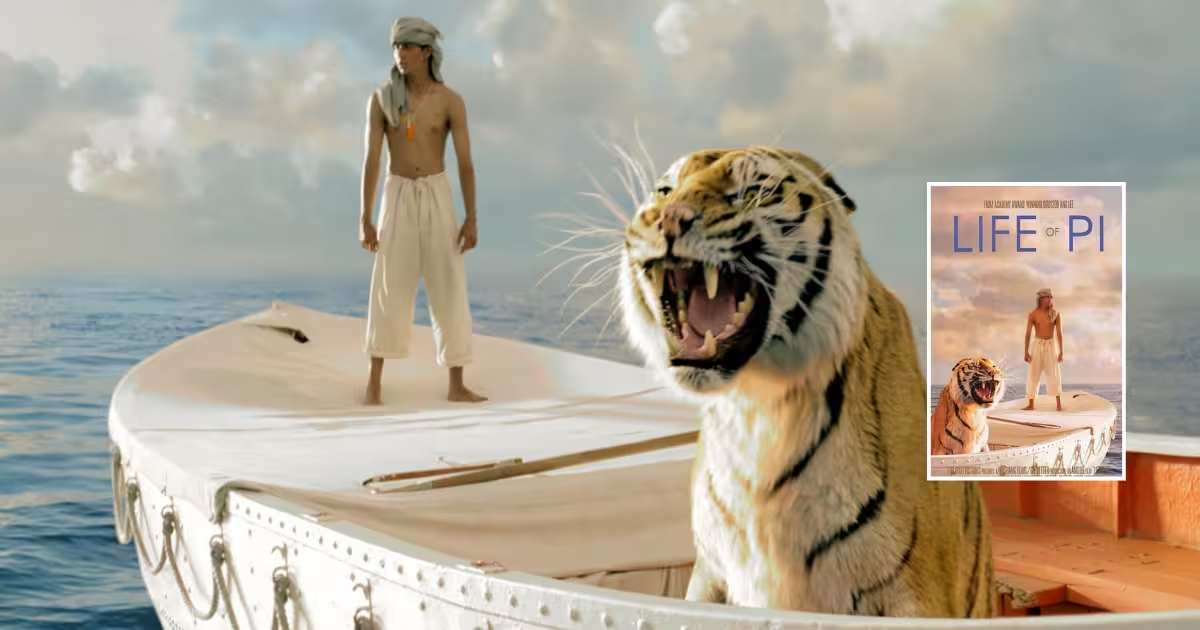
What if the most honest thing a survivor can do is tell you a story that isn’t strictly “true.” Life of Pi (2012) is Ang Lee’s adventure drama, built as a frame tale and shot as a kind of waking dream. It was released in late 2012 and arrived with the reputation of adapting a novel many people considered “unfilmable.”
I’ve also placed it in my own “101 Best Films You Need to See” list on probinism.com, because it’s the rare film that feels both intimate and enormous at the same time. The movie rewards rewatching in a way that surprises me.
I come away from it shaken, soothed, and strangely grateful.
This installment contains full spoilers, including the ending.
The film premiered as the Opening Night selection of the 50th New York Film Festival, and Film at Lincoln Center framed it as a combination of technological innovation and artistic vision. It was also the first time NYFF’s Opening Night film was presented in 3D, which matters because Lee doesn’t treat 3D like a carnival trick but like a way of thickening reality.
The story itself follows Pi Patel, a teenager who survives a shipwreck and ends up sharing a lifeboat with a Bengal tiger named Richard Parker. In other words, the movie openly dares you to believe it.
Financially, it performed like a genuine global event, earning over $609 million worldwide on a reported $120 million budget. And critically it landed strongly, sitting at 86% on Rotten Tomatoes from 253 reviews, with an audience score of 84%.
With that, let me tell you the story the way the film wants you to hear it.
Table of Contents
Background
Background of Life of Pi (2012 Film)
Life of Pi is a 2012 adventure-drama film directed by Oscar-winning filmmaker Ang Lee, based on Yann Martel’s acclaimed 2001 novel of the same name. The story follows Piscine “Pi” Patel, a young Indian boy stranded on a lifeboat in the Pacific Ocean with a Bengal tiger named Richard Parker after a shipwreck.
The film underwent a lengthy development process, with several directors, including M. Night Shyamalan and Alfonso Cuarón, attached before Ang Lee took the helm.
Lee aimed to translate the novel’s spiritual and visual complexity to the screen, pioneering the use of 3D technology to enhance the immersive experience of Pi’s journey.
Shot in India, Taiwan, and Canada, the production relied heavily on groundbreaking visual effects by Rhythm & Hues Studios to create the digital tiger and oceanic environments. Despite a high budget and initial box office uncertainty, Life of Pi became a critical and commercial success, grossing over $600 million worldwide.
It received 11 Academy Award nominations and won four, including Best Director for Ang Lee, Best Cinematography, Best Visual Effects, and Best Original Score.
The film is celebrated for its philosophical depth, visual artistry, and emotional storytelling, though it also faced controversies regarding animal treatment during filming and the bankruptcy of its visual effects studio.
Life of Pi remains a landmark in cinematic storytelling, blending technology, faith, and survival into a visually stunning narrative.
Life of Pi Cast
| Actor | Character | Defining Role in the Film |
|---|---|---|
| Suraj Sharma | Piscine Molitor “Pi” Patel (Teenage Pi) | The spiritual and resilient protagonist whose survival at sea becomes a test of faith, imagination, and endurance. |
| Irrfan Khan | Adult Pi Patel | The reflective narrator who recounts his extraordinary journey, framing the film’s themes of belief and truth. |
| Tabu | Gita Patel | Pi’s compassionate mother whose moral strength and love shape his spiritual foundation before the tragedy. |
| Adil Hussain | Santosh Patel | Pi’s rationalist father whose lessons about reality and survival foreshadow Pi’s ordeal on the ocean. |
| Rafe Spall | The Writer | The listener and recorder of Pi’s story, representing the audience’s struggle between reason and faith. |
| Gérard Depardieu | The Cook | A brutal survivor whose actions embody the darkest instincts of humanity under extreme conditions. |
| Ayush Tandon | Young Pi Patel | The curious child whose early religious exploration establishes the film’s central philosophical conflict. |
Life of Pi Plot
An older Pi Patel sits in Canada and tells a writer that he has a story that will make him believe in God.
The writer listens, and the movie slides into Pi’s childhood in Pondicherry, where his family runs a zoo. Pi grows up surrounded by animals, which teaches him wonder but also forces him to learn what animals are and what they are not.
Pi’s name is Piscine, and schoolmates turn it into a crude joke until he insists on being called “Pi.”
He is earnest in a way that would be unbearable if the film didn’t treat it as real.
He also becomes passionately religious, not in one lane but in several.
He is raised Hindu, then falls for Christianity, and later embraces Islam, collecting the languages of devotion like different ways of breathing. He wants closeness to God more than he wants to win an argument. His openness annoys the adults who treat belief as a border, not a bridge.
At home, Pi’s father tries to anchor the family in reason and practicality.
One of the film’s earliest emotional shocks is a lesson: a tiger is not a metaphor while it is hungry.
Pi watches a tiger kill, and the beauty of the animal doesn’t soften the fact of the violence. The scene isn’t there to be cruel to the audience, but to refuse the lie that nature is polite. It plants a seed that pays off later, because Richard Parker will never become a cuddly companion.
When the family decides to leave India and move to Canada, they sell the zoo and load some animals onto a Japanese freighter.
They set off, and the film gives you a calm-before-the-storm feeling that is almost physical.
Then the storm comes, and it is not a dramatic storm in a comfortable movie way.
The ship is swallowed, and Pi is separated from his family in the chaos. He ends up in a lifeboat, and the ocean becomes an entire universe that has no intention of being kind. The film treats the sea as both gorgeous and indifferent, which is the only honest way to film it.
At first Pi is not alone, because other survivors tumble into the lifeboat.
A zebra appears, injured and terrified, and then an orangutan clings to life with a heartbreaking dignity.
A hyena arrives, and you can feel the movie’s mood shift into something feral.
And then, finally, the tiger, Richard Parker, emerges as the true force that changes everything.
The hyena attacks, and the lifeboat becomes a small stage for a brutal hierarchy.
The zebra is killed. The orangutan is killed. The violence is swift enough to be shocking, but not so stylized that it becomes entertainment.
Pi is left with the tiger, and the film refuses to pretend this is “man and animal become friends” in the easy sense.
Instead, it becomes “man and animal share terror, hunger, and the daily math of survival.”
Pi survives by doing something counterintuitive: he keeps the tiger alive, because the tiger’s presence keeps other threats away and keeps Pi’s own will sharp.
He constructs a small raft so he can keep distance, and he studies the lifeboat like it’s a textbook he must memorize overnight.
He learns to fish, to collect rainwater, and to ration hope so it lasts.
The days stack up into weeks, and weeks into months, until survival becomes a routine with teeth.
Roger Ebert notes that the journey lasts 227 days, and the film makes that number feel heavy rather than impressive.
The ocean is sometimes flat and hypnotic, and sometimes violent, and sometimes strangely magical.
At night, the water can glow, and the sky can feel close enough to touch, and the image is so beautiful it almost hurts.
But beauty doesn’t feed you, and Pi’s body keeps reminding him of that.
Richard Parker is not a symbol first, because first he is a tiger.
Pi “trains” him through dominance rituals, not because Pi wants control for ego, but because control is the thin line between life and being eaten.
Their relationship becomes a tense partnership formed by necessity.
Pi learns patterns, boundaries, and the strange language of coexistence.
You start to understand that the tiger is also a mirror that won’t allow Pi to collapse into self-pity.
In one of the film’s strangest turns, Pi encounters another castaway: a blind Frenchman drifting on the ocean.
The scene feels like a myth dropped into a survival manual, which is exactly how the film likes to work.
The two men talk about food and despair, and the encounter tilts toward threat. Then Richard Parker kills the man, and the moment is both horrifying and, in a cold way, clarifying. After that, the ocean delivers something that looks like salvation: a floating island.
It is lush, green, and filled with meerkats, and it seems like the kind of miracle you beg for when you are exhausted.
By day it feels safe, almost holy.
By night it reveals itself as carnivorous, and Pi realizes this paradise is a trap that slowly consumes whoever stays.
He finds evidence that others have died there, and the island’s sweetness curdles into danger. So Pi chooses the frightening option: to leave. He returns to the lifeboat and the open sea, because at least the open sea is honest about what it is.
Eventually, land appears, and Pi reaches the shore in Mexico, barely alive. He collapses, and he cries, and the relief doesn’t feel triumphant so much as stunned.
Richard Parker steps off the lifeboat and walks into the jungle without looking back.
Pi is devastated by that lack of farewell, because after everything, he wanted one clean human moment of goodbye.
The film understands that survival does not guarantee closure. In the hospital, Pi is interviewed by Japanese representatives from the shipping company. They need a report they can file, and they cannot accept a story that includes a tiger in a lifeboat.
So Pi tells them another version.
In this second story, there are no animals: there is Pi, a sailor, a cook, and Pi’s mother on the lifeboat.
The cook is violent, the sailor is injured, and the descent into cruelty is human and sickening.
The cook kills the sailor, and later kills Pi’s mother, and Pi kills the cook. When Pi finishes, the room goes quiet, because this version has the weight of what trauma often sounds like when it stops dressing itself in metaphor.
Then Pi asks them which story they prefer.
The investigators choose the animal story, because it changes nothing about the facts of loss but changes everything about what a mind can bear.
And Pi, gently but unmistakably, connects that choice to the way faith works: you choose the story that gives meaning, not because you are stupid, but because meaning is sometimes how you stay alive.
That is the ending’s knife: the film doesn’t force you to believe in God, but it forces you to admit you are already choosing stories.
It also makes you wonder whether Richard Parker is a literal tiger, a psychological survival mechanism, or both.
And when you look back, you realize the movie has been preparing you for that question from the beginning, with every moment where beauty and brutality share the same frame.
Life of Pi Analysis
Ang Lee directs Life of Pi like a quiet philosopher who also happens to be a master illusionist.
His vision is confident enough to let silence do real work, especially in the long stretches where survival becomes routine rather than spectacle. The framing story (older Pi speaking to a writer) gives the film a reflective, almost confessional shape. That choice matters because the movie is less interested in “what happened” than in how a human being survives what happened.
Cinematographer Claudio Miranda’s images often feel like paintings that can suddenly turn predatory. The 3D isn’t used as a gimmick so much as a way to deepen immersion—making water, sky, and distance feel physically present.
On the acting side, Suraj Sharma carries an enormous burden with surprising steadiness.
Irrfan Khan, even with limited screen time compared to the sea journey, gives the older Pi a calm gravity that makes the whole story feel lived-in rather than narrated.
David Magee’s script is at its best when it trusts the audience to sit with uncertainty, because that’s where the film’s spiritual tension lives.
The dialogue is generally simple, but it’s designed to echo—especially when belief and evidence start tugging in opposite directions. If there’s a weakness, it’s that some early exposition can feel a touch tidy compared with the rawness of the ocean sections. Still, the pacing earns its patience: the film wants you to feel time passing, not just understand it intellectually.
Mychael Danna’s score blends Western orchestral textures with Indian instruments and is crucial to the film’s emotional temperature. It’s the kind of music that doesn’t tell you what to feel so much as it gives your feelings room to move.
All of that craft would be impressive on its own, but what stays with me is what the film is actually saying.
The film’s biggest theme is the way storytelling becomes a tool of endurance, not a hobby.
It also treats faith less like a doctrine and more like a daily decision made under pressure, when the world refuses to explain itself politely.
The “two stories” ending isn’t a cheap twist; it’s the moral and psychological center of the entire journey. When Pi asks which story is better, the film is quietly asking what kind of truth a wounded person can live with.
There’s also a hard, unsentimental message about nature: beauty and brutality share the same ocean, and neither apologizes. And then there’s loneliness—how isolation can warp you, but also how it can strip you down to something fiercely essential.
Comparison
If you enjoy films where survival turns into spiritual investigation, this sits in the same conversation as Cast Away—but it aims for metaphysical questions rather than everyday realism.
It also rhymes with Ang Lee’s own pattern of pairing intimacy with spectacle, though here the spectacle is inseparable from the inner life.
What sets Life of Pi apart from many survival-adventure films is that it refuses to end with a neat emotional bow. Cast Away gives you the ache of return; Life of Pi gives you the ache of interpretation. And compared with more straightforward “man versus nature” stories, the film’s willingness to live inside ambiguity is its signature strength.
The trade-off is that viewers who want clean answers—or who dislike allegory—may feel teased rather than satisfied. For me, that discomfort is the point, because the film’s question (“Which story do you choose?”) keeps working long after the credits.
Audience appeal and reception
This is a strong pick for cinephiles, literature lovers, and anyone drawn to philosophical adventure, and it’s also accessible enough for patient casual viewers who don’t mind a reflective pace.
Critically and publicly it landed well—Rotten Tomatoes lists an 86% critic score and an 84% audience score—and it was a major global box-office success.
Awards
At the 85th Academy Awards, Life of Pi won Best Directing (Ang Lee), Best Cinematography (Claudio Miranda), Best Original Score (Mychael Danna), and Best Visual Effects, and it’s prominently listed among the ceremony’s highlights and winners.
Personal insight and lessons
Every time I return to Life of Pi (2012), I notice that the film is less about a tiger than about what a mind does to stay alive.
In real life, pain often isn’t just the event, but the collision between what happened and what we believed “should” happen. Research on meaning-making after trauma describes distress as rising when the meaning we assign to an event clashes with our wider belief system.
That’s basically Pi’s dilemma in cinematic form: he can tell the facts, or he can tell the story that lets him keep living.
The film also reminds me that narrating an ordeal is not indulgence, it’s structure. The American Psychological Association describes narrative-based trauma treatments in which people shape their life story rather than letting trauma swallow it whole.
Richard Parker, for me, is the border between “I can’t” and “I must.”
And if you’ve ever felt guilty for coping “too well,” it helps to know resilience is often the most common outcome after terrible events.
A meta-analysis discussed by the Association for Psychological Science reports that 65% of people showed a resilience trajectory with few or no lasting psychopathology symptoms after potentially traumatic events.
So the film’s insistence on endurance doesn’t feel like fantasy to me, it feels like a hard-earned human pattern. At the same time, I’m wary of the modern habit of calling every discomfort “trauma,” because it can flatten language and trap people inside an identity they’re trying to outgrow.
Pi’s “better story” isn’t an excuse to deny harm; it’s a way to carry harm without letting it rule the entire self. That’s the ethical test I take from the ending: choose meaning, but choose it in a way that keeps you responsible.
One line that stays with me is the idea that “it’s important in life to conclude things properly,” because closure is not a luxury when you’re rebuilding a shattered inner world.
That’s why, today, I read Life of Pi (2012) as a guide to meaning without self-deception.
Life of Pi Quotes
- “Which is the better story…?” / “The story with animals.” / “Thank you. And so it goes with God.” — from my Life of Pi “better story” deep dive on probinism.com (novel-focused, but it matches the film’s final moral pivot).
- “It’s important in life to conclude things properly. Only then can you let go.” — as quoted in my probinism.com deep dive (this line is widely associated with the story’s closing philosophy). (
Pros and Cons
Pros:
- Stunning visuals and immersive 3D atmosphere that makes sea and sky feel physical.
- Gripping central performance from Suraj Sharma, with a calm, anchoring presence from Irrfan Khan.
Cons:
- Slow pacing in parts, especially if you prefer plot-forward survival thrillers over reflective cinema.
- The ending’s ambiguity can frustrate viewers who want a single, “official” explanation.
Conclusion
In the end, Life of Pi (2012) feels like a survival film that quietly turns into an argument for wonder.
I recommend it most to viewers who like philosophical adventure, spiritual questions, and visual storytelling that trusts your patience.
If you want a simple, literal survival narrative with no metaphorical aftertaste, you may admire it more than you love it. If you’re open to ambiguity, it can land like a private conversation you didn’t know you needed.
It also matters to me that it’s already on my “101 must-watch films” list on probinism.com, where it appears as #93 (2012).
Rating: 4.5/5.
