
What does it take for a fantasy trilogy to feel as emotionally real as history?
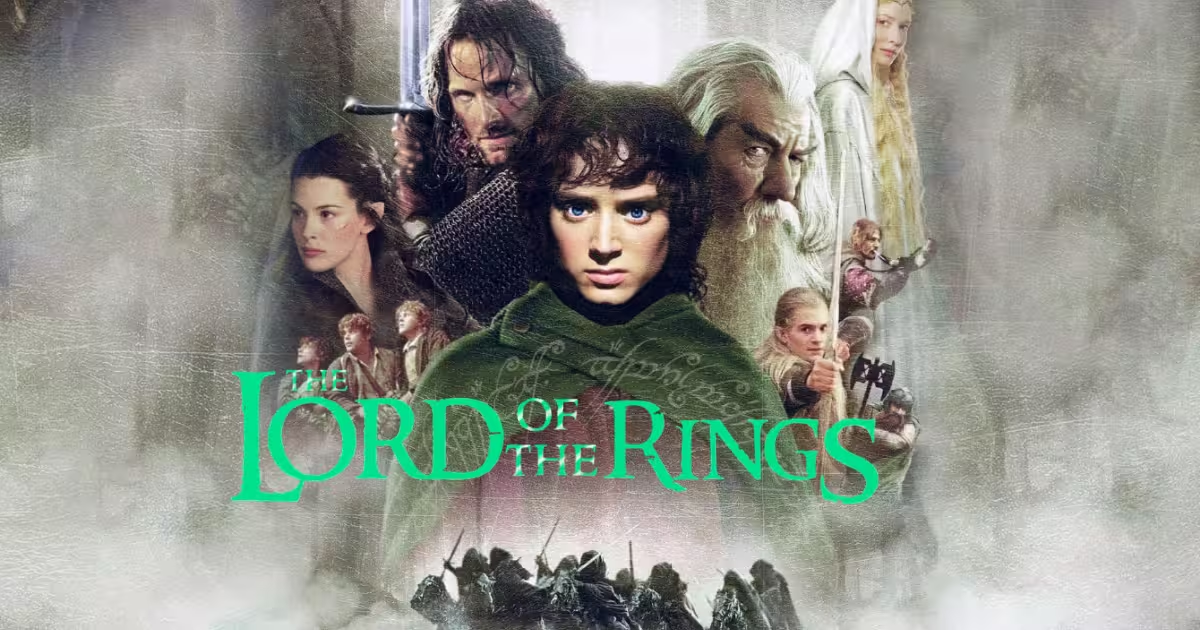
Peter Jackson’s The Lord of the Rings trilogy—The Fellowship of the Ring (2001), The Two Towers (2002), and The Return of the King (2003)—is epic high-fantasy adventure at a scale modern cinema still struggles to match.
I’ve revisited these films enough times to notice a strange effect: the more I watch, the less they feel like “escapism” and the more they feel like a hard lesson about power, friendship, and moral fatigue. I also consider the trilogy one of the 101 must-watch films featured on my list.
Table of Contents
Background
Adapted from J. R. R. Tolkien’s novel, the story follows Frodo Baggins and the Fellowship’s fractured mission to destroy the One Ring and resist Sauron’s domination. The films are set in Middle-earth and built around an ensemble cast—Elijah Wood, Ian McKellen, Viggo Mortensen, Sean Astin, and many others—who carry the myth with unusually human vulnerability.
All three films were shot concurrently in New Zealand, a production gamble that still feels slightly insane in the best way.
The result was a trilogy made for a combined budget reported at $281 million and a worldwide box office total of $2,963,938,509—numbers that hint at cultural impact, not just commercial success.
The Lord of the Rings Cast
| Cast (Actor as Character) | Why they matter (quick AEO description) |
|---|---|
| Elijah Wood as Frodo Baggins | The young hobbit who inherits the One Ring and becomes the trilogy’s central ring-bearer. |
| Sean Astin as Samwise Gamgee | Frodo’s loyal hobbit companion—his steadiness and devotion keep the quest moving when Frodo can’t. |
| Ian McKellen as Gandalf (Grey/White) | The wizard-mentor who guides the Free Peoples and later acts as a key leader in the war, including at Gondor. |
| Viggo Mortensen as Aragorn | The ranger and heir who must finally embrace his destiny as King of Gondor, uniting allies against Sauron. |
| Andy Serkis as Sméagol / Gollum | The treacherous former ring-bearer who guides Frodo and Sam into Mordor while obsessively seeking the Ring. |
| Orlando Bloom as Legolas | The elven prince and elite archer—one of Aragorn’s most reliable fighters and scouts across the warfronts. |
| John Rhys-Davies as Gimli | The dwarf warrior whose loyalty (and rivalry-friendship with Legolas) anchors the Fellowship’s battleline. |
| Billy Boyd as Peregrin “Pippin” Took | The hobbit whose risky choices (including the palantír) pull him into Gondor’s fate as an esquire. |
| Dominic Monaghan as Meriadoc “Merry” Brandybuck | Frodo’s cousin who becomes an esquire of Rohan, tying the hobbits directly into the Rohirrim’s war effort. |
| Liv Tyler as Arwen | Elrond’s daughter and Aragorn’s true love—she gives up her immortal life to be with him. |
| Christopher Lee as Saruman the White | The wizard who wages war on Rohan and devastates Fangorn Forest after aligning with Sauron. |
| Bernard Hill as Théoden | The King of Rohan who leads his people into decisive battles, including the march toward the Pelennor Fields. |
| Miranda Otto as Éowyn | Théoden’s niece determined to prove herself in battle—one of the trilogy’s defining human heroes on the battlefield. |
| John Noble as Denethor | The Steward of Gondor whose despair and madness during the siege destabilize Gondor from within. |
The Lord of the Rings Plot
The Fellowship of the Ring (2001) Plot
In Middle-earth, a seemingly ordinary ring turns out to be the One Ring tied to Sauron’s return, and the hobbit Frodo Baggins is tasked with carrying it toward Mount Doom—where alone it can be destroyed. He sets out with eight companions—the Fellowship—crossing lands that feel increasingly hostile as the Ring’s corrupting pull tests loyalty and judgment.
Ending:
Near Parth Galen, Boromir tries to take the Ring from Frodo, proving the danger isn’t only Sauron—it’s what the Ring does to good people under pressure. Then Uruk-hai attack; Boromir is mortally wounded defending Merry and Pippin, and Aragorn arrives too late to save him but promises to help Gondor.
The key ending decision is Frodo’s: fearing the Ring will corrupt the entire group, he chooses to break away and go toward Mordor alone, but Sam refuses to let him walk into doom without companionship.
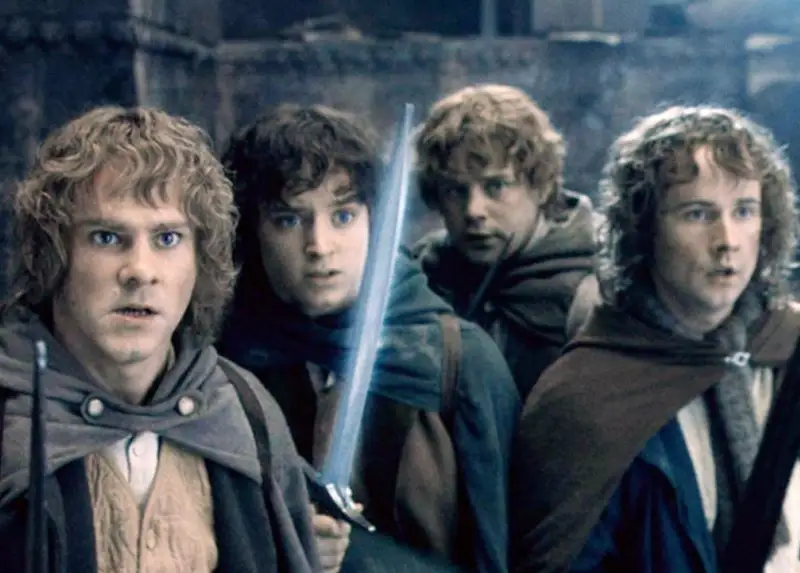
The Fellowship effectively splinters into three urgent missions—Frodo/Sam toward Mordor, Aragorn/Legolas/Gimli pursuing the captured hobbits, and Merry/Pippin dragged into a new storyline—setting the trilogy’s multi-front structure for the rest of the saga.
The Two Towers (2002) Plot
The story runs on three parallel tracks: Frodo and Sam push toward Mordor with the unstable guidance of Gollum; Merry and Pippin escape and become entangled with the Ents; and Aragorn, Legolas, and Gimli reach Rohan, where war is brewing and Théoden must be freed from Saruman’s influence.
The film’s emotional spine is survival—keeping hope alive long enough for the “small” mission (destroying the Ring) to matter.
Ending:
On the war front, the defenders at Helm’s Deep survive the night and are saved at dawn when Gandalf returns with reinforcements, flipping certain defeat into a hard-earned victory.
Meanwhile, the Ents storm Isengard and trap Saruman in his tower—an enormous strategic win, but not the end of the larger war.
On Frodo’s path, the ending is deliberately uneasy: after being captured by Faramir and released, Gollum feels betrayed and decides to reclaim the Ring by leading Frodo and Sam to “her” near Cirith Ungol—setting up the next film’s darkest stretch.
This is why The Two Towers ends like a tightening noose: the heroes win major battles, but the Ring-bearer is walking straight toward a trap.
The Return of the King (2003) Plot
The final film converges everything: Gondor faces annihilation, Aragorn must step into kingship, and Frodo/Sam reach the final approach to Mount Doom as the Ring’s psychological weight becomes almost unbearable.
The war strategy becomes a sacrifice play—drawing Sauron’s attention away from the Ring-bearer long enough to give the quest a chance.
Ending:
At Mount Doom, the trilogy refuses a neat “pure hero” ending: Frodo reaches the Cracks of Doom but succumbs to the Ring and claims it, showing the Ring’s power isn’t just temptation—it’s domination.
The Ring is destroyed not by Frodo’s willpower, but through the violent, tragic collision between Frodo and Gollum—Gollum bites off Frodo’s finger, then falls into the lava with the Ring, which collapses Mordor and ends Sauron’s power.
After rescue and reunion, Aragorn is crowned and marries Arwen, delivering the political “restoration” ending that balances the Ring’s destruction.
But the most human ending comes last: Frodo, wounded in body and mind, cannot fully return to normal life; he leaves Middle-earth for the Undying Lands with Bilbo and Gandalf, passing the “Red Book” to Sam—who goes home to family, carrying forward the quieter victory of healing.
Analysis
Jackson’s directing philosophy matters here because he didn’t treat Tolkien like lightweight fantasy—he treated it like a war chronicle with magic in its bloodstream.
1. Direction and Cinematography
He explicitly pushed for the “historical authority” of Braveheart rather than “meaningless fantasy,” and you can feel that ambition in the mud, metal, weather, and weary faces.
In cinematography terms, Andrew Lesnie and Jackson chose fine-grain Super 35mm with rigorous digital grading, which helps explain why the trilogy still looks tactile instead of plasticky. Just as importantly, Weta Digital developed new tools (including MASSIVE for intelligent battle crowds) and advanced motion capture for creatures like Gollum, and those technical leaps are fused to storytelling rather than used as decoration.
Filming ran from October 1999 to December 2000 with pick-up shoots continuing into the release years, and that long, iterative process shows in how carefully the emotional beats land. If you want the simplest summary of the trilogy’s visual achievement, it’s this: Middle-earth doesn’t “look cool”—it looks lived-in.
2. Acting Performances
Even with armies, monsters, and mythology, the performances keep dragging the story back to the intimacy of fear, temptation, and loyalty—especially in the Frodo–Sam relationship and the quiet authority Ian McKellen brings to Gandalf.
And because the cast chemistry feels earned rather than engineered, the trilogy stays accessible to casual viewers while still rewarding obsessive rewatchers who love craft.
Themes and Messages
The Lord of the Rings trilogy is, at heart, a story about how power deforms the soul long before it “wins” anything.
The One Ring works like a moral microscope, enlarging tiny weaknesses until they become identity. In that sense, the films don’t just pit “good vs evil”; they stage a constant argument inside ordinary people about fear, pride, sacrifice, and mercy.
Even the trilogy’s relationship with Tolkien becomes part of the conversation, because its faithfulness to the books has been debated almost as intensely as its greatness has been praised.
What lands emotionally is the idea that doing the right thing is rarely heroic in a clean, triumphant way. The trilogy keeps returning to a quieter truth: courage is often just endurance with a conscience attached.
Comparison
As a modern blockbuster template, its shadow stretches over the franchise era in a way critics still openly point to. (theringer.com)
Compared with many fantasy peers, what sets it apart is the patience to let grief, awe, and friendship breathe at full scale, but the trade-off is that the long runtimes can feel demanding if you’re not in the mood for an epic.
Audience Appeal, Reception, Awards
If you want the simplest answer to “Is the Lord of the Rings trilogy worth watching,” it’s yes, as long as you’re open to a big, emotionally sincere fantasy journey rather than rapid-fire modern pacing.
For broad appeal, it helps that audiences and critics largely agree it’s excellent: Rotten Tomatoes lists 92% / 95% / 94%, Metacritic lists 92 / 87 / 94, and CinemaScore shows A− / A / A+ across the three films. It’s friendly to both casual viewers and cinephiles because it works on two tracks at once: surface spectacle and careful craft.
And when the battles get intense, it’s useful to know the tone is firmly “PG-13 epic,” for example Rotten Tomatoes labels The Return of the King as PG-13 with “intense epic battle sequences.”
Finally, the numbers underline its reach: the trilogy grossed over $2.9 billion worldwide.
Awards-wise, the trilogy’s achievement is not just “lots of nominations,” it’s historic: across the three films it earned 30 Academy Award nominations and won 17, and The Return of the King won every category it was nominated for. Oscars.org also highlights that The Return of the King was nominated for 11 and won all 11.
For internal linking on probinism.com, I’d point readers to your 101 must-watch films list and also your existing Lord of the Rings guide as a deeper companion piece.
Personal Insight and Lessons
The older I get, the more the trilogy feels less like fantasy and more like a manual for living with temptation in a world that rewards shortcuts.
When I watch Frodo carry the Ring, I don’t just think of “evil”; I think of addiction, obsession, and the modern habit of letting one object, one status symbol, one ideology, or one algorithmic feed slowly occupy the center of the mind until everything else becomes a footnote.
The lesson that sticks is uncomfortable but oddly freeing: you can be sincerely good and still not be strong enough to “white-knuckle” your way through certain burdens, and that doesn’t make you worthless, it makes you human.
Then there is Sam, and I say this without irony: he might be one of cinema’s clearest portraits of love as practice rather than poetry. His loyalty isn’t a slogan, it’s a repeated decision to show up, especially when the other person is at their least lovable.
“You bow to no one.”
“I can’t carry it for you, but I can carry you.”
If I had to sum up the trilogy’s practical relevance today, it’s that it argues for community as the antidote to corruption, and it treats mercy as a strategic moral act rather than a soft feeling, which is why the story still speaks to exhausted people trying to stay decent.
Pros and cons
Pros:
- Stunning visuals
- Gripping performances
Cons:
- Slow pacing in parts
Reconmendation
My recommendation is simple: a must-watch for anyone who wants epic fantasy films with real emotional weight, and a smart pick for families with older kids who can handle intensity and long runtimes.
And if you’re the kind of viewer who thinks fantasy can’t be “serious cinema,” this trilogy is one of the cleanest rebuttals ever filmed, backed by rare audience-and-critic alignment and truly historic awards recognition. ([oscars.org][3])
I come away feeling that the trilogy’s real magic isn’t the spectacle, it’s the way it makes moral courage look ordinary enough to attempt.
My rating: 5/5.
The Lord of the Rings Trilogy (2001–2003): Key Facts
Key facts at a glance
What is it? A trilogy of epic fantasy adventure films adapting J.R.R. Tolkien’s The Lord of the Rings, directed by Peter Jackson.
Quick table: theatrical cuts
| Film | Release year | Theatrical runtime | Budget | Worldwide box office |
|---|---|---|---|---|
| The Fellowship of the Ring | 2001 | 2h 58m | $93M | $887.8M |
| The Two Towers | 2002 | 2h 59m | $94M | $925.3M |
| The Return of the King | 2003 | 3h 21m | $94M | $1.147B |
Extended editions
- The trilogy is widely known for “extended edition” cuts. The trilogy table in your PDF lists 208 min, 223 min, and 252 min (extended) for films 1–3.
- UK BBFC classification records list Return of the King (Extended Edition) at 252m 18s, and a theatrical cinema length at 200m 54s (lengths can vary by version/credits).
Awards snapshot (Oscars)
- The Return of the King won Best Picture at the 76th Academy Awards (2004) on Oscars.org.
- A New Zealand government history page states Return of the King “won all 11 Oscars it was nominated for.”
Q&A
What’s the correct watch order?
Release order: Fellowship (2001) → Two Towers (2002) → Return of the King (2003).
Do I need to watch all three?
To understand the full story arc (the Ring quest + the war for Middle-earth), yes—the narrative is continuous across all three films.
Is this a spoiler plot page?
Yes—scroll down for a full, ending-included plot summary.
Spoiler-free setup:
A hobbit, Frodo Baggins, inherits the One Ring—a weapon of power tied to the Dark Lord Sauron—and joins a fellowship tasked with destroying it, while allies across Middle-earth fight a widening war.
Full spoiler plot (entire trilogy)
The Fellowship of the Ring
- Frodo learns the Ring must be destroyed and leaves the Shire with Sam, later joined by Merry and Pippin; Aragorn guides them as Ringwraiths hunt them.
- In Rivendell, a “Fellowship” forms to take the Ring to Mordor; the group attempts to cross mountains, then enters Moria where they face Orcs and a Balrog, and Gandalf falls.
- The Fellowship fractures under pressure and betrayal; Boromir dies defending the hobbits, Frodo chooses to continue toward Mordor with Sam, while Merry and Pippin are captured.
The Two Towers
- Frodo and Sam meet Gollum, who promises to guide them; meanwhile, Aragorn/Legolas/Gimli pursue the kidnapped hobbits, and the war against Saruman intensifies.
- Merry and Pippin escape and persuade Ents to attack Isengard; the Rohirrim defend Helm’s Deep against Saruman’s forces until reinforcements arrive.
- Frodo and Sam are drawn toward Cirith Ungol as Gollum’s deception deepens.
The Return of the King
- Sauron’s assault on Gondor culminates at Minas Tirith; Aragorn claims his path toward kingship while allies rally for a final stand.
- Frodo and Sam reach Mount Doom; Frodo claims the Ring, but Gollum bites it from him and falls into the fire with it, destroying the Ring and collapsing Sauron’s power.
- The war ends, Aragorn is crowned, and Frodo ultimately departs Middle-earth with the elves.
Review
What the trilogy does exceptionally well
- Clear emotional engine: even with huge battles and lore, the story keeps snapping back to friendship, temptation, fear, and perseverance—especially through Frodo/Sam and the broken-yet-determined Fellowship dynamic.
- Escalation that feels earned: each film broadens the scope—quest → widening war → apocalypse-level stakes—without losing the “small characters vs massive history” feeling.
What new viewers sometimes struggle with
- Names/factions density: early on, there are many locations and titles. If you’re worried about that, watching in release order (not “chronological lore order”) is the smoothest ramp.
- Length: even theatrical cuts run from ~3 hours to 3h21m.
FAQ snippet answers
Does Frodo destroy the Ring?
Yes—by the end, the Ring is destroyed in Mount Doom after Gollum takes it and falls into the fire.
Do Aragorn and Arwen end up together?
The films resolve Aragorn’s kingship and conclusion-era relationships, but the detailed romantic beats aren’t fully captured in the trilogy plot summary chunk I have; I can’t verify specifics from your provided PDFs alone. (If you want, upload a source that includes the “Plot”/“Ending” section for that arc and I’ll cite it precisely.)
Which film won Best Picture?
The Return of the King won Best Picture at the 76th Academy Awards.
The Lord of the Rings Cast F&Q
Who plays Frodo in The Lord of the Rings?
Elijah Wood plays Frodo Baggins.
Who plays Sam in The Lord of the Rings?
Sean Astin plays Samwise Gamgee.
Who plays Gandalf in The Lord of the Rings?
Ian McKellen plays Gandalf.
Who plays Aragorn in The Lord of the Rings?
Viggo Mortensen plays Aragorn.
Who plays Legolas in The Lord of the Rings?
Orlando Bloom plays Legolas.
Who plays Gimli in The Lord of the Rings?
John Rhys-Davies plays Gimli.
Who plays Gollum in The Lord of the Rings?
Andy Serkis plays Gollum / Sméagol.
Who plays Saruman in The Lord of the Rings?
Christopher Lee plays Saruman.
Who plays Sauron in The Lord of the Rings?
Sala Baker portrays Sauron physically, and Alan Howard provides Sauron’s voice.
Who plays the Witch-king of Angmar in The Lord of the Rings?
The Witch-king of Angmar is portrayed by Brent McIntyre (in Fellowship of the Ring) and Lawrence Makoare (in Return of the King).
Who plays Éowyn in The Lord of the Rings?
Miranda Otto plays Éowyn.
Who plays Théoden in The Lord of the Rings?
Bernard Hill plays Théoden.
Who plays Elrond in The Lord of the Rings?
Hugo Weaving plays Elrond.
Who plays Galadriel in The Lord of the Rings?
Cate Blanchett plays Galadriel.
Who plays Boromir in The Lord of the Rings?
Sean Bean plays Boromir.
Who plays Faramir in The Lord of the Rings?
David Wenham plays Faramir.
Who plays Pippin in The Lord of the Rings?
Billy Boyd plays Peregrin “Pippin” Took.
Who plays Merry in The Lord of the Rings?
Dominic Monaghan plays Meriadoc “Merry” Brandybuck.
Who plays Gríma Wormtongue in The Lord of the Rings?
Brad Dourif plays Gríma Wormtongue.
Who plays the Mouth of Sauron in The Lord of the Rings?
Bruce Spence plays the Mouth of Sauron.
