
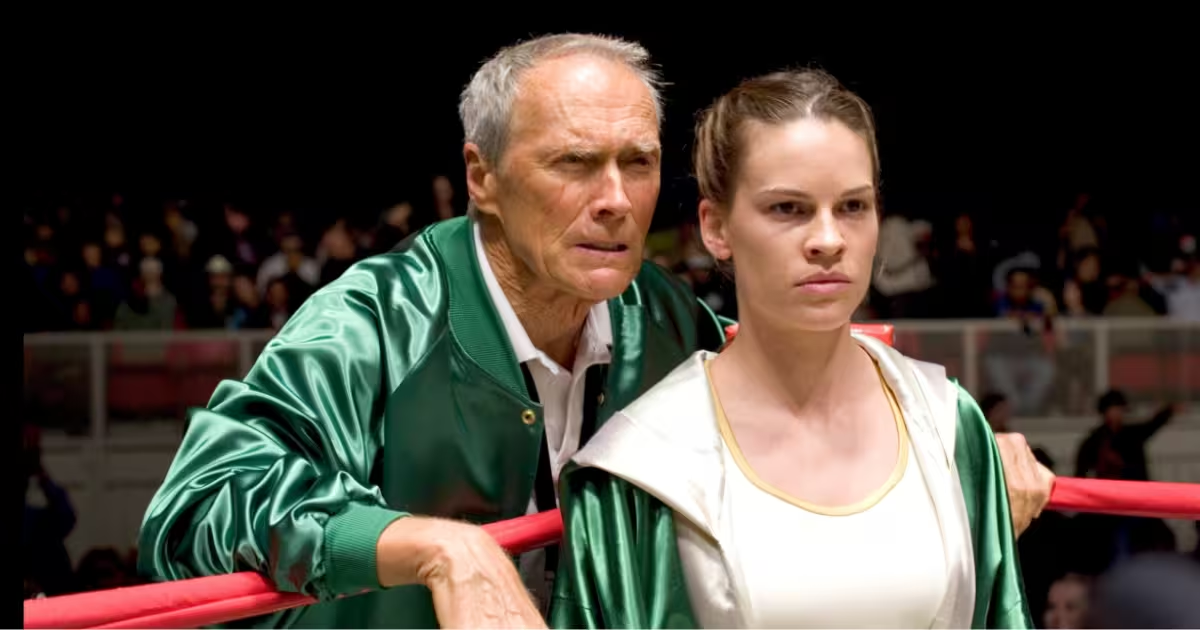
Have you ever watched a film that feels like it’s training you to hope—only to test what you’ll do with that hope when it breaks? Million Dollar Baby (2004), directed by Clint Eastwood, is a sports drama that looks like a boxing story until it quietly becomes something harsher and more intimate, and it went on to win major Oscars including Best Picture and Best Director.
I also count it among the 101 must-watch films on my own list.
So, if you came for an uplifting underdog movie, consider this your honest warning.
Table of Contents
Background
Million Dollar Baby is adapted from stories in Rope Burns: Stories from the Corner, written under the pen name F.X. Toole, and it was adapted for the screen by Paul Haggis.
It premiered in New York City in December 2004 and received a theatrical release later that month, and it became a commercial success against a reported 30 million dollar budget with worldwide box office around 216.8 million dollars.
Some of the film’s afterlife has been as debated as its storytelling.
According to Encyclopaedia Britannica, writers and disability-rights advocates argued over whether the story’s ending frames disability as a fate worse than death, while Million Dollar Baby’s popularity remained strong.
That tension matters, because it changes how you hear every “inspirational” beat that comes earlier.
Million Dollar Baby (2004) Key facts
- Title: Million Dollar Baby
- Release year: 2004
- Genre: American sports drama
- Director: Clint Eastwood
- Screenplay: Paul Haggis
- Based on: Rope Burns: Stories from the Corner by F.X. Toole
- Starring (top billed): Clint Eastwood, Hilary Swank, Morgan Freeman
- Runtime: 132 minutes
- Budget / Worldwide gross: $30M / $216.8M
- Release dates: Dec 5, 2004 (NYC premiere); Jan 21, 2005 (U.S.)
- Major Oscars: Won Best Picture (and also Best Director, Best Actress, Best Supporting Actor)
Million Dollar Baby cast
| Actor as Character | Description (why they matter) |
|---|---|
| Clint Eastwood as Frankie Dunn | The gruff, old-school trainer whose reluctance—and eventual commitment—to Maggie turns into a surrogate father bond that drives the film’s hardest moral choices. |
| Hilary Swank as Margaret “Maggie” Fitzgerald | The underdog boxer who pushes past rejection to chase her dream, then becomes the emotional center of the story when tragedy reshapes what “winning” means. |
| Morgan Freeman as Eddie “Scrap-Iron” Dupris | Frankie’s closest friend and gym mainstay—the steady witness who believes in Maggie early, and the conscience-like presence holding the story together. |
| Lucia Rijker as Billie “The Blue Bear” Osterman | The champion opponent whose dirty tactics trigger the film’s turning point, flipping a sports climb into a devastating life-or-death aftermath. |
| Brían F. O’Byrne as Father Horvak | Frankie’s priest and moral counterweight—presses the spiritual/ethical tension at the heart of the ending. |
| Margo Martindale as Earline Fitzgerald | Maggie’s selfish mother—embodies the exploitation Maggie is trying to escape, and sharpens why Frankie/Scrap become her real family. |
| Mike Colter as Willie “Big Willie” Little | Frankie’s longtime prospect whose career impatience indirectly opens the door for Maggie to become Frankie’s primary fighter. |
| Anthony Mackie as Shawrelle Berry | A hungry gym fighter who highlights the rough ecosystem around Frankie’s gym and the constant pressure of ambition, ego, and survival. |
| Jay Baruchel as “Danger” Barch | A would-be boxer used to show the gym’s “day-to-day” reality—where people cling to the dream even when talent and opportunity don’t match. |
Million Dollar Baby Plot
Maggie Fitzgerald walks into the Hit Pit gym like someone who has already been told “no” so many times that “no” has stopped sounding final.
She is a waitress from the Ozarks who wants to box, and Frankie Dunn is the gruff trainer who refuses her because he does not train women and he thinks she is too old. Scrap, the gym’s steady presence and Frankie’s closest friend, lets her train anyway, which is the first small crack in Frankie’s hard shell.
Frankie’s best prospect, Big Willie, grows tired of Frankie rejecting title opportunities and signs with another manager. That professional betrayal leaves a silence in the gym that Maggie quietly fills with work.
Frankie does not suddenly become kind.
He becomes careful.
He finally starts coaching her, and the film makes you feel the romance of discipline before it shows you the cost of needing someone else to believe in you.
At first, the victories come quickly, and that speed is part of the fantasy.
With Frankie’s training, Maggie rises through women’s boxing, and her reputation for quick knockouts becomes a practical problem because opponents stop wanting to face her. Frankie bribes managers to get her fights, which is the film admitting that pure merit is rarely enough in any industry, even when the work is honest. Scrap, always watching the human cost of Frankie’s stubbornness, tries to steer Maggie toward other opportunities, but she stays loyal.
Loyalty, here, is not a slogan.
It is Maggie’s way of choosing a family.
Frankie gives her a robe with “Mo Cuishle” stitched on it, but he does not tell her what it means, and that tiny secret becomes a loaded emotional promise later.
They travel to Europe while she keeps winning, and the film treats those sequences like the bright middle chapter in a biography you assume will keep climbing.
Maggie saves enough money to buy her mother a house, and she seems briefly proud in a way that has nothing to do with punching.
Then her family arrives on screen and the mood curdles.
Her mother and sister respond with disdain, and Maggie is told, in effect, that her success embarrasses the very people she is trying to lift. In the Wikipedia summary, her mother’s cruelty includes fear about welfare checks, which turns Maggie’s generosity into something she is punished for. Frankie takes her away from that house, and it feels like he is rescuing her, but it also feels like he is sealing their partnership into an “us against the world” pact.
At this point, the movie has done something sly: it has trained you to cheer for Frankie as a damaged mentor and for Maggie as the student who earns love through effort.
It has also trained you to accept pain as proof of worth.
That is why the turn, when it comes, hits like a betrayal of the viewer’s own expectations.
Frankie finally agrees to arrange a title fight, and it is framed as the reward for all those scenes of grinding repetition.
The fight is in Las Vegas, a one million dollar match against Billie “The Blue Bear” Osterman, who is known for dirty tactics.
Maggie starts to dominate, and the film gives you just enough time to believe you are heading toward the clean catharsis of a championship win.
Then the film commits to its darkest choice.
After the bell, Billie hits Maggie from behind with an illegal blow, and Maggie falls and lands on the corner stool in a way that breaks the story’s spine—literally and structurally.
She becomes a ventilator-dependent quadriplegic, and the earlier training montages suddenly look like a cruel rehearsal for a life where her body will not obey her will.
Frankie spirals through grief, prayer, and anger, and the film is blunt about how useless “fairness” feels when fate decides to be random.
Scrap tells him not to blame himself, but Frankie cannot stop treating the injury like a moral punishment for letting himself care.
If the film ended with tragedy alone, it would still be brutal, but it would also be simpler.
Instead, it keeps going into moral territory where the audience cannot just cry and leave.
Maggie waits for family support, and when they arrive, they are more interested in her assets than her spirit, which is its own kind of violence.
She orders them out and threatens to report welfare fraud if they contact her again, and it is one of the few moments where she reclaims control with language because her body cannot give it to her.
Then the suffering becomes medical and relentless, not heroic.
She develops bedsores, her leg becomes infected, and an amputation follows, and the film is determined to show decline without the comforting edits most dramas use to protect viewers.
Now comes the heart of the controversy: Maggie asks Frankie to help her die.
According to Britannica’s plot summary, Maggie’s request hardens after her condition worsens and she attempts to bleed to death by biting her tongue, which forces Frankie to confront whether refusing her is compassion or cowardice.
The film also places Frankie’s Catholic faith into the argument, including a priest warning that he will not find himself again if he does it.
In the end, Frankie returns at night, tells Maggie what “Mo Cuishle” means—“my darling, my blood”—and he administers a fatal injection, then disappears from the boxing world.
Scrap’s narration reframes everything as a letter to Frankie’s estranged daughter, which means the “story” we watched is also Scrap’s attempt to translate Frankie’s love into words Frankie himself could never say cleanly.
That is the ending explained in the film’s own emotional grammar: Frankie finally says “I love you” in the only language he believes he is fluent in—action—while Scrap is left to carry the moral weight of witnessing it.
Ending explained
Maggie’s condition deteriorates and she asks Frankie to help her die; after refusing at first (and after conversations that include warnings from his priest), Frankie ultimately enters the hospital and administers a fatal injection—then leaves boxing behind, with his whereabouts unknown afterward.
Million Dollar Baby Analysis
If Million Dollar Baby (2004) is remembered as a boxing film, it’s mostly because “boxing” is the doorway it uses to get you into a much quieter room.
Clint Eastwood’s direction feels deliberately unshowy, like he’s refusing to decorate a story that already has enough pain in it. The camera and lighting often settle into muted, shadowy spaces—especially inside the Hit Pit—so the gym looks less like a stage and more like a place where people hide their disappointments.
That restraint is part of the persuasion: the movie asks you to trust the characters because the filmmaking isn’t begging for attention.
Hilary Swank gives Maggie a stubborn, unglamorous hunger that never turns into a cartoon “inspiration” performance, and that’s why the early victories feel earned.
Morgan Freeman’s Scrap is the emotional translator of the film, and his warmth prevents Frankie from becoming a pure stone-faced archetype. Clint Eastwood, as Frankie, plays the role like a man who can only show tenderness through routine, which makes the eventual intimacy feel almost accidental.
Paul Haggis’s screenplay is strongest when it lets affection arrive indirectly—through training, through small rituals, through the things people avoid saying out loud.
The pacing is patient, and that patience is exactly what makes the later shock land as more than a plot twist.
The score is understated and spare, and it often behaves like a dim bedside lamp rather than a spotlight. Clint Eastwood composed the film’s score, and the soundtrack album was released by Varèse Sarabande.
The themes are where Million Dollar Baby stops being “about boxing” and starts being about the bargains people make with love.
It’s about class and family, too, because Maggie’s blood relatives treat her success like a threat while her chosen family treats her effort like a kind of prayer.
It’s about faith in the most uncomfortable sense: Frankie’s Catholic guilt doesn’t simply decorate the story, it actively argues with his compassion. It’s also about agency—what it means to choose your life, and what it means to try to choose your ending when your body won’t cooperate.
If you want a genre cousin, Million Dollar Baby shares DNA with Rocky in its underdog climb, but it refuses the comforting “victory lap” that defines most sports dramas.
As an Eastwood comparison, it echoes the moral ache of Unforgiven—different world, similar chill—so linking those two on probinism.com feels natural.
And that brings us to the big question most viewers leave with: who is this movie really “for”?
Audience appeal and reception
This film is for viewers who can handle a sports drama that turns into a moral and emotional confrontation, not for anyone wanting an easy uplift.
Critically, it performed like a heavyweight: Rotten Tomatoes lists a 90% critics score (with hundreds of reviews), and Metacritic shows an 86/100 weighted score that signals broad acclaim.
Roger Ebert famously called it a “masterpiece,” and his review leans into the idea that it’s not a boxing movie so much as a human one. Taken together, that reception explains why the film still gets recommended as a modern classic even by people who don’t watch boxing stories.
Awards-wise, the headline is the Oscars: the Academy’s own site notes Million Dollar Baby won Best Picture, Best Director (Eastwood), Best Actress (Swank), and Best Supporting Actor (Freeman). AFI also included it in its “Movies of the Year” list for 2004, praising its direct storytelling and ensemble.
IMDb’s awards listing also shows it won at the Golden Globes for Eastwood (Best Director) and Swank (Best Actress – Drama), among many other honors and nominations.
Still, popularity didn’t erase discomfort, and some of the most serious criticism has focused on what the ending implies about disability and dignity.
According to Encyclopaedia Britannica, disability-rights advocates argued over whether Million Dollar Baby frames disability as a fate worse than death, which is a debate you can’t un-hear once you’ve watched Maggie’s final stretch.
Personal insight and lessons today
What I keep thinking about, years after my first viewing, is how Million Dollar Baby (2004) treats love as something you “do” rather than something you announce. Frankie never becomes emotionally fluent, but he becomes devotion-fluent: he shows up, he trains, he protects, he worries, and he stays.
That’s a lesson that still matters in 2025, when we often confuse visibility with sincerity and performance with care. The film suggests that real support is repetitive and inconvenient, and that’s precisely why it counts.
It also warns that if you only know how to love through control, you will fall apart the moment control becomes impossible.
The second lesson is sharper: ambition can be holy, but it can also be a way of escaping a life you’re ashamed of. Maggie’s drive is beautiful, and the film honors it, yet it also shows how the dream becomes a single point of identity—so when the body breaks, the self feels erased.
And that’s where the film becomes a mirror for modern conversations about agency, chronic suffering, and what dignity means when dependence is unavoidable.
I don’t watch the ending and think, “This is what should happen,” because the story isn’t a policy argument and I don’t trust movies to solve moral philosophy.
I watch it and think about the loneliness of being trapped inside a body that won’t cooperate, and the loneliness of being the person asked to carry someone else’s unbearable request.
Frankie’s priest warns him that he won’t find himself again afterward, and that line lands because it names the hidden cost of the choice: even compassion can leave a bruise that never heals.
The film forces a question that still feels current: if love is partly about honoring another person’s autonomy, what do you do when their autonomy asks you to violate your own moral limits? And if you refuse, is that integrity—or abandonment?
Million Dollar Baby Quotes
On Boxing and Determination
- Eddie “Scrap-Iron” Dupris (narration): “If there’s magic in boxing, it’s the magic of fighting battles beyond endurance, beyond cracked ribs, ruptured kidneys and detached retinas. It’s the magic of risking everything for a dream that nobody sees but you.”
- Eddie “Scrap-Iron” Dupris: “Boxing is an unnatural act. Everything in boxing is backwards: sometimes the best way to deliver a punch is to step back. But step back too far, and you ain’t fighting at all.”
- Frankie Dunn: “Girlie, tough ain’t enough.”
- Maggie Fitzgerald: “I’m 32, Mr. Dunn, and I’m here celebrating the fact that I spent another year scraping dishes and waitressing, which is what I’ve been doing since 13… Other truth is, my brother’s in prison, my sister cheats on welfare by pretending one of her babies is still alive, my daddy’s dead, and my momma weighs 312 lbs. If I was thinking straight, I’d go back home, find a used trailer, buy a deep fryer and some Oreos. Problem is, this is the only thing I ever felt good doing. If I’m too old for this, then I got nothing.”
- Frankie Dunn: “Protect myself at all times.” (The core rule he drills into fighters.)
On Relationships and Family
- Maggie Fitzgerald: “You’re all the family I got, Frankie.”
- Frankie Dunn: “I got nobody but you, Maggie.”
- Eddie “Scrap-Iron” Dupris: “I found you a fighter. You made her the best fighter she could be.”
- Maggie Fitzgerald (to her mother): “Momma, you take Mardell and JD and get home ‘fore I tell that lawyer there that you were so worried about your welfare you never signed those house papers like you were supposed to. So anytime I feel like it, I can sell that house from under your fat, lazy, hillbilly ass.”
From the Ending
- Maggie Fitzgerald: “I can’t be like this, Frankie. Not after what I’ve done. I’ve seen the world. People chanted my name. Well, not my name… some damn name you gave me. But they were chanting for me. I was in magazines. You think I ever dreamed that’d happen? I was born two pounds, one-and-a-half ounces. Daddy used to tell me I’d fight my way into this world, and I’d fight my way out. That’s all I wanna do, Frankie. I got what I needed. I got it all. Don’t let ’em keep taking it away from me.”
- Maggie Fitzgerald: “Boss, I got one favor to ask. Remember what my daddy did for Axel?” (Referring to euthanizing their dying dog.)
- Frankie Dunn: “Mo cuishle means ‘my darling, my blood.'”
- Frankie Dunn (final words to Maggie): “All right. I’m gonna disconnect your air machine, then you’re gonna go to sleep. Then I’ll give you a shot, and you’ll… stay asleep.”
- Eddie “Scrap-Iron” Dupris (closing narration, revealed as a letter): “No matter where he is, I thought you should know what kind of man your father really was.”
- Eddie “Scrap-Iron” Dupris (narration): “Only ever met one man I wouldn’t wanna fight. When I met him, he was already the best cut man in the business.”
Pros and Cons
Pros:
- Gripping performances (Swank, Freeman, Eastwood)
- Subtle direction that avoids cheap melodrama
- Themes that linger and invite real debate
- Critical acclaim across major aggregators
Cons:
- Emotionally punishing, especially in the final act
- The ending’s implications about disability remain controversial
- Viewers expecting a traditional sports uplift may feel blindsided
Conclusion
I recommend Million Dollar Baby (2004) as a must-watch for cinephiles and serious drama lovers, especially if you appreciate films that risk upsetting you in order to tell the truth as they see it.
It’s the kind of movie you respect on the first watch and understand more painfully on the second.
Rating
4.5/5
