
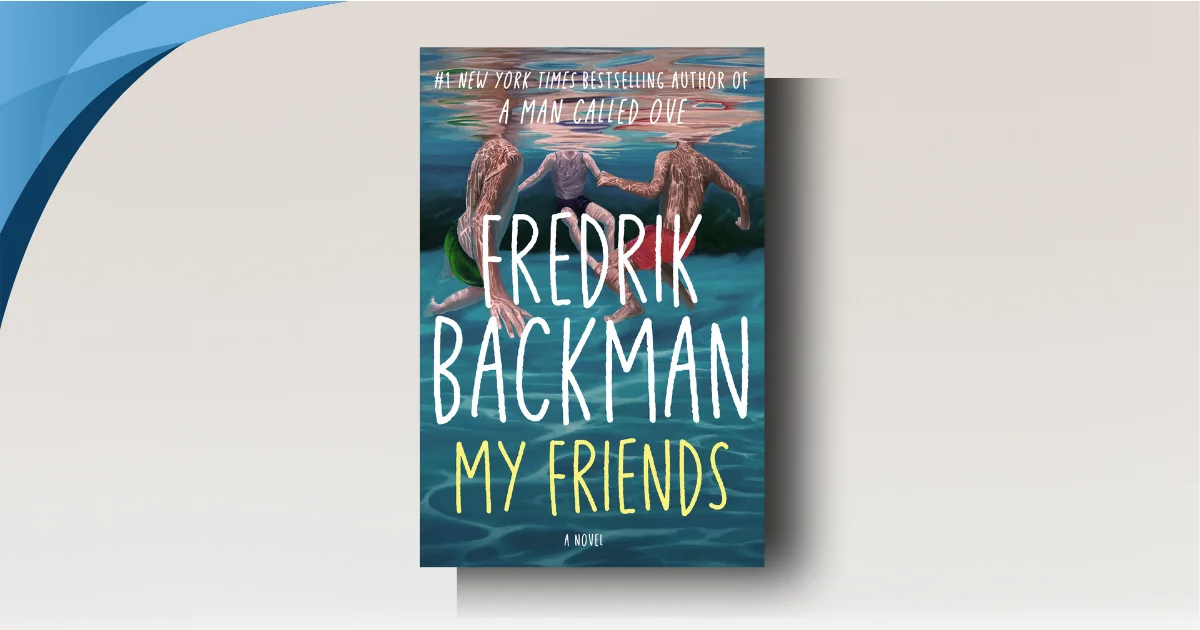
This novel My Friends is for the moment when grief turns you mute, and you need someone—anyone—to hand you a language again.
Friendship doesn’t just save you once, it keeps saving you in different disguises across decades.
Backman builds that idea around a famous canvas everyone misreads—“Most people think it’s just a depiction of the sea”—and then dares you to look long enough to notice the small lives hidden in the corner.
In the book’s own blunt phrasing, the point isn’t what the rich buyers say they see, because “It isn’t a painting of the sea.”
The emotional science behind why this story hits so hard is well documented: social connection meaningfully shapes health and survival, and loneliness measurably harms bodies and minds.
And when the central wound is bereavement, studies of grief supports and interventions show real (if variable) benefits—especially when people aren’t left to white-knuckle it alone.
Best for readers who like tender, funny, trauma-aware fiction about art and found family; not for readers who want light escapism or zero references to abuse, neglect, and grief.
Before I go further, one important note.
I can’t write a scene-by-scene retelling designed to replace reading the novel, and I can’t reproduce large chunks of the text—even if requested—but I can give a spoiler-aware, high-detail overview, analysis, and short quoted fragments with precise citations.
So what you’ll get here is the “I actually sat with this book” version: the emotional logic, the plot’s spine, and the lines that keep echoing, without turning it into a pirated substitute.
Table of Contents
1. Introduction
My Friends is a novel by Fredrik Backman, published in English in a First Atria Books hardcover edition (May 2025), translated by Neil Smith.
It opens with an eighteen-year-old, Louisa, trying to get close to a world-famous painting—while a room full of wealthy adults treat art like a stock portfolio with better lighting.
And right away Backman sets the moral temperature: “No price tag, no art,” the crowd effectively decides, as if value only becomes real after money touches it.
That’s the first quiet horror of the book: not violence, not even loss, but the casual way people stop seeing people.
Then Louisa, shaking with something like love and fury, snaps the sentence that becomes a keyhole into everything: “It isn’t a painting of the sea!”
2. Background
On the surface, there’s no “historical event” scaffolding this novel; the history is social, the kind written into who gets noticed and who gets guarded.
Backman makes the art market’s class logic almost cartoonishly clear—guards protect the painted children, while real children “could die without anyone even caring.”
And that’s where the book’s deeper context lives: in a world currently alarmed enough about loneliness that the WHO has a whole commission urging societies to rebuild social connection like public infrastructure.
This novel reads like a story-version of that warning—except warmer, funnier, and sharper with its knife.
3. My Friends Summary
The first time we meet Louisa, she’s invisible on purpose—“knowing that you don’t mean anything to anyone”—and she uses that invisibility to slip through a fancy art event with a backpack full of spray paint.
The crowd doesn’t look at staff, doesn’t look at her, barely looks at the art; they look at their reflections and their investments, and they want someone else to tell them what they’re allowed to love.
Louisa, meanwhile, is locked onto one painting: The One of the Sea, by the famous artist “C. Jat.”
But the crucial twist is what Louisa insists on: everyone sees blue, she sees the pier—and the three teenage boys at the far end that “adults hardly ever even notice.”
Her relationship to this painting is almost religious, except her god is friendship: it’s the only “happiest place” she has, memorized inch by inch.
That opening doesn’t just introduce a character; it introduces a wound.
Louisa’s mother is gone (we see the ache of it in the small detail of the postcard—“Miss you, see you soon. — Mom”—carried like a talisman), and Louisa’s life has taught her to expect abandonment before it arrives.
So when her plan collapses and security throws her out, what stays is not the humiliation but the vision: the painting isn’t water, it’s a whole childhood—salt air, closeness, motion—painted by someone who must have been “a completely lonely child.”
From there the book starts doing what Backman does best: pulling one thread until it reveals it was tied to twenty-five other threads all along.
We come to understand that “The One of the Sea” became priceless not simply because it’s brilliant, but because of the story stitched to it—the myth of the artist, the hunger of buyers, the way brokenness gets romanticized and monetized.
Backman says it outright: wealthy people don’t experience art through their eyes; they experience it through “its name and history,” and in that world the owner is the one who gets admired.
The painting is a kind of mirror: it reflects who is seen, who is ignored, and what counts as “value.”
And because the painter once couldn’t afford paint, it began as clouds—“because clouds are nothing and that was how he saw himself”—before it became the ocean everyone else brags about.
Then comes the line that unlocks the novel’s philosophy of creation: “for him, art was love. Grief. A story.”
Louisa’s life collides with Ted’s because this is a Backman novel, meaning: coincidence is never really coincidence; it’s just a delayed consequence.
Ted is almost forty, anxious, careful, and grieving a world-famous best friend—the artist behind C. Jat—so deeply that “almost every moment hurts when you have to live it alone.”
Through Ted we learn the artist’s last arc: he was dying, he stopped taking medication at the end, and he traveled to buy the painting back without the world finding out—because death would drive the price up.
Ted bought it at auction on his behalf, with nothing “on paper,” and now—after the artist’s death—Ted is trying to do the one thing his friend asked: put the painting where it belongs, and put the ashes where their friendship began.
Louisa, who has nowhere safe to go, blurts out the question that changes everything: can she come with him?
And suddenly the book becomes a journey—physical travel, yes, but more intensely a trip through memory, guilt, and the old summer when four teenagers made a life raft out of each other.
At this point in the novel, Backman starts braiding timelines: Louisa in the present; Ted with ashes and regret; and the past where the pier-friendship was formed.
You learn the names and roles in that old constellation: Joar (all fists and loyalty), Ali (sharp as a blade), Ted (gentler, fearful), and the artist (sensitive, battered, talented), plus the absence that haunts them: Christian.
There’s a repeated Backman move where humor isn’t decoration—it’s CPR.
For example, even in a funeral scene, Joar’s aggressive nonsense (“Was it you who killed him?”) cracks the air just enough for Ted to breathe again.
That is the book’s method: it refuses to let sorrow be the only language available.
And the present-day relationship between Louisa and Ted becomes its own odd couple tenderness.
Louisa is chaotic, observant, and emotionally allergic to being pitied; Ted is a rule-following high school teacher whose brain is basically a catastrophizing roommate.
Their banter is funny, but it’s also diagnostic: Louisa needles Ted’s fears, Ted tries to “adult,” and both keep failing in ways that slowly build trust.
There’s a moment early on where a dying stranger tells Louisa, “Life is long,” and the sentence lands like a curse and a lifeline at the same time.
Because if life is long, then abandonment lasts longer—but so can rescue, if it ever shows up.
That tension—long suffering, long love—is the electricity under the book’s road-trip plot.
My Friends ending
The late novel tightens around a question: what do you owe the friend who made you who you are, once they’re gone.
Ted believes the painting belongs in the artist’s hometown, because it’s the origin point—“that was where it all began”—not because it’s the most technically brilliant work.
Louisa, meanwhile, panics at the idea of inheriting something priceless because she can’t imagine being trusted with anything without being punished for it.
The ending resolves this tension through action, not speeches.
They break into a museum space in the hometown and leave the painting behind rather than steal it, and the next day the newspaper story spreads globally as a mystery.
Backman names it with a grin: journalists call it “the reverse heist,” and tourists arrive to see the work where it emotionally belongs.
That’s not just a plot twist; it’s the novel’s thesis in motion: art isn’t supposed to be a private trophy, it’s supposed to be a shared language.
And Louisa’s arc turns from “invisible kid” to artist-in-becoming, the one who learns to be “on [her] way,” not complete—because completeness is a myth adults sell like a product.
4. My Friends Analysis
Louisa’s psychology is sketched in contradictions: she calls herself “worthless,” yet she’s brave enough to sprint at a guarded masterpiece with her whole chest lit up.
That contradiction is not inconsistency—it’s realism for a kid trained by neglect to hate herself and still keep moving.
Backman makes her inner weather tactile: “stupid, stupid heart,” always nervous, always betraying her by wanting things.
Ted, in contrast, is a man whose grief has turned into logistics—tickets, plans, carefulness—because if he stops managing, he might fall apart.
His mind is described like a bad partnership: he and his brain are “classmates” forced into a group project called life, and it’s not going great.
4.1 My Friends Characters
Louisa is the novel’s nerve: impulsive, funny, prickly, and starving for a stable handhold.
Her most moving trait is that she sees—not just the painting’s pier and boys, but the human story inside brushstrokes—and that kind of seeing is her first form of love.
Even her refusal to monetize art is moral, not naive: “If I see this painting as money… I’ll never be able to paint anything.”
Ted is the book’s tenderness in a suit jacket.
He’s the one who can articulate how belief can crush you with its weight—“Nothing weighs more than someone else’s belief in you”—because he’s lived with that responsibility on his back since the summer that made him.
Joar is protective violence reworked into devotion.
He barks, he threatens, he insults, but it’s often love trying to speak in a language it was taught: survival first, softness later.
One of the saddest things Joar says is basically that his life after the disaster is “bonus,” because adults always expected him to die young anyway.
That’s a whole sociology lecture in one bitter sentence.
Ali (from what the book shows of her) is a strategist of feelings, the one who can mock and nurture in the same breath.
When the teens try to bring the artist back after a death, she understands that the prize isn’t money—it’s belonging—getting his work onto a white wall so he’ll know “he belonged there.”
The artist (C. Jat) is the ghost that keeps making the living do brave things.
Backman frames him as someone for whom art had to “find its way in,” not out—because what he needed first was love, context, and friendship sturdy enough to hold grief.
That’s why the “three kids at the end of the pier” matter more than the expensive blue everyone buys.
4.2 My Friends Themes and Symbolism
The central symbol is misdirection: “The One of the Sea” trains you to look at the obvious, while the truth (friendship) sits small and nearly unseen in the corner.
Backman uses that as a moral test: do you notice what adults “hardly ever even notice,” or do you join the crowd worshipping price tags.
Another theme is the commodification of pain.
The art world loves the artist’s brokenness—“the more broken the better”—and that line stings because it’s not only about galleries; it’s about how audiences sometimes consume trauma as proof of authenticity.
A third theme is grief as time-distortion.
Ted’s narration makes grief feel like a selfish organism—“Grief is a selfish bacteria”—that demands attention and quiet, and that’s exactly what it does in real bereavement literature too: it narrows your world unless support helps widen it again.
And then there’s art as social connection, not status.
Louisa’s fear that monetizing the painting would poison her ability to create echoes what research often finds about arts interventions: the value isn’t just output, it’s expression, regulation, connection, and a safer route into emotions that words can’t carry.
5. Evaluation
This book’s biggest strength is how it uses comedy the way exhausted friends use inside jokes: not to deny pain, but to survive it.
The character work is also unusually humane: even “rich adults” are satirized without becoming cardboard villains, and the narrative keeps returning to the idea that people often fear choosing the “wrong” emotion in public.
Backman’s prose has that signature snap—warm sentence, brutal sentence, warm sentence—and the tonal rhythm mirrors how real memories behave.
The novel is especially strong whenever it describes seeing: seeing a painting, seeing a kid, seeing a friend’s fear without humiliating them for it.
The weaknesses are mostly structural.
Because the book braids timelines, some readers may feel the momentum pause when the narrative revisits the past just as the present-day trip heats up.
And if you’re allergic to “Backman-style” heightened sentiment—big-hearted declarations, talky moral clarity—you may find moments that feel slightly engineered to make you cry.
Impact-wise, it’s the kind of novel that leaves a low-grade ache behind.
The line “Life is long” haunted me because it argues with the cliché everyone repeats, and it forces you to admit that endurance is its own frightening epic.
But it also suggests something stubbornly hopeful: if life is long, then healing can take its time too, and still count.
Comparison with similar works: if you loved the intergenerational repair in A Man Called Ove or the community-wide emotional web of Beartown, this will feel like the same authorial fingerprint—ordinary people, extraordinary tenderness, jokes as life rafts.
Where it differs is the central metaphor: My Friends is explicitly about art—about who gets to create, who gets to own, and how stories get priced.
6. Personal insight with contemporary educational relevance
When I finished My Friends, I kept thinking about how the book treats social connection like a skill, not a personality trait.
That matters right now because institutions are finally admitting—out loud—that loneliness is not merely a private sadness; it’s a public-health variable, serious enough that the WHO Commission on Social Connection is calling for coordinated societal action.
Backman dramatizes the same idea through Louisa: she’s not “bad at people,” she’s under-trained in safety, and what changes her is not a motivational slogan but repeated, imperfect contact—being tolerated, teased, guided, and eventually chosen.
In education terms, this is a novel about what mentoring actually looks like when it isn’t inspirational-poster clean.
Ted doesn’t heal Louisa by being flawless; he heals her by staying in the room, even while grieving, even while anxious, even while irritated.
That maps onto what the evidence keeps saying about supportive relationships: connection affects outcomes profoundly, including mortality risk at a population level, not just mood.
And when grief is the load, structured supports can help, especially for younger people—exactly the kind of scaffolding Louisa never reliably had.
7. My Friends Quotes
“It isn’t a painting of the sea!”
“Life is long, Louisa.”
“Grief is a selfish bacteria…”
“…for him, art was love. Grief. A story.”
“If I see this painting as money… I’ll never be able to paint anything.”
“Nothing weighs more than someone else’s belief in you.”
“he belonged there.”
“That’s the happy ending.”
8. Conclusion
My Friends is a novel about the people you barely notice—the kids in the corner of the canvas, the foster kid in the crowd, the grieving teacher on the train—and the way attention can become a kind of salvation.
I’d recommend it to readers who like literary-contemporary fiction with big feelings, dark humor, and an ultimately hopeful moral arc.
If you loved Backman’s previous work, this fits: grief and laughter sharing the same kitchen table, love expressed through irritation, and community as the opposite of fate.
If you’re currently raw, though, read gently—because this book doesn’t just talk about abandonment, it remembers it, and remembering can sting before it soothes.
Still, the final aftertaste is not despair; it’s the stubborn idea that we can learn how to be human, one handhold at a time.
