
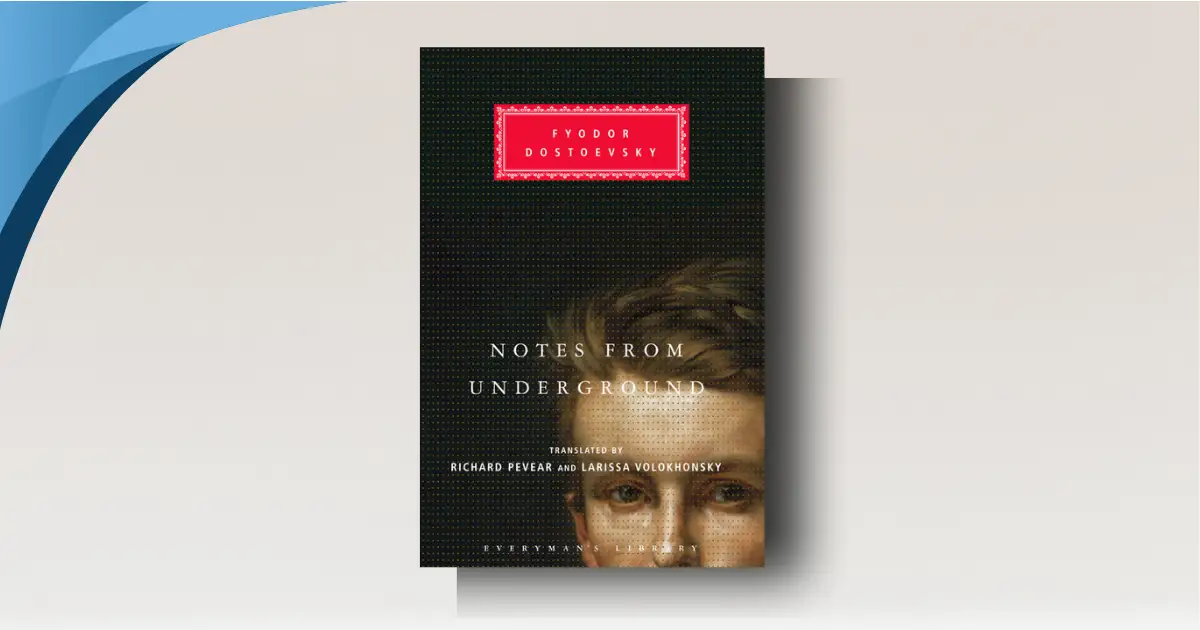
Like me, if you’ve ever scrolled through your own angry thoughts at 3 a.m., or felt a perverse pride in your own misery, or argued with an imaginary audience in your head, then you’ve already met the Underground Man. Fyodor Dostoyevsky’s Notes from Underground isn’t just a classic; it’s a mirror held up to the modern, hyper-conscious, and deeply conflicted soul.
Reading Notes from Underground feels less like studying literature and more like undergoing a radical, uncomfortable therapy session for the parts of yourself you rarely admit exist.
Notes from Underground argues that the defining, irreducible core of human nature is not rational self-interest, but the irrational, spiteful, and often self-destructive need to assert one’s own free will, even against one’s own advantage, simply to prove one is not a “piano key” to be played by the laws of nature, reason, or society.
Evidence Snapshot
The novella itself is the primary case study—a psychological portrait of its unnamed narrator. Critics and philosophers, from existentialists like Jean-Paul Sartre to psychologists exploring malignant self-awareness, have used the text as a foundational document for understanding the pathology of modern consciousness.
Research into cognitive dissonance and self-sabotage often echoes the Underground Man’s tortured logic, where individuals choose suffering to affirm their agency.
A 2022 study in the Journal of Personality and Social Psychology on “maladaptive self-reflection” and goal-undermining behaviors reads like a clinical footnote to Dostoyevsky’s 1864 masterpiece.
Notes from Underground is best for lovers of psychological deep-dives, philosophy enthusiasts (especially existentialism), writers studying voice and unreliable narration, and anyone who has ever felt alienated by the simplistic “logic” of modern life, progress, and utopian ideals.
Not for: readers seeking a fast-paced plot, traditional heroic characters, or clear moral resolutions. It will frustrate those who prefer narratives that comfort rather than confront.
1. Introduction
Notes from Underground by Fyodor Dostoyevsky is a foundational work of existential literature that continues to shock and resonate over 150 years after its 1864 publication.
This novella, penned after Dostoyevsky’s traumatic exile in Siberia, serves as a fierce rebuttal to the rising tide of utopian rationalism and Chernyshevsky’s novel What Is To Be Done?, which championed rational egoism. It is not a novel in the traditional sense but a violent, confessional monologue from a profoundly alienated narrator, a form that shattered literary conventions and announced the arrival of the modern psychological novel.
Dostoyevsky plunges us directly into the chaotic mind of his protagonist, bypassing plot for psyche.
The book is divided into two distinct parts: a theoretical, philosophical diatribe from the narrator’s present, and a harrowing recollection of events from his past that illustrate his theories in agonizing practice. This structure forces the reader to experience the narrator’s ideas not as abstractions but as lived—and ruined—realities.
To read it is to be trapped in a room with the most intelligent, spiteful, and self-loathing person you can imagine, and to realize, with growing dread, that you understand him perfectly.
It is a short book that feels infinitely long, a confession that accuses the reader, a masterpiece of spite.
2. Background and Historical Context
Dostoyevsky wrote Notes from Underground during a period of immense intellectual ferment in Russia. The 1860s saw the rise of Nihilism1 and Utopian Socialism2, ideologies that placed supreme faith in reason, science, and the idea that human beings, once enlightened to their true “advantage,” would naturally act to create a perfect, rational society—a “Crystal Palace” of harmony.
Thinkers like Nikolay Chernyshevsky believed that human behavior could be calculated like a mathematical formula: “twice two makes four.”
The Underground Man is Dostoyevsky’s screaming rebuttal to this cold calculus.
Having just returned from a decade of imprisonment and exile, where he lived among real people in extreme conditions, Dostoyevsky had a visceral distrust of these clean, theoretical models of humanity.
He saw them as denying the messy, paradoxical, and irrational core of human freedom. The story is thus a philosophical war cry, declaring that the human soul’s need for choice, even suffering choice, will forever shatter the walls of any Crystal Palace.
It is a text born from the collision of radical ideology and the brutal reality of the human heart, a collision that defines modernity itself.
3. Notes from Underground Summary
Part I: Underground
Notes from Underground opens not with a story, but with a manifesto. “I am a sick man…. I am a spiteful man. I am an unattractive man.” Our unnamed narrator, a retired low-level civil servant in his forties, addresses an imaginary audience of “gentlemen” from his literal and metaphorical underground hole in St. Petersburg.
In a series of disjointed, fiercely contradictory tirades, he lays out his worldview. He defines himself by his “acute consciousness,” which he calls a disease.
This hyper-awareness paralyzes him, making him incapable of action. While the “man of action” simply dashes at a wall, the conscious man, like a mouse, analyzes the wall, doubts the justice of charging it, and ultimately creeps away in humiliation, only to nurse his spite for decades.
His central thesis is a revolt against rational self-interest.
He savagely mocks the utopian idea that man, once shown his true advantage, will always act logically. He posits that man’s “most advantageous advantage” is his “own free unfettered choice, one’s own caprice.”
He famously states that man might deliberately choose the irrational, the harmful, even suffering, “simply to have the right to desire for himself even what is very stupid and not to be bound by an obligation to desire only what is sensible.” He would choose chaos “simply to gain his point” and prove he is a man, not a “piano-key.”
This section is a torrent of intellectual despair, establishing the narrator as both a brilliant critic of utopianism and a self-diagnosed casualty of his own mind.
Part II: A Propos of the Wet Snow
This theoretical storm is given flesh in the second part, a flashback to the narrator’s life twenty years prior. Here, we see the “mouse” in action. Isolated and consumed by fantasies of grandeur and revenge, his life is a series of humiliating social failures.
The core of this section involves two devastating episodes. First, his obsessive, years-long feud with an officer who slighted him by moving him aside without a glance. The narrator’s revenge is pathetically intellectual (writing an unpublished satire) and culminates in a calculated, petty physical victory on the Nevsky Prospect where he refuses to step aside, shouldering the officer.
This “triumph” leaves him empty and ill.
The second, longer episode is the crux of his moral undoing.
He impulsively invites himself to a farewell dinner for a former schoolmate, Zverkov—a smug, successful officer he despises. The entire evening is an excruciating study in social torture. He arrives too early, is poorly dressed, and is openly scorned by the group.
In a failed attempt to dominate them with wit, he delivers a bizarre, insulting speech that only isolates him further. He then proceeds to stalk the group to a brothel, where, drowning in humiliation and self-pity, he encounters Liza, a young, quiet prostitute.
Here, the narrator’s psychic violence turns outward.
In a perverse performance, he delivers a passionate, eloquent sermon to Liza about the horrors of her life, painting a vivid picture of her eventual degradation and death. He does this not from compassion, but from a desire to exert power, to play the “hero” and savior. “I wanted to exercise unbounded sway over her,” he admits.
He is shocked when his words, born of spite, genuinely touch her soul and awaken hope. She later visits him at his wretched lodging, seeking the salvation he cynically offered. Confronted with real, vulnerable emotion, he panics.
The reality of her need shatters his literary fantasy. In a final, cruel act of self-loathing and spite, he sexually consummates their encounter and then, in a fit of shame, thrusts money into her hand—reducing their spiritual connection back to a commercial transaction.
The act destroys them both.
Liza flees. He chases after her but stops, realizing the futility. The story ends with the narrator back in his underground hole, his “notes” complete. He admits he wrote not for readers but for himself, and that even his most painful confession is likely a lie. He remains trapped, a warning of what happens when consciousness divorces itself from life, love, and action.
The ending offers no redemption, only the endless, spiteful echo of his own voice in the dark.
4. Notes from Underground Analysis
4.1 Notes from Underground Characters
The Underground Man (Narrator): He is one of literature’s first and greatest anti-heroes and unreliable narrators. His complexity is his totality. He is not evil, but pathologically self-aware and paralyzed.
His motivations are a tangled knot of inferiority and superiority. He despises society’s “men of action” like Zverkov, yet desperately craves their respect. He seeks to dominate Liza to feel powerful, but is undone by her authentic humanity. His relationship with everyone, including the reader, is one of manipulative conflict.
He is a living paradox: “I was lying when I said just now that I was a spiteful official. I was lying from spite.” He represents the modern intellectual ego, brilliant enough to deconstruct every system, including its own happiness, leaving only the bare, stubborn will to exist on its own miserable terms.
Liza: She is the story’s silent, tragic heart and the only true counterpoint to the narrator’s noise. While initially a passive victim, she demonstrates a capacity for change and feeling that the narrator has willfully amputated in himself.
Her visit to his room is an incredible act of courage and hope. Her final act—silently leaving the money he gave her on his table—is a moment of profound moral clarity and crushing dignity.
It is a silent judgment that speaks louder than all his thousands of words. She represents the possibility of genuine connection and salvation that the narrator actively chooses to destroy.
Zverkov, Simonov, Ferfitchkin, Trudolyubov: These former schoolmates are not deep characters, and that is the point. They are the “normal” world—shallow, successful, socially fluent. They are the “piano keys” the narrator rages against.
Zverkov, with his casual confidence and lack of introspection, is the embodiment of everything the narrator loathes and envies. They serve as the collective “wall” against which the mouse of his consciousness dashes itself.
4.2 Notes from Underground Themes and Symbolism
The Irrationality of Human Nature: This is the central, pounding theme. Dostoyevsky argues that the essence of man is not reason but will, even willful stupidity.
The narrator declares that man will “purposely go mad in order to be rid of reason and gain his point!” This is a direct assault on 19th-century Utopianism and a prophecy of the 20th century’s ideological catastrophes.
Hyper-Consciousness as Disease: The narrator’s defining trait is his “acute consciousness,” which he calls “a real thorough-going illness.” It disconnects him from spontaneous life, trapping him in an endless feedback loop of analysis and doubt. This prefigures modern anxiety disorders and analysis paralysis.
Spite as a Source of Identity: When stripped of all positive traits, the narrator clings to spite as proof he exists. His refusal to see a doctor for his liver ailment is a classic example: “I refuse to consult a doctor from spite… I know better than anyone that by all this I am only injuring myself and no one else. But still, if I don’t consult a doctor it is from spite.” His identity is built on this negative freedom.
The “Crystal Palace” vs. The “Underground”: The Crystal Palace (London’s real-world symbol of progress) is the utopian ideal of a perfectly rational, pain-free society. The Underground Man’s dirty, irrational hole is its necessary antithesis.
He fears the Palace because “one will not be able to put out one’s tongue or make a long nose on the sly.” The underground represents the messy, defiant, human reality that any perfect system must deny and thus will inevitably produce.
Suffering and Redemption: The narrator posits a shocking idea: “Perhaps suffering is just as great a benefit to him as well-being? … suffering is the sole origin of consciousness.” While he uses this to justify his own masochism, the encounter with Liza suggests a different path: her suffering, acknowledged, leads her toward a potential redemption he cynically offers but tragically rejects. True suffering, connected to another, could be transformative, but he chooses the sterile suffering of isolation.
5. Notes from Underground Evaluation
5.1 Strengths
The book’s overwhelming strength is its psychological depth and prophetic voice. Dostoyevsky doesn’t just describe a state of mind; he makes you inhabit it. The confessional style is breathtakingly modern, feeling closer to a Kafka story or a postmodern rant than a 19th-century novel.
Its philosophical ideas are not dryly presented but felt in the narrator’s every pang of humiliation and spite.
The character of Liza provides a necessary and heartbreaking emotional anchor, making the narrator’s final cruelty almost unbearable to read. It is a short, dense, and utterly devastating performance.
5.2 Weaknesses
For some, the very qualities that make it great will be its weaknesses. Part I can be relentlessly abstract and repetitive; the narrator’s voice is intentionally grating. The almost complete lack of plot or traditional narrative momentum will frustrate readers who value story over idea.
The unrelenting pessimism and the narrator’s utter lack of redeemable qualities can make it a bleak, unrewarding slog if you’re not in the right headspace to engage with its philosophical challenge.
5.3 Notes from Underground Impact
Intellectually, it’s a landmark that forces you to question the very foundations of progress, psychology, and free will. Emotionally, it is a draining, profound, and strangely cathartic experience. It gives form to the unspoken, shameful thoughts of passivity, resentment, and self-sabotage that haunt modern life. You don’t just read it; you wrestle with it, and it often wins.
5.4 Comparison with Similar Works
It is the dark, irrational twin to the optimistic rationalism of Chernyshevsky’s What Is To Be Done?. It directly precedes and informs Dostoyevsky’s own greater novels like Crime and Punishment (Raskolnikov is the Underground Man turned to action) and The Brothers Karamazov.
In the 20th century, its DNA is visible in the existential angst of Sartre’s Nausea, the bureaucratic paranoia of Kafka’s The Trial, and the alienated narrators of Camus and Bellow. It is the godfather of literary neurosis.
6. Personal Insight & Contemporary Relevance
In our age of curated online personas, algorithmic life-hacking, and the pressure to constantly optimize ourselves for happiness and success, the Underground Man is more relevant than ever. He is the ultimate deconstructor of the “perfect life” Instagram feed.
A 2023 study by the American Psychological Association highlights a sharp rise in perfectionism and self-critical rumination among young adults, linking it to anxiety and depression—this is the Underground Man’s “acute consciousness” playing out on a societal scale.
We are taught to calculate our advantages, track our metrics, and follow the formula for a “successful” life (our own Crystal Palace). Yet, a pervasive sense of emptiness and a rebellious, often self-sabotaging desire to not be optimized grows.
We see it in “quiet quitting,” in the embrace of “delulu” culture, in the visceral backlash against sterile corporate jargon. We sometimes choose the messy, “irrational” path just to feel real.
Notes from Underground is the foundational text of this modern malaise, teaching us that until we acknowledge and integrate this dark, defiant, irrational part of our humanity—rather than trying to rationally engineer it away—we risk living in a spiritual underground, forever spiteful, forever alone, and forever free in the most terrible way.
7. Notes from Underground Quotes
- “I am a sick man…. I am a spiteful man. I am an unattractive man.”
- “To be too conscious is an illness—a real thorough-going illness.”
- “What man wants is simply INDEPENDENT choice, whatever that independence may cost and wherever it may lead.”
- “I say let the world go to hell, but I should always have my tea.”
- “Twice two makes four seems to me simply a piece of insolence. Twice two makes four is a pert coxcomb who stands with arms akimbo barring your path and spitting.”
- “We are stillborn, and for generations past have been begotten, not by living fathers, and that suits us better and better.”
- Liza’s silent act: The crumpled blue five-rouble note left on the table.
8. Conclusion
Notes from Underground is not a pleasant book, but it is an essential one. It is a brutal, brilliant, and uncomfortably familiar diagnosis of the modern condition. Its value lies not in providing answers, but in articulating the problem of our own conflicted natures with terrifying honesty.
I recommend it without reservation to anyone interested in philosophy, psychology, or the roots of modern literature—but with a warning: be prepared to see a part of yourself in the Underground Man’s spite, and in Liza’s crushed hope.
Its significance is immortal because the struggle it describes—between the rational world we build and the irrational self that inhabits it—is the permanent condition of being human. It is worth reading because it is true, and its truth is a kind of poison, and an antidote, all at once.
Notes:
- A philosophy that asserts life is without objective meaning, purpose, or intrinsic value, rejecting established moral, religious, and political beliefs as baseless fabrications. ↩︎
- Early socialist movements (19th century) advocating for ideal, cooperative societies free from poverty, competition, and inequality ↩︎
