
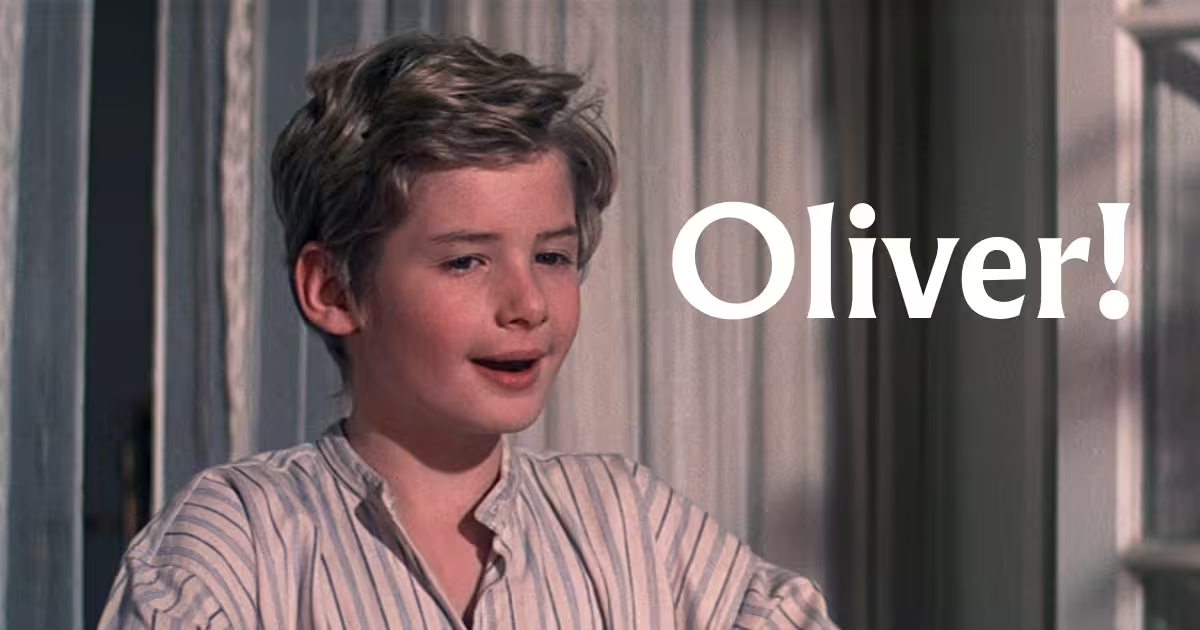
What if one of the darkest social critiques in English literature could be transformed into a joyous, Oscar-winning musical that captivates all ages? Oliver!, the 1968 film adaptation of Lionel Bart’s stage musical, achieves precisely that alchemy.
Directed by the masterful Carol Reed, this British period musical drama is not merely a film; it’s a cultural touchstone that brilliantly reimagines Charles Dickens’ grim novel Oliver Twist into a vibrant, song-filled spectacle.
Having secured its place as one of the 101 must-watch films, its enduring charm lies in its unique ability to balance social commentary with irresistible entertainment. For me, it remains a defining example of how to adapt a classic with both reverence and inventive flair.
Table of Contents
Background
Emerging from the success of the West End and Broadway stage production, the film Oliver! was a prestigious undertaking by producer John Woolf. Filmed at Shepperton Studios, it represented a significant investment in British filmmaking during a transformative cinematic era.
The project assembled a remarkable mix of established character actors and fresh, young talent under the guidance of Carol Reed, a director already celebrated for classics like . This combination aimed to preserve the theatrical magic while fully embracing the cinematic canvas, a challenge it met with resounding success, ultimately becoming the last G-rated film to win the Academy Award for Best Picture.
Oliver! cast
| Actor as Character | Description |
|---|---|
| Mark Lester as Oliver Twist | The innocent young orphan at the heart of the story whose courage and kindness drive the emotional journey from workhouse hardship through adventure and eventual safety. |
| Ron Moody as Fagin | The charismatic and cunning leader of a group of pickpocket boys who balances comic musicality with Dickens-inspired streetwise cunning, earning award recognition and audience affection. |
| Oliver Reed as Bill Sikes | The brutal and menacing criminal whose presence looms over the narrative, adding dramatic tension and danger to Oliver’s world in Victorian London. |
| Harry Secombe as Mr. Bumble | The blustering, self-important beadle of the workhouse whose comedic turn exposes the callous social systems facing orphans in Dickens’ England. |
| Shani Wallis as Nancy | A vulnerable yet strong-hearted member of Fagin’s circle whose compassion for Oliver brings some of the film’s most poignant and memorable musical moments. |
| Jack Wild as The Artful Dodger | The scrappy, quick-witted pickpocket who befriends Oliver, delivering a scene-stealing performance that became one of the film’s most iconic roles. |
| Joseph O’Conor as Mr. Brownlow | The kind gentleman who ultimately provides Oliver with a home, representing hope and redemption for the orphan at the story’s core. |
| Hugh Griffith as The Magistrate | A stern figure of authority whose encounter with Oliver adds weight to the narrative’s exploration of institutional power. |
Oliver! Plot
The narrative follows the arduous journey of the orphan Oliver Twist, portrayed with poignant innocence by Mark Lester. Our story begins in the grim Dunstable workhouse, where the boys are sustained on a meager diet of gruel. In a moment of famished desperation, Oliver draws the short straw and famously dares to ask, “Please, sir, I want some more.”
This act of defiance sees him sold into apprenticeship with the sinister undertaker, Mr. Sowerberry. After a brutal confrontation with another apprentice, Oliver escapes and makes his way to London, a sequence that masterfully transitions from rural hardship to urban chaos.
Here, he is befriended by the charismatic Artful Dodger, played with impish brilliance by Jack Wild. Dodger introduces Oliver to the underground den of Fagin, a role defined by Ron Moody’s iconic, complex performance. Fagin trains a gang of boys in “pickin’ a pocket or two,” and Oliver is reluctantly drawn into their world.
His first outing leads to wrongful arrest after the Dodger steals from the benevolent Mr. Brownlow. Brownlow, seeing the boy’s inherent goodness, clears his name and takes him into his comfortable home, offering Oliver his first glimpse of a loving family.
However, the criminal world refuses to let him go. Fagin and the terrifying burglar Bill Sikes, a menacing Oliver Reed, fear Oliver will expose their operation. They coerce Sikes’ kind-hearted girlfriend Nancy, played soulfully by Shani Wallis, into kidnapping Oliver during an errand.
This act sets in motion the film’s tense and tragic final act. Back in Fagin’s lair, Oliver is forced to assist Sikes in a botched burglary, while Nancy, guilt-ridden, secretly arranges with Brownlow to return the boy.
Her betrayal is discovered by Sikes, leading to her brutal murder on London Bridge—a scene of shocking violence that starkly contrasts the film’s musical numbers.
A vengeful mob, guided by Sikes’ own dog, descends on the thieves’ hideout. In a climactic rooftop chase, Sikes is killed, and a chastened Fagin is left to contemplate his choices.
The film concludes on an ambivalent note: as Oliver is joyfully reunited with Mr. Brownlow, who has discovered the boy is his long-lost grandson, Fagin and the Dodger dance off into the sunrise, choosing their life of crime. This ending preserves Dickens’ critique of a cyclical society while offering a sliver of hope for its titular hero, a resolution that is both satisfying and thought-provoking.
Oliver! Analysis
1. Direction and Cinematography
Carol Reed’s vision was to create a dynamic, living world that felt both authentically Victorian and theatrically grand. His storytelling approach seamlessly blends intimate character moments with sprawling crowd sequences, such as the energetic “Consider Yourself” number.
Reed and cinematographer Oswald Morris use a muted color palette that occasionally bursts with life during musical numbers, visually echoing the tension between despair and hope. The camera work is often inventive, using high angles and tracking shots through the labyrinthine London sets to immerse the viewer fully in Oliver’s perspective, making the environment itself a central character.
2. Acting Performances
The film is anchored by extraordinary performances. Ron Moody’s Fagin is a masterclass, transforming a potentially stereotypical villain into a tragicomic, almost sympathetic figure, driven by survival rather than pure malice.
Jack Wild’s Artful Dodger is all cheeky charm and streetwise swagger, earning him an Academy Award nomination. Oliver Reed brings a genuinely terrifying volatility to Bill Sikes, while Shani Wallis provides the film’s emotional heart as the conflicted Nancy.
The chemistry between Lester’s wide-eyed Oliver and this ensemble makes the relationships compelling, from Fagin’s warped paternalism to Nancy’s protective love.
3. Script and Dialogue
Vernon Harris’s screenplay adeptly condenses Dickens’ sprawling novel, focusing on the core narrative while making space for musical interludes.
The dialogue effectively captures the period’s cadence without becoming inaccessible. Its strength lies in balancing darker thematic elements with the musical’s lighter requirements, though some character depth from the novel is necessarily streamlined.
The pacing is generally brisk, using songs to advance plot and develop character, ensuring the lengthy runtime seldom drags.
4. Music and Sound Design
The music by Lionel Bart is the film’s pulsating soul. Songs like “Food, Glorious Food” and “You’ve Got to Pick a Pocket or Two” are not just catchy but are brilliantly staged to reveal character and setting.
The score, adapted by John Green, wonderfully supports the film’s emotional range, from the haunting “Where Is Love?” to the rousing “Oom-Pah-Pah.” The sound design is equally meticulous, from the cacophony of the workhouse to the eerie silence of the robbery sequence, creating an immersive auditory landscape that won the film an Academy Award for Best Sound.
5. Oliver! Themes and Messages
Beneath its melodic surface, Oliver! engages with profound themes of poverty, social injustice, and the corruption of innocence. It critiques a society that fails its most vulnerable, a message that, according to BBC analyses of Dickens’ enduring relevance, remains painfully topical.
The film explores the ambiguity of morality through characters like Fagin and Nancy, who exist in shades of gray. For the audience, it evokes a powerful emotional journey—outrage at systemic cruelty, heartbreak at personal tragedy, and joy in Oliver’s ultimate rescue, reminding us of the enduring need for compassion and social responsibility.
Comparison
Compared to other Dickens adaptations or large-scale movie musicals of its time, Oliver! stands apart. It lacks the overt sentimentality of some versions and is more cohesive and cinematically ambitious than its stage source.
While not as dark as David Lean’s 1948 Oliver Twist, it retains enough thematic weight to distinguish itself from purely escapist fare like Chitty Chitty Bang Bang.
Its true peers are musicals that successfully blend substance with spectacle, such as West Side Story or My Fair Lady, yet Oliver! carves its own niche with its distinctly British grit and its focus on a child’s-eye view of a corrupt world.
Audience Appeal
Oliver! has a remarkably broad audience appeal. It is immediately engaging for families and children, drawn in by the young protagonist and catchy songs.
For cinephiles and students of film, it offers a masterclass in adaptation, direction, and production design from the Golden Age of British cinema. Its themes resonate with adults, making it suitable for casual viewers seeking entertainment and those interested in more substantive drama. It is, unequivocally, a cross-generational classic.
Awards
The film’s excellence was recognized with a staggering eleven Academy Award nominations, winning six including Best Picture and Best Director. It also won Golden Globes for Best Motion Picture (Musical/Comedy) and Best Actor for Ron Moody.
These accolades cemented its status as a cinematic achievement, a fact proudly noted in archives from the Academy of Motion Picture Arts and Sciences.
Personal Insight and Lessons
Watching Oliver! today is a strikingly resonant experience. Its depiction of a vast economic divide, institutional neglect, and childhood vulnerability speaks directly to contemporary global issues.
The workhouse governors’ indifference mirrors modern bureaucratic failures, while the street-level economy of Fagin’s gang prompts uncomfortable questions about the choices forced upon the dispossessed.
The film teaches that cruelty is often systemic, but kindness remains a powerful, personal rebellion—a lesson embodied by Nancy and Mr. Brownlow.
In an age of increasing socioeconomic stratification, Oliver’s journey from neglected orphan to beloved grandson is a potent metaphor for the power of advocacy and the right to a second chance.
The film argues that our societal health is measured by how we treat our poorest children, a message championed by many modern social reformers.
Furthermore, Ron Moody’s nuanced portrayal of Fagin invites us to look beyond simplistic villainy, to understand the environmental forces that shape character.
Oliver! ultimately reminds us that while the world can be a dark and cruel place, humanity and hope persist in individual acts of courage and love, making it not just a period piece but a perpetually relevant social document.
Oliver! Quotes
- “Please, sir, I want some more.” – Oliver Twist
- “You’ve got to pick a pocket or two, boys, you’ve got to pick a pocket or two.” – Fagin
- “As long as he needs me, I know where I must be; I’ll cling on steadfastly, as long as he needs me.” – Nancy
- “Consider yourself at home. Consider yourself one of the family.” – The Artful Dodger
Pros and Cons
Pros:
- Superb direction and Oscar-winning production design that creates an immersive Victorian London.
- Iconic, career-defining performances from Ron Moody and Jack Wild.
- A unforgettable soundtrack that advances the plot and deepens character.
- A successful balance of light-hearted musical numbers with genuine dramatic heft.
- A timeless story with enduring social relevance.
Cons:
- Some narrative compression from the source novel simplifies complex characters.
- The tonal shift from musical comedy to violent tragedy can be jarring for some viewers.
- By modern standards, the pacing in the second act may feel deliberate to younger audiences.
Conclusion
Oliver! is a triumphant cinematic achievement that transcends its genre. It is a film of remarkable craft, emotional depth, and enduring energy. More than fifty years on, it continues to delight, move, and provoke thought. I wholeheartedly recommend it not only as a cornerstone of musical cinema but as one of the 101 best films you need to see—a vibrant, heartfelt, and masterfully told story for the ages.
Rating: 5/5 Stars
