
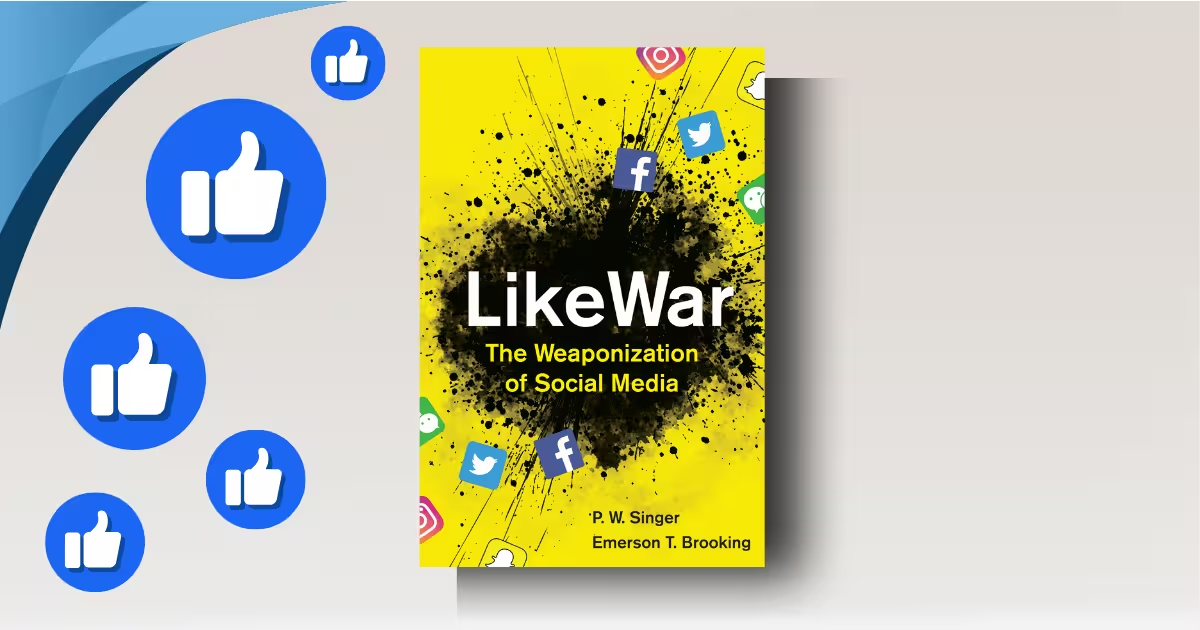
Singer and Brooking put it bluntly: “Power in LikeWar is measured by command of attention.”
In LikeWar: The Weaponization of Social Media, “likes,” “shares,” and “views” aren’t cute little counters—they’re the ammunition of a new kind of conflict. The authors define LikeWar as a conflict with “no clear separation between war and peace,” where the fight lives inside our everyday feeds. And their central warning lands hard: if you’re online, you’re already in the arena.
The book was published by Houghton Mifflin Harcourt (Boston/New York) in 2018, and it’s written by P.W. Singer and Emerson T. Brooking.
Their “opening shot” is famously dated: “THE OPENING SHOT OF THE WAR was fired on May 4, 2009,” tied to Donald Trump’s first tweet.
I came away feeling like the book isn’t just describing the internet—it’s describing us.
The authors argue that what we casually call “social media” has become a battlefield, not a neutral town square. They insist attention behaves like territory, and whoever captures it can shape events offline. Their framework is practical: they lay out five core principles—narrative, emotion, authenticity, community, and inundation—and keep returning to them as a kind of map for modern information warfare.
So let’s treat this as both a LikeWar book review and a full, no-backtracking LikeWar summary you can actually learn from.
LikeWar explains why the next crisis—an election, a war, a massacre, even a rumor—can be decided by who wins the story first.
It shows how social media gets weaponized so efficiently that ordinary users become collateral, combatants, and targets at the same time.
LikeWar is the idea that modern conflict is fought by capturing attention, steering emotion, and flooding the zone until truth can’t breathe.
Evidence snapshot
The book backs its claims with concrete episodes—terror groups building audiences, states running influence ops, and platforms struggling to govern themselves. One vivid example: during ISIS’s seizure of Mosul, “the Mosul Eye” had “fifteen hundred people” in its network, but its hashtag #AllEyesOnISIS made its reports global.
The authors also document scale: in the 2016 U.S. presidential race, researchers found “roughly 400,000 bot accounts,” and describe how bot-driven flooding can overpower real voices.
They pair that with the blunt cultural drift: “Your attention is like a piece of contested territory,” meaning the battlefield is literally your screen-time.
LikeWar is best for journalists, policy folks, marketers, educators, activists, OSINT investigators, and anyone trying to understand disinformation, propaganda, and algorithmic influence without academic sludge.
And not for readers who want a calm “tech optimism” narrative, or anyone who expects a single villain instead of a messy ecosystem of incentives, platforms, and human psychology.
Table of Contents
1. Introduction
The genre is nonfiction / geopolitics / media studies, written in an urgent, story-driven style rather than a purely academic one. P.W. Singer is associated with research on the future of war and security policy, and Emerson T. Brooking has worked on digital disinformation and online conflict research. Their combined credibility matters because the book is basically a field guide to information-age conflict.
The purpose is stated through the framing: a world where conflict doesn’t begin with bullets, but with posts that change what people believe is happening.
The thesis is that social platforms became core infrastructure for civic life and geopolitics, so “winning” means mastering attention, narrative, and virality rather than just territory. The five principles they emphasize—narrative, emotion, authenticity, community, inundation—are their recurring explanation engine.
The authors’ choice of May 4, 2009 as the “opening shot” is not random—it’s a signal that celebrity, media logic, and platform incentives became strategic assets long before most institutions admitted it. They describe how Twitter was already at “18 million users” then, and how shared online attention surged around breaking events like Michael Jackson’s death.
The point is simple: social media became the place people experience reality together, which makes it the place reality can be manipulated.
And yes—this book is trying to change the way you notice what’s happening, not merely what you think about it.
2. Background
If older propaganda tried to broadcast one message to millions, LikeWar is about tailoring and amplifying messages through networks built on identity and emotion. The book repeatedly shows that the “weaponization of social media” isn’t a side-effect—it’s a predictable outcome of engagement-driven systems.
A key backdrop is the collapse of gatekeeping: secrets, eyewitness accounts, and “official versions” get competed against in real time. The authors quote a CIA official: “Secrets now come with a half-life.” That one line explains why modern institutions feel permanently behind.
Even traditional monitoring couldn’t keep up: the FBIS once handled “45,000 pages a week” and later “500,000 words a day,” yet today the internet produces oceans of content at machine speed. That mismatch—human institutions vs. viral systems—is the oxygen LikeWar runs on. The authors’ background point is basically: we built tools for connection, then handed them to every actor willing to fight for attention.
3. LikeWar summary
The book begins by reframing “war” as something that can start inside entertainment logic, not military logic, calling May 4, 2009 the symbolic beginning.
It uses that to argue that conflict now rides on visibility: who trends, who frames, who provokes, who mobilizes. Then it lays down its map: narrative and emotion beat sterile fact-checking; “authenticity” is performative but powerful; community turns belief into identity; and inundation overwhelms competing realities.
A major early case is ISIS as a media-native actor: the authors describe how a small network like the “Mosul Eye” could spread reports via hashtags, while ISIS itself leveraged online propaganda to recruit at scale. They cite estimates that ISIS drew “between 25,000 and 30,000 foreigners” from abroad, and describe propaganda as operational—recruiting, intimidating, and building myth. In this frame, a tweet isn’t commentary; it’s logistics.
The book then shows how open-source visibility flips power relationships: an ordinary person live-tweeting strange helicopter noises becomes part of the public record of a covert raid.
That’s why “disintermediation” matters—witnessing escapes institutions. And again, the chilling takeaway is that being online makes you part of the information terrain whether you volunteered or not.
Then it widens into state behavior: governments learn to troll, meme, and manipulate like native users, and the line between diplomacy and shitposting gets thin.
The book describes official accounts using meme language and social tactics in geopolitical disputes, because attention is a currency states now spend. The strategic goal is not always persuasion—it’s confusion, cynicism, and division.
Now the book turns to what it basically calls the Unreality Machine—the ecosystem that manufactures “truthiness” through repetition and identity.
One of the most memorable sections is the economics of fake news: in Veles, Macedonia, teenagers pumped pro-Trump clickbait because it paid, and the lifestyle details (like champagne flexing) are used to show how mundane the incentive can be. In other words, sometimes nobody is “brainwashing” anyone—people are just monetizing outrage, and the outrage reshapes politics anyway.
From there, the authors zoom in on health and harm, using anti-vaccination as a model of community + emotion + inundation.
They trace the movement’s growth with social media, describe the targeting of critics as conspirators, and connect it to measurable public-health damage: in California, “personal belief exception” filings “quadrupled between 2000 and 2013,” and a Disneyland measles outbreak “sickened 147 children.” These aren’t abstract “bad takes”—they’re bodies and consequences.
The election chapters focus on tools that scale influence: bots, fake followers, astroturfing, and algorithmic manipulation. The authors describe how botnets appear across major elections, and for the 2016 U.S. presidential race they cite “roughly 400,000 bot accounts,” “two-thirds of them in favor of Donald Trump,” plus hashtag “colonization” tactics that drown opponents.
Their deeper point is that humans read popularity as legitimacy, so manufactured volume becomes manufactured reality.
Later, the book confronts the platforms themselves as actors: companies become quasi-states because they govern speech, identity, and reach. That’s why laws and enforcement matter, and why political pressure rises when harms scale faster than moderation.
The authors argue the “weaponization of social media” isn’t solved by one tweak—it requires literacy, policy, and cultural immunity.
And in the closing logic, Singer and Brooking land on a personal responsibility that feels almost unfair—but real: “you are now what you share.”
4. Critical analysis
LikeWar succeeds because it doesn’t treat disinformation as a mysterious dark art—it treats it as a predictable combination of incentives + psychology + platform mechanics.
The “five principles” framework is genuinely useful because it explains wildly different cases with the same underlying logic, from extremist propaganda to pop-culture memetics. And the narrative style makes it teachable, which is a hidden strength if your goal is public understanding rather than elite jargon.
Where it can frustrate some readers is that the solution-space is hard by nature: the book can outline what must change, but no single institution “owns” the whole battlefield.
Also, because the ecosystem evolves quickly, some platform details inevitably age, even if the principles stay stable. Still, the book’s argument holds up because it’s built on mechanisms (attention, identity, virality) rather than only on platform-specific trivia.
A big confirmatory signal from outside the book: Oxford’s work on computational propaganda documented manipulation across many countries and elections, reinforcing the idea that this is systemic rather than isolated.
5. My pleasant / unpleasant experience
The pleasant surprise is how readable it is without being shallow: it’s structured like a tour through a war zone where every “weapon” is something you already use daily. I also liked how it refuses to flatter the reader—attention is framed as territory, which makes scrolling feel less innocent. And the book’s examples are sticky; you remember them because they’re cultural, not just political.
The unpleasant part is emotional: once you accept the premise, you can’t unsee the way outrage gets engineered and recycled. Some case sections may feel U.S.-heavy to international readers, even though the book clearly ranges globally. And if you want a neat “do X and it’s fixed” ending, LikeWar won’t give you that kind of comfort.
6. Reception
The book has been widely discussed in foreign policy and security circles because it treats platforms as a strategic domain, not a cultural footnote.
Reviews in major outlets generally underline its timeliness: the argument that information operations are now routine statecraft aligns with what journalists and researchers have since documented. Its influence shows up in how often “attention,” “narrative,” and “platform governance” now appear in national security conversations.
Criticism tends to orbit around the same tension: diagnosing is easier than prescribing when the battlefield is privatized, global, and incentive-driven. And because it uses story as a teaching method, some critics prefer a more formal academic structure (even though that would make it less widely usable). Still, the core concept—that conflict is fought through social systems optimized for engagement—has only become harder to dispute.
7. Comparison with similar works
If LikeWar is a battlefield map, The Age of Surveillance Capitalism (Zuboff, 2019) is closer to an economic and moral indictment of data extraction as a business model.
The Attention Merchants (Tim Wu, 2016) complements LikeWar by tracing how industries learned to harvest attention long before social platforms perfected it.
This Is Not Propaganda (Peter Pomerantsev, 2019) overlaps strongly in theme, but it leans more into the lived weirdness of influence campaigns and the fragility of shared reality.
And War in 140 Characters (David Patrikarakos, 2017) is a close cousin—more focused on individual stories of online conflict shaping real events, while LikeWar builds the broader mechanism.
8. Conclusion
LikeWar is worth reading if you want to understand how social media manipulation, disinformation, and propaganda work as systems, not scandals.
If you’re a student, creator, journalist, marketer, activist, or policy-minded reader, you’ll benefit most because the book hands you a vocabulary—narrative, emotion, authenticity, community, inundation—that you can apply immediately. If you’re looking for a comforting story where “truth wins automatically,” you’ll probably bounce. And if you want the line that should haunt any of us before we post, Singer and Brooking give it: “you are now what you share.”
