

What does it mean to truly see another person? Rain Man, Barry Levinson’s 1988 masterpiece, confronts this question not with grand theatrics, but through the quiet, grinding journey of two brothers across America’s heartland.
Winning the Academy Award for Best Picture and the Berlin International Film Festival’s Golden Bear—a unique double honour it still holds—the film transcends its road-trip comedy-drama label to become a profound study in human connection.
For me, its enduring power lies not in its celebrated performances or accolades, but in its unwavering, often uncomfortable, focus on the slow, painful, and beautiful process of empathy being earned, not bestowed.
Table of Contents
Background
The journey to the screen was as winding as the brothers’ trip. Screenwriter Barry Morrow drew inspiration from two real-life individuals: Bill Sackter, a friend with an intellectual disability, and the remarkable savant Kim Peek.
Interestingly, according to production notes, directors like Steven Spielberg were attached before Levinson, and actors from Bill Murray to Mel Gibson were considered for the leads.
Ultimately, Dustin Hoffman and Tom Cruise committed, with Hoffman embarking on a year of meticulous research with autistic individuals and experts, including Dr. Ruth Sullivan of the Autism Society of America.
Made for a modest $25 million, it would astonishingly become the highest-grossing film of 1988, earning over $354 million worldwide and proving that a character-driven story could achieve blockbuster status.
Rain Man: Key Facts at a Glance
| Category | Details |
|---|---|
| Title | Rain Man |
| Release Date | December 16, 1988 (United States) |
| Director | Barry Levinson |
| Writers | Barry Morrow (story and screenplay), Ronald Bass (screenplay) |
| Main Cast | Dustin Hoffman (Raymond Babbitt), Tom Cruise (Charlie Babbitt), Valeria Golino (Susanna) |
| Genre | Road comedy-drama |
| Runtime | 134 minutes |
| Budget | $25 million |
| Box Office | $354.8–429.4 million (worldwide) |
| Production Companies | United Artists, Guber-Peters Company, Star Partners II Ltd. |
| Distributor | MGM/UA Communications Co. |
| Plot Summary | Selfish car dealer Charlie discovers his autistic savant brother Raymond after their father’s death. They embark on a cross-country road trip, leading to personal growth and family reconciliation. |
| Inspiration | Based on real-life savant Kim Peek and Bill Sackter; focuses on autism and brotherhood. |
| Awards | 4 Academy Awards (Best Picture, Best Director, Best Actor for Hoffman, Best Original Screenplay); Golden Globe for Best Drama; Golden Bear at Berlin Film Festival. |
| Critical Reception | 88% on Rotten Tomatoes; praised for performances and autism portrayal, but criticized for savant stereotypes. |
| Legacy | Highest-grossing film of 1988; increased autism awareness; only film to win both Golden Bear and Best Picture Oscar in the same year. |
Rain Man Plot
Rain Man is, on its surface, a story of inheritance and a cross-country drive. Charlie Babbitt, a slick, self-centered Los Angeles importer, is a man defined by transactional relationships. When his estranged father dies, leaving his $3 million estate not to him but to an unnamed trustee, Charlie’s fury is palpable.
He discovers the beneficiary is his older brother, Raymond, an autistic savant living at the Walbrook Institute, whose existence Charlie never knew. Viewing Raymond solely as a means to half the inheritance, Charlie essentially kidnaps him from the institution, setting off for Los Angeles to contest the will.
The road trip that follows is less an adventure and more a gruelling education for Charlie. Raymond’s world is one of immutable routine and overwhelming sensory detail.
He cannot fly, must watch The People’s Court at the same time every day, will only eat certain foods, and becomes deeply distressed by change or perceived danger. Charlie’s initial impatience is brutal.
He shouts, he manipulates, he treats Raymond’s needs as irrational obstructions. His girlfriend Susanna, seeing this cruelty, abandons him—the first crack in his hardened exterior.
The journey’s pace is dictated by Raymond, forcing Charlie to slow down and, for the first time, observe. He begins to witness the astounding contours of Raymond’s mind: his ability to instantly count hundreds of scattered toothpicks, memorise entire phone books, and perform lightning-fast mathematical calculations. Yet, these “skills” are inseparable from his disability; they are not party tricks but part of his fixed, internal logic.
The emotional breakthrough comes not from these feats, but from a shard of memory. Charlie realises the “Rain Man” he vaguely recalled as a comforting, imaginary childhood friend was, in fact, his own infantile mispronunciation of “Raymond.”
This memory unlocks the tragic family truth. Raymond had been living at home when Charlie was a baby. One day, he was left to watch the infant and, in an attempt to bathe him, accidentally turned on the hot water, nearly scalding Charlie.
Their father, Sanford, unable to comprehend Raymond’s condition or hear his explanation, sent him away to an institution, erasing him from the family history to protect Charlie. The “Rain Man” was not imaginary; he was a brother sacrificed to a misunderstanding and a father’s fear.
Charlie’s financial desperation, caused by the seizure of his Lamborghinis, leads them to a Las Vegas casino. Here, the film cleverly uses Raymond’s savant skills for narrative propulsion.
By counting cards in blackjack, they win $86,000, clearing Charlie’s debts. The sequence is thrilling, but its true function is to show Charlie and Raymond working as a unit, however unorthodox. It is here Charlie also reconciles with Susanna, having begun to shed his selfish skin.
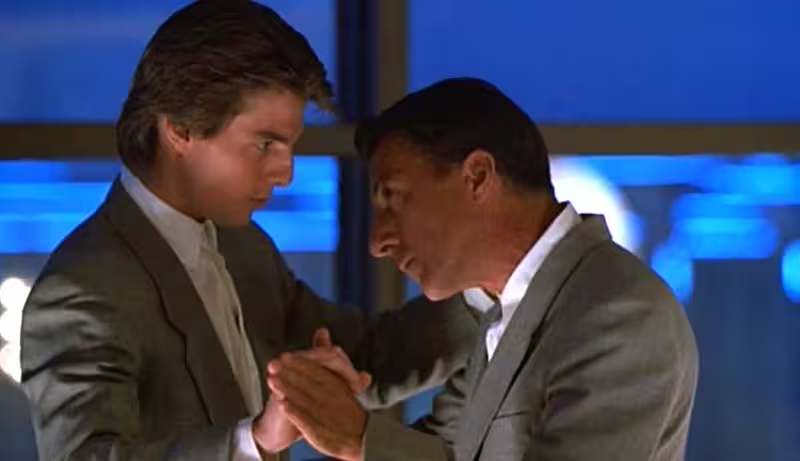
The ending is where Rain Man chooses poignant realism over sentimental triumph.
Back in Los Angeles, a court-ordered psychiatrist attempts to determine where Raymond would prefer to live. Raymond, unable to process such an abstract choice, simply recites the script of The People’s Court. Charlie, in a moment of profound grace, stops the questioning. He no longer sees Raymond as a financial asset or a problem to be solved.
He tells the doctors, and more importantly his brother, “I’m happy to have him as my brother.” He has finally seen Raymond.
Understanding that Raymond’s needs for stability and routine are best met at Walbrook, Charlie lets him return with Dr. Bruner.
The farewell at the train station is heartbreaking in its simplicity. As Raymond boards the train, mechanically reciting his schedule, Charlie promises to visit in two weeks. Raymond, unable to express emotion in a conventional way, simply asks, “Two weeks?” and begins to count down the days, “One day, two days…”
The film ends not with a healed family, but with a connection finally established—a bridge built across a chasm of neglect, with a schedule for future visits. It is a testament to the idea that love is not always about keeping someone close, but about understanding what they need to thrive, even if it means letting them go.
Rain Man Analysis
Direction and Cinematography
Barry Levinson’s direction is masterfully restrained. He avoids manipulative music or dramatic close-ups during emotional moments, instead relying on the actors and the stark, open landscapes captured by cinematographer John Seale.
The visual palette shifts from the cold, sterile institution to the warm, sometimes oppressive, hues of the American road, mirroring Charlie’s journey from emotional isolation to tentative connection.
Acting Performances
Dustin Hoffman’s performance is a monumental feat of detailed observation. His physicality—the stiff gait, the averted gaze, the repetitive murmuring—is never a caricature.
He makes Raymond’s internal world palpable. Tom Cruise, in perhaps his first truly dramatic role, is equally superb. His arc from arrogant wheeler-dealer to vulnerable brother is meticulously charted, his frustration and dawning empathy visible in every scene. Their chemistry is the engine of the film.
Script and Dialogue
The screenplay by Morrow and Ronald Bass brilliantly structures the brothers’ relationship. The dialogue is sparse where it needs to be, allowing silence and behaviour to speak volumes.
The pacing, dictated by Raymond’s routines, forces the audience to experience Charlie’s impatience and eventual adaptation, making the emotional payoff deeply earned.
Music and Sound Design
Hans Zimmer’s score, nominated for an Oscar, is a character in itself. The now-iconic marimba-based theme is haunting and minimalist, evoking both the ticking of Raymond’s rigid internal clock and the vast, lonely spaces between people. It underscores melancholy and wonder without ever demanding tears.
Themes and Symbolism in Rain Man
Barry Levinson’s 1988 film Rain Man explores profound themes through the road trip of brothers Charlie Babbitt (Tom Cruise) and Raymond Babbitt (Dustin Hoffman), blending comedy-drama with social commentary.
Central themes include family reconciliation, personal transformation, the humanization of disability, and the tension between materialism and emotional connection.
Symbolism enhances these, using motifs like journeys, vehicles, and routines to underscore character growth and societal insights.
The theme of family and brotherhood drives the narrative. Charlie, initially abrasive and estranged, discovers Raymond, his autistic savant brother, after their father’s death.
The inheritance—$3 million to Raymond’s institution—sparks conflict, but the cross-country drive fosters bonding. This evolves from exploitation to genuine affection, symbolizing rediscovered kinship. As Charlie recalls Raymond as his childhood “Rain Man” (a protective imaginary friend who saved him from scalding water), it represents buried family ties and unresolved guilt from their separation.
The road trip itself symbolizes life’s unpredictable journey, forcing Charlie to confront his selfishness amid detours caused by Raymond’s rigid routines, like avoiding interstates after an accident or insisting on watching The People’s Court.
Personal growth is another key theme, with Charlie transforming from a greedy wheeler-dealer to an empathetic sibling.
His initial motive—kidnapping Raymond for money—shifts as he witnesses Raymond’s abilities, such as card-counting in Las Vegas, which saves Charlie from debt. This highlights themes of understanding autism and savant syndrome, challenging stereotypes by portraying Raymond’s exceptional memory and calculations alongside his emotional limitations.
The film critiques societal views on disability, emphasizing compassion over pity, though it’s been noted for perpetuating the myth that many autistic individuals are savants.
Materialism versus human connection is evident in Charlie’s arc. The impounded Lamborghinis symbolize his shallow pursuits, contrasting with the inherited 1949 Buick Roadmaster, a relic of familial conflict that becomes their vessel for healing.
Las Vegas represents risk and redemption, where Raymond’s skills yield $86,000, but Charlie ultimately rejects a $250,000 buyout, prioritizing relationship over wealth. Rain symbolizes distress and chaos for Raymond, triggering meltdowns and mirroring emotional storms in their bond.
Symbolically, red hues in scenes (e.g., casino lights) evoke passion and transformation, while Raymond’s routines symbolize the need for stability in neurodiversity. Overall, Rain Man uses these elements to advocate empathy, influencing autism awareness and earning acclaim for its heartfelt portrayal. (412 words)
Comparison
Unlike sentimental contemporaries, Rain Man refuses to “cure” Raymond or have him teach Charlie a simple life lesson. Compared to Levinson’s earlier ensemble comedies like Diner, it shows a director embracing deeper, more sombre character study.
It stands apart from other “disability” films by making the neurotypical character’s transformation the central arc, a narrative choice that remains both powerful and debated.
Audience Appeal/Reception
The film captivated both critics and audiences, earning an 88% rating on Rotten Tomatoes and an ‘A’ CinemaScore. It appeals to those seeking powerful drama, exceptional acting, and a story that challenges perceptions.
It is essential viewing not just for cinephiles, but for anyone interested in the complexities of family and the human condition. It is precisely for these reasons that it features on our curated list of the 101 must-watch films.
Awards
The film won 4 Academy Awards: Best Picture, Best Director (Levinson), Best Actor (Hoffman), and Best Original Screenplay. It also won the Golden Bear at Berlin and the Golden Globe for Best Drama.
Personal Insight and Lessons
Watching Rain Man today is a different experience than in 1988. Our understanding of autism spectrum disorder has evolved dramatically.
The film’s portrayal, groundbreaking for its time, now exists in dialogue with contemporary critiques about representation. The legacy is twofold.
Firstly, it demonstrated the box-office viability of intimate, character-driven adult drama—a genre that often struggles today. Secondly, and more importantly, it ignited a global conversation about autism that continues.
However, its shadow is complex. Hoffman’s Oscar win is seen by some as the starting pistol for a trend where Oscars are awarded to non-disabled actors “portraying” disability, a practice increasingly challenged by disabled advocates calling for authentic casting. Furthermore, the persistent linking of autism with savant syndrome in the public imagination, partly fueled by the film, can obscure the vast diversity of the spectrum.
The lesson for today lies not in taking Rain Man as a documentary on autism, but in appreciating its core, timeless message about looking beyond the surface of another person.
In an era of rapid communication and often superficial connection, Charlie’s difficult journey to see his brother—to listen, to accommodate, to value difference—remains a profoundly necessary instruction manual for human empathy.
Quotations
- “Definitely. One for sure. Two for sure. Three for sure. Four for sure…” – Raymond counting cards, demonstrating his savant skill.
- “I’m an excellent driver.” – Raymond, a statement of fixed fact that becomes a touching mantra.
- “You don’t have to worry, Charlie. He’ll be fine. He doesn’t know he’s in a strange place. He’s in his own world.” – Dr. Bruner, highlighting a fundamental misunderstanding Charlie must unlearn.
- “I’m happy to have him as my brother.” – Charlie’s ultimate, simple declaration of acceptance.
Pros and Cons
Pros:
• Landmark, deeply researched performances from Hoffman and Cruise.
• Levinson’s subtle, confident direction that trusts the audience.
• A screenplay that balances humour, drama, and profound emotional weight.
• Hans Zimmer’s innovative and evocative score.
• Catalysed widespread public awareness and discussion of autism.
Cons:
• Criticised for perpetuating the association between autism and rare savant abilities.
• Some narrative elements, like the Las Vegas sequence, can feel contrived to modern viewers.
• The story is told predominantly from Charlie’s perspective, limiting Raymond’s interiority.
Conclusion
Rain Man is more than its awards; it is a cultural touchstone and a piece of cinematic humanity. It challenges viewers with its deliberate pace and uncompromising character study, rewarding them with one of the most authentic portrayals of fractured bonds slowly mending.
While our societal understanding of neurodiversity has progressed, the film’s heart—a story about learning to love someone on their own terms—remains utterly potent. It is a moving, essential, and beautifully crafted film that fully earns its place among the greatest stories cinema has to offer.
Rating: 5/5 Stars
