
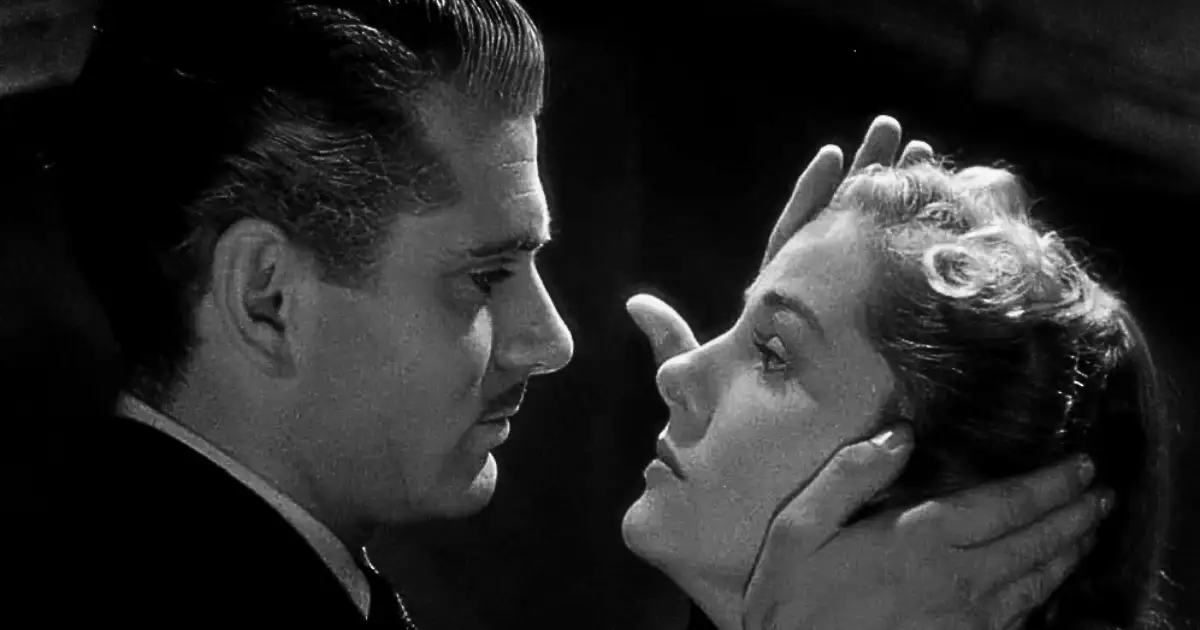
What if the most powerful character in a film never appears on screen? This is the haunting genius at the heart of Rebecca (1940), Alfred Hitchcock’s first American project and a landmark of gothic cinema.
Directed by the Master of Suspense and produced by David O. Selznick, this romantic psychological thriller, released in 1940, transformed Daphne du Maurier’s bestselling novel into an Oscar-winning masterpiece that continues to ensnare audiences.
To me, Rebecca is less a ghost story and more a chilling dissection of memory, identity, and the pervasive power of the past, a film that achieves its thrills not through specters but through psychology and shadow.
Table of Contents
Background
Rebecca arrived at a pivotal moment, marking Hitchcock’s ambitious transition from British to Hollywood filmmaking under a fraught but fruitful partnership with Selznick. The producer acquired the rights for a staggering $50,000, aiming to replicate the prestige of Gone with the Wind.
The collaboration was famously contentious, with Selznick demanding fidelity to the novel and Hitchcock pushing for cinematic dynamism, particularly for the unnamed protagonist. This creative tension, coupled with stringent Production Code censorship that forced a crucial change to the novel’s plot, shaped the film’s unique texture.
Despite these battles, or perhaps because of them, Rebecca emerged as a critical and commercial triumph, earning 11 Academy Award nominations and winning Best Picture, the only Hitchcock film to ever claim that top prize.
Top Important Cast of Rebecca (1940)
| Actor | Character |
|---|---|
| Laurence Olivier | Maximilian “Maxim” de Winter – The brooding aristocratic widower whose marriage to a shy young woman triggers the film’s psychological tension and reveals buried truths about love, guilt, and legacy. |
| Joan Fontaine | The second Mrs. de Winter – The naïve and unnamed heroine whose emotional journey from insecurity to resilience drives the story’s exploration of identity and the haunting presence of the past. |
| Judith Anderson | Mrs. Danvers – The ruthless housekeeper obsessed with Rebecca’s memory, whose psychological torment of the new Mrs. de Winter embodies the film’s gothic dread and thematic focus on obsession. |
| George Sanders | Jack Favell – Rebecca’s charming but dangerous cousin and lover whose reappearance stirs conflict and reveals hidden fractures in Maxim’s life and secrets of Rebecca’s death. |
| Nigel Bruce | Major Giles Lacy – A supportive family figure who provides social contrast and aids emotional grounding, illustrating the divide between societal normalcy and domestic turmoil. |
| Reginald Denny | Frank Crawley – The estate manager whose loyalty to Maxim and Manderley provides structural stability amid emotional chaos, highlighting class and duty. |
| C. Aubrey Smith | Colonel Julyan – A figure of authority and tradition whose presence underscores social expectations and the stabilizing elements of British upper-class society. |
| Gladys Cooper | Beatrice Lacy – A grounded, rational support to the second Mrs. de Winter, offering insight and perspective that contrast the emotional extremes around her. |
| Florence Bates | Mrs. Edythe Van Hopper – The pompous social employer whose early role establishes the second Mrs. de Winter’s insecurity and social struggle. |
| Leo G. Carroll | Dr. Baker – A minor but key rational voice in the narrative, providing medical and logical perspective on the revelations about Rebecca’s fate. |
Rebecca (1940) Plot
On a windswept cliff on the French Riviera, a young, mousy paid companion prevents a brooding, aristocratic stranger, Maxim de Winter, from what appears to be a suicidal leap. This fateful encounter sets in motion the entire psychological drama of Rebecca (1940).
The companion, never named, is employed by the grating social climber Mrs. Van Hopper, who is quick to fawn over the renowned widower Maxim. When illness confines Mrs. Van Hopper to her room, Maxim sweeps the timid young woman into a whirlwind of drives and lunches, leaving her both infatuated and bewildered by his attentions.
Upon Mrs. Van Hopper’s abrupt decision to depart Monte Carlo, the girl secretly says goodbye to Maxim, who responds with a shocking, curt marriage proposal.
A vindictive Mrs. Van Hopper dismissively tells her former employee that Maxim is merely seeking a distraction, still consumed by grief for his beautiful first wife, Rebecca, and warns she will never fit into the world of Manderley, his famed Cornish estate.
The new Mrs. de Winter arrives at Manderley overwhelmed by its grandeur and the imposing, coldly efficient housekeeper, Mrs. Danvers.
Danvers, utterly devoted to Rebecca’s memory, immediately establishes herself as an antagonist, systematically undermining the new wife’s confidence by preserving Rebecca’s lavish suite as a shrine and permeating the house with the late wife’s monogrammed “R.”
The second Mrs. de Winter’s every attempt to establish her role is sabotaged by Danvers and her own spiraling insecurity, convinced Maxim still loves his perfect, drowned wife. In a desperate bid to please Maxim, she plans a costume ball, and Danvers maliciously suggests she wear a dress modeled from a portrait in the gallery.
The suggestion is a trap. When she descends in the elegant gown, Maxim reacts with horror—Rebecca had worn an identical dress at her last ball.
Humiliated and broken, the second Mrs. de Winter is then led by Danvers to a window in Rebecca’s room, where the housekeeper insidiously suggests she jump, arguing she can never compete with a memory.
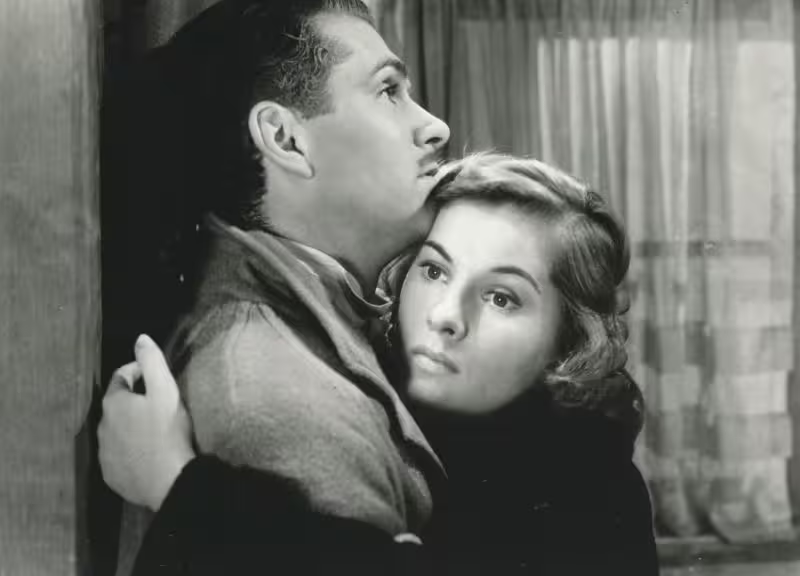
This moment of supreme despair is interrupted by a literal deus ex machina: a shipwreck in the fog leads to the discovery of Rebecca’s sunken boat and her body inside.
This discovery shatters the official narrative of her accidental death. In a tense, revelatory scene, Maxim confesses the truth to his second wife: his marriage to Rebecca was a hollow facade.
She was a cruel, adulterous woman who taunted him with her affairs, and on the night she died, she claimed to be pregnant by her cousin, Jack Favell, threatening to force her heir upon Manderley.
In a rage, Maxim struck her, and she fell, fatally hitting her head. Panicked, he took her body to sea and scuttled the boat, later identifying a different corpse as hers.
This confession transforms their marriage, forging a conspiratorial bond. When the inquest reopens, Favell attempts to blackmail Maxim, presenting a note from Rebecca that suggests a pregnancy, making suicide unlikely.
However, a final investigation reveals Rebecca was not pregnant but dying from cancer, implying she manipulated Maxim, hoping he would kill her and be ruined. The suicide verdict is upheld, clearing Maxim.
He returns to Manderley relieved, only to see it engulfed in flames, set by the maddened Mrs. Danvers, who perishes in the inferno.
The film ends as it began, with the estate in ruins, but now with the second Mrs. de Winter, no longer nameless or timid, standing firmly by Maxim’s side, the ghost of Rebecca finally exorcised.
Rebecca (1940) Analysis
1. Direction and Cinematography
Alfred Hitchcock’s direction in Rebecca is a masterclass in atmospheric suspense, proving his genius lay not just in chase scenes but in the psychology of space and gaze.
His vision transforms Manderley into a character itself—a beautiful, oppressive monument to the past.
Hitchcock uses the camera to mirror the second wife’s subjectivity; we often see vast, empty rooms from her cowed perspective, making us feel her insignificance.
The cinematography by George Barnes, which won an Academy Award, employs deep focus and dramatic, high-contrast lighting to create a gothic texture where shadows hold as much menace as any line of dialogue.
Notably, the scenes in Rebecca’s sealed bedroom are flooded with an ethereal, dusty light, making the space feel both sacred and profoundly haunted, a visual representation of a preserved memory.
2. Acting Performances
The performances in Rebecca are uniformly superb, anchored by Joan Fontaine’s profoundly vulnerable and empathetic turn as the second Mrs. de Winter.
Fontaine, who secured the role after an extensive search, perfectly captures a journey from trembling insecurity to resolved strength, earning her first Oscar nomination. Laurence Olivier brings a suitably tormented and aloof quality to Maxim, a man imprisoned by his own secret.
However, the film’s most unforgettable performance belongs to Judith Anderson as Mrs. Danvers. With her severe chignon, black dress, and whispery, insidious voice, Anderson creates one of cinema’s great villains—not through violence, but through chilling psychological warfare.
Her sheer presence in a scene, often materializing silently from shadows, is enough to elevate the tension to an almost unbearable degree.
3. Script and Dialogue
The screenplay, a product of multiple writers including Robert E. Sherwood and Joan Harrison, navigates a difficult adaptation with considerable skill.
Its primary strength is its faithful preservation of the novel’s oppressive, internal mood while navigating the strictures of the Production Code, which forced the change of murder to accidental death.
The dialogue is sharp and layered, particularly in the verbal duels between the second wife and Mrs. Danvers, where every polite phrase carries a venomous subtext.
If there is a weakness, it is perhaps in the final act, where the plot mechanics of the inquest and medical revelation can feel somewhat rushed compared to the slow, luxurious burn of the film’s first two-thirds, a necessary compression of the novel’s more complex legal proceedings.
4. Music and Sound Design
Franz Waxman’s Oscar-nominated score is indispensable to the film’s power, weaving a romantic yet ominously haunting melody that becomes Rebecca’s ghostly leitmotif.
It swells with faux-romantic grandeur during the Monte Carlo scenes, then twists into more discordant, unsettling strains within Manderley’s walls.
The sound design amplifies the psychological terror: the rustle of curtains, the echoing footsteps in vast halls, and most famously, the relentless, crashing waves that underscore key moments, symbolizing the inescapable past and Rebecca’s watery grave.
This aural landscape keeps the audience in a state of heightened sensitivity, where every sound feels portentous.
5. Rebecca (1940) Themes and Messages
Rebecca delves deep into themes of identity, imposter syndrome, and the corrosive nature of comparison.
The second wife’s struggle is a timeless one: feeling inadequate in the shadow of a seemingly perfect predecessor.
The film also explores gaslighting long before the term was popularized, with Danvers and even Maxim’s silence systematically undermining the heroine’s perception of reality.
On a broader level, it is a film about the tyranny of the past and the secrets that bind a marriage.
According to BBC analyses of gothic romance, Rebecca stands out for making the central terror not a supernatural force, but the psychological legacy of a deeply flawed human being, a theme that resonates with anyone who has ever felt haunted by a history not their own.
Comparison
When compared to other Hitchcock films of the era, Rebecca is less a pure thriller like The 39 Steps and more a gothic melodrama, sharing DNA with later works like Suspicion (1941) which also features Fontaine in a perilous marriage.
It stands apart from other du Maurier adaptations, like Jamaica Inn, for its psychological depth and visual sophistication.
Within the genre of gothic romance, it set a high bar for atmosphere and female psychological terror, influencing everything from Jane Eyre adaptations to modern works like Crimson Peak.
Its distinction lies in its perfect alchemy of Selznick’s lavish production values and Hitchcock’s unique suspense language, creating a hybrid that is both a prestige literary adaptation and a gripping, moody thriller.
Audience Appeal/Reception
Rebecca holds a broad audience appeal, perfect for cinephiles interested in Hitchcock’s oeuvre, fans of classic Hollywood glamour, and lovers of gothic literature and psychological drama.
While its pacing may feel deliberate to modern viewers accustomed to faster cuts, its timeless themes of anxiety and self-doubt remain profoundly relatable.
It is a film that rewards careful viewing, offering rich layers in its visuals and performances.
Upon release, it was a massive popular success, topping box offices in both the US and UK, and according to Kinematograph Weekly, it was the most popular film of 1940 in Britain, proving its appeal spanned from critics to the general public.
Awards
Rebecca was a major awards contender, winning two Academy Awards from eleven nominations. Its wins were for Outstanding Production (Best Picture) and Best Cinematography for George Barnes.
Notably, it holds the singular distinction of being the only film to win Best Picture without receiving a single award for acting, directing, or writing.
Key nominations included Best Director for Alfred Hitchcock, Best Actor for Laurence Olivier, Best Actress for Joan Fontaine, and Best Supporting Actress for Judith Anderson.
The film also won the Film Daily year-end poll of critics and has since been preserved in the National Film Registry.
Personal Insight and Lessons
Watching Rebecca today, its resonance is startlingly contemporary. At its core, it is a profound study of emotional manipulation and the struggle to claim one’s space in a world defined by someone else’s legacy.
The second Mrs. de Winter’s experience is a stark allegory for modern imposter syndrome, amplified by a culture of curated perfection we see on social media, where we are constantly comparing our behind-the-scenes to everyone else’s highlight reel.
Mrs. Danvers is the ultimate toxic gatekeeper, enforcing the rules of a past regime, a figure we might encounter in stagnant workplaces or rigid family structures.
Furthermore, the film’s central twist—that the idolized Rebecca was in fact monstrous—speaks powerfully to our era of re-evaluation, reminding us that nostalgia often whitewashes a far more complex, and sometimes ugly, truth.
The lesson of Rebecca is ultimately one of liberation: to build a future, you must first be willing to burn down the gilded prison of the past, a message as vital now as it was in 1940.
Rebecca (1940) Quotes
- “Last night I dreamt I went to Manderley again.” – The iconic opening line, spoken by the second Mrs. de Winter, immediately establishes the film’s haunting, nostalgic tone.
- “You’re overwrought, Madam. I’ve opened a window for you. A little air will do you good.” – Mrs. Danvers’ chillingly calm suggestion of suicide, a masterclass in malevolent manipulation.
- “I am Mrs. de Winter now.” – The heroine’s final, simple declaration to Mrs. Danvers, marking her hard-won claim to her own identity and place.
Pros and Cons
Pros:
- Unforgettable, gothic atmosphere and Oscar-winning cinematography.
- Landmark, psychologically nuanced performances from Joan Fontaine and Judith Anderson.
- Alfred Hitchcock’s masterful direction, building suspense through environment and psychology.
- A compelling adaptation that deepens the novel’s themes of identity and memory.
- A timeless story about imposter syndrome and resilience that remains deeply relevant.
Cons:
- The pacing, especially in the first act, may feel slow to viewers accustomed to modern editing.
- The plot mechanics of the third act inquest can feel somewhat contrived compared to the psychological build-up.
- Some character motivations, dictated by 1940s censorship, are slightly less complex than in the source novel.
Conclusion
Rebecca (1940) is not merely a film; it is an immersive, haunting experience that showcases Alfred Hitchcock at the height of his powers, weaving suspense from the threads of memory and insecurity.
Its brilliance lies in its ability to make a ghost palpably real without ever showing her, a testament to the power of suggestion and masterful filmmaking.
For anyone who appreciates classic cinema, psychological depth, and stories where the true mystery lies within the human heart, Rebecca is an essential, enduring masterpiece. I wholeheartedly recommend it as a must-watch, a film that will linger in your mind long after Manderley’s ashes have settled.
Rating
5/5 Stars
