
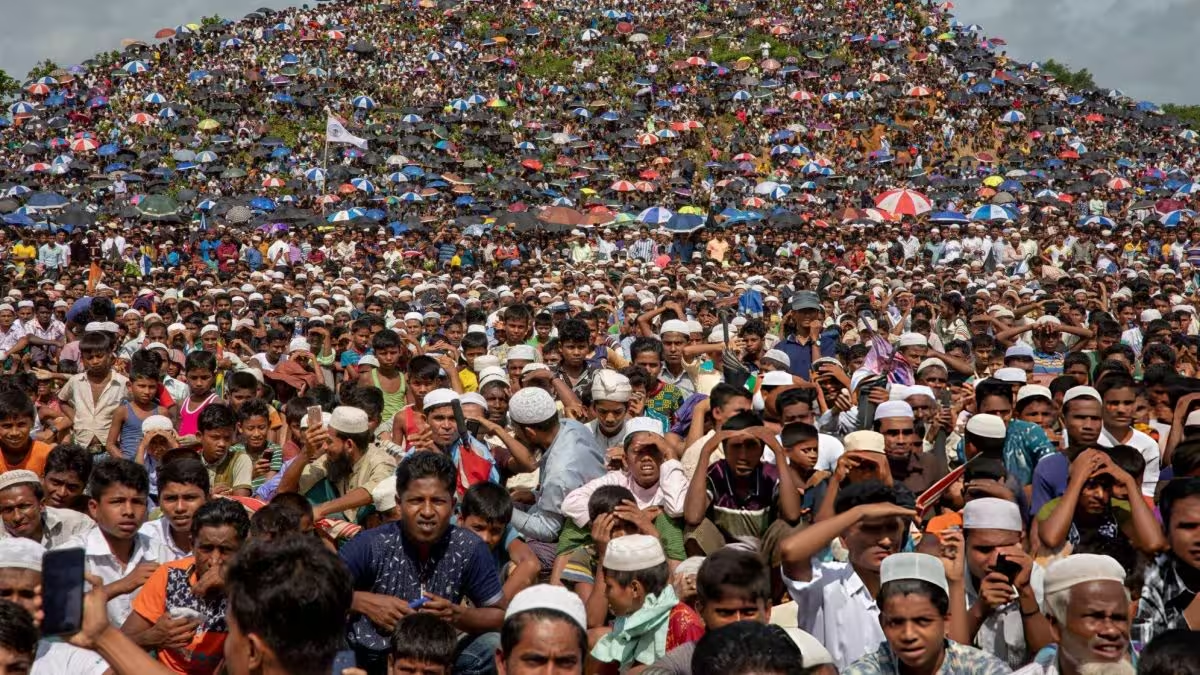
In its eighth year, the Rohingya crisis in Bangladesh has moved from emergency to a deeply entrenched, and increasingly fragile, status quo. More than a million Rohingya refugees who fled persecution in Myanmar remain confined to overcrowded camps in Cox’s Bazar and the remote island of Bhasan Char, living on shrinking aid and limited prospects of change.
What began as a humanitarian response is now also a security challenge, as crime, trafficking and armed groups exploit despair inside the camps and strain relations with host communities.
At the same time, international compassion fatigue has led to funding cuts that threaten food supplies, healthcare and especially children’s education, risking the rise of a lost generation with no recognised schooling or legal pathway to a better future.
Against this backdrop, political promises of safe return to Myanmar remain uncertain and largely theoretical, leaving both Bangladesh and the Rohingya trapped in a prolonged crisis with no clear exit.
Over 1.1 million Rohingya remain effectively trapped in Bangladesh, aid money is under severe strain, security risks in and around the camps are rising, and there is still no realistic path home to Myanmar in the near term.
Table of Contents
1. Rohingyas and history
- History and identity
It traces centuries of Muslim presence in Arakan (now Rakhine State) but leans on historians who argue that many Rohingya families have roots in Bengal and that the term “Rohingya” became prominent only in the mid‑20th century.
Whatever one makes of that argument, the article is clear that Myanmar’s 1982 Citizenship Law deliberately excluded Rohingya from citizenship, formalising decades of discrimination. - Waves of exodus and Bangladesh’s burden
It outlines three major influxes into Bangladesh – 1978, 1991–92 and the 2017 mass flight after military “clearance operations” – and stresses that each time Bangladesh has had to improvise massive emergency responses in already poor, densely populated districts. - The “dark sides of kindness”
Most of the essay focuses on the costs to Bangladesh:
- huge pressure on land, forests and water in Cox’s Bazar
- loss of tourism and local livelihoods
- fears of crime, drugs, human trafficking and militancy linked to some Rohingya and Bangladeshi criminal networks
- large flows of donor money that, in the author’s view, sometimes enrich NGOs and contractors more than refugees or host communities.
Rohingya are victims of Myanmar policy, but Bangladesh is paying an unsustainable price to shelter them.
2. Scale and geography of the crisis in 2025
2.1 How many Rohingya, and where?
According to the Joint Government of Bangladesh–UNHCR population dashboard, as of 31 July 2025 there were 1,148,529 registered Rohingya refugees in Bangladesh, organised in 238,507 households.
A UNICEF humanitarian situation report from March 2025 gives a similar picture: 1,102,566 Rohingya refugees, 51% of them children, hosted in 33 very densely populated camps in Cox’s Bazar, plus 36,920 refugees on Bhasan Char island.
UNHCR’s Bangladesh country page summarises it this way:
- 33 “highly congested camps” in Cox’s Bazar
- since 2021, around 35,000 refugees relocated to Bhasan Char as part of a government decongestion plan.
The small differences in totals reflect new arrivals and registration timing, but all sources agree: Bangladesh is still hosting well over a million Rohingya, roughly half of whom are children.
2.2 New arrivals from Myanmar
Despite Dhaka’s stated policy of not accepting more refugees, UNHCR says up to 150,000 Rohingya have arrived in Cox’s Bazar over the last 18 months, fleeing intensified fighting and hunger in Myanmar’s Rakhine State.
A joint UNHCR–IOM appeal notes that at least 70,000 people arrived in 2024 alone as conditions inside Rakhine deteriorated.
So the crisis is not static: it is slowly but steadily growing, even as donor fatigue increases.
3. Life in the Cox’s Bazar camps
3.1 Overcrowding and environment
Cox’s Bazar remains one of the most crowded refugee sites on earth. UNHCR and IOM describe over one million people spread across 33 camps over a very small area.
- Hills that were once forested have been clear‑cut for shelters, fuel and roads.
- Studies and UN assessments have repeatedly flagged deforestation, landslide risk, and pressure on groundwater and sanitation systems as serious long‑term environmental impacts.
Fires are a recurrent disaster. A long series of blazes – including a major one in 2023 that destroyed more than 2,000 shelters in Kutupalong – shows how fragile bamboo‑and‑tarpaulin housing is in such conditions.
In short, the “fragile environment and overcrowding” that Probinism emphasises remains a central reality, and has only worsened with time.
3.2 Health: a worsening picture
A February 2025 situation report from the World Health Organization warns that the camps face a “severe health crisis” after the United States announced it would suspend funding and withdraw from WHO.
- Essential services at five primary health centres had already been partially disrupted, with six more at risk, affecting over 300,000 people.
- Health partners are trying to stretch limited resources with a 2025–26 Public Health Needs Assessment and targeted cholera and WASH activities, but the basic message is that core health provision is being cut faster than needs.
The latest WHO and UNICEF reports suggest the situation has shifted from “strained” to genuinely fragile, especially if another major disease outbreak strikes.
4. Food, funding and international compassion fatigue
4.1 Planned ration cuts and partial reprieves
The World Food Programme (WFP), which provides food vouchers to all Rohingya refugees, has been very clear: without new money, it cannot maintain basic rations.
- In early 2025, WFP warned it would have to halve monthly rations from US$12.50 to US$6 per person unless it received at least US$15 million for April and US$81 million to sustain full rations through the end of 2025.
- The Guardian reported in March 2025 that WFP had in fact reduced the value of food vouchers from 1,515 taka to 726 taka per person per month because of a serious funding gap, warning of increased malnutrition and insecurity.
A few weeks later, the Associated Press reported a US$73 million US aid package, saying this would allow rations to stay around US$12–13 per person rather than falling to US$6.
These reports are partially contradictory about exactly when and for how long rations were cut. Based on them, I cannot say with certainty what the current per‑person amount is. What is clear – and consistent across all sources – is that:
- WFP has been at the brink of halving rations.
- Rohingya themselves report severe anxiety about hunger and rising prices inside the camps.
4.2 The bigger funding picture
The Probinism article spoke about “compassion fatigue” in fairly general terms. The 2025 data shows how concrete that has become.
- The 2025–26 Joint Response Plan (JRP) launched in March 2025 seeks US$934.5 million for its first year to support about 1.48 million people (Rohingya plus host communities).
- UNHCR and IOM warn that if this appeal is not met, cuts to food, fuel and shelter could push people into “desperate actions”, including hazardous sea journeys.
The direction of travel is clear: compared with the early years after 2017, donor enthusiasm is fading, even as the number of people in need has risen. That’s exactly the trend the Probinism essay feared – only sharper.
5. Children and education: heading towards a lost generation
The Probinism article already worried about educational opportunity, but the last year has brought an acute education crisis.
5.1 Numbers at risk
- Human Rights Watch estimates there are 437,000 school‑age Rohingya children in the camps.
- A UNICEF press release from May 2025 warns that the education of around 230,000 children is directly at risk because of an “acute and deepening funding crisis.”
- Save the Children reports that approximately 300,000 children risk losing access to education after learning facilities in Cox’s Bazar camps were forced to close due to funding cuts.
On 3 June 2025, UNICEF actually suspended thousands of learning centres run by NGOs in the camps because the money simply wasn’t there.
Bangladeshi media summarised it bluntly: funding cuts are deepening the education crisis for nearly half a million Rohingya children.
5.2 Structural barriers
Even before these cuts, Rohingya education faced structural obstacles:
- Bangladesh banned Rohingya‑run schools back in 2021, threatening teachers with sanctions or relocation to Bhasan Char.
- Formal schooling follows a version of the Myanmar curriculum only up to Grade 9 and is not yet certified, limiting children’s future options.
HRW’s 2025 interviews with students, parents and teachers (including on Bhasan Char) underline that with formal learning centres closed, many children now rely on informal community schools that charge small fees and are not officially recognised.
Taken together, this means hundreds of thousands of children are at high risk of becoming a “lost generation”: confined to camps, with no recognised schooling beyond lower secondary level and very limited prospects of work or legal mobility.
6. Security challenges and Rohingya‑linked activities affecting Bangladesh
The Probinism article devotes a lot of attention to crime, trafficking and militancy, sometimes presenting Rohingya as a broad security threat. The most recent UN protection monitoring data paints a more nuanced but still alarming picture.
6.1 Armed groups and coercion inside the camps
A Joint Protection Monitoring report on Quarter 4 of 2024, covering all 33 camps, highlights:
- 14 killing incidents in just three months, most of them tied to violent competition between armed Rohingya groups such as ARSA (Arakan Rohingya Salvation Army) and RSO (Rohingya Solidarity Organization).
- Abduction and kidnapping as the main protection concern, with incidents up 11% compared to the previous quarter and often used for ransom or forced recruitment.
- Large‑scale meetings where organised groups urged Rohingya to return to Myanmar and fight for their homeland, with reports of young men being pressured or coerced into going back across the border as fighters.
The same report documents 96 cases of human trafficking in that quarter alone, mostly men lured with promises of paid work who ended up in forced labour, plus at least 14 child trafficking victims.
From a Bangladeshi security perspective, this is serious: armed Rohingya factions, sometimes working with or against local Bangladeshi gangs, are turning parts of the camps into contested territory, with spillovers including drug trafficking and weapons circulation.
6.2 Impact on ordinary Rohingya and on Bangladesh
At the same time, the monitoring data and rights reports make clear that most Rohingya are victims, not drivers, of this insecurity:
- Over 1,300 children have been documented as affected by serious violations by armed groups since 2022, including 454 abducted, 92 recruited, and 23 killed, according to UN child‑rights monitoring.
- Families describe being forced into unpaid night patrols, with children and people with disabilities sometimes compelled to participate if they cannot pay bribes.
For Bangladesh’s authorities, these dynamics understandably raise security alarms – especially when combined with:
- cross‑border smuggling and trafficking
- the risk of radicalisation among frustrated, jobless young men
- occasional tensions between refugees and nearby host communities.
But the evidence suggests the core problem is prolonged confinement with no legal work, no political horizon and shrinking aid, which creates fertile ground for criminal and armed networks.
7. Bhasan Char: safety valve or island prison?
Bangladesh’s plan to relocate up to 100,000 Rohingya to Bhasan Char was originally presented as a way to relieve pressure on Cox’s Bazar. The island now hosts about 35,600 people (UN figures as of September 2024).
Human rights and medical organisations, however, have raised persistent concerns:
- HRW and others describe Bhasan Char as remote, flood‑prone and lacking robust health systems, warning that major cyclones could be catastrophic.
- Refugee testimonies collected by HRW in recent years describe it as “an island jail”, with limited freedom of movement and heavy dependence on humanitarian supplies arriving by boat.
UNICEF’s 2025 SitRep notes that around 18,900 refugees on Bhasan Char have access to improved water services, suggesting that basic WASH infrastructure may actually be better there than in some congested mainland camps.
So Bhasan Char offers more space and somewhat better physical infrastructure, but also isolation, weather risk and rights concerns. It can relieve some pressure on Cox’s Bazar, but it does not solve the underlying issues of statelessness, lack of work, or the need for durable solutions.
8. International politics, compassion fatigue and Bangladesh’s diplomacy
Bangladesh’s leadership has spent years telling the world that sheltering over a million Rohingya is not sustainable in the long run.
- In 2025, Chief Adviser Prof Muhammad Yunus presented a seven‑point plan at a high‑level UN conference, calling for a clear roadmap for repatriation and stronger international pressure on Myanmar.
- A June 2025 analysis in Broadsheet Asia notes that multiple repatriation agreements since 2017 have produced no substantive returns, largely because conditions in Myanmar remain unsafe and Rohingya continue to be denied citizenship.
Meanwhile, a joint UNHCR–IOM media push in March 2025 warned that if donors allow funding to slide, the consequences will be “dire”: cuts to food, fuel, shelter and services could push more people onto dangerous sea routes and further destabilise the region.
This is exactly the “international compassion fatigue” that the Probinism article predicted – but now with concrete manifestations:
- threatened or actual food ration cuts
- closure of learning centres
- a health system at risk of hollowing out
- serious shortfalls in the first year of a multi‑year JRP.
Bangladesh’s worry is simple: if donors lose interest while the Rohingya remain unable to return, the country will be left holding a permanent, severely under‑resourced refugee population.
9. Possibility of return to Myanmar: any real prospects?
The last major element you asked about is the chance of Rohingya returning safely to Myanmar.
9.1 Diplomatic moves
There have been some political signals:
- In April 2025, Bangladesh announced that Myanmar’s authorities had confirmed 180,000 Rohingya as “eligible” for repatriation, with another 70,000 under review, from a list of 800,000 names submitted in previous years.
On paper, this looks like progress. But the underlying conditions in Myanmar have not fundamentally changed:
- Rohingya still lack guaranteed citizenship rights, and the discriminatory 1982 law remains in place.
- Fighting between the Myanmar military and armed groups like the Arakan Army in Rakhine State has intensified, with UN and NGO reports linking this to new displacement and worsening hunger that even pushed around 70,000 people towards Bangladesh in 2024 alone.
Refugee representatives interviewed by Reuters and others say they will not return without full citizenship, security guarantees and freedom of movement – none of which currently exist.
9.2 Realistic outlook
Based on available reporting, there is no evidence yet of conditions in Rakhine that would allow large‑scale, safe, voluntary and dignified repatriation. The “180,000 eligible” headline may help Bangladesh diplomatically, but it has not translated into actual returns.
That means the de facto scenario for the next few years is:
- Rohingya remain in Bangladesh
- aid levels are uncertain and trending downward
- security risks inside the camps and along the border remain
- children grow up stateless, with weak education and almost no legal work prospects.
This is the protracted limbo the Probinism article feared – now made harsher by funding cuts and new waves of arrivals.
10. Conclusion: the latest status of the Rohingya crisis in Bangladesh
Pulling all of this together:
- Population and locations
Around 1.15 million Rohingya are in Bangladesh, mostly in 33 overcrowded camps in Cox’s Bazar, with roughly 35–37,000 now on Bhasan Char. Numbers continue to rise due to renewed conflict and hunger in Myanmar. - Living conditions
The camps remain extremely crowded, environmentally fragile and fire‑prone. Access to water, sanitation and safe shelter is under pressure, and health services are being squeezed by global funding decisions such as the US move to withdraw from WHO. - Security and Bangladesh’s safety concerns
Organised Rohingya armed groups and Bangladeshi criminal gangs are deeply embedded in parts of the camps, involved in killings, abductions, forced recruitment and trafficking. These activities unquestionably hamper Bangladesh’s security, but the majority of Rohingya are caught in the middle as victims rather than instigators. - International compassion fatigue
The 2025–26 JRP is underfunded; WFP has had to plan ration cuts; UNICEF, Save the Children and others have closed learning centres; WHO warns of a health crisis. Occasional infusions like the US$73 million US package help, but the trend is towards chronic under‑funding of a long‑term crisis. - Children’s future
Nearly half a million children face an education system that is underfunded, restricted and not fully recognised. Funding cuts mean hundreds of thousands risk having no meaningful schooling at all, heightening the danger of a “lost generation” vulnerable to exploitation and recruitment. - Prospects for return
Despite announcements about “eligible” lists and diplomatic plans, nothing on the ground in Myanmar indicates that mass returns can be safe or voluntary anytime soon. Citizenship remains unresolved, conflict continues, and new Rohingya are still being pushed towards Bangladesh.
From a neutral standpoint, and based on the available data, the latest status of the Rohingya crisis in Bangladesh is therefore:
- More entrenched than when the Probinism article was first written.
- More underfunded, with sharper consequences for food, health and education.
- More insecure, due both to organised armed groups and to the frustrations of long‑term camp life without rights or work.
- No closer to a durable solution, because conditions in Myanmar remain unsafe and politically unchanged.
For Bangladesh, this means a continuing security and resource challenge. For the Rohingya, it means another year of life in limbo – stateless, confined, and increasingly worried that the world is moving on.
If you’d like, I can now help you adapt this into a formal academic essay (with thesis statement and conclusion), a class presentation outline, or a policy brief with recommendations tailored to Bangladesh, donors, or ASEAN.
