
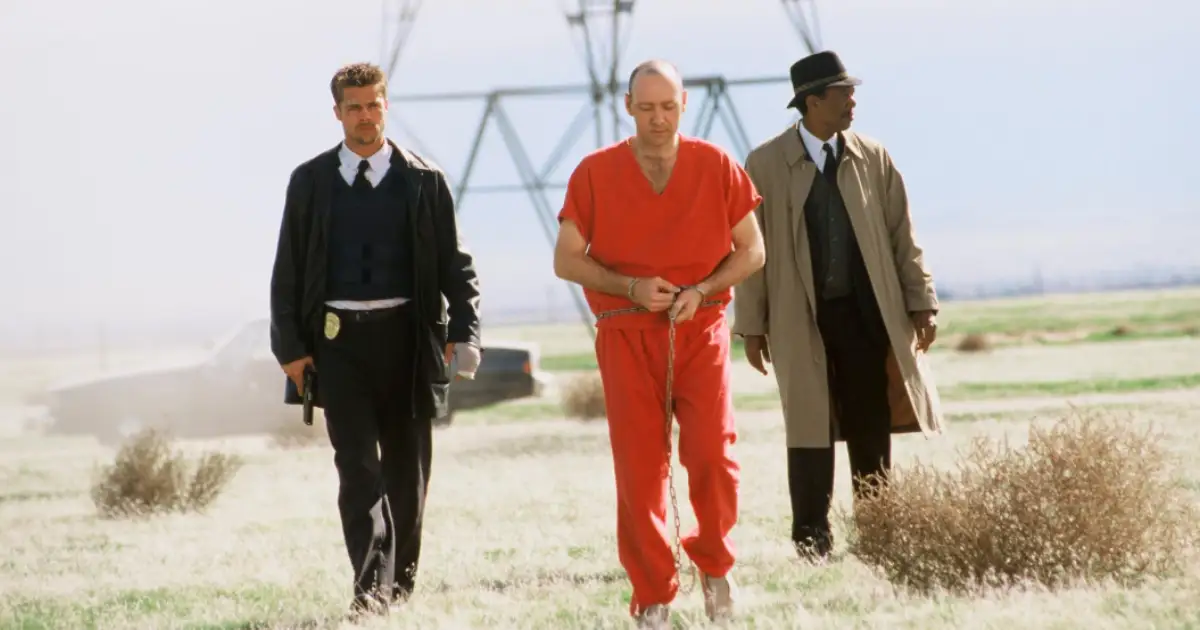
Se7en (or Seven) is the kind of crime thriller that doesn’t just unsettle you for two hours—it quietly rearranges the furniture in your head afterwards.
Released in 1995 and directed by David Fincher, Se7en is a bleak American crime thriller starring Morgan Freeman and Brad Pitt, with Gwyneth Paltrow in a crucial supporting role. It’s set in a rain-choked, unnamed city where two detectives follow a serial killer whose murders are staged around the seven deadly sins.
The first time I watched it properly, I admired it and resented it at the same time—because it doesn’t give you the emotional “exit” most Hollywood thrillers offer.
On my site, I list Se7en/Seven (1995) as one of the 101 must-watch films, because it’s both culturally influential and genuinely educational in how it builds dread and moral discomfort.
It’s also a film that still gets recommended by serious critics decades later—Roger Ebert, for example, calls it “one of the darkest and most merciless films ever made in the Hollywood mainstream.”
Before I spoil everything, it’s worth pausing on why Se7en hit so hard, and why it still does.
The screenplay came from Andrew Kevin Walker, who drew on his own experience of moving from a calmer place to a big, troubled city during a period of rising crime and drug addiction, and you can feel that “culture shock” in every grimy frame.
Fincher fought to keep the original bleak ending intact even when studio voices wanted something safer, and that stubbornness became the film’s defining moral punch.
Principal photography ran from December 1994 to March 1995 in Los Angeles, and the final result was made on a reported budget in the $33–34 million range.
It went on to gross about $327.3 million worldwide, turning into a sleeper hit despite its harsh content. Howard Shore’s score underlines the film’s coldness without ever “comforting” you, which is exactly the point.
Even the opening titles became part of the film’s legacy, with Art of the Title noting how the sequence helped drive the movie’s word-of-mouth impact and how its influence echoed across design culture.
That same write-up points out that the New York Times credited the title work as “one of the most important design innovations of the 1990s,” which is a rare kind of praise for something most viewers barely notice consciously.
Now, a clear warning: the plot section below contains full spoilers, including the ending.
Table of Contents
Background
Se7en (1995) came out of a very specific 1990s mood: urban anxiety, rising cynicism, and a mainstream appetite for thrillers that didn’t pretend the world was tidy.
The script was written by Andrew Kevin Walker, and David Fincher shaped it into a bleak, rain-soaked crime thriller that refuses an easy catharsis. The film stars Morgan Freeman and Brad Pitt as two detectives tracking a killer who stages murders around the seven deadly sins, with Gwyneth Paltrow in a key supporting role and music by Howard Shore.
Production-wise, it was filmed in Los Angeles from December 1994 to March 1995, and it was made on a reported budget of about $33–34 million. It went on to earn roughly $327.3 million worldwide, which is part of why it became such a lasting reference point in the serial-killer/thriller genre.
| Actor | Role |
|---|---|
| Brad Pitt | as Detective David Mills – a well-meaning but impulsive homicide detective whose volatility becomes central to the film’s final moral trap. |
| Morgan Freeman | as Detective Lt. William Somerset – a veteran, disillusioned detective lieutenant one week from retirement, trying to outthink a city (and a killer) that feels beyond saving. |
| Kevin Spacey | as John Doe – the serial killer who designs murders around the seven deadly sins, steering the investigation toward an ending meant to “complete” his message. |
| Gwyneth Paltrow | as Tracy Mills – Mills’ lonesome wife, the film’s main source of human warmth, and the off-screen centre of the ending’s cruelty. |
| R. Lee Ermey | as the Police Captain – the detectives’ grizzled superior trying to manage an investigation that becomes a public and psychological crisis. |
| Richard Roundtree | as District Attorney Martin Talbot – the district attorney pulled into the case as it escalates from homicide to headline-making terror. |
| John C. McGinley | as “California” – a SWAT team leader who enters when the investigation turns tactical and the crimes demand force as well as deduction. |
Se7en/Seven Plot
Consider this your last gentle exit before Se7en becomes a guided tour through deliberate nightmares.
The story opens in an unnamed, decaying city where it seems to rain as a default mood, and Detective Lieutenant William Somerset is counting down his final week before retirement.
Into this exhausted landscape arrives Detective David Mills, newly transferred, loud with impatience, and still young enough to believe that willpower can beat the job.
On Monday, they respond to a murder scene so grotesque it feels like a dare: an obese man forced to eat until he dies, with the word “gluttony” written as the killer’s signature.
The next day, the case shifts from disgusting to chillingly symbolic, and the detectives begin to suspect the deaths are being curated rather than committed impulsively.
The “greed” murder is staged as a cruel parody of punishment, and the breadcrumbs left behind feel intentional—like the killer wants to teach, not merely kill.
Soon after, they discover the “sloth” victim: a man emaciated and restrained in his bed for a year, kept alive as a living exhibit of suffering, which is the moment the film stops being a police procedural and becomes an endurance test for your imagination.
As the body count rises, the partnership becomes the film’s emotional engine: Somerset’s controlled intelligence trying to steer Mills’s anger into something useful.
Somerset pieces together the pattern as the seven deadly sins, and the idea lands with the weight of an old religious threat—simple words that still feel dangerous when someone treats them like a checklist.
If you want a plain reminder of how embedded this framework is in everyday language, even BBC Learning English casually references greed as “one of the seven deadly sins,” which shows how recognisable the concept remains outside theology.
Midway through the investigation, the film deliberately slows down to let something human breathe, and it’s one of the reasons the ending hurts as much as it does. Mills brings his wife Tracy to dinner with Somerset, hoping the older detective’s calm discipline might rub off on his marriage as well as his work.
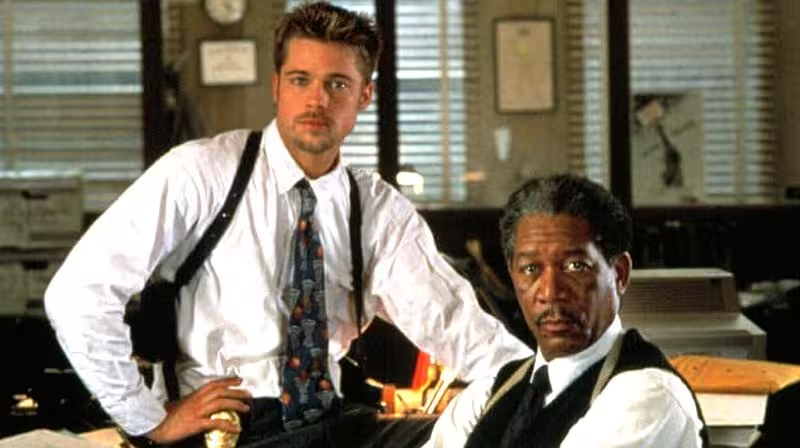
Tracy confides privately to Somerset that she’s pregnant, that she’s afraid of raising a child in this city, and that she hasn’t told Mills because she doesn’t want to burden him when he’s already under pressure.
Somerset admits he once urged a partner to have an abortion and that he regretted it, which is the closest the film comes to warmth—two people sharing the kind of truth that isn’t heroic, just honest.
For me, this scene is the emotional “trapdoor” of Se7en, because it quietly locks the audience into caring about a future the film is already preparing to destroy.
With time tightening, Somerset leans into research, tracking the sins through literature and clues, and the investigation pushes them toward a suspect rather than a mystery.
Their leads bring them to an apartment that screams obsession—journals, meticulous notes, the feeling of a mind that has made order out of ugliness—and when the killer returns, he flees, drawing the detectives into a frantic chase.
The killer even has a moment where he could finish Mills and doesn’t, which reads less like mercy and more like choreography: Mills is being preserved for a purpose.
From here, Se7en starts accelerating toward its endgame, and each step feels like it’s happening inside a tightening fist.
Somerset and Mills comb through what they can, tracing the killer’s movements and trying to anticipate the next sin before it becomes another body. The case also turns them into public spectacle—reporters push in, pressure mounts, and the city begins to feel like it’s watching the detectives as much as they’re watching the killer.
By the weekend, the murders become even more psychologically aggressive, as if the killer’s goal isn’t just to punish individuals but to prove a thesis about human nature. On Saturday, the “lust” crime is staged as an act of forced brutality, the kind of horror you don’t want described in detail, and the film is careful to let implication do most of the damage.
On Sunday, the “pride” victim is driven toward self-destruction after being disfigured, and again the killer’s “lesson” is that vanity is not a harmless sin but a doorway into despair.
Then the film pulls its most unnerving trick: John Doe surrenders. Covered in blood and eerily calm, he gives himself up, and the police can’t even enjoy the victory because he insists the final part of his plan is still in motion.
He demands to be driven to a location with Somerset and Mills, and the fact that the authorities comply feels like the film admitting a terrible truth: sometimes a criminal controls the story more than the system does.
What follows is one long, tense journey into open space where the city’s grime is replaced by a different kind of emptiness, and that emptiness is somehow worse.
A delivery van arrives, a small box is handed over, and Somerset’s reaction tells you everything before any words do.
Doe reveals the final sins as a trap: he claims envy drove him to covet Mills’s life, then says he went to Mills’s home, confronted Tracy, and that she “begged for her life” and for the baby she was carrying.
Somerset realises the box contains Tracy’s head, while Mills—still running on adrenaline and anger—can barely process what’s happening and keeps repeating the question audiences still quote: “What’s in the box?” Doe’s final push is vile in its precision: he wants Mills to become wrath, to complete the set, to turn a detective into the final exhibit.
Mills shoots Doe, and the film lands on a conclusion that feels both inevitable and preventable, which is exactly why it haunts.
In the aftermath, Mills is taken away in shock, and Somerset—who planned to retire—finds himself unable to simply step out of the world he wanted to escape. The film ends by echoing an Ernest Hemingway line about the world being “worth fighting for,” while also making it painfully clear that this belief is not a comfortable one.
When I reach the end of Se7en, I’m always struck by how the killer “wins” without surviving, because the real victory is psychological and it’s designed to outlive him.
Se7en/Seven Analysis
Direction and Cinematography
Fincher directs Se7en (1995) like he’s building a moral trap, not just a mystery.
According to Encyclopaedia Britannica, David Fincher is known for stylish work that trends dark and atmospheric, and Se7en is basically that description made flesh.
Britannica also notes his perfectionism and how he’ll shoot an enormous number of takes, which matches the film’s obsessive precision. And the production deliberately leaned into constant rain to make the city feel inescapable and to strip away any “sunny Los Angeles” association.
Cinematographer Darius Khondji described Klute (1971) as a key influence, especially its use of toplight and intimate widescreen compositions, and you can feel that in how faces and rooms look carved out of gloom.
The American Society of Cinematographers also frames Khondji’s Se7en work as a defining early Hollywood-studio feature for him, which helps explain the confidence in the look even when it’s ugly.
What I respect most is that when the studio complained the dailies were too dark, Fincher refused to “brighten” the film into something safer.
Acting Performances
The performances are the reason Se7en stays believable even when it’s morally unbelievable.
Morgan Freeman plays Somerset with a calm that feels earned rather than posed, and critics frequently singled him out as the film’s stabilising force.
Brad Pitt’s Mills is intentionally hot-headed and raw, and even where critics disagreed on his subtlety, that volatility is exactly what the ending needs.
Gwyneth Paltrow’s Tracy has limited screen time but functions as the film’s only real warmth, and reviewers noted both her effectiveness and how underused she is.
Kevin Spacey’s John Doe is praised for being creepy and understated rather than theatrical, which makes him feel like a real person who decided to become an idea.
The script’s smartest move is how it reshapes dialogue around the two leads so their personalities clash naturally rather than mechanically.
Se7en/Seven Themes explained
What is Se7en really saying, beyond “evil exists”?
One central theme is apathy, and the film treats the unnamed city like an infection point where decay is ambient rather than exceptional. Scholars quoted in the same source connect the omnipresent rain to a sense of sin getting into every crevice, which is why the film’s weather feels philosophical, not decorative.
When Somerset says people respond to “fire” more than “help,” it’s basically the movie’s thesis statement about selfish attention.
John Doe openly claims he’s sending a message about “the ubiquity of sin” and society’s indifference, and that self-righteous framing is what makes him scarier than a killer who simply enjoys killing. The film never proves he’s right, but it does show how easily disgust turns into spectatorship.
The seven deadly sins structure isn’t just a gimmick; it’s a way of turning morality into a machine that keeps moving even when the people inside it beg for it to stop.
And the most brutal message is that the “sins” aren’t limited to the victims—John Doe designs the final two to infect the investigators.
A big, uncomfortable theme is how culture turns killers into events, because Se7en understands that notoriety can be a kind of afterlife. The same analysis notes debate around whether discussing and studying figures like Doe risks validating them, which is a frighteningly modern question in an attention economy.
I feel this every time someone quotes “What’s in the box?” like it’s a meme divorced from grief—because the line is actually the sound of a life collapsing in real time. Somerset’s meticulousness and Doe’s meticulousness also mirror each other in a way that hints the film’s darkest idea: that order and intelligence are not automatically virtues.
And Mills’s anger isn’t merely a character flaw—it becomes the final instrument, which is why the ending feels like an execution of a plan rather than a spontaneous tragedy.
So what does the ending of Se7en (1995) mean in plain terms: Doe “wins” by turning envy into a confession and wrath into an action, forcing Mills to complete the set.
The last words—Somerset quoting Hemingway about the world being worth fighting for, but only agreeing with “the second part”—leave you with a kind of bruised hope rather than comfort.
And yes, the bleakness was contested behind the scenes, but the ending survived because the filmmakers believed the story’s point collapses without it—something Entertainment Weekly describes through the tension between studio concerns and the original conclusion.
Comparison: Se7en (1995) in its thriller family tree.
If The Silence of the Lambs is a cat-and-mouse thriller dressed in procedural elegance, Se7en (1995) feels like a moral contagion spreading through a city that has already given up.
David Fincher’s film shares the serial-killer architecture you’ve seen elsewhere, but it refuses the comfort of mastery—the idea that evil can be neatly “solved” and then sealed away.
It also sits closer to noir than to a conventional police thriller: the case is a corridor, not a destination, and the air itself feels poisoned.
And unlike many imitators, Se7en doesn’t glamorise the chase so much as interrogate why the chase starts to resemble compulsion.
When I compare it to Fincher’s later Zodiac, I feel a shift from apocalyptic certainty to obsessive ambiguity, but the emotional DNA is recognisably his.
Both films stare at systems—policing, media, public appetite—and ask what they do to the human beings trapped inside them.
What sets Se7en apart is that it uses the mechanics of a genre film to stage a philosophical ambush, and then it walks away without apologising.
Audience appeal and reception.
If you’re a casual viewer who wants a clean “bad guy caught, world restored” arc, Se7en is going to feel like a deliberate act of sabotage.
But if you like dark thrillers, neo-noir, or films that leave a residue in your thinking, it’s almost designed to become a reference point you keep returning to.
Critically, it has held up extremely well: Rotten Tomatoes lists an 83% critics score (with a 95% audience score), while Metacritic gives it a 65 (generally favourable).
Those numbers matter less to me than the pattern behind them—people don’t just “like” Se7en; they argue with it, and that argument is part of its longevity.
It’s the sort of film cinephiles rewatch for structure and symbolism, while first-timers remember it as an experience their body went through.
Awards
The Academy Awards nominated Se7en for Best Film Editing (Richard Francis-Bruce) at the 68th Oscars. (Oscars)
At the BAFTAs, it was a nominee for Best Original Screenplay (Andrew Kevin Walker), which makes sense to me because the script’s boldest trick is how patiently it tightens the noose.
And yes—on Probinism, it’s explicitly listed as one of the 101 Best Films You Need to See, which is exactly the kind of canon slot this movie earns by being unforgettable rather than “pleasant.” Se7en is one of the highest rated film on IMDb with 8.6 stars while The Shawshank Redemption (1994) has highest rating of 9.3 of 10 stars.
Personal insight and lessons: what Se7en (1995) keeps teaching me now.
I think about Se7en most when the modern world feels loud, flooded, and strangely numb at the same time.
We live in an era where brutality is not only reported but packaged, shared, clipped, and reacted to in real time, and the sheer volume can make empathy feel like a muscle that cramps.
Fincher’s rain-soaked city has always felt metaphorical, but today it also feels predictive: a place where people are surrounded by signals and still starved of meaning.
When I rewatch the film now, I don’t just see a serial-killer story—I see a meditation on attention, and on how moral certainty can become a drug.
The killer’s “lesson plan” is monstrous, but the film’s unsettling insight is that he’s building it on a real foundation: public apathy, private loneliness, and the temptation to treat human beings as examples.
That hits differently in a time when algorithms reward outrage and when being “right” can matter more than being humane.
What the ending keeps whispering to me is that vengeance is not justice—it’s just pain that has found a language. Mills believes he’s walking into a case, but he’s really walking into a trap built out of his own identity: pride in his strength, impatience with ambiguity, hunger to be the hero who ends the story.
Somerset, meanwhile, is a portrait of fatigue—the kind of intelligence that has seen too much and is tempted to call detachment “wisdom” because feeling hurts. The film scares me because it suggests both men are vulnerable in opposite directions: one to rage, one to resignation.
And the city around them feels like the third character, constantly teaching the same bleak curriculum: don’t care, don’t look, don’t stop.
So the lesson I take—painfully, imperfectly—is a practical one: if you want to stay human, you have to choose your attention on purpose.
You have to keep your moral imagination alive even when it’s inconvenient, because the alternative is either apathy (Somerset’s risk) or fanaticism (John Doe’s pose), and both end up shrinking the world.
That’s why Se7en still matters to me today: it doesn’t merely show evil; it shows the emotional conditions that let evil become theatrical, and it asks what kind of person you become when you watch.
Some films end, and you feel relief; Se7en (1995) ends, and you feel implicated.
Quotations
The most famous quote is famous because it’s a breakdown, not a punchline. And the last quotation matters because it argues with you after the credits, which is why I think Se7en deserves its place among my 101 must-watch films list.
Here are a few that still sting on rewatch, and I’m keeping them short because the full context is the real knife.
- “What’s in the box?”
- “Detective Mills, M-I-L-L-S, … off!”
- “We’ll just talk to him.” / “Are you, by any chance, a serial killer?”
- Hemingway’s “The world is a fine place and worth fighting for…” (followed by Somerset’s reluctant agreement with only “the second part”)
Pros and Cons
This is where I stop describing what the film is and say what it does to a viewer.
I find it masterful, but I’d be lying if I said it’s an “easy” watch.
Pros:
- Oppressive, unforgettable atmosphere and visuals
- Two-lead chemistry that feels like lived experience
- A structure that escalates with terrifying clarity
Cons: - Relentless bleakness that some viewers will reasonably reject
- A few moments where the killer’s control can feel “too perfect” if you demand strict realism
- Content that is disturbing enough to require real emotional readiness
I still think the “slow” stretches are purposeful, because they create the lull that makes the final trap land like a body blow.
And if you’re wondering whether it’s “worth it,” the answer depends on whether you want entertainment, or a film that studies you back.
Conclusion
I recommend Se7en as a must-watch for thriller and neo-noir fans who can handle a genuinely dark moral ending.
My rating: 4.5/5.
