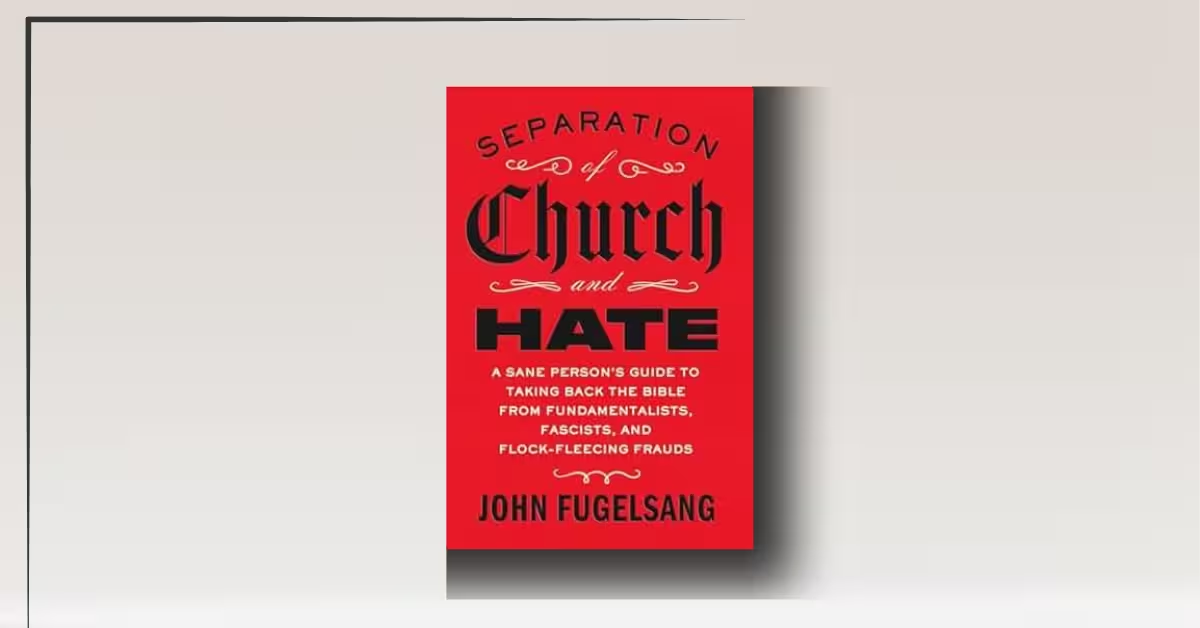
If you’ve ever felt your faith—or your family chat—hijacked by cherry-picked verses and political talking points, Separation of Church and Hate gives you language, history, and scripture to get the conversation (and the Gospel) back.
Christianity isn’t a culture war; it’s a practice of mercy, service, and peacemaking—and when you put Jesus’ teachings first, the case against Christian nationalism, cruelty, and performative piety becomes both biblically obvious and morally urgent.
Fugelsang builds his case on Jesus’ own words (Matthew 5–7; Matthew 25) and applies them to modern U.S. politics with pointed statistics—e.g., roughly three in ten Americans qualify as Christian nationalism adherents or sympathizers, a stable figure since 2022 (PRRI’s national survey of 22,000+ adults).
He also threads in current events like Alabama’s 2024 nitrogen-gas execution—condemned by U.N. experts and covered by BBC, AP, and others—to show how “law and order” rhetoric collides with a Messiah who overturned lex talionis.
Inside the book, he quotes and glosses Jesus’ Sermon on the Mount, opposition to public show-prayer, and the Matthew 25 “least of these” mandate.
Separation of Church and Hate is best for readers who are exhausted by “Bible-as-brand” politics, progressive believers seeking a scriptural backbone, and curious non-believers who want to understand Jesus’ ethic without supernatural buy-in.
Not for readers who prefer partisan sermons, punitive theologies, or culture-war victory laps over hard, humble work with the poor, the sick, the stranger, and the incarcerated.
Table of Contents
1. Introduction
Separation of Church and Hate: A Sane Person’s Guide to Taking Back the Bible from Fundamentalists, Fascists, and Flock-Fleecing Frauds by John Fugelsang (Avid Reader Press / Simon & Schuster). Publisher materials list the U.S. release for late summer 2025.
Part polemic, part pastoral toolkit, the book sits at the intersection of religion, politics, and media criticism; Fugelsang is a comedian and broadcaster (host of SiriusXM’s Tell Me Everything) known for witty, historically literate riffs on theology and public life.
The opening pages set the tone with a now-viral refrain: Jesus was an “anti-wealth,” “anti–death penalty,” “anti–public prayer” brown-skinned Palestinian Jew—“but only if you believe what’s actually in the Bible.”
Fugelsang’s thesis is simple: prioritize what Jesus taught and did, and much of today’s Christian-branded grievance politics collapses under the weight of the Sermon on the Mount and the Judgment of the Nations (Matthew 25).
2. Background
Raised by a former nun and a former Franciscan brother, Fugelsang writes from a lived tension between reverence and resistance—“I’m here because two people broke a promise to God”—a line that tells you you’re in memoir territory even as you enter a catechism of dissent.
He situates his project amid a measurable political trend: PRRI finds 29% of Americans align with Christian nationalist ideas (10% adherents; ~19–20% sympathizers), with higher concentrations in several Southern states.
3. Separation of Church and Hate Summary
Highlights
Jesus’ actual teachings—not partisan proof-texts—are the measuring rod.
Fugelsang returns again and again to the Sermon on the Mount (Matthew 5–7) and the Judgment of the Nations (Matthew 25) to argue that public Christianity should look like humility, mercy, peacemaking, and concrete care for “the least of these,” not theatrical piety or punitive policy. “And when you pray, do not be like the hypocrites… to be seen by others,” he quotes, before reminding readers that Jesus prescribes private prayer instead: “go into your room, close the door” (Matthew 6:5–61).
From there, he builds a simple, radical thesis: Jesus explicitly overturns retaliation (“Eye for eye… But I tell you, do not resist an evil person”), commands love of enemies, and lays down the Golden Rule as the baseline for politics and policy.
The result is a counter-narrative to Christian nationalism2: the Beatitudes bless the poor, the meek, mourners, and peacemakers; none of that baptizes cruelty, domination, or culture-war swagger.
A signature chapter tackles capital punishment head-on: as of the book’s publication, 21 U.S. states still execute prisoners; every U.S. president has claimed Christianity, but only Jimmy Carter explicitly cited Christ to oppose the death penalty, and in 2024 President Joe Biden commuted most federal death-row sentences to life in prison.
He frames the moral crux with Sister Helen Prejean3’s question—“The profound moral question is not, ‘Do they deserve to die?’ but ‘Do we deserve to kill them?’”—and then returns to Jesus’ rejection of retribution.
He also unpacks “fulfilling the law” (Matthew 5:174): Jesus doesn’t re-activate every Levitical rule; he completes the law’s purpose and shifts the emphasis to love, grace, and compassion—signaled by the repeated formula, “You have heard… but I tell you…”.
And when someone insists that helping the poor is only a church job, not a government one, he points straight to Matthew 25—Jesus’ global standard for nations—and argues that laws can be written to reduce poverty and protect dignity.
Detailed summary
1. Opening gambit: strip the brand off the Bible
Fugelsang begins by separating two things many public debates conflate: the teachings of Jesus and the uses of “Christianity” in American politics.
He foregrounds the universals that “cut across religious and secular boundaries”—love of enemies, care for the poor and marginalized, and the Golden Rule—observing that “these teachings don’t require belief in supernatural events to be meaningful.”
He sketches Jesus’ social practice: sharing resources, breaking cycles of retaliation (“turn the other cheek”), and crossing purity lines to be with the excluded.
This is also where he sharpens the contrast between Jesus’ ethic and contemporary pieties: Jesus supports paying taxes in Mark 12:175, forbids his disciples from using weapons in Matthew 26:526, and interrupts a legal execution in John 8—each a jab at our instinct to conscript Jesus into partisan scripts.
The rhetorical pivot is deliberate: rather than arguing about abstract “Christian values,” he insists we read what Jesus actually commands.
2. Prayer, performance, and the staging of piety
The book pivots from values to visibility: Jesus explicitly warns against public theater-religion.
Quoting Matthew 6:5, Fugelsang writes: “do not be like the hypocrites… to be seen by others,” and immediately pairs it with Jesus’ direction to pray in private.
It’s not an anti-public-faith screed; it’s a claim about motive. The point is whether a public act flows from service—or from self-promotion. He calls this craving “a thirsty public audition for America’s Next Top Christian,” a line that threads humor into exegetical clarity.
3. “That Sermon on that Mount”: the manifesto chapter
Fugelsang treats the Sermon on the Mount like a constitution for Christian ethics.
He compresses the Sermon’s arc: reject vengeance; practice humility over religious superiority; love persecutors; suspend hypocritical judgment; live the Golden Rule; and internalize the Beatitudes as the movement’s DNA.
He highlights Jesus’ blessings on the poor, mourners, meek, merciful, and peacemakers—an index of who gets centered in the Kingdom.
Two interpretive keys do the heavy lifting here. First, Jesus’ repeated “You have heard… but I tell you…” formula is not a verbal tic; it is an authority claim and a legal hermeneutic, fulfilling the law by intensifying its aims toward love and reconciliation.
Second, “fulfilling the law” (Matthew 5:17) points to a New Covenant emphasis on grace and compassion, not a cut-and-paste of every Mosaic penalty.
4. The law, the Prophets, and the “fulfillment” debate
Anticipating pushback, Fugelsang addresses the common rejoinder: “Jesus came to fulfill the law, not abolish it.”
He parses this with examples: murder moves from act to anger; adultery from deed to desire; retaliation to non-resistance—each “but I tell you” a re-calibration from legal minimalism to heart-level maximalism.
The upshot is not antinomianism; it’s that Jesus is Lord of the interpretive tradition, and Christians should “prioritize following Jesus’s words above the other parts of the Bible.”
5. Capital punishment: the book’s most sustained policy case
The longest sustained polemic is the death-penalty chapter—titled, with gallows wit, “THOU SHALT NOT KILL PEOPLE WHO KILL PEOPLE TO PROVE KILLING PEOPLE IS WRONG.” Fugelsang stacks moral, constitutional, and empirical appeals (deterrence doubts; Eighth Amendment arguments; the prevalence of serious mental illness on death row), but he knows his readers: “at the end of the day, these stats and facts won’t move our Christian brothers and sisters,” so he returns to Jesus.
The theological case is concise: Mosaic retribution (“life for life… eye for eye”) was a stage in Israel’s legal development; Jesus overturns it in his first sermon and commands non-retaliation.
He then shows Jesus confronting legal execution in John 8 (“Let any one of you who is without sin be the first to throw a stone”), reframing justice around humility and universal fallenness.
For stakes and context, he names the politics plainly: most Americans have supported capital punishment, though support has declined; the loudest “small government” voices often still want a state powerful enough to kill.
The tension is especially jarring on Good Friday, he notes, when pro-death-penalty Christians commemorate the execution of an anti-death-penalty Jesus.
6. Matthew 25: “Jesus goes global”
If the Sermon on the Mount is Jesus’ Woodstock, Fugelsang calls Matthew 25 his Live Aid: Jesus judges nations (not merely individuals) by their treatment of the hungry, thirsty, stranger, naked, sick, and imprisoned.
The “sheep and goats” parable is therefore a public policy ethic, not a private charity hint. He follows this with a straightforward claim: when someone says “that’s church work, not government,” you’re hearing a voting-booth rationale for sidestepping Jesus’ clearest national standard.
Laws can be written to fight poverty and protect human dignity; a society must simply want that.
7. Pharisees, stereotypes, and honest context
Midway, the book widens the lens on Pharisees. Rather than treating them as cartoon villains, Fugelsang consults Rabbi Danya Ruttenberg, who reminds readers that Pharisaic tradition was democratizing and debate-driven; what reads to outsiders as “ferocious rebuke” can also be intra-Jewish argument with rules, parameters, and mutual sharpening.
That correction underlines a core method of the book: resist easy caricatures—of Scripture, of Judaism, of your opponents—and do the harder, contextual reading.
8. Internal tensions and talking points: inconsistency isn’t the point
One resource chapter equips readers for conversations with literalists by listing apparent contradictions (e.g., where Peter confesses Jesus; “mount” vs. “level plain” sermons; Noah’s animal counts; how Judas dies).
The aim is not to dunk on Scripture but to show that the Gospel’s message does not depend on harmonizing every detail: the empty tomb and the women witnesses remain central whether two or three arrived first.
9. Parables, satire, and saying the quiet part safely
Fugelsang pauses to explain why Jesus loves parables: indirect speech carries truth past censors, much like satire.
That connection—parables to comedy—doubles as the book’s tone guide: pointed but invitational, funny but focused.
The big takeaway he attaches to this section repeats the front-matter theme: Jesus’ wisdom is legible even to skeptics because its demands—love enemies, help the poor, treat people as you want to be treated—are universally intelligible.
10. Government, taxes, and “render unto Caesar”
Fugelsang puts Mark 12:17 on the table (“render unto Caesar”), making the counterintuitive observation that Jesus endorses paying taxes and, by implication, the redistribution that governments perform. That, combined with Matthew 25’s national judgment scene, makes a strong case that Christian political reasoning cannot stop at “private charity only.”
11. The book’s rhetorical spine: mercy over retaliation, humility over performance
Threaded through every chapter are short, memorable lines that crystalize the thesis:
- “Prayer is… personal and humble communion with God, not one’s thirsty public audition for America’s Next Top Christian.”
- “Blessed are the merciful…”: the opening move of Jesus’ legal reinterpretation toward mercy.
- “You have heard… but I tell you…”: the refrain of authority and fulfillment.
- “Let any one of you who is without sin be the first to throw a stone”: the classic disarming of a legally sanctioned execution.
12. Where the book anticipates your hardest conversations
Fugelsang is a broadcaster; he understands that most readers will meet these ideas not in seminars but in text threads and holiday tables. So he arms you with:
- Scripture-first counters to pro-death-penalty proof texts—“Jesus overturns ‘eye for an eye’” and institutes non-retaliation from the jump.
- Policy coherence arguments: if you believe in small government, be wary of granting it the power to kill; if you claim national Christianity, meet the Matthew 25 standard.
- Context correctives: respect Jewish debate culture when reading “Pharisees,” and resist lazy villainy tropes.
13. Tone, humor, and the “field manual” feel
Even the chapter titles and asides signal that this is catechesis with a wink—not to trivialize the stakes, but to keep the conversation human.
You’ll spot pop-culture nods (“Woodstock,” “Live Aid”), rhetorical over-explanations (“if you’re into that sort of thing” about the Eighth Amendment7), and barbed summaries of inconsistency lists that nonetheless land in a pastoral place: the core of the faith is intact even if you don’t solve every harmonization puzzle.
14. A last word on audience: who is this for?
If you identify as a believer who’s uncomfortable with Christian nationalism, or a non-believer who’s curious why so many Christians reject cruelty in Jesus’ name, the book reads like a personal toolkit.
It gives you quotable scripture, historical perspective, and policy-adjacent reasoning you can actually use—without demanding allegiance to every doctrinal claim.
Thematic lessons
1) Jesus > brand.
- Argument: Center Jesus’ teachings to unmask culture-war distortions.
- Evidence: Universals (Golden Rule, love enemies) work across belief lines.
- Lesson: Lead with the red letters, not cable-ready slogans.
2) Mercy > retaliation.
- Argument: Non-retaliation replaces lex talionis8; executions contradict Jesus’ ethic.
- Evidence: Matthew 5:38–399; John 8; Sister Helen Prejean.
- Lesson: If policy can’t pass the “would you want this done to you?” test, it won’t pass Jesus’ test either.
3) Humility > theater.
- Argument: Public piety for applause is anti-Jesus.
- Evidence: Matthew 6:5–610’s command for private prayer.
- Lesson: Quiet faith, loud service.
4) Nations judged by mercy.
- Argument: Jesus judges nations on care for the vulnerable.
- Evidence: Matthew 25, “sheep and goats.11”
- Lesson: Policy is moral when the hungry eat, the stranger is welcomed, the prisoner is visited.
5) Fulfillment > literalism.
- Argument: Jesus fulfills and deepens the law; not every ancient penalty remains binding.
- Evidence: “You have heard… but I tell you…” refrain; Matthew 5:17.
- Lesson: Christian ethics take their final form in Jesus’ voice.
6) Honesty > gotchas.
- Argument: Apparent contradictions exist; they don’t dissolve the message.
- Evidence: Peter’s confession locations; Judas’ death accounts; Noah’s animal counts.
- Lesson: Read Scripture for its through-line, not as a trivia test.
Memorable lines
- “Do not be like the hypocrites… to be seen by others.” (Matthew 6:5)
- “Go into your room, close the door, and pray.” (Matthew 6:6)
- “Eye for eye… But I tell you, do not resist an evil person.” (Matthew 5:38–39)
- “Let any one of you who is without sin be the first to throw a stone.” (John 8:7)
- “Blessed are the merciful.” (Matthew 5:7)
- “Do to others what you would have them do to you.” (Matthew 7:12)
- “Jesus was … anti-wealth and anti–death penalty … Anti–public prayer, too (Matthew 6:5) … brown-skinned … Palestinian … unarmed … homeless Jew—but only if you believe what’s actually in the Bible.”
- “And when you pray, do not be like the hypocrites … to be seen by others.”
- “The King will reply, ‘Truly I tell you, whatever you did for one of the least of these … you did for me.’”
- “You have heard … ‘Eye for eye’ … But I tell you, do not resist an evil person. If anyone slaps you … turn to them the other cheek also.”
- “He treated them all with compassion, directing his anger instead toward economic injustice and exploitation.”
Final synthesis
Separation of Church and Hate reads like a field manual for anyone trying to talk about Jesus without losing the plot to politics.
Chapter by chapter, Fugelsang invites readers to test every hot take against a short list of Jesus’ own demands: love enemies; reject retaliatory violence; avoid performative religion; treat others as you want to be treated; and measure public life by how it treats the hungry, the stranger, the sick, and the imprisoned.
The book’s data points—the 21 states executing as of publication, the 2024 federal commutations—are not there to substitute for theology but to bring theology to ground.
What makes the argument persuasive is its consistency: whether the topic is taxes, prayer, punishment, or poverty, the same through-line holds.
If a position can’t sit comfortably inside the Beatitudes or the Golden Rule, the book argues, it probably isn’t Christian—at least not in the Jesus sense of the word. And if a nation wants to call itself Christian, Matthew 25 gives the audit rubric in plain language.
This is the kind of summary Fugelsang is aiming for in the first place: not a new ideology, but a return to first principles—so self-evident in the red letters that, once you see them, it becomes difficult to un-see how far our public religion sometimes drifts.
4. Separation of Church and Hate Analysis
Evaluation of Content.
At its best, the book is a scriptural explainer wrapped in stand-up timing: “I’ve come to view Jesus the way I’ve come to view Elvis. I love the guy, but some of the fan clubs terrify me.”
That humor opens the door to precise exegesis. Fugelsang cites Matthew 6:5–6—Jesus’ clear rebuke of public show-prayer—before immediately showing how today’s televised piety flips the ethic on its head.
He then layers the Beatitudes, the command to love enemies, and the Golden Rule to argue that coerced public religion is not Jesus’ model; humble, private devotion and public mercy are.
Fugelsang’s most persuasive chapter centers Matthew 25. He quotes the king’s judgment—“whatever you did for one of the least of these … you did for me”—to insist that Christian political witness must preferentially bend toward food, shelter, health, and prison visitation.
It’s hard to miss the contemporary resonance when he adds: Jesus’ second speech in that same passage condemns those who withheld these acts of mercy.
Where the book moves from biblical to brutally topical is its treatment of the death penalty. Fugelsang shows how Jesus explicitly overturns “eye for an eye” in his first sermon: “You have heard that it was said … But I tell you, do not resist an evil person.”
He sets that against 2024 headlines: Alabama’s nitrogen-gas execution of Kenneth Eugene Smith drew condemnation from U.N. experts, with global outlets reporting witnesses who described Smith thrashing and suffering for minutes.
The clash is stark: a crucified, anti-death-penalty Jesus versus political theater that some called “state-sanctioned torture.”
Does the book fulfill its purpose?
When Fugelsang sticks to “What did Jesus command?” the book shines; by returning to servant leadership and the ethics of the Sermon on the Mount, he equips readers to answer not with snark but with scripture.
It’s less a deconstruction than a re-construction: take Jesus at his word about violence, wealth, strangers, prisons, and prayer—and watch the culture-war scaffolding wobble.
5. Strengths and Weaknesses
What worked for me.
First, the clarity of the canon: by prioritizing red-letter teachings over partisan proof-texts, Fugelsang gives both Christians and skeptics a shared moral grammar—“teachings don’t require belief in supernatural events to be meaningful.”
Second, the Matthew 25 chapter reads like a civic lectionary for voters who wonder what “Christian policy” would actually look like when the poor, sick, immigrant, and incarcerated are centered.
Third, the anti-execution section is devastating, pairing Jesus’ words with contemporary reporting and even the Catholic witness of Sister Helen Prejean.
Where it strained my patience.
The tone sometimes oscillates from pastoral to punchline so quickly that readers allergic to satire might miss the serious argument underneath; Kirkus flagged the same register clash in its review.
And while the book offers a sharp diagnosis of “Christianity-as-brand,” some policy sections could use more granular engagement with how non-profits, congregations, and governments can realistically shoulder Matthew 25 commitments at scale.
6. Reception
Early trade and media notes frame Separation of Church and Hate as a lively “how to argue with Christian nationalists” manual, with a release pegged to August/September 2025.
PopMatters called it a reference guide for “fraught cultural-political times,” while The Humanist praised its clarity for both believers and non-believers.
Beyond reviews, the argument lands in a moment when Pew shows the Christian share stabilizing around the low 60s after years of decline—a reminder that faith remains a majority identity even as public trust in institutional religion shifts.
7. Comparison with similar works
Fugelsang’s book sits on a shelf with titles that deconstruct Christian nationalism and retrieve Jesus’ social ethic, but his tone is distinct—equal parts catechism and comedy.
Where a PRRI/Brookings-inflected policy analysis (or works by historians of American religion) will map ideology with bar graphs, Fugelsang responds with the Beatitudes, Golden Rule, and the “least of these” as a political hermeneutic.
Compared with progressive Christian memoirs, this reads more like a field manual for family arguments: he quotes the Bible, then translates—sometimes with a zing, sometimes with a hug.
8. Applicable takeaways
When in doubt, read Matthew 25 out loud; if a policy hurts “the least,” it misses Jesus.
Don’t confuse public performance with prayer; Jesus says go to your room, shut the door.
On violence and vengeance, Jesus replaces retribution with mercy and non-retaliation—full stop.
If someone cites “Christian nation,” ask them to define it in terms of the Sermon on the Mount, not cable news.
Keep the data handy: CN support ≈ 29% nationally; policy built around grievance is loud, not popular.
9. Conclusion
If you’re a pastor, parent, teacher, journalist, or just the designated peacemaker at Thanksgiving, Separation of Church and Hate is the one book I’d hand you before the next round of “What would Jesus vote?” debates.
It’s suitable for general readers (no seminary degree required) and invaluable for specialists who need crisp, quotable summaries of scripture-first ethics amid the noise.
It won’t please readers who want Jesus as a mascot for punitive politics, but it will strengthen anyone who suspects the Sermon on the Mount—not performative religiosity—should set the tone for public life.
Notes
- 5 “And when you pray, do not be like the hypocrites, for they love to pray standing in the synagogues and on the street corners to be seen by others. Truly I tell you, they have received their reward in full. 6 But when you pray, go into your room, close the door and pray to your Father, who is unseen. Then your Father, who sees what is done in secret, will reward you. ↩︎
- Christian nationalism is a political and cultural movement that seeks to advance and enforce specifically Christian beliefs and values within public institutions and national identity, aiming to secure Christian dominance across political, social, and cultural life. ↩︎
- Helen Prejean CSJ is an American Catholic religious sister and a leading advocate for the abolition of the death penalty. ↩︎
- 17 “Do not think that I have come to abolish the Law or the Prophets; I have not come to abolish them but to fulfill them. ↩︎
- 117 Then Jesus said to them, “Give back to Caesar what is Caesar’s and to God what is God’s.” ↩︎
- 52 “Put your sword back in its place,” Jesus said to him, “for all who draw the sword will die by the sword. ↩︎
- In the United States, it’s part of the Bill of Rights and prohibits excessive bail, excessive fines, and cruel and unusual punishments ↩︎
- The law of retaliation, whereby a punishment resembles the offence committed in kind and degree. ↩︎
- 38 “You have heard that it was said, ‘Eye for eye, and tooth for tooth.’ 39 But I tell you, do not resist an evil person. If anyone slaps you on the right cheek, turn to them the other cheek also. ↩︎
- 5 “And when you pray, do not be like the hypocrites, for they love to pray standing in the synagogues and on the street corners to be seen by others. Truly I tell you, they have received their reward in full. 6 But when you pray, go into your room, close the door and pray to your Father, who is unseen. Then your Father, who sees what is done in secret, will reward you. ↩︎
- 31 “When the Son of Man comes in his glory, and all the angels with him, he will sit on his glorious throne. 32 All the nations will be gathered before him, and he will separate the people one from another as a shepherd separates the sheep from the goats. 33 He will put the sheep on his right and the goats on his left. ↩︎
Read also