
What if the real romance in Shakespeare in Love (1998) isn’t between two people, but between a writer and the act of writing itself?
John Madden’s Shakespeare in Love (1998) is a romantic comedy-drama set in Elizabethan London, released in 1998, and it playfully imagines how William Shakespeare might have stumbled into writing Romeo and Juliet. It is also one of those films that wears intelligence lightly, like a velvet cloak you only notice once you’re already warmed by it. I came away feeling oddly cheerful, then slightly bruised—because the movie knows how to flirt, and it also knows how to say goodbye.
I’m mentioning it here because I consider it one of the 101 must-watch films, and I’ve already pointed readers on probinism.com toward that larger journey through cinema. It’s the kind of movie that rewards rewatching: the jokes land twice, and the heartbreak lands harder the second time.
The keyword I keep returning to is “delight”, although the delight comes with teeth.
I first watched it expecting a costume romance, and I didn’t expect it to feel like a love letter to rehearsal rooms and creative panic.
Before the lovers even lock eyes, the film sets up a world where theatre is messy commerce, censorship, vanity, and hunger, all at once.
The screenplay was developed from Marc Norman’s idea, with Tom Stoppard brought in to deepen and sharpen it, and the film ultimately landed under Miramax with John Madden directing. It became a box-office and critical hit, and it famously won Best Picture at the Oscars for films released in 1998.
On the official Oscars site, you can see it listed among the major wins at the 71st Academy Awards ceremony (held in 1999).
Its cultural afterlife has been loud ever since, partly because it beat Saving Private Ryan for Best Picture, an upset Britannica explicitly notes as surprising at the time.
Historically, the movie leans into the reality that women were forbidden on the English stage, which becomes the engine of its disguise plot and much of its tension. Even the BBC Shakespeare Archive synopsis foregrounds Viola’s disguise as “Thomas Kent,” which is basically the film’s spark plug.
Table of Contents
Shakespeare in Love Plot
Will Shakespeare begins the story not as a monument, but as a working writer with a deadline and a headache.
In London’s theatre world, money is immediate and brutal, and Philip Henslowe of the Rose Theatre is literally being tortured because he owes the financier Hugh Fennyman.
Henslowe tries to buy time by promising a brand-new comedy from a rising playwright, a play with the wonderfully ridiculous working title Romeo and Ethel, the Pirate’s Daughter. The problem is that Shakespeare has writer’s block, and “new play” is more of an optimistic rumour than an actual script.
From the start, the film treats writing as a kind of superstition that everyone depends on, but nobody can force.
Shakespeare’s block isn’t presented as gentle melancholy; it’s closer to humiliation, because he has reputation but not cash, and the theatre needs pages, not poetry.
At a tavern, Christopher Marlowe drifts into the story like the charismatic friend who always seems to have the better line, and he casually offers Shakespeare plot ideas. It’s one of the film’s sly jokes: genius is collaborative, even when history prefers lone legends.
Meanwhile, Henslowe holds auditions because he believes the play is nearly finished, which is either faith or madness.
At the auditions, a young performer calling himself Thomas Kent reads so intensely that Shakespeare is immediately struck, not just by talent, but by a kind of focused desire that feels like the missing ingredient.
Kent bolts before formalities can pin him down, and Shakespeare follows, chasing the feeling like it’s a sentence he can’t quite complete. The pursuit leads all the way to a wealthy home, where we learn “Kent” is actually Viola de Lesseps, a noblewoman who adores the theatre and has disguised herself because women cannot perform.
Viola isn’t simply “in disguise”; she is in rebellion, and the movie makes that rebellion romantic without pretending it’s safe.
Viola’s nurse quietly enables the deception, accepting Shakespeare’s note that “Kent” has been cast, and the lie becomes a doorway that can’t be easily closed. That same night, Shakespeare sneaks into a party celebrating Viola’s engagement to Lord Wessex, a match that is political and profitable, not tender.
Wessex notices the pull between Viola and this unknown man, threatens him, and Shakespeare panics—giving the name “Christopher Marlowe” as a false identity before fleeing. As Shakespeare escapes into the night, inspiration finally hits, and he begins writing again with the urgent relief of someone who has been drowning.
This is the film’s central seduction: it makes you feel that desire can unlock language, and that language can remake desire.
Back at the theatre, Shakespeare’s imagined comedy starts mutating, because what he’s actually living is not farce but tragedy.
John Webster, a boyish would-be actor, is dismissed, while the swaggering star Ned Alleyn is nudged into taking a key role, because theatre is always compromise with ego.
Shakespeare discovers that his Romeo is Viola, and once the secret is shared, their affair becomes both a romance and a rehearsal process—touching, testing, improvising. As Shakespeare writes, the play shifts into Romeo and Juliet, as if the story he’s making is the only container large enough for what he’s feeling.
Viola’s double life becomes exhausting: dutiful fiancée by day, ravenous actor and lover by night.
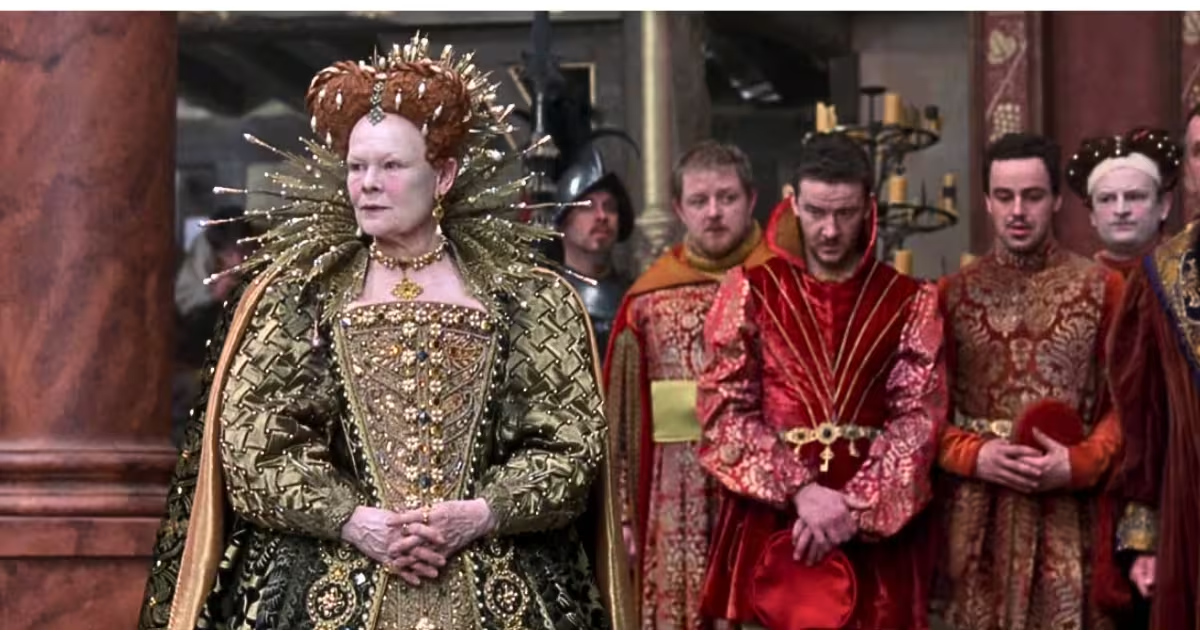
The film also brings in Queen Elizabeth as a kind of amused referee, summoned because Viola’s engagement matters to court politics, and Elizabeth senses Viola’s passion for theatre.
The romance continues, but the world tightens around it, because the Master of the Revels, Tilney, polices morality and legality, and a woman on stage is forbidden. John Webster, resentful and hungry for attention, spies on Viola and Shakespeare, and the secret becomes leverage rather than intimacy.
At this point, the movie begins to feel like a clock: you can hear the gears turning toward exposure.
Tilney shuts down the Rose Theatre, killing the production in one official stroke, and everyone’s livelihood evaporates on the spot. The cast and crew mourn not only the play, but the fragile belief that art can survive power. Then a rival theatre owner, Richard Burbage, offers a lifeline: he will stage the play at the Curtain Theatre, because competition sometimes looks like generosity when it smells profit.
Rehearsals restart, but the stakes rise, because the premiere is now on the same day Viola is scheduled to marry Wessex.
Shakespeare is forced into performing Romeo himself, which feels symbolic: the author is now trapped inside the part he wrote.
Viola marries Wessex, not because she believes in him, but because she is cornered by class, law, and the brutal arithmetic of women’s choices in that world.
Yet on the night of the premiere, the nurse helps Viola escape to the theatre, because the heart, in this film, is always looking for a stage. In a cruelly perfect twist, the boy playing Juliet suddenly hits puberty and his voice changes, making him unusable, and Viola steps in as Juliet, performing the role she was never allowed to claim.
The performance is not just a show inside the movie; it is the moment where private longing becomes public art.
Wessex arrives, furious, and the audience’s rapture collides with the threat of punishment, because love and law are not interested in compromise.
The play succeeds—its emotion overwhelms the room—yet Tilney shows up to arrest them for staging a play with a woman actor, turning applause into danger.
Queen Elizabeth is present, and she resolves the chaos with a royal sleight of hand: she reveals herself, then declares that the actor playing Juliet is “Thomas Kent,” effectively protecting Viola by naming the disguise as truth. It’s an ending that feels almost like a fairy tale except for one thing: reality still has the final veto over the romance.
Viola must leave with Wessex for his plantation in America, and Shakespeare is left behind with the one power he can still control: words.
The final beat turns heartbreak into craft, because Shakespeare begins writing a new play—Twelfth Night—and the story quietly suggests that Viola, now moving toward the sea, has become the seed of another invented world.
That is the film’s ending “explanation,” if you want it plainly: the lovers do not end up together, but the love affair survives by being transformed into art, and the movie argues that this transformation is both beautiful and cruel.
Analysis, Comparison, Reception & Awards
When I return to Shakespeare in Love (1998), I’m struck by how confidently it turns the sweaty mechanics of theatre into a story about why we make art in the first place.
Director John Madden stages London as a living workplace—muddy streets, cramped backstage corridors, candlelit taverns—so the romance grows out of labour rather than postcard prettiness.
Richard Greatrex’s cinematography keeps finding the “stage” inside everyday spaces, with frames that feel like proscenium arches and crowds that move like choreography.
That visual idea matches the film’s premise: Shakespeare’s life and his playwriting are happening at the same speed, almost in the same room.
Joseph Fiennes plays Will with the right mix of swagger and panic, and Gwyneth Paltrow makes Viola feel less like a muse than a co-author of the romance. Geoffrey Rush’s Henslowe is the film’s comic engine, while Judi Dench’s Queen Elizabeth arrives like a blade wrapped in velvet.
On the page, Marc Norman’s story plus Tom Stoppard’s language gives the screenplay its rare trick: it sounds clever without feeling like it’s showing off.
Stephen Warbeck’s score doesn’t just decorate the period—it actively carries the film’s sweetness and melancholy, and the Academy recognised it with the Oscar for Original Musical or Comedy Score.
Underneath the wit, Shakespeare in Love keeps asking whether love is inspiration or simply the story we tell ourselves to survive the work. Because Viola must pretend to be a boy to act, the film turns gender into a practical problem of access: who is allowed on stage, who is allowed to speak, who is allowed to want.
The censorious presence of the Master of the Revels makes creativity feel precarious, as if art is always one official stamp away from silence.
I also like how the movie refuses to separate “high” culture from commerce—debts, egos, contracts, and audience appetite are treated as part of the creative engine, not a stain on it. A film-study guide for students explicitly frames that interweaving of fact and fiction as a core pleasure, and I think that’s exactly why the movie still feels both romantic and instructive.
Compared with prestige period romances that treat history as wallpaper, this one behaves more like a backstage comedy that gradually breaks your heart. Its closest cousin is the kind of writer’s-block story where jokes and panic become the fuel for a masterpiece, except here the masterpiece is part of the plot’s ticking clock.
That craft-first approach shaped the reception too, because the film invites you to enjoy the machinery, not just the kiss.
Critically, Shakespeare in Love has held a 92% critic score on Rotten Tomatoes.
Rotten Tomatoes also reports 141 critic reviews and an 8.30/10 average rating, paired with a consensus that praises the film as “endlessly witty” and “sweetly romantic.” On Metacritic, it sits at 87/100 from 33 critic reviews, which helps explain why it’s so often recommended as an easy “yes” even for viewers who don’t chase costume dramas.
And I still smile at Roger Ebert’s reaction to its busy mixture of tones—he literally asks, “Is this a movie or an anthology?,” and then shrugs, “I didn’t care.”
Financially, it turned into a genuine mainstream hit, with a reported budget of about $25 million and worldwide box office around $289.3 million. Wikipedia’s reception summary also notes that North American box office crossed $100 million, which is one more reminder that this wasn’t only an “awards people” movie.
At the 71st Academy Awards, it won Best Picture and finished the night with seven Oscar wins overall.
Those wins included Best Actress (Paltrow), Best Supporting Actress (Dench), Best Original Screenplay (Norman and Stoppard), and the score win for Warbeck.
The Best Picture victory is still debated largely because it beat Saving Private Ryan, which many critics and filmgoers expected to take the top prize.
Subsequent reporting has argued that Miramax’s aggressive campaigning—closely associated with Harvey Weinstein—helped redefine awards-season tactics for years afterward.
Beyond the Oscars, it won BAFTA’s Best Film and took the Golden Globe for Best Motion Picture – Musical or Comedy. And because it teaches while entertaining, it still shows up in classroom-oriented study guides that use it to discuss Elizabethan theatre, censorship, and the film’s playful blend of history and invention.
Personal Insight and Lessons
The older I get, the more Shakespeare in Love (1998) feels like a film about permission: who gets to speak, and what it costs when you do.
It begins with a blocked writer and a desperate theatre economy, where art isn’t born in a vacuum but under pressure, debt, rivalry, and fear. I find that oddly comforting, because it frames creativity as something human rather than magical: sometimes you write because you’re inspired, and sometimes you write because the landlord—or the loan shark—will not wait.
And in that sense, Shakespeare’s “genius” becomes less a statue and more a working life, with deadlines, compromises, and the messy assistance of other minds.
The film’s most modern lesson, though, arrives in Viola’s disguise, because the rule is brutally simple: women cannot act, so she must become “Thomas Kent” to touch the stage she loves. When I watch her risk everything for a few hours of truth, it lands as a reminder that talent is often present long before the world decides it’s acceptable.
Today’s gatekeeping looks different, but it still has the same voice: “not you,” “not yet,” “not here,” “not like that.”
And then the ending turns the knife gently, because the film insists that love doesn’t always resolve into togetherness—it sometimes resolves into art.
What stays with me is how Shakespeare in Love treats heartbreak as a kind of fuel without romanticising the pain itself. Viola’s departure isn’t a victory lap; it’s a forced journey, a dutiful marriage, and a life redirected by power.
Yet Shakespeare’s response isn’t to “get over it” in the modern self-help sense, but to convert private loss into a public story—Twelfth Night—as if art is the only honest way he knows to keep her near. I also like that the movie admits, quietly, that creation is rarely solitary:
Marlowe’s nudges, Henslowe’s chaos, the actors’ improvisations, and even Tilney’s censorship all shape what finally reaches the audience. A
nd because the film itself plays with what we know and don’t know about Shakespeare, it encourages a broader truth: the story behind a work is usually less “destiny” than a chain of accidents, constraints, and stubborn persistence.
Personally, it makes me want to treat my own “unfinished drafts” with more patience, because sometimes the missing ingredient isn’t discipline but a spark of lived feeling. It also nudges me to collaborate more openly, since even this film’s fantasy of genius still shows genius leaning on others.
Conclusion
As a Shakespeare in Love review from a human angle, my simplest verdict is that it’s one of those rare films where craft feels like play.
It also has the receipts: the film’s budget is reported as $25 million with worldwide box office around $289.3 million, which is an enormous cultural footprint for a literate period romance.
Critics were broadly enthusiastic—Rotten Tomatoes lists 92% (141 reviews) and Metacritic 87/100—which lines up with the film’s long-running reputation as a crowd-pleaser with brains. Awards-wise, it won Best Picture and finished Oscar night with seven wins, a tally that still surprises people who only remember the controversy. (
If you want a reference point, the BFI listing frames it as a polished, mainstream piece of British-adjacent prestige entertainment—smart, romantic, and built for audiences who enjoy performance as much as story. (BFI) It’s also the kind of film that makes you notice theatre mechanics—rehearsal rhythms, actor ego, and the constant negotiation between commerce and art—without turning it into homework.
For me, it’s ideal for romantics who like wit, writers who like process stories, and cinephiles who enjoy spotting how a screenplay can braid comedy into heartbreak.
Yes, the Oscar campaign around it has been debated for years, and even Wikipedia documents how heavily the win has been discussed in comparison with Saving Private Ryan.
But when I rewatch it now, I’m less interested in the trophy argument than in the film’s central trick: it makes literature feel physical—ink, sweat, stairs, backstage panic, stolen minutes, and lines learned by candlelight.
Pros and Cons
Pros:
- Stunning visuals
- Gripping performances
- Sharp, theatrical screenplay that keeps its pace lively
- A satisfying, bittersweet ending that clearly sets up Twelfth Night
Cons:
- Slow pacing in parts
- If you dislike self-referential “art-about-art,” the backstage focus may feel indulgent
- The Oscar-win context can distract from the film itself
