
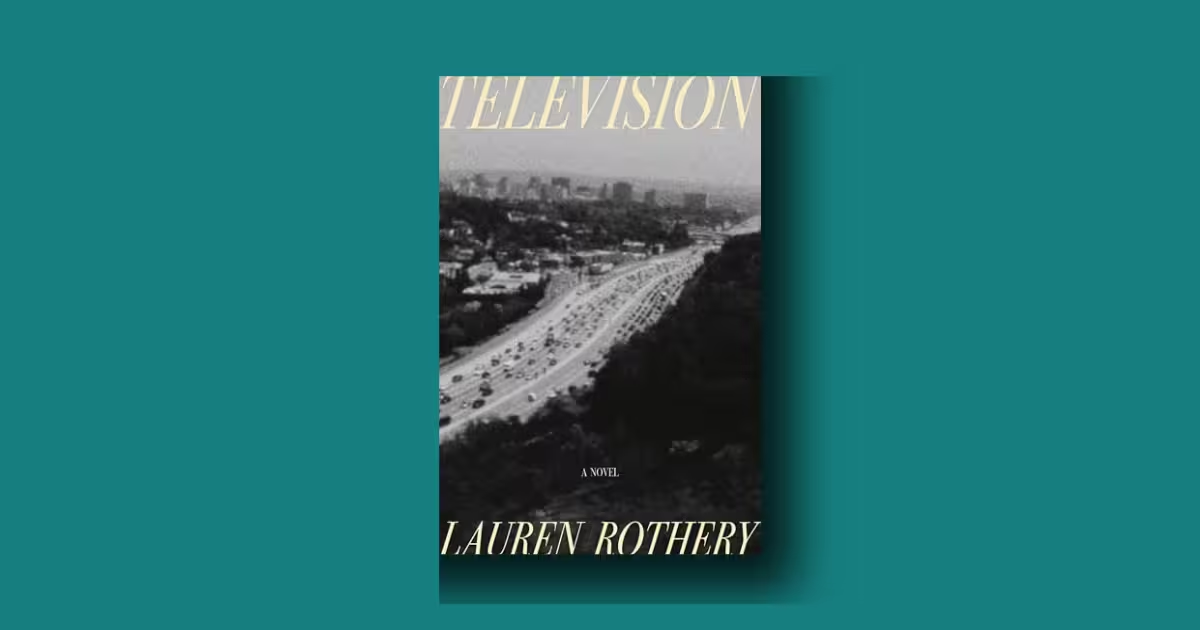
When I finished Television by Lauren Rothery, I couldn’t shake the feeling that my own life looked less like a grand film and more like a messy, low-stakes TV show that just keeps going.
In one slim novel about a jaded movie star, his oldest friend, and a hungry young filmmaker, Rothery makes you feel how much of your life is quietly ruled by luck, timing, and who happens to be watching.
Television argues that life in the age of streaming, celebrity, and lotteries is not a meritocracy but a series of episodes shaped by absurd, unevenly distributed luck, and the people who misread it.
** Rothery bakes this thesis into both plot and dialogue: Verity literally lotteries off his multimillion-dollar salary and box-office “points” to one random moviegoer, turning chance into a viral stunt and a moral crisis, and the novel keeps returning to the idea that “Romeo and Juliet is a story of luck” and that “life is not a meritocracy… it’s all luck, unevenly distributed.”
It is best for readers who like voice-driven, formally playful literary fiction—think Joan Didion, Sally Rooney, or BoJack Horseman—who enjoy sharp dialogue, Hollywood satire, and meditations on beauty, ageing, and chance, and it is not for readers who want a tight, plot-heavy thriller or a clear-cut moral about fame and money.
Table of Contents
Introduction
Title and publication details.
Lauren Rothery’s Television: A Novel is a 256-page debut published by Ecco, an imprint of HarperCollins, with its hardcover release dated 2 December 2025 in the US and other English-language markets.
It sits firmly in contemporary literary fiction and Hollywood satire, marketed with the irresistible hook: “BoJack Horseman meets Joan Didion”, and structured as a series of interlocking first-person narratives that read like bright, hypnotic episodes rather than a single linear film.
The story centers on Verity, an aging A-list actor who announces via a chaotic GQ-style profile that he will lottery off his entire salary and box-office share from a bloated franchise film to one random moviegoer, a decision that detonates his relationships with Helen—his long-time friend, editor, sometime lover—and Phoebe, an aspiring filmmaker who is writing a script about best friends and lovers while dreaming of financial freedom.
Rothery herself brings a filmmaker’s eye to the book: born in London and raised in San Diego, she spent her twenties directing short films and music videos in New York and Los Angeles, then shifted to fiction after Covid made shooting impossible, a career pivot she has described in interviews as the “origin story” of Television.
Her background matters here, because Television is obsessed with images, edits, and how a life looks when you press pause on it, in the way that only someone who has literally cut film (or video) can convincingly dramatize on the page.
Background
To really feel what Television is doing, it helps to remember the real world it comes out of, because Rothery is writing from inside a media ecosystem where both TV and lotteries are everywhere.
According to Ofcom’s Media Nations reports and BBC-commissioned modelling, people in the UK now spend well over four hours a day watching TV and video at home, with the TV set still accounting for about 84% of in-home viewing, even as streaming overtakes traditional schedules.
Finder’s 2024 TV statistics estimate that 97% of UK households have a TV and the average person spends around 28 hours a week on TV and streaming content, while Netflix alone reaches roughly 58% of UK households by 2024.
At the same time, the lottery isn’t a fringe hobby: the UK Gambling Commission reports that roughly a third of adults have spent money on lottery products in the last four weeks, and broader surveys suggest almost two-thirds of UK adults play a lottery or lottery-style game at least once a year, while in the US, around 57% of adults—181 million people—buy at least one lottery ticket annually.
The National Lottery itself has given out over £90 billion in prizes and created more than 6,800 millionaires or multimillionaires since its launch, which makes Rothery’s idea of a movie star handing a random citizen an extra eighty million feel like an exaggerated but believable extension of what is already happening around us.
In other words, Television is not just about one actor with a bad case of conscience; it’s about how we live in economies of screens and tickets, where both views and luck are counted, charted, monetised, and yet still experienced as strangely personal and emotional.
Television Summary
Rothery’s plot is deceptively simple when described straight, yet slippery and impressionistic in execution, so I’ll start with a wide-angle summary and then move into the main threads and themes.
At its core, Television follows three intertwined points of view: Verity, a world-famous actor who is both disgusted by and addicted to his own image; Helen, his oldest friend who has edited his work, shared his bed, and watched his rise from a cramped Beachwood bungalow; and Phoebe, a younger filmmaker and sometime babysitter whose life is still mostly drafts, letters unsent, and projects unfinished.
The novel opens not with the lottery itself but with Helen looking back at her strange friendship with Verity: nights spent watching Turner Classic Movies in a lilac-lit bedroom, red-carpet walks where strangers assume she is his mother, and the early Laurel Canyon “cabin” where Verity burns a hole in the floor because he can’t stop playing with the central fireplace or turning on every TV in the house to the same channel so the dialogue echoes from room to room.
Already the book is telling you that its title is literal and metaphorical: these people are raised by television, live with television, and are trying to see themselves clearly through a medium that keeps reflecting them back as a performance.
The inciting incident—the lottery—arrives via a chaotic, drunken profile Verity gives to a magazine writer (a GQ-like piece that Ramona Ramona, Helen’s contact, calls “this fucking GQ fucking thing about Verity”) in which he riffs about his parents, beauty, and the meaninglessness of his wealth.
In the middle of that monologue, he delivers what becomes the book’s thesis in miniature:
“The way I see it, life is not a meritocracy… It’s all luck, disevenly distributed.”
He then announces his plan to lottery off the entire eighty-million-dollar package—his $50 million franchise salary plus roughly $30 million in anticipated box-office points—to one random viewer who buys a ticket to his “sorry excuse for a movie.”
Helen hears this via phone, half-amused and half-appalled, but she’s not surprised, because to her this is simply Verity externalising a lifelong obsession with luck, guilt, and having “enough.”
The logistics of the lottery are presented with noir-comic precision: Verity sets up a system where every cinema ticket can be mailed in with a name and address to a studio backlot PO box, and the studio suddenly finds trucks full of envelopes arriving daily, as people who “hadn’t gone to a movie in a decade” return night after night to buy tickets, not for the film but for the odds of becoming an instant multimillionaire.
Theaters cap the number of tickets per person and insist you immediately go into the auditorium so you’re not “just buying a lottery ticket and going to dinner,” and on paper the movie becomes the biggest American box-office hit in twenty-five years, even though “it didn’t matter what anybody thought about the movie.”
What might have been a publicity stunt becomes a moral panic: the studio would never officially allow such a thing, yet they “made billions,” and the public can’t decide whether Verity is a reckless saint or a narcissistic gambler putting “eighty million on black.”
Rothery then undercuts the spectacle with a TikTok video, shot by an unknown actress Nina “BB” Walker in a warehouse, where Verity, blindfolded and in a suit, stands among mailbags full of envelopes, empties his pockets for the camera, and theatrically rummages for the winning ticket on a countdown, turning a life-changing financial decision into a clip sized for a vertical screen.
Phoebe’s sections, by contrast, are smaller-scale but just as obsessed with chance: she has an imaginary friend as a child, she babysits in Pasadena, she studies filmmaking while feeling constantly “rooned” (ruined) by things like a dug-up yard or a rash from undercooked shiitake mushrooms, and she writes letters she cannot send to people from her past and present.
These letters—never mailed, but carefully composed—include one to a hairdresser where Phoebe vows to stop bleaching her hair, insisting she wants to be “a more obvious progression of myself at nine,” walking out of the sea, body as means not end, and another to a friend where she reflects on the ways desire and dignity shape the ageing female face.
Helen, meanwhile, is the book’s conscience and most wounded lens; she is painfully aware of being considered “the mother” on red carpets and spends whole afternoons pausing movies to compare her “mouth commas” (wrinkles) with actresses like Jeanne Moreau and Meryl Streep at various ages, subtracting a year for postproduction and tracking their faces across decades like a private secular liturgy.
In one of the standout sequences, Helen visits rural France to arrange graves for her grandparents and ends up in a semi-comic, semi-philosophical conversation with a church groundskeeper about Romeo and Juliet; struggling for the French word for “grave,” she calls them “les lits de la terre” (the beds of the earth), and the man gently corrects her while insisting that the Shakespearean lovers’ story is “romantic.”
Helen replies, in halting French and English, that “Romeo and Juliet is not truly a story of Italians… Romeo and Juliet is a story of luck,” a line that quietly ties the lottery plot to older stories about fate, blood, and families.
The novel keeps looping back to this idea that “all life is luck,” which Helen tentatively asserts and the groundskeeper pushes back against as “lazy thought,” quoting Proust about needing to go “too far” to find the truth, while also reminding her that her grandfather has already bought a grave—another joke about how our endings are both planned and shockingly random.
By the final chapters, Verity is half-ashamed, half-relieved of his fortune, and obsesses over the “asshole in Tucson” who has won the lottery, imagining this anonymous man’s life as one long prelude to being a multimillionaire—failing his driving test, squeaking by with a C+ in communications, swiping right on “hard fours,” always invisible to others yet always “famous to himself.”
Helen and Verity, now older, ride the train to Santa Monica to put their feet in the water, reflecting on past dangers and rescues (a man named Pete, a dangerous ride years earlier) and the strange fact that you can share a literal train or a figurative life with your younger self, without ever quite fully overlapping.
Phoebe moves between Los Angeles and Europe, nursing a rash, guarding her grandfather’s film rolls from airport scanners, and thinking about how “the mind is warm butter” into which experiences press their ghosts, while debating whether writing is about filling pre-existing holes or “digging a new hole” and filling it so beautifully that strangers feel grateful for it.
The novel refuses a neat climax; instead, it ends in a register that is contemplative and slightly aching, insisting that there “wasn’t a climax to anything,” only the slow slipping away of people and chances, like Helen’s grandmother dying alone in her kitchen, and the knowledge that sound waves in a café or a strip-mall restaurant go on bouncing forever even after the door opens to admit someone new.
In that sense, Television keeps its promise: it doesn’t tie things off like a movie; it just keeps broadcasting lives until the credits quietly roll.
Television Analysis
Evaluation of Content
From a critical standpoint, Television does exactly what it sets out to do: it dramatizes the idea that life under late-capitalist media is ruled by chance and perception, then tests that idea against the emotional reality of three people who can’t quite live with that knowledge.
Verity’s lottery is the clearest dramatization of this; by giving away his money, he thinks he is both punishing the system and cleansing himself, but the narrative shows how the stunt is quickly eaten by that same system—turned into viral content and box-office records—and how his guilt persists, because the problem isn’t just the money but his belief that he never “deserved” any of it.
When he rants that he doesn’t deserve his face, house, job, or girlfriend, that “it’s all luck,” he sounds like a mash-up of internet self-loathing and genuine ethical clarity, and Rothery doesn’t try to decide for us whether he is brave or merely self-dramatising; instead, she lets the consequences play out in how people react to him—all the way from Helen’s weary “fine” to the studio’s panic and the public’s fascination.
Helen’s sections are where the book’s emotional intelligence really lives, at least for me; she is the one who notices the way Los Angeles trains people to freeze their faces, track their age against famous actresses, and silently count their own “mouth commas,” and those details give the novel a texture that goes far beyond high concept.
In my reading, the strongest thematic thread is the one that links luck to representation: Rothery suggests that the same culture that tells us success is earned is also the culture that endlessly films and streams us, making our “visibility” feel like a form of destiny, when in reality, the numbers are brutal.
According to the London Economic’s summary of National Lottery figures, more than 6,800 people have become millionaires through UK lottery draws in three decades, which is both a huge number and a rounding error in a population of tens of millions, and yet ticket sales stay high because we narrativise those winners as proof that the system “works.”
Rothery weaponises that same cognitive glitch: Verity pictures the man in Tucson as someone who was “always famous to himself,” stalked by millions all his life, and now retroactively right about his feeling that he was destined for more, which is exactly how a culture of television and streaming teaches us to interpret our own lives—if the camera finds you, you must have deserved it somehow.
One thing I really appreciate is how Television quietly cross-examines the idea of “truth” as well: Helen’s French groundskeeper insists that “all life is luck” is lazy thinking, quoting Proust’s “don’t be afraid to go too far because that’s where the truth is,” while Verity, in another scene, dismisses the pursuit of ever deeper “truth” as a kind of addiction with no end point.
The book never resolves this argument, and that’s part of its strength; it leaves you with the uncomfortable possibility that both are right, and that living well means learning how far you want to go in excavating the forces that shaped you, without becoming consumed by the digging.
Stylistically, Rothery’s decision to use alternating first-person voices (and, at times, embedded letters and imagined dialogues) works beautifully for what is essentially a novel about subjectivity and self-editing; it feels, at points, like flipping channels between slightly different versions of the same show.
The prose has been rightly praised for its “bright, nimble dialogue” and “profoundly modern style,” a consensus view you can see in early blurbs and summaries from sites like BookBrowse and StoryGraph, and there were passages—especially Helen’s long meditations on dignity or Phoebe’s notebook of mis-remembered words—that I reread simply for the sentences.
Does it fulfil its purpose or contribute meaningfully to its field.
Based on the available data, I would say yes, it does, though with caveats that will matter a lot depending on your taste.
In terms of contribution, Television slots into a growing line of millennial-ish literary fiction that interrogates media, class, and desire—Sally Rooney’s Normal People and Intermezzo, for example, or Bonnie Garmus’s Lessons in Chemistry, both of which have been analysed on probinism.com for their critiques of romantic and professional meritocracies—and Rothery’s particular twist is to push that conversation into the realms of Hollywood money and the literalisation of luck via a lottery.
It’s also philosophically explicit in a way that reminded me of popular psychology classics like Cialdini’s Influence, which argues that people often respond to social “scripts” without real reflection; here, the scripts are fame, beauty, and “deserving,” and Rothery shows how her characters half-consciously enact or resist them.
Where the novel may fall short for some readers—and this is echoed in a few early Goodreads reviews—is in conventional plot satisfaction: the story wanders, jumps in chronology, and sometimes feels more like a collage of moments than a tightly plotted arc, and if you come in expecting a thriller about financial scandal, you may feel unmoored.
For me, that looseness felt entirely appropriate to a book literally called Television, about people whose lives are shaped by discontinuous episodes, streaming queues, and long stretches where nothing climactic happens, but I can’t claim that it will work for everyone.
Reception
Because Television is a late-2025 debut, its reception is still in motion, and I want to be honest about the limits of what can be known right now.
As of early December 2025, Goodreads lists the book with an average rating around 3.5–3.6 stars from a relatively small base of readers, with several early reviewers praising the prose and voice but flagging the plot as “thin” or “hard to follow,” a pattern that matches my own experience of reading it as language-driven rather than story-driven.
Professional pre-publication coverage has been cautiously enthusiastic: Kirkus describes it as “a slick and largely entertaining debut about the entertainment world” and highlights the aging actor—and his orbit of women—as central to its appeal, while BookBrowse and Bookshop.org emphasize its “arresting feat of literary impressionism” and “plays in chronology” in their marketing copy.
A particularly interesting critical essay from the site death kit pushes back against over-eager marketing comparisons to Joan Didion, arguing that Rothery is being prematurely slotted into a glamorous, glib archetype of the female novelist, but still noting that she feels “far from average” and that the book stands out in a crowded field of Hollywood novels.
On the industry side, Publishers Weekly’s “How ‘Television’ Got Made” feature frames the book as a Covid-era pivot project: Rothery, unable to shoot short films, turned to writing fiction, and the article situates the novel within a broader trend of filmmakers moving into prose to explore themes that are hard to finance on screen.
Commercially, it is too early to talk about long-term influence or sales rankings with any confidence, and I couldn’t find verifiable data on print runs or bestseller lists yet, so anything I might say about its “impact” beyond early reviews would be guesswork, which I want to avoid.
That said, the book is already being positioned in catalogues and on sites like Fantastic Fiction and StoryGraph alongside other high-profile literary titles like Intermezzo, Blue Sisters, and The Hotel Avocado, which suggests that booksellers and recommendation engines see it as part of the same contemporary-fiction conversation rather than as a niche experiment.
Given how many contemporary readers live at the intersection of streaming addiction and precarious economics, I would not be surprised if Television becomes the kind of cult favourite that gets recommended in essays about “Hollywood and money” or “novels of the algorithmic age,” especially if word of mouth catches on around Verity’s lottery as a symbol for our current obsession with windfalls.
Comparison with Similar Works
Reading Television, I kept thinking of three different comparison points: media satires like BoJack Horseman, interior literary novels like Sally Rooney’s Normal People, and feminist-adjacent stories of work and visibility like Lessons in Chemistry.
The marketing tagline “BoJack Horseman meets Joan Didion” is not just hype; Verity really does have something of BoJack’s blend of self-loathing, charisma, and self-sabotage, and the novel shares the show’s interest in how Hollywood recycles both people and pain into content, even as everyone involved insists they’re trying to do something meaningful.
At the same time, Helen’s sections—full of careful noticing, morally ambivalent observations about Los Angeles manners, and a slightly chilly, ironic intelligence—have a Didionesque flavour, though Rothery’s sentences are warmer, funnier, and more forgiving than Didion’s famously flinty reportage.
If you’ve read the Normal People analysis on probinism.com, you’ll recognise a shared fascination with how two people can be bound to each other over many years without quite knowing what their relationship is or should be; Verity and Helen are a distinctly older, Hollywood-poisoned version of that dynamic, hauling around decades of sleepovers, rent-free years, and red-carpet cameos instead of Irish high-school awkwardness.
Where Rooney leans heavily into class differences and Irish austerity, Rothery leans into fame, money, and transatlantic glamour—Laurel Canyon cabins, Cannes hotel rooms, French cemeteries—but both writers are attentive to how a single relationship can contour an entire life, and both refuse to give neat answers about whether their protagonists “wasted” their chances.
In the way it explores women navigating professional spaces, I also see kinship with the probinism.com reading of Lessons in Chemistry, which celebrates Elizabeth Zott’s refusal to play by mid-century gender rules; Helen and Phoebe are not crusading scientists, but they are both caught between wanting to be taken seriously and knowing how relentlessly the industry judges them by their faces, ages, and bodies.
Phoebe’s internal monologue about never finishing anything—abandoning French, Bitcoin, painting, physiology once she has a “good sentence”—also resonates with the site’s writing on creative paralysis and perfectionism in other cultural texts, showing how deeply Rothery understands that for many younger adults, the problem is not lack of opportunity but a suffocating surplus of half-started projects.
If we zoom out further, Television shares DNA with older Hollywood novels like Joan Didion’s Play It As It Lays or Bret Easton Ellis’s Less Than Zero, in the way it uses Los Angeles freeways, strip malls, and studios as emotional landscapes, but Rothery’s world is distinctly 2020s: TikTok deepfake rumours, influencer girlfriends, and a streaming ecosystem where TikTok videos can make or break a reputation overnight.
It also feels uncannily in tune with current debates about the decline of traditional TV and the rise of YouTube and TikTok, where Ofcom and BBC documents now treat non-linear viewing as central to public-service strategy, and former Channel 4 executives blame “viewers” themselves for the flight from curated programming to algorithmic feeds, which is exactly the sort of cultural context Rothery’s title is quietly winking at.
Conclusion
For me, Television by Lauren Rothery is less a story you race through to find out what happens and more a set of voices you live with, then miss when you close the book.
If you are the kind of reader who cares about how a sentence moves, who likes novels that feel like they were written by someone who has watched far too much TV but still believes in literature, this will very likely be your kind of book.
It is especially well-suited to readers who: enjoy contemporary literary fiction; have patience for non-linear structures; are interested in Hollywood, streaming culture, and lotteries; and like philosophical digressions about luck, merit, and ageing alongside gossip, sex, and jokes about red-carpet photographers.
It is probably not a good fit if you: need a clear, conventional plot with escalating stakes; dislike first-person narration; want a tidy moral judgment on whether Verity’s lottery is “good” or “bad”; or feel frustrated by books that end on an emotional beat rather than a big twist.
Personally, I finished Television feeling weirdly comforted and unsettled at the same time—comforted because it admits, out loud, that so much of what happens to us is dumb luck, and unsettled because it doesn’t let that truth become an excuse.
The book’s final gift, I think, is the sense that even if we can’t control the lottery of our circumstances, we still have some say over how we watch ourselves, how we frame the people we love, and how carefully we choose the “hole in the ground” we’re going to dig and fill with our brief presence.
