
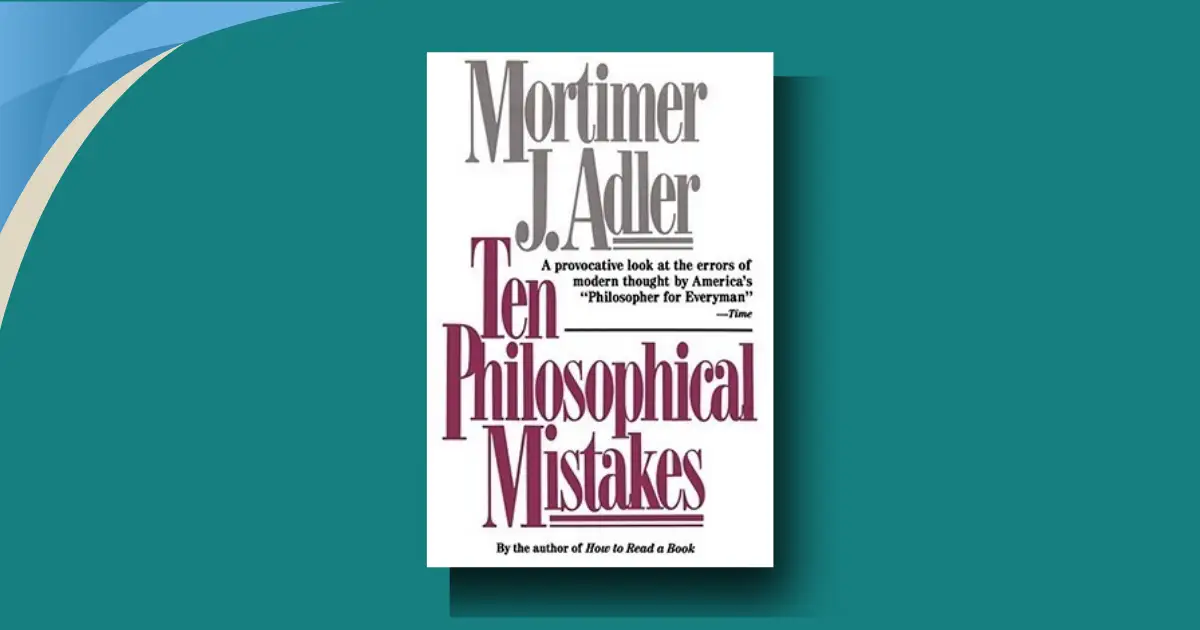
I picked up Ten Philosophical Mistakes by Mortimer J. Adler because I was tired of watching smart conversations collapse into “it’s just opinion” or “science says so, end of story.”
This book tackles the exact kind of confusion Adler calls “little errors in the beginning” that quietly multiply into bigger intellectual messes later.
Adler’s plain-English thesis is that modern philosophy got key starting assumptions wrong, and those wrong starts still mislead how we talk, judge, and live today.
A modern datapoint that made Adler feel eerily current to me: 55% of U.S. adults say right and wrong often depends on the situation, and 68% say you can be moral without believing in God, per Pew’s 2023–24 Religious Landscape Study (published Feb 26, 2025).
In psychology experiments, prompting people toward determinism has been linked with more cheating (Vohs & Schooler, 2008), and related work reported reduced helping and increased aggression when disbelief in free will was induced (Baumeister et al., 2009).
Ten Philosophical Mistakes is best for / not for
If you love books that argue carefully but stay readable, Adler is your person, and I felt him constantly nudging me back to distinctions I didn’t realize I’d blurred.
If you want a purely historical survey of philosophy, or you hate Aristotle/Thomism being used as a measuring rod, you may bounce—Adler is unapologetic that modern thinkers ignored older insights and paid the price.
If you’re the type who debates “truth vs opinion,” “morality is relative,” “free will is an illusion,” or “humans have no fixed nature,” this book will feel like someone finally cleaning the lens.
If you want a quick motivational read, this isn’t that—Part One is longer because (as Adler admits) the foundational mistakes are harder to explain and correct.
Mortimer J. Adler is also described by Simon & Schuster as a longtime public intellectual (Britannica leadership, Institute for Philosophical Research) who authored 50+ books and died in 2001.
Now here’s the heart of what the book argues—and why it changed how I hear everyday claims.
Table of Contents
1. Introduction
Ten Philosophical Mistakes: Basic Errors in Modern Thought—How They Came About, Their Consequences, and How to Avoid Them is Mortimer J. Adler’s 1985 diagnosis-and-repair manual for modern intellectual confusion.
Adler writes as a teacher more than a professional-philosophy insider, and even sympathetic reviewers note that he often aimed at educated general readers rather than academic fashion.
His credibility, historically, is rooted in institutions: the University of Chicago “great books” era is part of his public biography, and he’s repeatedly framed as a curriculum/education reformer as much as a theorist.
The book’s central engine is summed by a line Adler quotes from Aristotle: “the least initial deviation from the truth is multiplied later a thousandfold.”
That line isn’t decoration—Adler’s whole method is: find the starting confusion, show the downstream consequences, and then restore the distinction that was lost.
He even warns us right away that the title is “inaccurate,” because he treats more than ten mistakes, but around ten subjects where mistakes cluster.
And he tells you his strategy bluntly: he’s not trying to “prove” everything in a technical way, but to rely on “the reader’s common sense” to recognize the correction’s “ring of truth.”
So the best way to read him (and how I’m writing this review) is as a guided rebuild of everyday thinking.
2. Background
Adler argues that most of these errors are modern, especially “since the seventeenth century,” when he names departures in thought initiated by Hobbes and Descartes.
What hit me is that he’s not doing history for history’s sake; he’s saying: the modern mind inherited a handful of wrong moves, and they’re still steering our debates.
He frames the ten subjects in a compact overview before the main chapters, which is basically a map of the book’s whole territory.
One reason this matters now is that popular culture absorbs philosophical assumptions without realizing it—Adler says moral subjectivists among “people generally” often don’t know the underlying mistakes, because they “filtered down” into their minds.
At the same time, he thinks the opposite camp often holds “objective morality” dogmatically without knowing how to defend it rationally.
That background—mistakes filtering down + people arguing past each other—matches what I see online every day, especially when arguments spiral into slogans instead of reasons.
Now let me “give away the facts” and summarize the whole book with full spoilers.
3. Ten Philosophical Mistakes Summary
Most people (including me, before Adler smacked my hand away from it) assume we’re directly aware of the contents of our own minds.
Adler says the first mistake is confusing ideas with their objects, and he states the correction in a way I kept rereading: “It is always the idea’s object of which we are directly conscious, not the idea itself.”
In Chapter 1, he starts with the everyday contrast between being unconscious (no awareness, no apprehension) and being conscious (perceiving, remembering, imagining, thinking).
From there he builds the core fix: feelings like pains are one thing, but “perceptions, memories, imaginations… thoughts or concepts” are another, and calling them all “contents” you’re directly aware of is a trap.
He insists ideas are means—they “place objects before our minds,” and the objects are what we are directly conscious of, while the ideas “are inapprehensible.”
That matters because if you get it wrong, you drift toward skepticism and solipsism—if all you ever “directly know” are inner contents, the external world becomes a rumor.
Adler’s fix is almost embarrassingly sane: the object is what we’re aware of, and shared objects make public conversation possible, not impossible.
This first correction quietly sets up the next nine.
The second mistake is failing to distinguish perceptual thought from conceptual thought, which Adler says has “serious consequences” for math, physics, philosophy, theology, and even the human/animal difference.
In the summary of this mistake, Adler ties it to a historical confusion where “intellect” got reduced to sense-bound processing, and he points out how telling language is: the Greek nous and Latin intellectus are linked to understanding, not sensing.
He argues that treating the mind as if it only handles images and sensory traces makes conceptual knowledge look impossible or mystical, so modern thinkers either deny it or misdescribe it.
The correction is to admit we can think about objects we cannot imagine or perceive—exactly what higher mathematics and theoretical physics require.
This distinction also grounds later claims about moral knowledge and free choice, because both require something beyond the push-and-pull of sensation.
When I read this, I kept thinking of how often people say “it’s just brain chemistry” as if that ends the story, which is basically reductionism waiting to happen.
Adler’s point isn’t anti-science; it’s anti-category error.
The third set of mistakes is about language: if you mess up consciousness and intellect, you’ll also mess up meaning.
Adler’s root claim here is clean: the errors come from failing to recognize that “ideas are meanings,” and that words and symbols only get meaning from that source.
He criticizes twentieth-century linguistic philosophy for abandoning the referential significance of most everyday words and replacing it with slogans.
Then he goes after one slogan with real contempt: “Don’t look for the meaning; look for the use,” because, he argues, you can’t know use without meaning already being in place.
And he flips the fashionable claim of his era: “Language does not control thought… It is the other way around.”
Modern research doesn’t support the strongest “language determines thought” version either; the strong claim is contested and the field is full of nuance rather than a simple takeover story.
What I took from this chapter is a practical diagnostic: when a debate stalls, it’s often because the words are floating free of shared ideas.
The fourth mistake is drawing the line between knowledge and opinion so harshly that philosophy gets shoved onto the “mere opinion” side while math and science keep “knowledge.”
Adler starts Chapter 4 with Aristotle’s famous claim that “all men… by nature desire to know,” and then he clarifies what knowledge means in ordinary speech: knowledge implies truth, and “false knowledge” is a contradiction.
His key repair is to separate knowledge from opinion without pretending opinion is worthless; opinions can be true or false, knowledge cannot be false.
He then adds two more distinctions that matter in real life: certitude vs lingering doubt, and corrigible/mutable vs incorrigible/immutable.
This is where the book starts feeling like a toolkit for modern misinformation, because it shows how to treat uncertainty without collapsing into “nothing can be known.”
When I finished this chapter, I realized how often people weaponize “science changes” to imply “science is just opinion,” which is exactly the confusion Adler is trying to prevent.
He’s not saying philosophy replaces science; he’s saying philosophy can still claim real knowledge in its proper domain.
That sets up the moral chapters.
The fifth mistake is moral subjectivism/relativism: treating judgments of right/wrong as mere opinion, with no objective standards.
Adler defines the battleground with crisp contrasts: subjective vs objective, relative vs absolute.
He points out a key downstream consequence that’s not academic at all: denying objective moral standards “undermines… natural, human rights,” and can lend support to “might makes right.”
He attacks popular hedonism first—if the only good is pleasure, then wealth, health, friends, knowledge, and wisdom aren’t good, which contradicts “the facts of everyday life.”
He also quotes (and then criticizes the vibe of) the noncognitivist move where ethics becomes mere preference; he brings in Russell’s quip: “Ethics is the art of recommending to others what they must do to get along with ourselves.”
He then wrestles with Hume’s “is/ought” gap and A. J. Ayer’s verificationist claim that moral sentences “do not say anything,” while arguing that prescriptive statements still make genuine assertions even if they’re not descriptive facts.
This chapter felt painfully current beside Pew’s finding that a majority of Americans lean situational about morality, because Adler’s whole argument is about what you lose when “right and wrong” becomes purely personal taste.
And his bigger point is: if you can’t argue about moral truth, you can’t reasonably defend rights, justice, or responsibility.
The sixth mistake follows “hard upon the fifth,” Adler says: confusing happiness with the psychological feeling of contentment.
He says modern people ignore “the other meaning of happiness as the moral quality of a whole life well lived,” and that this confusion undermines moral philosophy.
He adds two related failures that I underlined like a student: not distinguishing needs vs wants, and not distinguishing real goods vs merely apparent goods.
He even takes on John Stuart Mill’s “better to be Socrates dissatisfied than a fool satisfied,” saying that kind of line can mislead if it denies that contentment does matter at some level.
In the freedom chapter he ties happiness to the will: we cannot will not to seek happiness when it’s understood as the totum bonum—the sum of all real goods.
Reading this beside modern wellbeing research was striking: the World Happiness Report 2024 draws on Gallup World Poll data from 140+ countries and highlights social connection and life-stage differences in wellbeing.
To me, Adler’s “whole life well lived” frame is exactly the kind of philosophical backbone that prevents happiness-talk from shrinking into mood-tracking.
The seventh mistake is different: it’s a controversy where Adler says the main failure is misunderstanding, especially by determinists who “miss the mark.”
He opens Chapter 7 by sorting kinds of freedom people confuse—like circumstantial freedom (“do as we please”) and political liberty—before reaching the contested kinds.
He mocks class-blind slogans using R. H. Tawney’s line: “the poor man is not free to dine at the Ritz.”
Then he dives into the determinism/free choice mess: determinists identify free choice with chance, while Adler insists causal indeterminacy is not “the complete negation of causality.”
He argues that both quantum indeterminacy and free choice can allow probabilistic prediction, so “chance” isn’t the right category, and the controversy becomes “illusory” because “the issues are not joined.”
He also connects the debate to moral responsibility: if choice were mere chance, Hume was right that responsibility collapses, but Hume’s error was identifying free choice with chance.
This is exactly where modern experiments enter my mind: Vohs & Schooler (2008) found deterministic prompts increased cheating, and Baumeister et al. (2009) reported reduced helping and more aggression under induced disbelief in free will, though replication debates exist.
So Adler’s “moral responsibility” angle isn’t just metaphysical—it maps onto measurable behavior questions researchers still argue about.
The eighth mistake is the “widely prevalent” denial of human nature, including the extreme claim that nothing common underlies human behavioral tendencies.
Adler places a real number on the table: he says it was “generally accepted” that Homo sapiens may have emerged “perhaps as long ago as 35,000 to 50,000 years,” and that all humans since are members of one species.
He then targets twentieth-century cultural and behavioral thinkers who challenged the “essential sameness” of human beings, and even quotes Merleau-Ponty’s line: “it is the nature of man not to have a nature.”
Adler’s big claim is practical: if moral philosophy is to have a sound factual basis, it’s “to be found in the facts about human nature and nowhere else.”
In other words, delete human nature and you either get moral relativism or a harsh rationalism detached from human life.
This chapter made me notice how often “identity” debates accidentally assume either biology is destiny or biology is irrelevant, when Adler is pushing for a middle path that keeps shared nature without erasing variation.
It also circles back to the needs/wants distinction, because “needs inherent in human nature” help distinguish real goods from apparent goods.
So the denial of human nature, for Adler, is like cutting the root system under ethics.
The ninth mistake is about society and the state: Adler says modern thinkers “foist two totally unnecessary myths” on us—the primitive isolated individual and the social contract that supposedly created civil society.
He argues the real situation is subtler: basic forms of association are both natural and conventional in humans, unlike instinct-driven associations in other gregarious animals.
This matters because if you treat society as an artificial add-on, you misread family, tribe, and state as mere inventions rather than partly natural expressions of human life.
It also feeds modern “self-made atom” myths where the individual is imagined as fully formed prior to community.
When I connect this to current loneliness and wellbeing concerns, it’s hard not to see Adler’s point: social structure isn’t just politics, it’s part of what a human life is.
So Adler’s anti-myth stance here is also an anti-fantasy stance: humans don’t start as isolated units who later sign a contract to become social.
If you get that wrong, you’ll build political theory on a fictional anthropology.
The tenth mistake is metaphysical: the “fallacy of reductionism,” where only ultimate parts (like elementary particles) are treated as real and wholes are treated as appearances or illusions.
Adler says this is disastrous when applied to persons: if individual identity is illusory, moral responsibility collapses again.
In Chapter 10 he digs into perception vs judgment and shows how, in normal perception, asserting “I perceive the table” already implies “it really exists.”
He uses hallucinations and dreams as contrast cases: they “masquerade as perceptions,” and the illusion vanishes upon waking or cure.
Then he makes a sophisticated move about modes of existence: components of a real whole can exist “virtually” within it, becoming fully actual as parts only when the whole breaks apart.
He argues that if we assign different modes of existence to particles-in-a-cyclotron versus particles-as-constituents, science and common sense aren’t irreconcilable enemies.
And he ends that arc by saying the challenge to the reality of human existence and identity is removed, along with the threat to moral responsibility.
So the “reductionism” chapter is not just physics talk—it’s Adler protecting the reality of persons against a worldview that dissolves them.
Finally, Adler’s Epilogue is his big historical zoom-out: he praises modern science’s progress over “the last three centuries” as “breathtaking,” but says philosophical progress in modern times has been comparatively small.
He also argues modern philosophy “got off to a very bad start” with early modern figures acting as if they had no predecessors worth consulting, which helped generate avoidable errors.
This ending is where I felt Adler’s emotional undertone: frustration that wisdom was available in the tradition, but ignored out of arrogance or forgetfulness.
Whether you agree or not, the epilogue clarifies what the whole book is doing: it’s an attempt to reconnect modern debates to older distinctions that keep us sane.
That’s the full skeleton of the book, with the major arguments and outcomes.
Now here’s my judgment of how well Adler actually pulls it off.
4. Ten Philosophical Mistakes Analysis
Adler is at his best when he makes a single distinction do real work across multiple debates, like how confusing idea/object creates skepticism, language confusion, and then knowledge confusion.
He’s unusually honest about method: he doesn’t “prove” everything, but aims for clarity and common-sense recognition of what’s been missed.
That honesty is a strength and a weakness: it makes the book accessible, but it also means specialists may want more technical defense at key transitions.
His argumentation is strongest where he shows internal contradiction (like pleasure being the only good) and then uses ordinary experience as the corrective.
He is also careful to avoid straw-manning determinists by dividing soft- and hard-determinism and showing where their moral-responsibility logic diverges.
But he sometimes writes with a sweeping “modern philosophy failed” tone, and even when that’s rhetorically satisfying, it risks flattening real differences among modern thinkers.
I can’t confirm from the sources I reviewed that the academic consensus agrees with his “few if any advances” claim; I can verify only that Adler himself asserts it.
Still, as a reader, I felt the overall contribution is meaningful: the book doesn’t just criticize, it gives reusable definitions that stop confusion from reproducing.
5. Strengths and Weaknesses
The biggest strength is clarity: Adler repeatedly turns foggy debates into clean, answerable questions by fixing what words are supposed to be doing.
I also loved how he takes “popular” positions seriously—he explicitly says philosophical mistakes filter down to ordinary people, which is exactly why the book matters outside academia.
And the structure is satisfying: ten subjects, two parts, and a final epilogue that explains why the mistakes happened and how they could have been avoided.
My main frustration is his occasional confidence that a correction has “the ring of truth,” because sometimes I wanted him to slow down and argue a bit more when the step is controversial.
I also felt the book can be stern toward modern thinkers, and if you come in loving contemporary analytic or continental philosophy, you may feel he’s dismissing too broadly.
That said, even when I disagreed with his tone, I rarely disagreed with the usefulness of his distinctions, especially on knowledge vs opinion and happiness vs contentment.
So my pleasant experience was the “mental decluttering,” and my unpleasant experience was occasionally wanting more patience from him.
Overall, I finished the book feeling sharper, not just persuaded.
6. Comparison with similar works
If you like Adler here, you’ll probably also like his broader project of restoring philosophy’s practical and theoretical roles, which shows up in other Adler titles and summaries of his career.
On the language/thought side, modern discussions of linguistic relativity are more empirical and nuanced than the strong “language determines thought” claim Adler rejects, but the shared target is the same category mistake.
On free will, Adler’s moral-responsibility framing lines up with why psychologists even test determinism primes: the concern is exactly whether undermining agency affects cheating, helping, or aggression.
On happiness, contemporary wellbeing research (World Happiness Report) is data-heavy and policy-facing, while Adler is philosophical, but both push beyond “momentary feelings” toward whole-life conditions and social structure.
And on moral relativism, Adler’s worry that relativism erodes rights debates connects directly to today’s measured split between situational morality and absolute standards in U.S. survey data.
So I’d describe Adler’s niche like this: less self-help than Adler-the-psychologist books, less trendy than academic debates, and more like intellectual plumbing that makes everything else stop leaking.
7. Conclusion
I recommend Ten Philosophical Mistakes to readers who want a single, coherent map of the most common philosophical confusions behind modern arguments about truth, morality, happiness, freedom, and the reality of persons.
If you’re a general reader, you can absolutely benefit, because Adler writes for educated common sense, and he tells you directly that he’s counting on that.
If you’re a specialist, you may argue with his historical judgments and want more technical proof, but you’ll still find the distinctions useful as a diagnostic checklist.
If you’re firmly committed to moral relativism, hard determinism, or strong reductionism, this book will challenge you at the root rather than at the surface.
If you’re allergic to Aristotle/Thomism being treated as a corrective standard, you’ll struggle with Adler’s stance that modern errors reflect ignorance of Aristotle’s refutations.
