
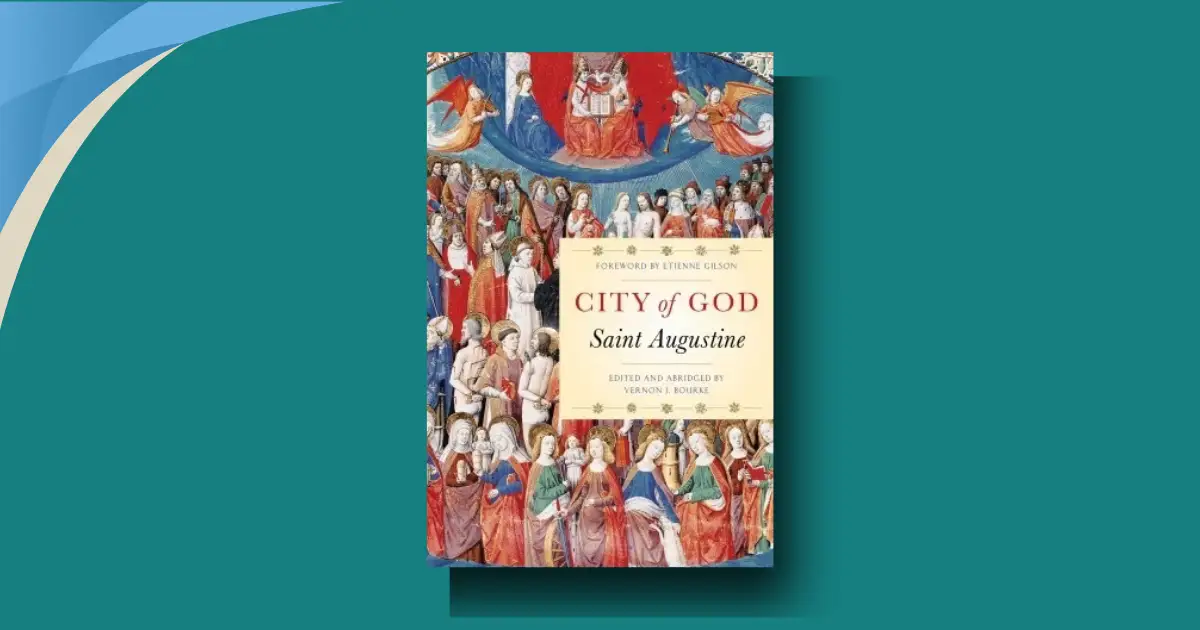
When empires fracture and headlines howl, The City of God by Saint Augustine still solves the same old problem: how to make sense of human history, suffering, and politics without losing your soul.
At its starkest, this book confronts the fear that “everything is falling apart” and answers with a vision of two rival loves shaping two rival cities—one earthly and one divine—so we can live sanely in the ruins and the routine.
The City of God by Saint Augustine teaches that “two cities have been formed by two loves”—self-love to the point of contempt for God (the earthly city) and love of God to the point of contempt for self (the heavenly city)—and you must decide which love will order your life.
Augustine wrote this not as an armchair philosopher but as a bishop amid panic after the 410 sack of Rome, and he insists the line through history is drawn by love, not luck, which is why justice, peace, and politics only make sense when they are ordered to God.
So The City of God is not escapism; it’s a hard reset on what counts as victory, freedom, and happiness now and forever, which is why it keeps returning in every crisis.
Evidence snapshot: Historically, the work was composed c. 413–426 CE in response to claims that Christianity caused Rome’s fall; modern scholarship and reference works (e.g., Britannica) confirm the dates and purpose, along with the basic narrative of the 410 Visigoth sack under Alaric and its shock to the Roman world.
More sharply, Augustine’s Book XIX defines peace in the line now quoted by theologians and political thinkers alike—“the peace of all things is the tranquility of order”—and he parses kinds of peace from the household to the city to the soul.
Inside the book itself, Augustine catalogues philosophical rivals (Varro’s 288 possible schools of ethics), insists no republic can exist without justice, and grounds justice in rightly ordered worship—all of which I’ll unpack below with direct quotations.
Best for / Not for: If you want a framework to evaluate empires, policies, and personal choices through a theological lens that still respects reason, The City of God by Saint Augustine is for you.
If you expect a quick political program or a neat historical “gotcha” against pagans or skeptics, you’ll balk—this is a 22-book marathon whose method is patient argument and scriptural reasoning, not sound bites.
Table of Contents
1. Introduction
Title and Author Information. The City of God (De civitate Dei contra paganos) is a monumental Christian-philosophical treatise by Saint Augustine of Hippo (354–430); the work was composed c. 413–426 and the complete version circulated by 426 CE, in the Western Roman Empire.
Context. The immediate spark was the 410 sack of Rome by Visigoths under Alaric and the widespread charge that abandoning Rome’s ancestral gods had courted disaster; Augustine wrote to refute that narrative and to console Christians with a deeper map of history and hope.
Purpose. Across twenty-two books, Augustine draws an epochal contrast between two orders of love and citizenship, arguing that the earthly city will pass while the City of God will endure, and that the Christian’s political life must be real, responsible, and explicitly subordinated to God’s final ends.
To name his theme he quotes the Psalm: “Glorious things are spoken of thee, O city of God,” then announces his plan to explain the nature and pilgrimage of that city through time.
And the most famous hinge is here too: “Two cities have been formed by two loves…” a line whose explanatory power for culture, ambition, and conflict is why you still hear it in sermons and syllabi alike.
In scope, The City of God by Saint Augustine moves from the critique of pagan piety to a patient philosophy of history, then to an account of happiness, justice, and peace that culminates in the resurrection; its argumentative ballast and spiritual horizon are why it remains a cornerstone of Western thought.
2. Background
Augustine begins with the pastoral scandal of violated women after the sack, insisting that Christian hope does not deny horror; with sobriety he exhorts survivors and rebukes slanderers.
He points out that many who escaped the worst did so by fleeing into Christian churches, which even pagans respected as sanctuaries; if Rome was spared in places, it was because of Christ, not Jupiter.
He also refutes the claim that Roman gods had a track record of rescue, cataloguing earlier disasters and the empire’s moral slide.
His pastoral clarity is bracing on suicide, where he applies the command “Thou shalt not kill” to the self, counseling conscience rather than despair in the aftermath of assault and war.
And then he pivots.
The pivot is to love and order: in early books he argues that created goods are genuinely good but can be loved inordinately, and later he offers the lapidary line, “virtue is the order of love,” a definition that underwrites everything from ethics to city-building.
In Book XIX—the beating heart—Augustine dissects rival answers to the supreme good and concludes with a Christian account of peace, layer by layer: peace in the soul, the household, and the commonwealth, all ordered by and to God.
He summarizes this with the line cited for centuries: “The peace of the celestial city is the perfectly ordered and harmonious enjoyment of God… The peace of all things is the tranquility of order.”
That’s why reading The City of God by Saint Augustine feels like reading a constitution of reality itself rather than a partisan manifesto.
The City of God Summary
Book 1 : After Rome’s fall: suffering, mercy, and true security
Augustine opens in the smoke of the 410 sack of Rome and asks what Christians should think about catastrophe.
He rejects the pagan charge that abandoning the old gods brought ruin, pointing out that many lives were spared precisely in Christian sanctuaries and that earlier pagan ages suffered equally or worse.
He consoles traumatized believers—especially women violated in war—insisting their dignity is not destroyed by crimes committed against them and warning against suicide as a false remedy. The theme is moral triage: distinguish what can be taken from us (property, honorifics, even bodily safety) from what cannot (virtue ordered to God).
The city of this world promises peace but cannot secure it; the City of God teaches how to interpret loss without despair. Suffering, Augustine argues, is a test of love: if our joy depends on mutable goods, our hearts will break whenever history lurches; if our joy rests in God, we can use temporal goods without being used by them.
The book sets the pastoral tone: sober realism, theological courage, and practical comfort.
Book 2 : Pagan Rome’s morals under the microscope
Turning from consolation to confrontation, Augustine asks whether Rome’s ancestral gods ever produced the moral excellence their devotees claim.
He catalogs public vice—from stage shows and gladiatorial blood to civic lust for domination—and argues that cultic piety divorced from virtue is hypocrisy writ large. The city’s literature and festivals themselves tutored citizens in disorderly desire; if gods delighted in obscene plays, why expect citizens to be chaste?
Roman greatness, he concedes, did feature civic energies—courage, discipline, love of glory—but these were misdirected loves, potent but crooked. The pressing theme is moral causality: worship shapes character, and character shapes politics.
If Rome admired its gods for power rather than goodness, it trained its people to prefer victory over virtue. Augustine isn’t sneering from outside; he’s diagnosing from within history’s autopsy room: look at the effects.
The City of God doesn’t deny Rome’s achievements; it denies their sufficiency, arguing that without right worship there can be no stable justice, and without justice no commonwealth worthy of the name.
Book 3 : Did the old gods ever protect Rome from disaster?
Here Augustine plays historian. He surveys Rome’s long ledger of calamities—plagues, wars, treasons, famines, fires—across republican and imperial centuries to refute the nostalgic myth that the gods once kept the city safe.
The timeline reads like a litany: civil wars that gutted the republic, invasions, and internal corruptions that made the empire brittle from the inside.
Augustine’s method is intentionally empirical: he marshals Roman sources to show that disasters came both when the gods were honored and when they were allegedly neglected.
If cause-and-effect is the apologetic pagans demand, the record doesn’t support them. But he presses further: fixation on fortune blinds the mind to providence.
The true God governs history with moral ends, not as a talisman to shield empires from the natural consequences of pride. This book’s message is theological realism: don’t misread temporal prosperity as divine approval or temporal distress as divine absence.
The City of God learns to interpret history for wisdom, not for self-exonerating legends.
Book 4 : Greatness without goodness is no salvation
Augustine now evaluates imperial size and longevity. Rome’s expansion is undeniable; its dominion spanned seas and peoples.
But does magnitude equal beatitude? No. He argues that empires can be nothing more than “great robberies” when they lack justice—organized power without rightful order.
Rome grew because God, in providence, sometimes grants earthly goods (victory, cohesion, gifted rulers) even to disordered loves, both as a temporal reward for certain civic virtues (courage, discipline) and as a restraint on worse evils.
Yet such gifts are ambiguous goods: they seduce the proud into imagining themselves self-sufficient. Augustine’s recurring question shows up crisply: what makes a people a people?
Not the mere sharing of interests but the shared acknowledgment of right, which requires rightly ordered worship.
The City of God measures political success by justice and peace ordered to God; everything else is glitter. This book’s nerve is to de-mythologize civil religion without despising politics, preparing readers to desire rightly within societies that are, at best, penultimate.
One of the most powerful and quoted sections (Book IV, Chapter 4)
“Justice being taken away, then, what are kingdoms but great robberies?
For what are robberies themselves, but little kingdoms?
The band itself is made up of men; it is ruled by the authority of a prince, it is knit together by the pact of the confederacy; the booty is divided by the law agreed on.
If, by the admittance of abandoned men, this evil increases to such a degree that it holds places, fixes abodes, takes possession of cities, and subdues peoples, it assumes the more plainly the name of a kingdom, because the reality is now manifestly conferred on it, not by the removal of covetousness, but by the addition of impunity.
Indeed, that was an apt and true reply which was given to Alexander the Great by a pirate who had been seized.
For when that king had asked the man what he meant by keeping hostile possession of the sea, he answered with bold pride, ‘What thou meanest by seizing the whole earth; but because I do it with a petty ship, I am called a robber, whilst thou who dost it with a great fleet art styled emperor.’”
Book 5 : Providence, free will, and the limits of fate
Against Stoic fate and astrological determinism, Augustine defends both providence and meaningful freedom. He shows how “fate” talk dissolves responsibility and undermines law, praise, and blame.
God foreknows; humans still choose—foreknowledge is not compulsion. He applies this to Roman exemplars: figures like Scipio illustrate natural civic virtues rewarded by temporal goods, yet those achievements remain bounded by mortality.
Most striking is Augustine’s portrait of Christian rulers: a good emperor fears God, uses power to serve, restrains vice, and loves mercy more than conquest. Such rulers seek not the flattery of men but the judgment of God.
The thematic arc: history is neither chaos nor clockwork. Instead, providence actively weaves free choices and events toward divine ends.
This dissolves astrology’s fatalism and civic superstition’s bargaining view of the gods. Citizens of the City of God can therefore engage politics clear-eyed: they neither despair at losses nor idolize victories, because they trust governance deeper than fortune while honoring real responsibility.
Book 6 : Civil theology and the bankruptcy of public cult
Augustine turns to Varro’s famous taxonomy of Roman religion—mythic, natural, civil—and homes in on civil theology (the state’s liturgy) as politically useful but spiritually poisonous.
The state’s gods, he argues, are props for social cohesion and imperial glory, not mediators of truth. Priests and politicians colluded: keep the crowd docile, crown Rome’s ambitions, ignore whether these deities are morally worthy or metaphysically real.
Augustine exposes the contradiction: the same elites who mocked the theater’s indecency still consecrated those indecencies to the gods.
The book’s message is that public religion without truth becomes pageantry that cannot reform souls. By contrasting Rome’s civil rites with the biblical God’s holiness, Augustine dismantles the idea that the city’s good is secured by ritual correctness.
The City of God insists that liturgy must serve truth, not propaganda; otherwise religion becomes a tool of statecraft, sacralizing vice and masking injustice under pious ceremonies. This critique resonates wherever national myth tries to do theology’s work.
Book 7 : The “select gods” and the failure of polytheism
Continuing with Varro, Augustine asks whether narrowing the pantheon to a few “select gods” solves the problem. It doesn’t.
He shows how functions overlap absurdly—multiple deities for one natural effect—and how moral incoherence remains: if supreme deities are truly supreme, why need a swarm of specialists for rain, childbirth, thresholds, or war?
He also probes the origin tales of these gods, highlighting their passions, rivalries, and vices. Such beings may be powerful spirits but cannot be worthy of worship; reverence is due to the highest, simple, unchangeable Good.
The larger theme is unity vs. fragmentation: the human heart craves a single, intelligible source of being and goodness; polytheism fractures reality into competing causes and rites, producing anxiety rather than peace.
The City of God proposes a metaphysical simplification: one Creator, the giver of every good, who orders all things. That unity anchors ethics and politics because love can be ordered only when the Good is one, not parceled out among capricious powers.
Book 8 : Philosophers, especially Platonists, as allies and limits
Here Augustine engages the philosophers, praising Platonists for perceiving the immaterial, eternal reality above change and for affirming that the highest good is participation in that reality.
Yet he marks decisive limits: many Platonists treat mediating demons as necessary go-betweens for humans and the highest God, and they often remain proud of intellect rather than humbled by grace.
Augustine extracts gold where he can—reason can recognize God’s existence and some moral truths—but the route to beatitude requires incarnation and mediation by Christ, not by demons or mythic heroes.
The book’s pedagogical theme is generous critique: truth is scattered among the schools; Christianity gathers and completes it.
This forges an important bridge from the City of Man’s wisdom to the City of God’s worship: philosophy can aim the mind toward the summit, but only divine revelation opens the way by which the humble, not just the clever, can enter. Thus Athens is respected, Jerusalem is decisive.
Book 9 : Demons are not mediators to God
Augustine now dismantles the demonological framework. Demons, he argues, are proud, deceitful spirits who crave honor and lead people from the true God.
Reports of oracles and marvels are not evidence of sanctity but of spiritual manipulation.
Even if demons can perform signs, their moral character disqualifies them from serving as bridges to the divine; mediation must be purifying, not corrupting. By contrast, Christ mediates as both God and man, healing the will and uniting us to God without compromising holiness.
The theme is the ethics of worship: it matters not only that one reaches a greater power but which power it is and what participation in that power does to the soul.
The City of God seeks likeness to God in humility and charity; demon-mediated cult entrenches pride and fear.
Augustine thus relocates religious authority from occult spectacle to revealed holiness, urging readers to judge spiritual claims by truth and goodness, not by bare displays of power.
Book 10 : Sacrifice, worship, and the one Mediator
Having rejected demons as mediators, Augustine articulates positive theology of sacrifice: true sacrifice is every act by which we cleave to God in holy fellowship; its visible sign is the Church’s Eucharist, in which the one sacrifice of Christ—head and body—is presented. Worship is not bargaining for goods but transformation of love.
The point: the City of God is formed by right sacrifice, which orders the soul and, through the Church, orders a people.
Augustine celebrates the angels as fellow citizens and examples but denies them worship; all honor terminates in God.
He also insists that the incarnation uniquely answers philosophy’s desire: the Word by whom all things were made becomes the way for us to be remade. With this, the first half of the work (demolition of pagan religion and philosophy’s insufficiency) closes.
The message is constructive and liturgical: only the God-given Mediator can heal desire and bind a community in the love that is, finally, God Himself.
Book 11 : Two cities begin: creation, angels, time, and will
The second half opens with origins. Augustine contemplates creation ex nihilo, the nature of time (created with the world), and the creation of angels.
Some angels, by pride, fell; others remained in holy love. Here the two cities appear in seed: the angelic society turned by self-love and the angelic society fixed by God-love.
The human story will mirror this angelic cleavage. Augustine also charts how Scripture narrates creation for our instruction rather than for curiosities, emphasizing order, goodness, and purpose.
Evil is not a substance but a privation of good, born when rational wills turn from the higher to the lower. Thus the frame is ethical-metaphysical: in a good creation, love’s direction determines destiny.
The City of God is a fellowship of rightly ordered loves—among angels first, then among men—pilgriming through time toward eternal rest. By defining time as creaturely, Augustine undercuts fatalism and grounds history as the arena of grace, not an eternal cycle.
Book 12 : Why some angels and humans fall; predestination and responsibility
Book XII opens a new phase of Augustine’s project: he wants to explain how the “City of God” and the “earthly/worldly city” begin, and he frames that origin around a single core problem: why some rational creatures have a good will and others an evil will.
1. The first split happens among the angels
Augustine’s starting point is that the earliest “two cities” appear before human history fully unfolds, in the division among angels:
- Good angels constitute the City of God because they adhere to God (their good will “wants to adhere to Him”).
- Bad angels form the opposing society because they turn toward themselves, wanting to “adhere to themselves.”
Crucially, Augustine draws a sharp asymmetry about causation:
- The good will in good angels is “effected… by God.”
- The evil will in evil angels is “effected… by themselves.”
This sets the book’s basic moral-metaphysical architecture: God is not the author of evil, yet God remains sovereign.
2. Evil isn’t a “thing” God created: no evil nature
Augustine immediately blocks a common escape route: you can’t explain evil by claiming some creature was made with an evil essence.
He insists there is no evil nature—even the devil did not become evil because his nature was created evil; rather, evil arises by will.
So the debate turns into a harder question:
If all created natures are good, how does an evil will arise at all?
3. How an evil will begins: “defection,” not an efficient cause
In the sections where Augustine presses the problem (and anticipates objections), he characterizes evil willing as a turning-away:
- Evil will is described as a “defection”—a movement away from the unchangeable good (God) and toward the creature’s own self-directed preference.
The key move: Augustine argues that asking for a productive (“efficient”) cause of evil will is a category mistake, because evil is not a positive substance that needs manufacturing. In his framing, evil is a kind of failure/defect, a falling short—so the “cause” is not like a craftsman producing an artifact.
4. Humans: created without evil, yet able to fall
Augustine applies the same logic to humanity. He emphasizes that in the human nature God made, there was no evil, but there was still the possibility of an evil will.
That is: the human will is genuinely capable of turning—evil does not need to be implanted as a substance; it can arise as a misdirection of a created good (the will).
5. The world is not eternally old (and human history isn’t infinite
A major middle stretch of Book XII turns outward to critique pagan claims of vastly ancient—or eternal—world history.
Augustine argues that the world and human story are not unimaginably old; he contrasts Christian-scriptural chronology with grand pagan chronologies and explicitly says that (on his account) the world is not older than about six thousand years.
The point of this isn’t just “dating.” It supports his larger claim that creation and history have a beginning—and therefore the two cities have a real origin in time, not an endless cycle.
6. “Always” and time: only God is eternal in the strict sense
Augustine also carefully distinguishes God’s eternity from created duration. When people say something created has “always” existed, Augustine warns that “always” can be used loosely:
- Something can be said to “always” exist through all time, even though time itself has a beginning (i.e., it exists from the beginning of time onward).
This lets him maintain: created beings (including angels) are not co-eternal with God in the strict sense, even if they are spoken of as existing “always” relative to time’s span.
7. God can know infinites: rejecting cyclical necessity
Late in the book Augustine fights a philosophical claim that the infinite can’t be comprehended by God’s knowledge. He treats this as impious and argues:
- Numbers are infinite, yet God knows them (appealing both to philosophical tradition and scriptural ideas of God’s ordering “in number, measure, and weight”).
- Therefore the infinite is not “too big” for God: the infinity of number is not incomprehensible to the One whose “understanding is infinite.”
- And God does not need reality to repeat in identical cycles for divine foreknowledge to work: God can will “later works” that are novel and unlike what went before, yet still governed by eternal foreknowledge.
This undercuts cyclical/eternal-return models that try to trap God’s knowledge inside repetitive cosmic loops.
8. How Book XII ends : Adam, unity, marriage, and the “two cities” in foreknowledge
Book XII concludes by pivoting from angels/cosmology to the beginning of the human race:
- Man is made in God’s image and is made one individual at first, not to keep him isolated forever, but to anchor human unity—Augustine calls humanity “social by nature” yet “unsocial by its corruption,” and says being derived from one first parent is meant to admonish unity.
- The creation of woman from man’s side is read as a sign of the dearness of the marital bond.
- Most importantly for the whole work: in this first man, there is laid—not openly yet, but in God’s foreknowledge—the foundation of the two cities in the human race:
- some humans will be associated with good angels in reward,
- others with wicked angels in punishment,
- all “ordered by the secret yet just judgment of God.”
Immediately after, Book XIII announces the next step: having dealt with “the origin of our world and the beginning of the human race,” Augustine moves to the fall of the first man and the origin/propagation of human death.
Book 13 : Death through Adam; mortality and the hope of resurrection
Here Augustine treats death: physical death entered the world through sin; had Adam obeyed, he would have been immortal in a higher mode, sustained by God.
Death is punishment and misery, not natural fulfillment. Yet God turns punishment toward medicine by humbling pride and awakening the longing for salvation.
Augustine rebuts those who call death a friend, insisting that grief testifies otherwise. He explores the soul-body relation, rejecting Platonist contempt for embodiment: bodies are good as created by God; it is sin, not flesh as such, that corrupts. Thus the gospel promise of resurrection restores unity, integrity, and immortality—goods no empire can grant.
The book clarifies anthropology for politics: if citizens are mortal exiles, the state’s pretensions shrink and charity’s urgency grows.
The City of God dares to hope not for escape from body but for its glorification, so the posture toward suffering and medicine, birth and burial, becomes one of sober patience threaded with confidence.
Book 14 : The two loves: passions, will, and the divided city
This is a psychological keystone. Augustine analyzes the affections (joy, fear, hope, sorrow) and argues they are not evil in themselves; what corrupts them is misdirected love.
Adam’s sin disordered the will, introducing a war within—what he calls concupiscence—and bequeathing to his descendants a wounded nature.
Here the famous formula rings out: “Two cities have been formed by two loves”—the earthly by self-love to the contempt of God, the heavenly by love of God to the contempt of self.
Each city has its own peace, language, heroes, and destiny. The City of Man stabilizes itself with temporal goods and the love of domination; the City of God orders all loves to God and neighbor.
This internal anthropology marks Augustine’s politics: the state can restrain vice and promote external peace, but it cannot remake the will; only grace can. Knowing this tempers utopian projects and protects civic cooperation that neither despairs nor deifies government.
Book 15 : Genealogies of the two cities: Cain & Abel to the Flood
Augustine argues that human history quickly separates into two “cities” (two societies, two loves):
- The earthly city: formed by love of self, status, domination, and the use of even religion as a tool for worldly gain.
- The City of God: formed by love of God, humility, hope, and pilgrimage—living in this world without treating it as the final home.
He uses Genesis to track these two lines through:
- Cain vs Abel as the first visible split (envy → murder).
- The two genealogies (Cain’s line vs Seth’s line) as symbolic histories of the two cities.
- Their later mixing (the “sons of God” captivated by “daughters of men”) as moral collapse.
- The Flood as deserved judgment.
- Noah’s Ark as both a real event and a figure of the Church and Christ—and Augustine insists you must not reduce it to only history or only allegory.
1. Two lines dividing the human race
Augustine restates the core framework: from the beginning, humanity divides into two communities distinguished not by geography but by the orientation of love and will. The City of God is a pilgrim city here—producing citizens on earth while aiming at an eternal homeland.
2. Children “of the flesh” vs children “of the promise”
He anchors his two-cities reading in Paul’s interpretation of Hagar/Sarah: two covenants, bondage vs freedom, “earthly Jerusalem” vs “Jerusalem above.” The point isn’t only ancient family drama—it’s a template for understanding how the two cities exist intertwined in history.
3. Sarah’s barrenness made fruitful by grace
Sarah’s inability to conceive becomes an emblem of divine grace producing what nature cannot. Even the detour via Hagar is folded into the larger lesson: the “promised” line highlights that the City of God is generated by God’s gift, not human power.
4. Conflict and “peace” of the earthly city
The earthly city seeks peace, but its peace is instrumental—valued mainly as the condition under which it can enjoy power, comfort, and success. Its apparent goods are unstable, and when it loses them it spirals into misery because it has no higher end than temporal prosperity.
5. The founder of the earthly city: fratricide (Cain) and Rome’s parallel
Cain, driven by envy, kills Abel—so the earthly city effectively begins with murder of the righteous by the wicked. Augustine draws a pointed analogy to Romulus and Remus: Rome’s founding myth also features fratricide, reinforcing the pattern of rivalry for rule.
6. The City of God’s citizens still struggle with weakness
Even God’s citizens suffer the wounds of the Fall—disordered desire, inner conflict, mortality. Their difference isn’t that they are already flawless, but that they are being healed and redirected by grace toward final peace.
7. Cain’s obstinacy despite God’s warning
Augustine lingers over God’s speech to Cain (“If you do well… sin lies at the door…”). Cain’s problem isn’t lack of information; it’s envy and refusal to be corrected.
Augustine reads the command as God urging Cain to master sin rather than defend it. He also briefly notes Cain as a figure of those who persecute the righteous, even drawing a typological line toward the killing of Christ (though he declines to expand here).
8. How could Cain build a city “so early”?
Augustine answers the objection that there were “only a few people”: Genesis is selective, naming the generations relevant to the sacred line and the theological story.
Many more people could have existed than are listed. He also explains why Scripture mentions the earthly city only as needed to frame the City of God’s story.
9. The great longevity (and stature) of the antediluvians
He defends the plausibility of extremely long lifespans: if people lived many centuries, population growth and city-building become more credible.
He notes that even non-biblical traditions discuss extraordinary ages; skepticism isn’t automatically more rational than the text.
10. Discrepancies in age calculations (manuscripts/transmissions)
Augustine confronts the fact that different textual traditions (notably Hebrew vs Greek/Septuagint) yield different chronologies for patriarchal ages. He does not hand-wave it away; he treats it as a real textual problem and tries to reason about where copying errors could have entered.
11. Methuselah and the “after the Flood” puzzle
A famous difficulty: some reckonings make Methuselah live beyond the Flood. Augustine argues this is best explained by textual variation/copyist error, and he notes manuscript traditions where Methuselah’s death falls before the Flood, removing the contradiction.
12. Against the idea that “years were shorter back then”
He rejects the attempted fix that antediluvian “years” were tiny (e.g., months). Scripture dates Flood events by month and day, which would become nonsensical if “years” were radically shorter.
13. Should we trust Hebrew or Septuagint chronology?
Augustine defends the integrity of the Septuagint translators against accusations of fraud, but still concludes: when two accounts conflict, it is generally safer to prefer the language from which the translation was made (i.e., the Hebrew) unless strong reasons say otherwise. He treats patterned numerical shifts as suspicious of deliberate alteration—but remains cautious.
14. Ancient years were the same length as ours
He argues from the Flood timeline (specific months/days) that the calendar structure is continuous: the text presupposes real months and days, not symbolic mini-years.
15. Could men really wait so long to have children?
He addresses the “biology objection” (begetting at advanced ages). He offers possible explanations consistent with the text: either different bodily vigor/aging patterns, or genealogies not always tracking firstborns. He treats it as a question of interpretation, not a reason to dismiss the narrative.
16. Marriage between close relatives in early humanity
Early on, sibling-marriage would have been unavoidable to propagate the human race. Augustine argues moral evaluation must consider divine permission and necessity in that unique beginning, while later law forbids it once humanity is established.
17. Two fathers/leaders from one progenitor: Cain and Seth
He frames Cain and Seth as the two “heads” of the two cities after Adam: Cain representing the earthly city’s trajectory; Seth representing the line through which the City of God is traced in Genesis.
18. Abel, Seth, Enos as figures of Christ and the Church
Augustine gives a symbolic reading of names and milestones:
- Abel linked with grief/suffering (and thus the persecuted righteous).
- Seth as “replacement,” connected to resurrection-life hope.
- Enos is singled out with the phrase about “hoping to call on the name of the Lord,” which Augustine reads as prophetic of a people living by grace and hope, not earthly satisfaction.
19. Enoch’s translation: a sign of “dedication” fulfilled at the end
Enoch (seventh from Adam in Seth’s line) is interpreted as “Dedication.” His being taken by God becomes a figure of the City of God’s final dedication—already begun in Christ the head, but completed when the whole body is raised and perfected.
20. Why Cain’s line seems to stop earlier than Seth’s (8th vs 10th generation)
Augustine asks: if Cain’s genealogy matters only until the Flood wiped it out, why is it recorded the way it is? He explores explanations:
- genealogies may not list all firstborns,
- or puberty/childbearing timing differed,
- and he also hints at symbolic numerology (Cain’s line culminating in a pattern of violence and worldliness, Seth’s line carrying the sacred story forward).
21. Why Genesis “recaps” Adam after Enos
After naming Enos, Genesis restarts with “This is the book of the generations of Adam…” Augustine reads the structure as deliberate: the sacred writer marks off the godly line with a renewed emphasis on humanity made in God’s likeness, while also contrasting Cain’s city as beginning and ending in violence (he notes Lamech’s confession of killing).
22. The fall of the “sons of God” through desire for the “daughters of men”
Here’s the turning point: the two lines become morally mixed. The “sons of God” (understood as the godly line) desire women for beauty, abandon higher goods for lower, and adopt corrupt manners—leading to widespread depravity that makes the Flood deserved.
23. Were these “sons of God” angels? What about giants?
Augustine discusses the claim that angels had sex with women and produced giants. He’s firm that God’s holy angels did not fall this way; he leans toward reading “sons of God” as human beings, though he acknowledges widespread reports about demonic manifestations.
Giants are treated as possible in the human line as well, and their existence proves nothing about virtue—strength and beauty are morally irrelevant compared to wisdom.
24. “Their days shall be 120 years”
Augustine says this is not a universal lifespan cap, since people after the Flood live beyond 120. Instead it is a countdown: God declares 120 years remain before judgment comes (the Flood), tied to Noah’s age at the time of the warning.
25. God’s “repentance” and “anger” are not passions
When Genesis says God “repented” or was “grieved,” Augustine explains this as accommodated language: God’s eternal will doesn’t fluctuate emotionally; the text describes the change in God’s works toward humans (judgment replacing forbearance) in human terms we can grasp.
26. The ark as a figure of Christ and the Church
Augustine gives a concentrated typology:
- The wood saving Noah’s family prefigures salvation through the wood of the Cross.
- The ark’s dimensions are linked to proportions of the human body, tied to Christ’s incarnation.
- The door in the side signifies the wound in Christ’s side, from which the Church’s sacraments flow.
- Even construction details (like squared timbers) symbolize stability and order in the Church.
27. History and allegory together: rejecting extremes
He rejects two opposite errors:
- taking the ark/Flood as bare history with no spiritual meaning, and
- taking them as pure allegory with no real event behind them.
Augustine defends the Flood’s plausibility against “physics” objections (e.g., claims about clouds not rising above certain mountains), and argues that difficulties about animals, space, and logistics do not justify denying the event—especially since God can command creation and act miraculously. Yet he insists the historical event is also prophetic, ultimately pointing to the Church’s salvation and judgment themes.
The core takeaways Augustine wants you to leave with
- The two cities show up immediately: Cain kills Abel; envy is the spiritual DNA of the earthly city.
- The City of God exists as a pilgrim community long before Israel, defined by hope and worship rather than domination.
- Human history is not “progress” by default: the two lines mix, corruption becomes nearly universal, and the world is judged by the Flood.
- The Flood is simultaneously real judgment and a pattern: the ark prefigures the Church rescued through Christ.
Book 16 : From Noah to Abraham to the kings: promise threads history
From Noah to Abraham, Isaac, Jacob, and onwards, Augustine shows God’s promissory line weaving through ordinary and scandalous histories alike.
He lingers on Abraham as father of faith and figure of the City of God’s pilgrim character: called out, given land only as a pledge, living by promise rather than possession.
He treats Israel’s judges and kings—David preeminently—as nodes in the same story: God elects not the largest empire but a people to bear scripture, worship, and the messianic hope. Pagan kingdoms rise and fall next to Israel; divine providence uses them but is not bound to them.
The theme is typology: events, persons, and institutions prefigure Christ and the Church, the community of the City of God among the nations.
By narrating this, Augustine roots Christian identity in a long, patient history that relativizes Rome and sacralizes ordinary fidelity, showing how the highest good advances by promise, not by imperial spectacle.
Book 17 : Prophecy and figure: Christ prefigured in Israel’s story
Book 17 lingers over prophetic and liturgical texts, especially Davidic psalms and prophetic promises about a kingdom and a priest forever.
Augustine reads these as converging on Christ, the true David, and on the Church as the people drawn from all nations. He explains temple, sacrifice, and covenant as pedagogies of desire pointing beyond themselves.
The key theme is continuity and fulfillment: God’s plan is one; the City of God is not a novelty but the flowering of promises long given. Augustine carefully answers “Jew and Gentile” objections, showing how prophetic descriptions fit Christ’s humility, suffering, and universal reign better than any merely earthly monarch.
This book functions as a theological hinge between Israel’s sacred history and the Church’s mission within the world empires.
The result is a deepened sense that history has direction and that political theologies must be measured not by Rome’s fortunes but by the fidelity of the messianic promise kept.
Book 18 : World history in parallel; the prophets among the nations
Augustine surveys world chronologies—Assyrians, Egyptians, Greeks, Romans—running them in parallel with Israel’s line to show that God’s providence governs all peoples.
He highlights prophecies not only in Hebrew scripture but also in unexpected quarters (e.g., the Sibyl), arguing that fragments of truth surface among the nations as preparations for the gospel.
He catalogs persecutions and heresies to show that the City of God advances amidst contention, not in serene dominance.
The method is encyclopedic: align dates, examine claims, and trace convergences on Christ. The message is universality without homogenization: God has not left Himself without witness anywhere, yet the criterion remains Christ’s humility and charity.
Politically, this relativizes every empire’s boasts and invites Christians to patient citizenship within any regime. The City of God lives alongside the City of Man—sharing languages, laws, trades—while carrying a hope and memory the empires neither grant nor cancel.
Book 19 : The supreme good and true peace: “tranquility of order”
This is Augustine’s political-moral masterpiece. He evaluates philosophies of the summum bonum and argues that the true supreme good is eternal life in God; all temporal goods are to be used (uti) in love that enjoys (frui) God.
From this he derives a layered account of peace: peace of body, of the irrational with the rational, of persons with each other, of the household, of the earthly city, and finally of the City of God—“the perfectly ordered and harmonious enjoyment of God.”
Even brigands have a counterfeit “peace,” seeking order for wicked ends; hence peace must be judged by its end and order. Augustine’s provocative claim that a republic requires justice—right worship being its foundation—does not mandate theocracy; rather, it clarifies that politics cannot deliver beatitude and that the pilgrim city uses earthly peace “so far as it can without injuring faith and godliness.”
The book supplies a durable ethic for plural societies: pursue just order, love God above all, accept penultimate goods gratefully, and suffer their limits without despair.
Book 20 : Judgment and the last things: history’s decisive court
Augustine turns to eschatology. He interprets biblical apocalyptic passages—especially Revelation—to teach a single final judgment in which Christ judges the living and the dead.
He cautions against speculative date-setting, reading symbolic numbers as signs of fullness rather than timetables. The two cities continue commingled in history until the end; the Church’s trials are part of her purifying pilgrimage.
The resurrection of the body is central: judgment concerns embodied persons whose deeds—public and hidden—are weighed in truth. Justice delayed is not justice denied; God’s patience invites repentance and magnifies mercy.
Politically, this undercuts both despair (evil seems to win) and triumphalism (we mistake provisional success for the kingdom). The City of God learns to expect mixed fields until harvest, to practice vigilance and hope, and to measure victories by fidelity, not by headlines.
The theme is accountability before the true court, which relativizes every earthly tribunal while dignifying every moral choice now.
Book 21 : Eternal punishment: the seriousness of sin and mercy
Addressing the doctrine of hell, Augustine contends that eternal punishment coheres with the gravity of freely chosen alienation from the Highest Good.
He weighs objections (disproportion, divine cruelty) and replies by clarifying the nature of sin as a will’s settled turning from God, the justice of retribution, and the scriptural witness.
Bodies of the damned will be raised incorruptible in the sense of endlessly capable of suffering, just as the blessed are incorruptible in endless joy; divine justice fits the person’s final orientation.
Yet he never gloats; the rhetoric aims to sober and to spur mercy. Augustine also rebuts theories of universal restoration and annihilationism, defending the Church’s teaching.
The theme is the moral seriousness of destiny: choices shape character; character becomes a “second nature”; and judgment ratifies what love has become.
For the City of God, this doctrine kindles urgent charity: discipline, evangelization, and patience now are acts of love aimed at eternal rescue.
Book 22 : Resurrection glory and the final peace of the City of God
The finale celebrates resurrection and the eternal city. Bodies will be restored in integrity, beauty, and agility, reflecting personal identity transfigured.
No defect, no pain, no death—yet true embodiment and recognition. Augustine answers curiosities (age, stature, scars), typically by elevating the principle: perfection of nature ordered to God.
The blessed enjoy visio Dei—the direct vision of God—such that love rests without sloth and activity delights without weariness.
He recounts miracles as signs that God already interrupts the fallen order in mercy, pledges of the world to come.
The book closes the long argument: two cities born of two loves reach two ends—eternal peace or eternal loss. Politics, culture, science, and art are not despised; they are transvalued: goods to be used in charity on pilgrimage.
The City of God is thus both a future homeland and a present commonwealth by faith, hope, and love, schooling citizens to live well now because the end is sure.
3. Critical Analysis
Augustine claims two things at once: that present political orders matter profoundly and that their final good is not found within themselves.
He advances this claim with a double method—Scripture and reason—arguing against pagan philosophers on their own ground while rooting his conclusions in revelation and the church’s worship.
On the philosophical side, his use of Varro’s classification of 288 schools of ethics sets the stage for his insistence that the supreme good must be enjoyed for its own sake and that any good not ordered to God is—by definition—less than ultimate.
This is not anti-political; it is anti-idolatry.
In the justice chapters, Augustine famously contends that a republic requires a common acknowledgment of right, which is impossible if citizens do not serve the true God, and he thus concludes that where there is no justice, there is no people and no republic by strict definition.
His criterion has teeth: in a passage that still provokes debate, he argues that Rome’s civic virtue was real but truncated by idolatry; zeal for glory can build an empire, but only rightly ordered worship sustains justice.
Those arguments aren’t a call to theocracy; they are Augustine’s demand that citizens love the highest good first, so that lower goods—laws, borders, offices—can be loved in the right way.
Peace is where all of this lands. In a luminous development, Augustine distinguishes the “unjust peace” that even brigands seek from the peace of the saints, showing how even vice counterfeits order; this is social psychology long before social science.
He then grounds the political in the spiritual without collapsing them, arguing that the pilgrim city makes use of earthly peace—“so far as it can without injuring faith and godliness”—to aim at the higher peace where we “enjoy God and one another in God.”
That line is not pietism; it’s constitutional: he defines what peace is, from the bedroom to the senate.
Finally, in a move too often missed, Augustine argues that the Christian hope concerns the resurrection of the body and the renewal of creation, not a gnostic escape; his exegetical pages on Isaiah’s “river of peace” are not poetry alone but policy for patient people.
This realism is why political philosophers (from medieval jurists to modern theorists) keep returning to The City of God by Saint Augustine to test our democracies and empires against a thicker measure of the good.
Reception, Criticism, and Influence
From late antiquity forward, The City of God by Saint Augustine has been treated as a world-redefining book, shaping Christian political thought, medieval philosophy, and—through them—Western law and education.
In modern reference works, it’s standard to see its composition tied to 413–426, its two-city thesis summarized, and its critique of civic idolatry noted; political-philosophy entries (e.g., Britannica) regularly frame Augustine as the architect of a new church-state imagination.
A concrete thread of influence even runs through Vatican II, where the struggle of “two cities” reappears as an interpretive key, and Pope John XXIII explicitly invoked Augustine’s contrast when sizing up the modern world.
Meanwhile, in public-facing scholarship, you’ll find readable introductions from university libraries and think-tank essays arguing why City of God “still matters,” even for citizens uneasy about theology in politics.
Broadcast culture hasn’t ignored Augustine either; BBC Radio 4’s In Our Time has devoted episodes to his thought (notably Confessions), and the same scholars usually point to City of God when explaining Augustine’s political vision to general audiences.
Some modern critics worry Augustine is too pessimistic about earthly politics, but the text’s repeated use of civil peace—and its detailed account of diverse degrees of peace and concord—suggests realism rather than withdrawal.
If anything, contemporary readers under pressure from ideology and outrage discover in Augustine a way to desire less violently and deliberate more honestly.
Comparison with Similar Works
In spirit, Augustine’s project answers Plato’s Republic (order and justice), Cicero’s De Republica (people and right), and later christens the medieval “two swords” debates; in our era, his critics and heirs include Hobbes, Calvin, and Machiavelli, all wrestling with his claims about order, sovereignty, and sin.
Against Eusebius’s more triumphalist history, Augustine humbles all empires; against purely private religion, he humbles us, insisting that justice and worship cannot be divorced without consequences for the poor and the polis.
Readers of Augustine’s Confessions (and yes, Probinism has a full guide to it) will recognize the biographical core—restless love seeking rest—as the emotional engine that drives the public theology of The City of God by Saint Augustine.
What distinguishes City of God, however, is the scope: this is a theology of history and a handbook for pilgrims, not just a memoir of grace.
Conclusion
If you want to think and live clearly in confusing times, The City of God by Saint Augustine is not optional.
It will demand patience: twenty-two books, arguments within arguments, and exegesis that assumes you can hold Deuteronomy and Cicero in your head at once.
It will also reward you with a compact rule of life: love the highest good first, for “virtue is the order of love,” and peace—true peace—is “the tranquility of order,” which begins in the soul and then makes households, neighborhoods, and nations more human.
Recommendation. I recommend The City of God by Saint Augustine for serious general readers, students of political theory, theologians, pastors, and anyone mentoring young adults through cynicism or zeal; it’s less suitable if you need a rapid-fire how-to, but indispensable if you want the why.
The City of God Quotes
- “Glorious things are spoken of thee, O city of God.”
- “Two cities have been formed by two loves: the earthly by the love of self … the heavenly by the love of God.”
- “Thou shalt not kill” (applied to suicide).
- “Virtue is the order of love.”
- “Where there is no justice there can be no people, and therefore no republic.”
- Churches as sanctuaries even pagans respected during the sack.
- “The peace of the celestial city… [is] the perfectly ordered and harmonious enjoyment of God… The peace of all things is the tranquility of order.”
Augustine’s most-cited lines The City of God
1. The famous “two loves / two cities” thesis
“Accordingly, two cities have been formed by two loves: the earthly by the love of self, even to the contempt of God; the heavenly by the love of God, even to the contempt of self… The one delights in its own strength… the other says to its God, ‘I will love Thee, O Lord, my strength.’”
2. What peace really is
“The peace of all things is the tranquillity of order. Order is the distribution which allots things equal and unequal, each to its own place.”
3. Virtue as rightly ordered love
“It is a brief but true definition of virtue to say, it is the order of love… the bride of Christ, the city of God, sings, ‘Order love within me.’”
4. Kingdoms without justice
“Justice being taken away, then, what are kingdoms but great robberies?… ‘What thou meanest by seizing the whole earth; but because I do it with a petty ship, I am called a robber, whilst thou who dost it with a great fleet art styled emperor.’”
5. The hollowness of earthly glory vs. real felicity
“When you cannot point out the happiness of men who are always rolling, with dark fear and cruel lust, in warlike slaughters and in blood… let us suppose a case of two men… [One] anxious with fears… [and another] contented… in conscience secure. I know not whether any one can be such a fool, that he dare hesitate which to prefer.”
6. Who really gives kingdoms (and what He doesn’t give)
“[God] Himself gives earthly kingdoms both to good and bad… Felicity He gives only to the good… And therefore earthly kingdoms are given by Him both to the good and the bad; lest His worshippers… should covet these gifts from Him as some great things.”
7. Freedom and slavery of the soul
“The good man, although he is a slave, is free; but the bad man, even if he reigns, is a slave, and that not of one man… but of as many masters as he has vices.”
8. Peace defined across body, soul, home, city, and heaven
“Peace between man and God is the well-ordered obedience of faith to eternal law. Peace between man and man is well-ordered concord. Domestic peace is the well-ordered concord between those of the family who rule and those who obey. Civil peace is a similar concord among the citizens. The peace of the celestial city is the perfectly ordered and harmonious enjoyment of God, and of one another in God.”
9. Love of God and neighbor structures just households
“As this divine Master inculcates two precepts—the love of God and the love of our neighbour… he must endeavour to get his neighbour to love God… This is the origin of domestic peace… For they who care for the rest rule… and they who are cared for obey… even those who rule serve those whom they seem to command; for they rule not from a love of power, but… because they love mercy.”
10. Why God permitted sin (and what that shows)
“Who will dare to believe or say that it was not in God’s power to prevent both angels and men from sinning? But God preferred to leave this in their power, and thus to show both what evil could be wrought by their pride, and what good by His grace.”
11. “Saved… as by fire” (what that really means)
“Whoever… has Christ in his heart, so that no earthly or temporal things… are preferred to Him, has Christ as a foundation… if he loves [even lawful goods] inordinately… he shall be saved as by fire. For the fire of affliction shall burn such luxurious pleasures and earthly loves, though they be not damnable… the superstructure will be loss… but by this fire he shall be saved through virtue of the foundation.”
“If it be said that… in the interval… the bodies of the dead shall be exposed to a fire… if it be said that such worldliness, being venial, shall be consumed… this I do not contradict, because possibly it is true.”
12. Why miracles were rife at the beginning (and the “great prodigy” now)
“Why… are those miracles… wrought no longer? I might… reply that miracles were necessary before the world believed, in order that it might believe. And whoever now-a-days demands to see prodigies that he may believe, is himself a great prodigy, because he does not believe, though the whole world does.”
13. On the theatre’s corrupt catechism
“These games are reckoned devout in proportion to their lewdness… to avert the danger which threatened men’s bodies, the gods were conciliated in a fashion that drove virtue from their spirits… they did not enrol themselves as defenders… until they had first stormed and sacked the morality of the citizens.”
14. Faith, safety, and martyrdom
“The safety of the city of God is such that it can be retained, or rather acquired, by faith and with faith; but if faith be abandoned, no one can attain it. It is this thought… that has made so many noble martyrs…”
15. What truly makes us blessed
“Let… all these give place to those philosophers who have not affirmed that a man is blessed by the enjoyment of the body, or by the enjoyment of the mind, but by the enjoyment of God… the student of wisdom… will then become blessed when he shall have begun to enjoy God.”
16. Even the wicked still seek a distorted peace
“Even wicked men wage war to maintain the peace of their own circle, and wish that… all men… might serve but one head… It is thus that pride in its perversity apes God… it seeks to impose a rule of its own upon its equals.”
17. “There cannot be war without some kind of peace”
“As… there may be life without pain, while there cannot be pain without some kind of life, so there may be peace without war, but there cannot be war without some kind of peace.”
18. Idolatry vs. the Creator
“Professing themselves to be wise… they became fools, and changed the glory of the incorruptible God into an image… and worshipped and served the creature more than the Creator… But in the other city there is no human wisdom, but only godliness.”
19. God’s providence in history (against pagan fate)
“[God] gives earthly kingdoms both to good and bad… according to the order of things and times… He does not serve [that order] as subject to it, but Himself rules as lord and appoints as governor.”
20. A striking meditation on postmortem “fire” and venial attachments
“How many edifices… of gold or of hay, built on the best foundation, Christ Jesus, which that fire shall prove, bringing joy to some, loss to others… But whosoever prefers… father or mother… more than me is not worthy of me.”
21. Temporal peace as a true (but lesser) gift of God
“God… imparted to men some good things adapted to this life, to wit, temporal peace… health and safety and human fellowship… and all things needful for the preservation and recovery of this peace…”
22. The scandal of pagan “gods”
“To delight in the ascription of an unreal crime [to the gods] is a real one.”
23. The test of unjust rulers
“To the just all the evils imposed on them by unjust rulers are not the punishment of crime, but the test of virtue.”
24. The call to “order love” after the fall
“Beauty… is God’s handiwork… it is loved rightly when it is loved ordinately; evilly, when inordinately… it is a brief but true definition of virtue to say, it is the order of love.”
25. Why the world believed in Christ (and still does)
“Had not the divinity of the truth itself… and corroborating miraculous signs proved that [Christ’s resurrection] could happen and had happened?… the world embraced the faith it had furiously persecuted.”
