
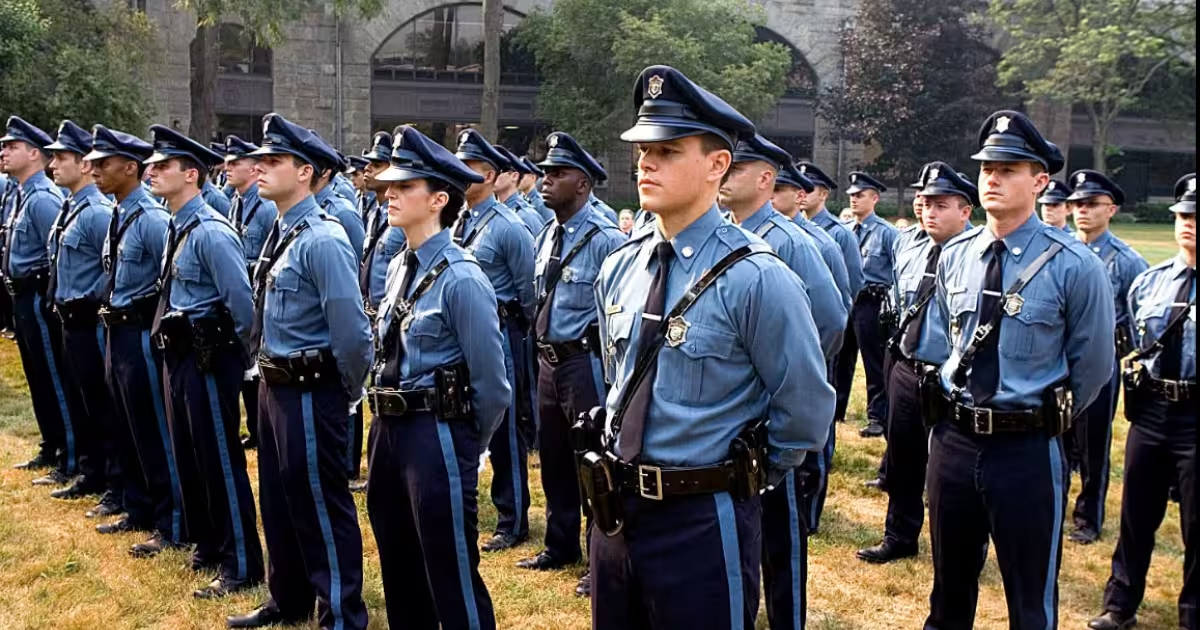
What if the person you trusted most was living a lie so deep that even they no longer knew who they were. The Departed (2006), directed by Martin Scorsese, is a crime thriller released in October 2006 that plunges the viewer into a violent psychological chess match between the Irish mob and the Massachusetts State Police in Boston.
Adapted from the Hong Kong classic Infernal Affairs, the film stars Leonardo DiCaprio, Matt Damon, and Jack Nicholson, and it stands as Scorsese’s most narratively ruthless exploration of identity, loyalty, and moral erosion .
I remember watching The Departed for the first time and feeling not thrilled, but unsettled, as if the film had followed me out of the screen and refused to let me rest.
It is not merely a gangster film but an emotional endurance test where every character is trapped inside a role they did not entirely choose.
This is one of those rare films that earns its place among the 101 must-watch films, a distinction it rightfully holds on probinism.com for its lasting cultural and psychological impact.
Even after nearly two decades, The Departed still feels dangerously alive, as if it understands something uncomfortable about how power and corruption truly operate.
Table of Contents
Background
Martin Scorsese came to The Departed at a pivotal moment in his career, having already shaped American cinema through films like Taxi Driver, Raging Bull, and Goodfellas.
The screenplay, written by William Monahan, reimagines Infernal Affairs by transplanting its story into the gritty socio-political ecosystem of Boston’s Irish-American underworld .
Rather than a simple remake, the film draws loose inspiration from real-life figures such as Whitey Bulger and corrupt FBI agent John Connolly, lending the narrative a disturbing sense of plausibility.
The story unfolds against a post-9/11 American backdrop where paranoia, surveillance, and distrust feel embedded into everyday institutional life.
According to the production notes, Scorsese was particularly interested in the theme of identity, not as a philosophical abstraction but as a lived psychological wound .
The film was produced on a budget of approximately $90 million and went on to gross $291.5 million worldwide, making it both a critical and commercial success.
It also marked a historic moment when Scorsese finally won the Academy Award for Best Director, alongside Best Picture, Best Adapted Screenplay, and Best Film Editing at the 79th Academy Awards.
Yet what makes The Departed enduring is not its accolades but its refusal to offer comfort, justice, or moral clarity.
The film insists that in a world built on deception, survival often belongs not to the good, but to the most convincing liar.
The Departed Plot
A boy is recruited before he even knows he is being recruited.
In 1980s Boston, Frank Costello, an Irish mob boss who treats the city like his private parish, takes an interest in a young Colin Sullivan and quietly shapes his future. Sullivan grows up with a polished smile and a hidden purpose, and that purpose is to become Costello’s eyes and ears inside the Massachusetts State Police.
By the time he is an adult, he is no longer simply loyal, he is strategically planted.
At the same time, another young man, Billy Costigan, is being prepared for a different kind of life behind a mask.
Costigan enters the police world with the wrong surname, the wrong family history, and the right kind of anger. Captain Queenan and Sergeant Dignam decide he is perfect for undercover work precisely because he looks compromised on paper. They strip him of any visible police identity and push him into the dark where he cannot be protected in ordinary ways.
What follows is a cruel symmetry, because the film gives both men the same job in reverse.
Sullivan becomes a rising figure in the police unit that targets Costello, and he feeds the mob information that keeps the gang one step ahead.
Costigan is sent in the other direction, toward Costello’s circle, where every gesture could be a test and every mistake could be fatal. The two tracks begin to run in parallel, close enough to feel each other, but never close enough to touch.
I always find the early stretch almost sickening, because you can sense the trap tightening long before either man admits it.
Costigan’s cover is built through a prison stint and a calculated descent into believable criminal behaviour, and Costello notices him the way a predator notices weakness that can be turned into usefulness.
The mob’s world is loud, physical, and unpredictable, and Costigan learns quickly that courage is not the same thing as control. Meanwhile, Sullivan’s world is clean offices and controlled conversations, which makes his betrayal feel even colder.
Then the film introduces Doctor Madolyn Madden, and suddenly the double life gains a psychological mirror.
Sullivan begins dating her, and she becomes a kind of confessional space for him even when he is not confessing anything real. Costigan is assigned to see her as part of his conditions, which means the same woman starts listening to two different men who are both lying for a living.
The triangle is not romantic in the usual way, because the true intimacy here is secrecy.
As Costigan sinks deeper, his mind starts to fracture under the pressure of constant performance.
He is surrounded by violence and casual cruelty, and the longer he stays inside Costello’s crew, the more the role begins to stick to his skin. Queenan and Dignam try to hold him steady from the outside, but their support is brief, hidden, and always at a distance. Costigan is not just risking death, he is risking the slow erasure of his own self.
The police plan a sting involving stolen microprocessors and a deal with Chinese mobsters, and it feels like the first real chance to end the game.
Costigan sends the police the tip, but Sullivan quietly sabotages the operation from inside the unit. The deal collapses, trust collapses with it, and both sides suddenly realise there is a rat in their walls. Costello demands to know who is leaking, and the police demand to know who is protecting him.
This is where the story stops being a chase and becomes a hunt.
Sullivan starts searching for the undercover cop inside Costello’s crew, and he uses police resources to do it. Costigan starts searching for the mole inside the police, and he has almost nothing to work with except intuition and fear. Both men now wake up every day knowing someone like them is looking for them.
Costigan discovers something even more corrosive than a mole, because he learns Costello is a protected informant for the FBI.
He passes this discovery to Queenan, and the stakes shift from street crime to institutional rot.
Costigan and Madolyn grow closer, and their connection feels like two exhausted people grabbing at warmth in a freezing place. The relationship is messy and ethically tangled, yet it also reveals how badly Costigan needs a witness to his real identity. Sullivan remains in Madolyn’s life too, which turns her into a living junction where both lies intersect.
The plot tightens with a simple object, an envelope.
Costigan tailing Costello sees him hand Sullivan an envelope of information, but he cannot clearly identify Sullivan in the moment. Sullivan senses someone is following him, panics, and his paranoia spills into violence when he stabs a passerby by mistake before fleeing. It is one of those scenes that shows how fear makes even the powerful look pathetic.
Sullivan’s next move is ruthless, because he weaponises his authority inside the police to isolate Queenan.
He arranges surveillance that points Costello’s men toward the meeting between Queenan and the undercover mole.
Queenan meets Costigan in a building, trying to guide him out safely while the mob closes in, and the mood feels like a last prayer spoken too late.
Costigan escapes, but Queenan is captured and thrown from the building to his death, a public and brutal punctuation mark on the idea that the system can protect its own. The shock is not just the fall, it is how quickly the world keeps moving afterward.
In the chaos that follows, Costigan is told by a dying henchman that his cover is known, which is the kind of information that lands like a blade.
Dignam explodes and is suspended after a confrontation with Sullivan, which effectively removes one of the few people who truly cares whether Costigan survives.
Sullivan, digging through Queenan’s files, learns that Costello has been cooperating with the FBI, and the betrayal multiplies again.
Costello begins to suspect that the police may be using misdirection to protect their real mole, which makes him even more volatile.
Sullivan directs the police to tail Costello, and a confrontation erupts that kills most of Costello’s crew in a gunfight that feels less like justice and more like a cleansing fire that burns indiscriminately. In the aftermath, Sullivan confronts a wounded Costello, who admits he has been informing, and Sullivan kills him.
At this point, the film does something heartbreaking, because Costigan’s mission is “complete” but his life is not returned to him.
Costigan reveals himself to Sullivan as a police officer, believing he has finally reached the moment where truth can surface safely.
Then he notices the envelope on Sullivan’s desk and understands instantly what it means, because evidence does not lie even when people do. Costigan realises Sullivan is the mole, and the air goes cold.
Costigan flees, and Sullivan reacts not with panic but with paperwork, deleting Costigan’s records to erase him.
Costigan leaves an envelope of evidence with Madolyn, and she later finds a recording that captures Sullivan’s incriminating conversations with Costello.
The recording matters because it turns suspicion into proof, and proof is the only thing that survives these power games. Madolyn is no longer just a therapist or a lover, she is now a custodian of a truth that can get her killed.
The rooftop meeting that follows is loaded with the ghost of Queenan’s death, and the film wants you to feel that history in the air.
Costigan arrests Sullivan and holds him at gunpoint, trying to drag him into daylight.
Trooper Brown, a classmate of Costigan, arrives, and Costigan insists he has evidence tying Sullivan to Costello. In an elevator ride that feels like a short trip through hell, Costigan is shot dead by Trooper Barrigan, who reveals he is another one of Costello’s spies inside the police.
Brown is shot too, and Barrigan is then shot by Sullivan, allowing Sullivan to frame Barrigan as the only mole.
This is the ending’s first cruel lesson, because the truth can be murdered and still be replaced with a convenient story.
Sullivan recommends that Costigan be posthumously commended, which is a final insult dressed up as honour. Madolyn, now pregnant, leaves Sullivan after Costigan’s funeral, and the emotional weight here is not melodrama, it is recoil. She cannot unknow what she knows, and she cannot look at Sullivan the same way again.
Sullivan returns home thinking he has survived the storm, and that is exactly when the film stops pretending survival equals victory.
Sergeant Dignam appears in Sullivan’s apartment and shoots him, delivering a blunt form of justice that the official system never manages.
The film then shows a rat on the balcony railing in the final shot, a literal reminder of the word everyone has been whispering, and a visual confirmation that betrayal was the film’s real climate from the beginning.
In story terms, Sullivan dies because the lies finally meet consequences, but in moral terms the film refuses to call it cleansing, because too many bodies are already on the floor.
What lingers for me is not the violence, but the emptiness that follows it.
The Departed Analysis
Direction & cinematography: Scorsese shoots The Departed like a moral panic disguised as a police procedural, and Michael Ballhaus’s camera keeps Boston feeling both lived-in and claustrophobic, as if the city itself is complicit.
Acting performances: Leonardo DiCaprio makes Billy Costigan’s paranoia feel physical, the way sleeplessness starts to show up in your posture before it shows up in your face.
Matt Damon plays Colin Sullivan with a controlled emptiness that becomes its own kind of menace, because he looks calm even when he’s dissolving inside.
And Jack Nicholson’s Costello is performed like a storm that enjoys being a storm—funny, grotesque, terrifying, and oddly charismatic in the worst way.
Script & dialogue: William Monahan’s screenplay is sharp, profane, and constantly in motion, which suits a story where stillness would mean being found out. The pacing is long but purposeful at 151 minutes, because the film needs time to make identity feel like a prison rather than a twist.
Music & sound design: Howard Shore’s score and the film’s needle-drops (including “I’m Shipping Up to Boston”) add menace and swagger without letting the tension off the hook.
Themes & messages: For me, the film’s core theme is identity as corrosion—what happens when the role you’re playing starts playing you back.
Personal insight and lessons (today)
Watching The Departed now, I read it less as a gangster thriller and more as a study of how institutions manufacture blindness—how organisations can become so obsessed with “protecting the operation” that they forget they’re meant to protect human beings, which is exactly why Costigan’s suffering feels so modern, so familiar, so quietly rage-inducing.
In real life, we often treat deception as a personal flaw, but the film suggests something harsher: deception can be a job description, and once it becomes your job, your soul becomes “collateral,” because you start making choices for the role rather than for the person you were.
That’s why Sullivan is such an unsettling character—he isn’t simply evil in a theatrical sense, he’s an example of careerism without conscience, the kind that grows in clean offices and polite meetings, and that’s also why he can erase Costigan with a few bureaucratic moves near the end: the system gives him tools that feel legitimate even when they’re used for rot.
Roger Ebert described the story as a “moral labyrinth” where good and evil wear each other’s masks, and I think that nails the emotional trap: when you live long enough inside a lie, you stop knowing whether you’re hiding your true self or hiding the fact that you no longer have one.
The final act—where justice arrives not through official channels but through a personal reckoning—lands like a warning that still matters: if institutions won’t correct corruption, people eventually try to correct it themselves, and that usually comes with blood on the floor and no sense of peace afterward.
Comparison: Compared with Infernal Affairs, Scorsese’s version is more sprawling and more aggressively American—louder, darker-humoured, and soaked in institutional cynicism—while still keeping the same basic double-mole engine. Within Scorsese’s own crime lineage, it shares the propulsion of Goodfellas but swaps nostalgia for dread, which is why it stands apart.
Audience appeal / reception: This is best for adult viewers who can handle brutal violence and very strong language, and it’s the kind of crime film that rewards both casual thrill-seekers and detail-obsessed cinephiles.
Reception snapshot: Critically, it’s widely acclaimed, and the story’s mainstream reach is reflected in its box-office performance (about $292M worldwide), not just its reputation.
Awards: At the 79th Academy Awards, The Departed won Best Picture, Best Director (Scorsese), Best Adapted Screenplay (Monahan), and Best Film Editing (Thelma Schoonmaker).
It’s hard not to see that night as cultural closure too, because Scorsese had been nominated repeatedly before finally winning in this category. It also performed strongly across major awards circuits, including the Golden Globes where Scorsese won Best Director for the film.
Quotations / standout lines and moments (spoilers): The dialogue is full of acid one-liners and intimidation-as-small-talk, but what stays with me most are the “quiet” sentences spoken under pressure—therapy-room sparring, rooftop confessions, and the elevator ride where words stop mattering because the roles have already decided the outcome.
If you want a single idea the film keeps circling, it’s this: “good and evil wear each other’s masks,” which is how the story makes betrayal feel spiritual, not just criminal.
Pros and cons: Pros: • Gripping cat-and-mouse structure • Electric central performances • Razor-edged dialogue • Tense editing rhythm • A bleak, unforgettable ending;
Cons: • Length may feel heavy for some viewers • Emotional exhaustion is part of the experience (not always “fun”) • The cruelty can be relentless.
Conclusion: I’d still recommend The Departed as a must-watch for crime-thriller lovers precisely because it refuses to let the genre stay comfortable, and it fully earns its spot on my 101 must-watch films list on probinism.com.
