
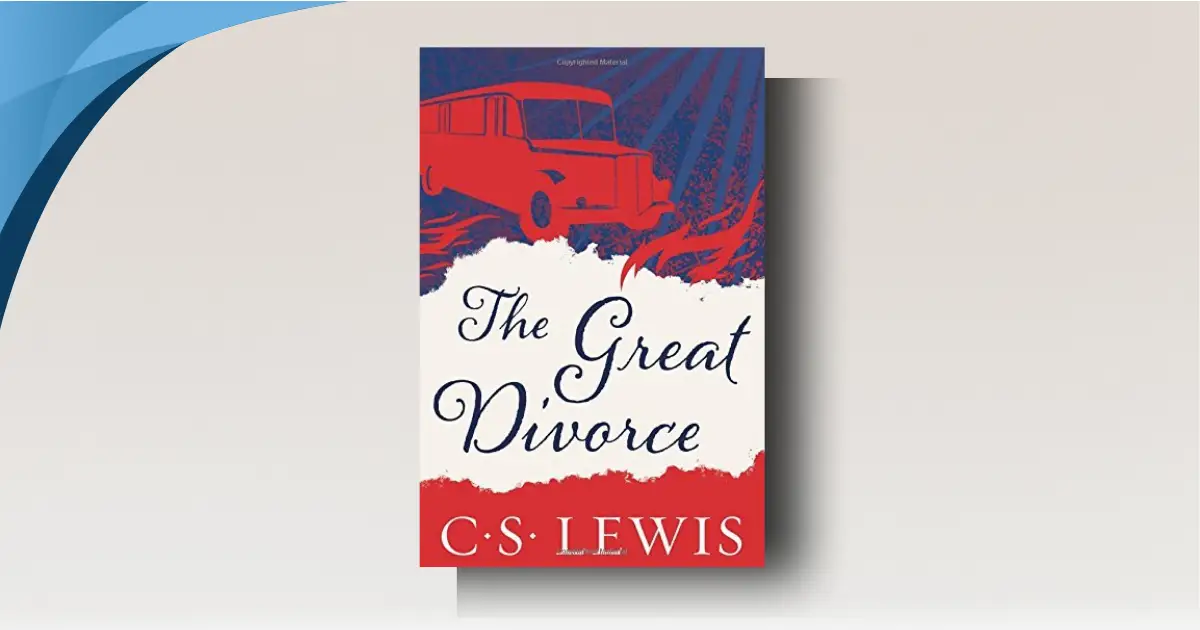
What if the restlessness of modern life isn’t accidental? What if our frustrations, compromises, and inner conflicts are pointing toward something larger—something eternal? The Great Divorce by C.S. Lewis presses into those questions rather than skirting them. I came to it on a bleak, rain-soaked night, and by the final pages, my assumptions about joy, choice, and responsibility had been quietly but permanently dismantled.
The Great Divorce argues that Hell is not a punishment imposed from without, but the final, locked-in state of a soul that has consistently chosen its own self-centered fantasies, resentments, and intellectual pride over the solid, demanding, and glorious reality of God’s joy.
Entire The Great Divorce is the evidence—a detailed case study presented as a dream vision. Through a series of haunting encounters between ghostly, insubstantial visitors from a grey, dreary town (a version of Hell or Purgatory) and radiant, solid citizens of a heavenly landscape, Lewis dramatizes his thesis.
We see a ghost who clings to his sense of “justice” and “rights” rather than accept grace; an intellectual who prefers endless, fruitless theological debate over submission to Christ; a mother whose “love” for her son is really a desire to possess and control him.
Their choices, not divine decree, are shown to be the decisive factor in their fate.
The Great Divorce is best for readers wrestling with questions of free will, eternity, and the nature of good and evil; fans of theological allegory and imaginative fiction; Christians and skeptics alike who appreciate rigorous, poetic thought experiments; anyone who has enjoyed Dante’s Divine Comedy or Bunyan’s The Pilgrim’s Progress.
Not for: Readers seeking a straightforward, doctrinaire theological treatise; those completely averse to Christian presuppositions (though Lewis’s reasoning challenges many cultural Christian assumptions); anyone wanting a light, plot-driven novel without philosophical depth.
Table of Contents
1. Introduction
The Great Divorce: A Dream by C.S. Lewis. First published in 1945-1946 as a serial in The Guardian, this short novel stands as one of the most accessible and penetrating works of Christian apologetics and speculative fiction of the 20th century.
This book is a theological allegory and dream vision in the tradition of John Bunyan and Dante Alighieri, though distilled through Lewis’s uniquely accessible, mid-20th-century English prose.
It belongs to the genres of Christian Fiction, Philosophical Fiction, and Allegorical Fantasy. Following his wildly successful The Screwtape Letters (1942), Lewis continued to explore spiritual realities through inventive narrative frames.
His credentials are formidable: a Fellow of Oxford and Cambridge, a towering literary scholar, and perhaps the most influential Christian apologist of his era, whose works like Mere Christianity have sold over 200 million copies worldwide.
The Great Divorce’s core purpose is to dismantle the idea of a benign, universal salvation without choice, and to combat what Lewis saw as a sentimental, vague belief in “a heaven for everyone.” His central argument, as my Teacher George MacDonald explains in the book, is stark: “There are only two kinds of people in the end: those who say to God, ‘Thy will be done,’ and those to whom God says, in the end, ‘Thy will be done.’ All that are in Hell, choose it.
Without that self-choice there could be no Hell” (Page 46). The “Great Divorce” of the title is the ultimate, unbridgeable separation between those who ultimately choose the hard, solid reality of God and those who choose the soft, self-made fantasies of their own ego.
2. The Great Divorce Summary
The narrator finds himself in the “Grey Town,” a dreary, endless suburb where it is perpetually evening with drizzling rain. The inhabitants are quarrelsome, spiteful, and endlessly moving apart from one another due to petty grievances.
Lewis masterfully sets the stage: “Time seemed to have paused on that dismal moment when only a few shops have lit up and it is not yet dark enough for their windows to look cheering” (Page 4).
This is a hell of triviality and isolation, made by its residents simply by thinking houses into existence and then abandoning them after arguments.
He joins a queue for a bus, where we witness petty violence and selfishness, and boards a vehicle that miraculously lifts off the ground, flying upwards.
His fellow passengers are a motley crew: a Tousle-Headed Poet full of resentment about his lack of “Recognition” (Page 6-7), a practical Intelligent Man who plans to import “red commodities” to bring economic scarcity and “civilization” to the Grey Town (Page 10), and a Big Ghost—a blustering, self-righteous man obsessed with his “rights.”
Their destination is the “Thundering waterfall… like giant’s laughter” of a breathtaking, overwhelming landscape at the foot of towering, sunrise-lit mountains (Page 29). The crucial twist is immediately apparent: the visitors are ghosts, transparent and intangible.
The grass of this country is diamond-hard to their feet, a daisy is immovable, and a beech leaf is heavier than a sack of coal. Conversely, the citizens of this land—the “Solid People”—are blazingly real, substantial, and beautiful.
They have come to meet the ghosts, offering them a chance to stay.
What follows is a series of devastating psychological and theological dialogues, each a case study in damnation:
The Big Ghost and Len (Murderer turned Saint)
In one of the most foundational encounters in The Great Divorce, the Big Ghost—a blustering, indignant spirit from the Grey Town—is met by a luminous, solid Spirit named Len, who recognizes him immediately.
The Big Ghost is horrified to discover that Len, who in life had been a mere employee under him, is now a radiant citizen of Heaven. His outrage centers on a perceived inversion of justice: “I wouldn’t have believed it… It isn’t right, Len, you know. What about poor Jack, eh?” (Page 17).
He references “Jack,” whom Len had murdered on Earth. To the Ghost, his own lifelong record of being a “decent man” who did his job and claimed no more than his “rights” should surely rank him above a murderer.
Len’s response dismantles this entire economy of merit. He explains that Jack is also in Heaven, and then delivers the devastating, humble truth: “Murdering old Jack wasn’t the worst thing I did… But I murdered you in my heart, deliberately, for years” (Page 19).
Len reveals that his crime was a momentary madness, but his hatred for the Ghost—a sustained, cold resentment—was the deeper sin. He has come not to boast, but to beg forgiveness and to serve the Ghost for as long as needed.
The Ghost cannot compute this. He clings fiercely to his identity as a self-made, honest chap: “I done my best all my life, see? … I’m asking for nothing but my rights” (Page 18).
When Len gently tells him, “You will not get yours. You’ll get something far better. Never fear,” the Ghost recoils (Page 18). He interprets the offer of grace (“Bleeding Charity”) as an insult.
The core conflict is this: The Ghost prefers the validation of his own narrative—where he is the wronged, respectable man—over the unearned, humbling gift of joy.
He would rather reign in the hell of his self-righteousness than serve in the heaven of forgiven fellowship. In the end, still grumbling about “damned nonsense” and “cliques,” he chooses to limp back to the bus, choosing the Grey Town where his “rights” remain conceptually intact, over the mountains where they would be joyously obliterated (Page 20).
His choice perfectly illustrates Lewis’s thesis: Hell is chosen by those who prefer the sovereignty of their own ego, however miserable, to the surrender required for true salvation.
The Episcopal Ghost and Dick (The Liberal Theologian)
The Encounter:
A well-spoken, clerical ghost—described as a “fat clean-shaven man” who speaks in a “cultured voice”—encounters a bright, shining Spirit who is naked and blindingly white. The Spirit is Dick, the ghost’s former pupil.
The Dispute:
The Ghost, cheerful and condescending, assumes he and Dick will resume their old intellectual companionship. He hints that Dick had become “rather narrow-minded towards the end” but has surely “broadened out again.” Dick shatters this assumption by revealing the fundamental truth: the Ghost is not in a forward-looking afterlife of progress, but in Hell.
The core of their debate revolves around intellectual honesty and the nature of belief:
- The Ghost’s Defense: He prides himself on following his “honest opinions fearlessly.” When the doctrine of the Resurrection “ceased to commend itself to the critical faculties which God had given me, I openly rejected it” (Page 23). He sees this as heroic integrity.
- Dick’s Rebuttal: He dismantles this. He argues their disbelief wasn’t born of honest struggle but of a cowardly drift with the intellectual current. “We didn’t want the other to be true. We were afraid of crude salvationism, afraid of a breach with the spirit of the age, afraid of ridicule…” (Page 23). Their “sincere” beliefs were like the sincere beliefs of a jealous man convinced of his friend’s betrayal—sincere as a psychological state, but not innocent.
The Offer and The Rejection:
Dick cuts through the debate with a direct command: “I am telling you to repent and believe” (Page 24). The Ghost, taken aback, claims he already believes in a “spiritual sense.” Dick then offers a tangible test: “Will you come with me to the mountains?”
The Ghost, ever the negotiator, wants assurances first: a “wider sphere of usefulness,” “scope for [his] talents,” and an “atmosphere of free inquiry.”
Dick’s answer is final and devastating: “I can promise you none of these things. No sphere of usefulness: you are not needed there at all. No scope for your talents: only forgiveness for having perverted them. No atmosphere of inquiry, for I will bring you to the land not of questions but of answers, and you shall see the face of God” (Page 25).
The Ghost cannot accept this. He prefers the endless, open-ended “journey” of inquiry to the finality of “arrival.” He makes an excuse about having to return to read a paper to his “Theological Society” in Hell, a paper speculating on what a more “mature” Jesus might have believed. He departs, beaming a “bright clerical smile,” humming “City of God, how broad and far.”
The Lesson:
This encounter is Lewis’s stark critique of the sin of intellectual pride. The Ghost is damned not by grand evil, but by preferring his own critical autonomy, his self-image as a brave thinker, and the endless, fruitless debate of the Grey Town over the humble, joyful submission to a Truth greater than himself. He chooses the illusion of seeking over the reality of finding.
The Ghost with the Lizard (Lust Transformed)
This encounter, found in Chapter 6 of The Great Divorce, is one of the book’s most powerful and hopeful vignettes. The narrator observes a Ghost who is different from the others—he carries on his shoulder a red lizard, a creature that constantly twitches its tail like a whip and whispers incessantly into the man’s ear. The lizard is a clear allegory for a persistent, besetting sin of lust or a habitual sensual appetite.
The Ghost is approached by a flaming Angel (a “Burning One”) of immense brightness and authority. The Angel offers to silence the lizard permanently: “Would you like me to make him quiet?” The Ghost initially agrees, but when the Angel clarifies, “Then I will kill him,” the Ghost recoils in fear and negotiation (Page 65).
What follows is a masterful depiction of the addict’s relationship to his sin. The Ghost makes excuses: “I’m not feeling frightfully well today,” and suggests a “gradual process.” The lizard itself whispers promises of “really nice dreams” if it is allowed to live (Page 67).
The Ghost is trapped, knowing the lizard torments him but terrified of the acute pain of its removal.
Finally, after much anguished back-and-forth where the Angel insists he cannot act without the Ghost’s consent, the Ghost screams, “Damn and blast you! Go on can’t you? Get it over. Do what you like… God help me” (Page 68). The Angel seizes the lizard, twists it, and kills it, an act that makes the Ghost scream in agony.
But this death is a prelude to resurrection. The Ghost is transformed into a solid, immense, glowing Man. The dead lizard, in turn, is transformed into a magnificent, silvery-white stallion with a golden mane and tail, powerful and stamping. The new Man mounts the new Horse, and together they ride with joyous haste into the mountains toward the sunrise.
The Lesson: This story illustrates Lewis’s core theme that sin, when surrendered and allowed to be “killed” by divine grace, does not merely leave an empty space. It can be resurrected and transformed into a glorious, ordered strength within a redeemed personality.
Lust, when crucified, can become a powerful steed of passion and energy directed toward Heaven. The key is the individual’s ultimate, painful consent to let go.
The Female Ghost and the Unicorns (Pride and Shame):
A well-dressed ghost, horrified by her own transparency, hides from the Solid People out of shame.
A Spirit gently offers to help her “thicken up,” but she cannot bear the thought of being seen in her ghostly state. “It’s far worse than going out with nothing on would have been on earth” (Page 38).
The Spirit explains that shame must be fully embraced and drunk down to become nourishing. When she refuses, the Spirit summons a herd of terrifying, magnificent unicorns. The implied hope is that sheer, primal fear might shock her out of her self-consciousness.
We do not see the outcome, leaving it as a moment of unresolved, urgent possibility.
Pam and Reginald (Idolatrous Mother-Love)
This is one of the most poignant and psychologically sharp encounters in The Great Divorce. A female Ghost arrives, expecting to be met by her deceased son, Michael. Instead, she is met by her brother, Reginald, now a radiant Solid Spirit. Her immediate reaction is one of unconcealed disappointment: “Oh… Reginald! It’s you, is it?” (Page 59).
The core conflict revolves around Pam’s idolatrous love for her son. She demands to see Michael immediately, but Reginald explains she is currently too ghostly and insubstantial for Michael to even perceive. To become solid enough for that reunion, she must undergo a transformation, which begins with a fundamental shift in desire.
Reginald delivers the hard truth: “You will become solid enough for Michael to perceive you when you learn to want someone else besides Michael. I don’t say ‘more than Michael,’ not as a beginning. That will come later. It’s only the little germ of a desire for God that we need to start the process” (Page 59-60).
Pam treats this as a religious hurdle to clear, a box to tick to get what she really wants: “I’ll do whatever’s necessary… The sooner I begin it, the sooner they’ll let me see my boy” (Page 60). Reginald corrects her: this transactional attitude is the very problem. The treatment is learning to want God for His own sake.
The dialogue escalates as Reginald dissects her “love.” He reveals it was a “merely instinctive love” that became “uncontrolled and fierce and monomaniac” (Page 60). Her all-consuming grief after Michael’s death dominated her living family—her husband Dick and daughter Muriel—making their lives wretched. It was “the wrong way to deal with a sorrow… like embalming a dead body” (Page 62).
Pam defends it as the highest “Mother-love,” but Reginald explains that no natural feeling is holy in itself; it only becomes so when God guides it. When she defiantly claims she believes in a “God of Love,” Reginald delivers the devastating checkmate: “And yet, Pam, you have no love at this moment for your own mother or for me” (Page 63). Her love is entirely self-referential.
In the end, Pam makes her tragic choice. She rejects God and the path to healing, declaring: “He is mine, do you understand? Mine, mine, mine, for ever and ever” (Page 62). She chooses the possessive fantasy of her son over the reality of love itself. As she leaves, Reginald tells the narrator there is still a faint hope—a “wee spark” in her love that is not entirely selfish—but the outcome remains perilously uncertain.
In essence, Story 11 is a masterful study of how even the purest natural love (a mother’s for her child) can become a hellish prison when it turns inward, possessive, and refuses to be converted into something selfless and directed toward its true source in God.
The Tragedian and Sarah Smith (The Dramatization of Self-Pity)
In The Great Divorce’s emotional climax, we see the glorious spirit Sarah Smith (a former humble resident of Golders Green) met by a pathetic composite ghost: a dwarfish, shrunken figure (her earthly husband, Frank) chained to a grandiose, theatrical “Tragedian” who acts out his self-pity and sense of injury.
Sarah pours out pure, forgiving love on the Dwarf, but the Tragedian speaks for him, demanding acknowledgment of his suffering: “You missed me?” (Page 74). Sarah tries to explain that in Heaven, there are no past miseries to nurse.
The ghost, however, is addicted to its narrative of victimhood. “You can really have thought that love and joy would always be at the mercy of frowns and sighs?” Sarah asks (Page 80). In the end, the Tragedian vanishes, and the Dwarf, having failed to let go of his chain, disappears with him. Sarah cannot be blackmailed by misery.
Throughout these encounters, the narrator is guided by the sage George MacDonald (the real 19th-century Scottish author, a major influence on Lewis), who explains the nature of this reality.
He clarifies that the Grey Town is Hell for those who choose to remain, but Purgatory for those who leave it. He delivers the book’s most famous metaphysical insight: “Both good and evil, when they are full grown, become retrospective…
The good man’s past begins to change so that his forgiven sins and remembered sorrows take on the quality of Heaven: the bad man’s past already conforms to his badness and is filled only with dreariness” (Page 43).
The vision ends abruptly. The narrator, sensing the imminent, terrifying sunrise of full Reality, screams and clings to his Teacher—and awakens hunched on the floor of his study, having pulled the books and tablecloth down in his sleep. It was all a dream, but one of profound consequence.
3. Critical Analysis: The Unflinching Logic of Joy
Evaluation of Content and Argument:
Lewis’s argument is supported not by empirical case studies, but by impeccable logical reasoning and psychological observation dramatized in allegory. His evidence is the internal consistency of the choices he portrays. Does the Liberal Theologian truly love truth, or just the pursuit of truth? Does the mother love her son, or her role as his mother? Lewis forces these distinctions with brutal clarity.
He successfully fulfills his purpose of making the doctrine of free will in damnation intelligible and morally coherent. He shifts the discussion from “How could a good God send people to Hell?” to “How could a person, given an eternity of choices, ultimately refuse the source of all joy?” This is a monumental shift in perspective.
The Great Divorce contributes meaningfully to theological discourse by providing a powerful imaginative model that complements logical apologetics.
The Great Divorce quotes
Followings are some of the top and most quotable lines from C.S. Lewis’s The Great Divorce, drawn from the text you provided. These lines capture The Great Divorce‘s core theological insights, poetic imagery, and penetrating psychological observations.
On the Nature of Hell and Choice:
- “There are only two kinds of people in the end: those who say to God, ‘Thy will be done,’ and those to whom God says, in the end, ‘Thy will be done.’ All that are in Hell, choose it. Without that self-choice there could be no Hell.” (Page 46)
- “Hell is a state of mind – ye never said a truer word. And every state of mind, left to itself, every shutting up of the creature within the dungeon of its own mind – is, in the end, Hell. But Heaven is not a state of mind. Heaven is reality itself. All that is fully real is Heavenly.” (Page 44)
- “Milton was right. The choice of every lost soul can be expressed in the words ‘Better to reign in Hell than serve in Heaven.’ There is always something they insist on keeping, even at the price of misery.” (Page 44)
On the Illusion of Self-Righteousness:
- The Big Ghost: “I’m not asking for anybody’s bleeding charity.” / The Solid Spirit: “Then do. At once. Ask for the Bleeding Charity. Everything is here for the asking and nothing can be bought.” (Page 19)
- “You weren’t a decent man and you didn’t do your best. We none of us were and we none of us did.” (Page 19)
On Intellectual Pride and “Honest” Error:
- “The question is whether she is a grumbler, or only a grumble.” (Page 48)
- “There have been men before now who got so interested in proving the existence of God that they came to care nothing for God Himself… as if the good Lord had nothing to do but exist!” (Page 46)
On the Transformative Nature of Heaven:
- “Both good and evil, when they are full grown, become retrospective… The good man’s past begins to change so that his forgiven sins and remembered sorrows take on the quality of Heaven: the bad man’s past already conforms to his badness and is filled only with dreariness.” (Page 43)
- “Flesh and blood cannot come to the Mountains. Not because they are too rank, but because they are too weak. What is a Lizard compared with a stallion? Lust is a poor, weak, whimpering whispering thing compared with that richness and energy of desire which will arise when lust has been killed.” (Page 70)
On Idolatrous Love vs. True Love:
- “Love, now, as mortals understand the word, isn’t enough. Every natural love will rise again and live forever in this country: but none will rise again until it has been buried.” (Page 64)
- “There is but one good; that is God. Everything else is good when it looks to Him and bad when it turns from Him.” (Page 65)
On the Solid People (the Saved) and Their Joy:
- “Redeemed humanity is still young, it has hardly come to its full strength. But already there is joy enough in the little finger of a great saint such as yonder lady to waken all the dead things of the universe into life.” (Page 72-73)
- “I am in Love Himself, not lonely. Strong, not weak. You shall be the same. Come and see. We shall have no need for one another now: we can begin to love truly.” (Page 76)
On the Futility of Pity as Blackmail:
- “Pity was meant to be a spur that drives joy to help misery. But it can be used the wrong way round. It can be used for a kind of blackmailing. Those who choose misery can hold joy up to ransom, by pity.” (Page 79)
On the Shrinking, Self-Imprisoned Soul:
- “For a damned soul is nearly nothing: it is shrunk, shut up in itself. Good beats upon the damned incessantly as sound waves beat on the ears of the deaf, but they cannot receive it. Their fists are clenched, their teeth are clenched, their eyes fast shut. First they will not, in the end they cannot, open their hands for gifts, or their mouths for food, or their eyes to see.” (Page 84)
On Time, Freedom, and Eternity:
- “That thing is Freedom: the gift whereby ye most resemble your Maker and are yourselves parts of eternal reality. But ye can see it only through the lens of Time…” (Page 85)
Vivid Descriptions:
- On the Grey Town: “Time seemed to have paused on that dismal moment when only a few shops have lit up and it is not yet dark enough for their windows to look cheering.” (Page 4)
- On the Solid People’s arrival: “The earth shook under their tread as their strong feet sank into the wet turf.” (Page 16)
These lines are not only philosophically rich but are also key to understanding the dramatic arguments Lewis makes throughout his allegorical dream vision.
4. Strengths and Weaknesses: A Personal Reader’s Experience
Strengths (My Positive Experience):
- Allegorical Power: The imagery is unforgettable. The hard grass, the tragic ghosts, the solid, joyful people—these concepts embed themselves in your mind. I still think of “the lizard” when dealing with stubborn sins.
- Psychological Depth: Lewis understands the subtleties of damnation. It’s not about mustache-twirling villains, but about the respectable sinner, the grieving mother, the intellectual—people like us. This is deeply compelling and personally convicting.
- Clarity of Thought: Complex theological ideas (the nature of sin, repentance, heaven, hell) are distilled into crystalline dialogues. MacDonald’s explanation of retrospective reality (Page 43) is a philosophical masterpiece in miniature.
- Emotional Range: The Great Divorce is not just stern; it’s filled with poignant longing (Pam for her son), hilarious satire (the Intelligent Man’s economic plans), and breathtaking beauty (the description of the waterfall and the stallion).
Weaknesses (My Struggles with the Text):
- Potential for Rigidity: The clear-cut choices can feel schematic. In real life, the lines between a “sin” and a “weakness,” between idolatrous love and healthy love, are often blurrier. The book’s clarity can sometimes feel reductive.
- Limited Scope of Damnation: Most ghosts are damned by intellectual or “respectable” sins (pride, possessiveness, cynicism). While the lizard touches on sensuality, The Great Divorce leans heavily towards diagnosing the sins of the “educated” or “middle-class” soul. What of simpler, more brutal evils?
- The Dream Frame: While effective, the “it was all a dream” ending can feel like a narrative cop-out to some readers, potentially softening the ontological punch of the vision.
5. Reception and Criticism
Upon its release, The Great Divorce was generally praised for its ingenuity and power, though some theological reviewers questioned its speculations on Purgatory and its stark view of damnation.
Over time, it has become a beloved classic, often ranked alongside The Screwtape Letters and The Chronicles of Narnia as among Lewis’s most popular works.
According to publishing data, it has never been out of print and sells hundreds of thousands of copies globally each year, a testament to its enduring relevance.
Modern critics sometimes analyze it through the lens of Lewis’s own biography, seeing reflections of his struggles with doubt, loss, and intellectual pride. Its portrayal of female characters (like Pam or the shame-filled ghost) has also been subject to feminist critique for being stereotypical or unsympathetic.
6. Comparison with Similar Works
- Dante’s Divine Comedy: The most direct ancestor. Both are guided tours of the afterlife structured around encounters with souls. However, Lewis is less concerned with cosmic geography and poetic justice, and more focused on the immediate, psychological moment of choice.
- John Bunyan’s The Pilgrim’s Progress: Both are Protestant allegories of the spiritual journey. Bunyan’s is a linear progression; Lewis’s is a static, decisive confrontation. The Great Divorce is like a deep, focused biopsy of the moments Bunyan’s hero passes through quickly.
- J.R.R. Tolkien’s Leaf by Niggle: Tolkien’s short story, a contemporary of Lewis’s book, also deals with purgatory, artistry, and salvation in a similarly gentle-but-firm allegorical mode. Both emerge from the same Inkling literary milieu.
- Modern Works like Mitch Albom’s The Five People You Meet in Heaven: Albom’s book shares the structure of afterlife encounters but leans heavily towards sentimentality, closure, and self-actualization. Lewis’s work is theologically rigorous and far less concerned with making the reader feel unconditionally warm.
7. Conclusion and Final Recommendation
The Great Divorce is a masterpiece of imaginative theology. It is a short, dense, and profoundly unsettling book that has the power to haunt a reader for a lifetime. It does not provide easy answers but offers a terrifyingly clear framework for understanding the deepest questions of human existence.
Who should read it? I recommend it unreservedly to:
- The Spiritually Curious, regardless of belief. It is a supreme work of moral and philosophical imagination.
- Christians feeling complacent or grappling with the doctrine of hell.
- Readers and Writers who want to see how abstract ideas can be made flesh in narrative.
- Anyone in a “Grey Town” season of life—feeling petty, isolated, resentful, or trapped in cyclical thoughts.
It is less suitable for those seeking dogmatic certainty or purely escapist fantasy. The Great Divorce is a confrontation, not an escape.
In the end, The Great Divorce remains, for me, a permanent landmark. On certain grey evenings, I remember the bus queue, and it prompts a vital, unsettling, and ultimately hopeful question: What, at this very moment, am I choosing to hold onto—and what solid, unimaginable joy might I be refusing because of it?
