
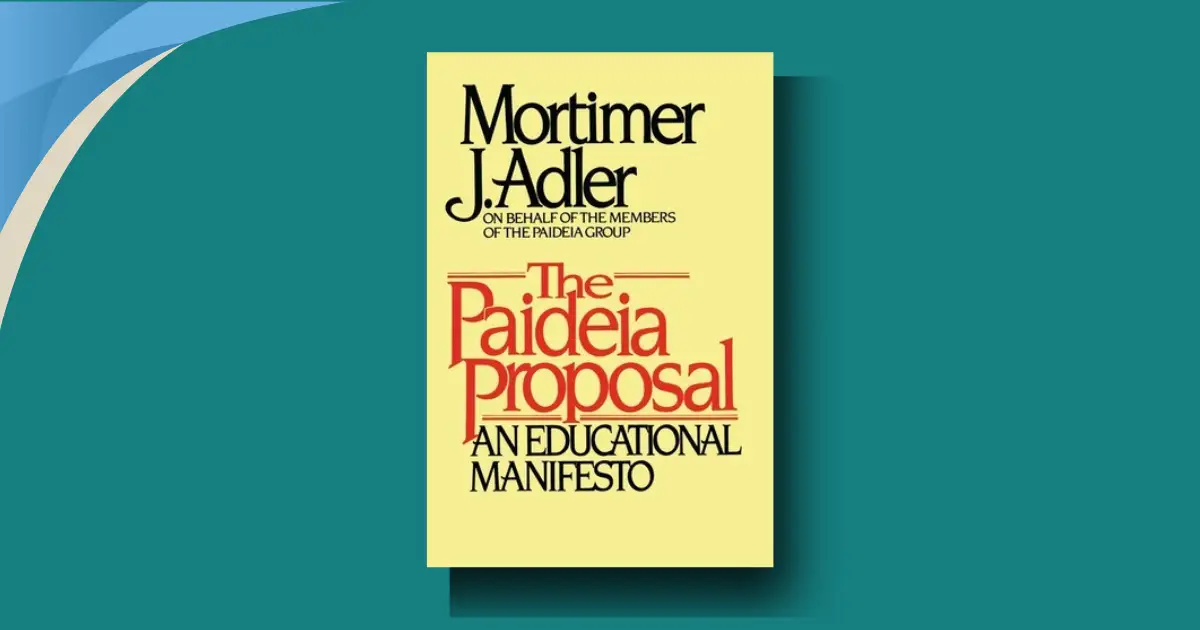
The Paideia Proposal by Mortimer J. Adler exists for the moment you look at modern schooling and think: “How did we end up here, and what would a sane, democratic fix actually look like.”
In 2024, only 31% of US fourth graders performed at or above the NAEP “Proficient” level in reading. When I place that next to Adler’s insistence on “the best education for all,” the book stops feeling like a 1982 artifact and starts feeling like a living argument.
The best idea in The Paideia Proposal is that “a democracy survives only when every child gets the same high-quality liberal education—knowledge, skills, and deep understanding—not a tracked system that quietly decides who is “meant” to think.
Evidence snapshot: The book’s diagnosis matches long-running alarms about achievement and literacy, from A Nation at Risk (1983) documenting SAT declines and functional illiteracy to today’s NAEP and PISA results.
The Paideia Proposal is best for you if you want a bold, coherent blueprint that treats schooling as democracy’s infrastructure, you’ll love it; if you want small tweaks, lots of electives, or a “skills-only” curriculum, you may bounce.
I’m writing this as a full, reader-first review and “complete summary” of The Paideia Proposal: An Educational Manifesto (Macmillan, first paperback 1982), because the book is short enough to be digestible and dense enough to be misunderstood when it’s reduced to a slogan.
Adler wrote it on behalf of the Paideia Group, and he frames “paideia” as the Greek idea of the upbringing of a child—general learning meant to belong to all human beings.
His credentials matter because this is not a casual opinion piece: he was chair of the Board of Editors of Encyclopaedia Britannica and led the Institute for Philosophical Research.
The manifesto is dedicated to Horace Mann, John Dewey, and Robert Hutchins—three names that hint at the book’s moral spine: public schooling, democratic citizenship, and liberal learning. And yes, I’m going to quote the book carefully and directly, because Adler’s phrasing is part of the force.
So here is the Paideia Proposal review, built to answer search intent like “Paideia Proposal summary,” “Paideia Proposal education manifesto,” “Mortimer J Adler education reform,” and “Paideia Seminar meaning,” while still reading like a human who actually cares.
Table of Contents
1. Introduction
The Paideia Proposal: An Educational Manifesto (1982) is Mortimer J. Adler’s plan, written for the Paideia Group and published by Macmillan.
Adler positions the book as a democratic intervention, not a niche pedagogy, and he defines “paideia” as general learning that should belong to all human beings.
He’s explicit that the proposal is addressed to parents, teachers, school boards, employers, and citizens worried about declining schooling and civic capacity. Even the dedication—Horace Mann, John Dewey, Robert Hutchins—signals that this is about public institutions and liberal education, not “school hacks.”
The thesis, in Adler’s own civic logic, is that democracy without high-quality universal schooling becomes a “travesty,” because universal suffrage without universal education produces an electorate that cannot govern itself.
Everything that follows is his attempt to show what “universal” must mean—quantitatively (everyone attends) and qualitatively (everyone gets the same serious education).
The book’s structure is clean—four parts, twelve chapters, plus a direct “what to do next Monday morning” checklist that makes the manifesto feel operational rather than dreamy.
My goal in this article is simple: I will lay out the full argument, explain the key terms, translate the philosophy into what it would look like in classrooms, and then tell you where I think Adler is brilliant and where he is stubborn.
At the heart of the manifesto is a refusal of tracking as moral common sense, because he sees multitrack schooling as a disguised form of discrimination that assigns “different goals for different groups of children.”
He argues that the “tracking system” still divides children “into those destined only for labor and those destined for more schooling,” which is why he wants one demanding program for all. For Adler, equality is not achieved by offering everyone a building called “school,” but by ensuring that all children get the same intellectual future in that building.
And he insists the fix is not “watering down” the program, but supporting kids so they can actually reach high standards. If you read the book as a whole, you realize it’s less about nostalgia for classics and more about preventing democracy from hollowing out.
To make that urgency feel real in 2025 terms, it helps to look at what the data keeps repeating: when reading skill collapses, everything else becomes harder—science, citizenship, even employability.
Adler’s point is not that schools should become political machines, but that a free society cannot stay free if most people are trained for compliance rather than educated for judgment.
Now let’s step back and see the background forces—then I’ll walk through the book’s content as one continuous, spoiler-full map.
2. Background — why this manifesto still matters
The Paideia Proposal comes out of an era when the US was already anxious about education and competitiveness, and a year later A Nation at Risk (1983) would harden that anxiety into national rhetoric.
That report famously documented that SAT verbal scores fell “over 50 points” and math scores “nearly 40 points” from 1963 to 1980.
It also claimed “some 23 million American adults” were functionally illiterate, and that about 13% of 17-year-olds could be considered functionally illiterate. Whether you agree with every policy conclusion of A Nation at Risk, the numbers show why Adler’s manifesto landed in a culture primed to ask, “What is school for?”
Adler’s answer is blunt: we’ve been hypocritical, saying we believe in democracy while implying only some children are “fully educable” for citizenship and “a full human life.” He insists that vocational training for particular jobs is not the education of free people, echoing Dewey, and he treats job-tracking in basic schooling as a democratic failure.
He also confronts a quieter background issue that still haunts education reform: early-childhood inequality, the kind that makes schools misread “lack of preparation” as “lack of ability.”
He writes that preschool help—“one year, or better, two or three years”—must be provided for children who do not get preparation from favorable environments.
If I bring this forward to now, the headline is brutal: the foundational skill Adler relies on—reading—remains weak at scale, with 2024 NAEP showing 31% of fourth graders at or above proficient.
Internationally, OECD reporting on PISA 2022 says 66% of US students reached at least Level 2 in mathematics and 80% reached Level 2 or higher in reading, which still leaves a large minority below baseline proficiency.
Even if we argue over what “proficient” should mean, the pattern Adler feared—huge numbers of students not reaching robust literacy—has not vanished.
Meanwhile, the National Paideia Center continues to promote Paideia implementation and even lists accredited and certified schools, showing the approach has not died as a historical curiosity. So the question becomes less “Is Adler relevant,” and more “Is Adler workable without turning into an ideology.”
On research: the evidence base for Socratic seminars and structured discourse includes qualitative and applied studies (for example, ERIC-indexed work exploring perceived impacts on reading comprehension and critical literacy in adult learners), but it is not the kind of massive randomized trial literature that would end all debate.
That matters because Adler’s manifesto is persuasive as philosophy and system design, yet modern readers will reasonably ask, “Where are the outcomes?”
With that context set, here is the full content summary—part by part, chapter by chapter, with the key claims and the tensions left intact.
3. The Paideia Proposal summary
Part One — The Schooling of a People (what democracy demands)
Adler opens with a line that functions like the book’s moral engine: “The best education for the best… is the best education for all.”
He argues we already know what excellent education looks like, but we’ve been “slow to learn how to provide it,” and we’ve tolerated a national double-talk where we claim democratic equality while treating many children as “not fully educable.” He wants to end that hypocrisy because it shows up in policy, expectations, and the structure of schooling itself.
This is where Adler’s tone becomes almost prosecutorial: the failure to educate all children is not the children’s failure, but society’s.
Then he throws down a sentence that sounds sentimental until you notice how much it costs to believe it: “There are no unteachable children.”
He insists the category “unteachable” is mostly an excuse we use to justify unequal schooling, and he treats it as a civic sin because it lets a democracy abandon its own people. This is not naïve optimism in his framing; it is a demand that schools and adults accept responsibility for changing methods, time, and support.
Adler then makes a move that feels wise rather than convenient: he says schooling is only part of education, and no one becomes fully educated in school.
He frames learning as lifelong and writes, “learning never reaches a terminal point.”
This matters because it changes what “successful school” means, and Adler says schooling that does not prepare a person for continuing learning has “failed.” He treats basic schooling as a preparatory stage that forms the habit of learning and provides the means to keep learning after school.
He even revives an old term—“baccalaureate diploma”—to describe what a truly complete basic schooling would certify at the end of twelve years. To show how deep the tracking problem runs, he cites Thomas Jefferson’s 1817 proposal of common schooling and notes that Jefferson still divided children into those “destined for labor” and those “destined for learning,” then argues that modern tracking repeats the same moral split.
By the end of Part One, Adler has established a demanding standard: basic schooling must prepare all children to keep learning in adult life, not merely sort them for different social functions.
That sets up Part Two, where he defines the objectives and the curriculum that would make the promise real.
Part Two — The Essentials of Basic Schooling (one program, three aims, zero tracking)
Adler’s central claim here is that in a democratic society, children share a future in “essential respects,” and those shared facts justify “the sameness of the objectives” in basic schooling.
He argues that all children will become citizens with rights, and therefore they have a right to the conditions needed for pursuing happiness and living well. That sameness is why he wants a required course of study for all and a satisfactory standard of accomplishment for all.
He defines three “common callings” for all children: earn a living responsibly, function as responsible citizens, and lead responsible lives that make room for the goods of a good human life.
This is where Adler’s proposal becomes more precise than many education reform books, because he doesn’t float “critical thinking” as a vibe; he ties schooling to specific adult roles that everyone must perform.
He also answers a predictable objection: “How can schooling be ‘nonvocational’ if it must prepare people to earn a living?” by distinguishing broad preparation for work from narrow training for one particular job.
He then anchors the entire argument to democracy itself: universal suffrage without universal schooling creates an “ignorant electorate” and becomes a “travesty of democratic institutions.”
So, for Adler, qualitative universality is nonnegotiable, which is why he hates the “two-track or multitrack system.” His fix is not to pretend differences do not exist, but to refuse to turn difference into a justification for unequal aims.
This is where the most controversial piece appears: the same course of study for all, with no electives in basic schooling.
He writes that “all sidetracks, specialized courses, or elective choices must be eliminated,” because electives let some students “downgrade their own education.”
Then he draws a line: “Elective choices are appropriate only” at the level of advanced schooling, and they are “wholly inappropriate” at the level of basic schooling. The only exception he allows in the twelve-year basic program is the choice of a second language.
He introduces the famous Three Columns of Learning, describing three ways the mind can be improved: acquiring organized knowledge, developing intellectual skills, and enlarging understanding, insight, and appreciation.
He also includes auxiliary studies: physical education for all twelve years, manual arts for some years, and an introduction to the world of work later on. In other words, he is not proposing a purely bookish curriculum; he is proposing a curriculum where manual skills exist for human development rather than for early job sorting.
All of this triggers the obvious pushback—what about individual differences, and what about the reality of unequal homes.
Overcoming Initial Impediments and Individual Differences (support without lowering the ceiling)
Adler knows the first counterargument: children arrive at school unequal in preparation because homes and environments are unequal, and pretending otherwise is fantasy.
So he argues for preschool support, praising the logic behind Head Start and insisting that preschool tutelage should be publicly funded for those who need it and cannot afford it. He says the sooner a democratic society intervenes to remedy cultural inequality, the sooner it will fulfill equal educational opportunity.
When critics accuse him of being utopian—same objectives, same course, no electives—he basically answers: yes, I am insisting on sameness, and no, I am not ignoring difference.
His method is “remedial” in the literal sense: help children overcome deficiencies so they can meet the same standard, and never let a child fall “irremediably behind.”
He also delivers a line that, to me, is the manifesto’s psychological hinge: he says faith in educability “rejects with abhorrence” the notion of “irremediable deficiencies” that block the same goals for all.
In the crucial passage, he insists the answer is not “retreat from the sameness of the program” or any “watering down,” but administering the program flexibly and giving special help where needed.
That’s how he tries to thread the needle: the curriculum remains common, the standards remain serious, but the supports vary to meet real differences. He is also explicit that the existing “remedial teaching” often fixes defects caused by prior educational failure, while his proposed remedial teaching assumes good teaching but recognizes some children need more time and help.
If you’re looking for the moral core, it’s right here: schools should be designed so the child is not blamed for the system’s lack of flexibility and care. This is where Adler moves from philosophy into pedagogy, because even a perfect curriculum fails if classroom learning is passive.
That brings us to Part Three, which he literally calls “the heart of the matter.”
Part Three — Teaching and Learning (the three columns in real classroom life)
Adler says the essentials—principles, objectives, course of study, standards—are “external prerequisites,” but not enough, because the heart is the quality of learning that happens during class and homework.
He emphasizes that teaching quality matters most for those least adept at learning, and he states, “All genuine learning is active, not passive.” This is where the Paideia Proposal becomes strongly anti-worksheet and anti-memorization-as-a-goal, without denying that knowledge matters.
His Three Columns translate into Three Kinds of Teaching: didactic instruction for organized knowledge, coaching for intellectual skills, and maieutic (Socratic) questioning for understanding of ideas and values.
He even defines maieutic teaching as “midwifery”: helping students give birth to their own understanding through questions and dialogue.
Adler’s most vivid fear is a student who becomes a “memorizing machine,” able to pass tests but not understand.
So he asks, almost like an accusation, when students have been called upon to “think for themselves,” respond to important questions, pursue an argument, defend a view, and understand its opposite.
He says without joy in learning—joy that comes from hard work and shared intellectual task—basic schooling cannot initiate young people into the life of learning. He insists the student whose mind is engaged in thinking is the active participant that real schooling requires.
The Paideia Seminar, in this sense, is not a cute discussion circle; it is the machinery that turns “learning” from reception into participation.
The modern research on Socratic seminars tends to emphasize perceived gains in comprehension and critical literacy, though it is often qualitative and context-specific rather than definitive at national scale.
Then Adler gets practical about adults: teachers and principals.
In “The Preparation of Teachers,” he argues colleges of education are not sufficiently equipped and must become staffed by scholars who understand the spirit of the reform, not merely methods courses.
In “The Principal,” he says the principal must lead teachers, and he frames leadership as ensuring the program is carried out, standards are held, and teaching quality is supported rather than merely supervised.
He wants a school where the three columns interact constantly: reading and knowledge feed skills; skills enable deeper discussion; discussion prevents knowledge from becoming dead memory.
This is why the manifesto feels systemic: it is not “add one seminar and call it reform,” but redesign the whole rhythm of schooling to make thinking the norm. If you are searching for what the Paideia Proposal actually does inside a classroom, this part is the answer.
And then Adler steps beyond basic schooling, because he wants the system to stop forcing colleges to repair what K–12 failed to build.
Part Four — Beyond Basic Schooling (college, work, and the survival of free institutions)
Adler says higher institutions are “severely crippled” by inadequate preparation and are compelled to “teach all kinds of elementary work” that should have been done years earlier.
He argues that improving basic schooling would enlarge and strengthen the student body and allow colleges to become what they claim to be, rather than remedial factories.
He then proposes two purposes for college: specialized vocational preparation for certain professions, and the pursuit of general learning itself by older students capable of advanced liberal education.
He also insists that even vocational students should have a required component of general liberal learning beyond what they received in basic schooling.
On work, his argument is surprisingly modern: humans are flexible creatures, “least specialized,” so general schooling best fits human nature and rapid change.
He says twelve years of general schooling is the most practical preparation for work precisely because a changing society makes narrow job training quickly obsolete.
That’s why he wants to “eliminate all training for specific jobs” from basic schooling while still introducing students to the world of work in a broad, exploratory way. He ties all of this to democracy’s survival, warning that without much better education, a poorly schooled population will “despoil” institutions and corrupt itself. Then, in the most practical section of the book, he answers school boards who ask what to do “next Monday morning” by listing steps: ensure the three kinds of learning and teaching, set challenging standards, eliminate nonessentials, restore homework, ensure preschool support, and remove electives except the second language choice.
This is where the manifesto stops being merely inspiring and becomes confrontational, because Adler is not polite about what he thinks must be cut.
If I compress the entire book into one emotional takeaway, it’s this: Adler thinks we are wasting human potential, and he calls that a form of national self-harm.
Now, after the full summary, here’s what I think the book gets brilliantly right—and where it makes me argue back.
4. Strengths and weaknesses
The book’s greatest strength is moral clarity: Adler refuses to let “democracy” be a ceremony while schooling remains a sorting machine, and he states plainly that we cannot say we are for liberty for all while saying only some children are educable for full citizenship.
The second strength is structural: the Three Columns are not vague, and they distinguish knowledge, skills, and understanding in a way that still maps onto what good teachers do.
The third strength is pedagogical courage: he defends discussion and Socratic questioning as the key to understanding, and he names the “memorizing machine” problem without pretending it is a minor flaw.
But Adler’s biggest weakness is also his clarity: his hostility to electives in basic schooling will irritate readers who see choice as motivation, identity-building, or a way to honor student interests.
He also underplays how hard it is to build teacher capacity for maieutic teaching at scale, especially in systems already strained by staffing shortages and uneven preparation.
The evidence base is another weakness if you demand modern “what works” proof, because the manifesto reads more like a constitution than a program evaluation.
Even Adler admits reform depends heavily on the quality of teaching, and he places enormous responsibility on teachers and principals.
In teacher preparation, he criticizes colleges of education as not sufficiently equipped and calls for scholars who truly understand the reform, which is a strong claim but also a heavy lift institutionally.
Practically, the Paideia model demands time for reading, coaching, and seminar discussion, and many schools will struggle to create that time without political conflict. Emotionally, the proposal can feel “too pure” because it assumes communities will agree on high standards and cut beloved nonessentials. And yet, it is exactly that purity that makes it useful: it gives you a measuring stick against which compromises become visible.
I finished the book feeling both challenged and strangely hopeful, because a coherent philosophy is rare in education policy talk.
5. Comparison with similar works
If John Dewey’s Democracy and Education argues that education is the method of social progress, Adler’s Paideia Proposal feels like a concrete attempt to engineer that Deweyan ideal into a national K–12 structure, and he explicitly invokes Dewey in the text.
If Robert Hutchins and the Great Books tradition emphasize liberal education as formation of the mind, Adler borrows that seriousness but pushes harder on universal access and the rejection of tracking.
Compared with E D Hirsch’s cultural literacy style arguments, Adler is less about a particular “list” and more about the modes of learning that turn knowledge into understanding.
Compared with Paulo Freire’s liberation pedagogy, Adler is less explicitly about oppression language, but he shares the belief that treating some students as “trainable” rather than “educable” is morally dehumanizing..
6. Conclusion
If you want a serious, system-level answer to the question “What is school for in a democracy,” I recommend The Paideia Proposal because it refuses both cynicism and empty optimism.
Adler’s argument is that the only stable form of equal educational opportunity is a common, demanding, liberal education for all, backed by flexible support rather than watered-down tracks.
He connects that directly to citizenship and warns that suffrage without education produces an electorate that cannot govern wisely. Reading it today, with NAEP showing only 31% of fourth graders at or above proficient in reading, I feel the urgency rather than the nostalgia.
For evidence-minded readers, the manifesto aligns with decades of concern about literacy and achievement, from A Nation at Risk documenting functional illiteracy and achievement decline to OECD reporting that a meaningful minority of US students remain below baseline proficiency in PISA measures.
