

What if a single film attempted to capture the entire story of existence, from the cosmic dawn to the intimate grief of a single family? Terrence Malick’s The Tree of Life (2011) is that audacious, breathtaking gamble. More than a mere movie, this experimental epic is a philosophical tone poem, a visual symphony, and a profound meditation on memory, loss, and the search for meaning.
It is a film that polarized audiences at Cannes—earning both boos and a Palme d’Or—and has since been enshrined as a landmark of 21st-century cinema. To me, it remains a towering, emotionally resonant work that demands and rewards patient engagement, securing its place as one of the 101 must-watch films for any serious cinephile.
Table of Contents
Background
Emerging from decades of gestation, The Tree of Life is the product of Terrence Malick’s legendary, reclusive artistry. The project originated from an abandoned concept called Q, which envisioned a history of the cosmos.
After the critical success of The New World (2005), Malick, with producers including Brad Pitt, Dede Gardner, and Bill Pohlad, resurrected these grand ideas.
Shot primarily in Texas with a mix of 35mm, 65mm, and IMAX film by the visionary cinematographer Emmanuel Lubezki, the production was famously improvisational and secretive.
It involved casting over 10,000 local children to find its young leads, creating a unique, naturalistic atmosphere far from a typical Hollywood set.
| Actor | Character | Importance Summary |
|---|---|---|
| Brad Pitt | Mr. O’Brien | The stern and complex father figure whose strict discipline shapes his sons’ experiences and embodies the film’s exploration of nature vs. grace. |
| Jessica Chastain | Mrs. O’Brien | The nurturing, philosophical mother whose compassion and grace contrast with her husband’s severity, grounding the film’s emotional heart. |
| Sean Penn | Jack O’Brien (adult) | The reflective adult son whose journey through memory, loss, and reconciliation provides the film’s emotional and existential anchor. |
| Hunter McCracken | young Jack | The childhood version of Jack, whose experiences of wonder, conflict, and growth help shape the film’s nostalgic core. |
| Laramie Eppler | R.L. O’Brien | The spirited middle brother whose life and loss underscore themes of innocence, family, and grief. |
| Tye Sheridan | Steve O’Brien | The youngest brother whose presence emphasizes familial connection and the shifts in perspective across time. |
The Tree of Life Plot
The Tree of Life is not a narrative in the conventional sense; it is a memory, a prayer, and a vision. The film opens in the present day with the O’Brien parents receiving news of their 19-year-old son R.L.’s death.
This tragic loss sends Jack (Sean Penn), their eldest son now a disillusioned architect, spiraling into a mid-life crisis, haunted by fragments of his 1950s childhood in Waco, Texas. His mother’s (Jessica Chastain) anguished voiceover asks God the timeless question of Job: “Where were you?”
The Tree of Life then answers with a staggering, wordless sequence depicting the birth of the universe, the formation of galaxies, volcanic Earth, and the dawn of life. We witness a pivotal, almost merciful moment where a dinosaur spares a wounded rival. This cosmic prologue establishes the film’s scale: one family’s pain is framed against the billion-year drama of creation and evolution.
The heart of The Tree of Life is Jack’s childhood, seen through the lens of adult regret and wonder. His world is defined by the two “ways” his mother teaches him: the “Way of Grace” and the “Way of Nature.”
She embodies grace—ethereal, forgiving, teaching her three boys to see the world with love and wonder. His father, Mr. O’Brien (Brad Pitt), embodies nature—a frustrated, domineering patriarch and failed musician who rules his home with stern discipline, believing the world is a brutal place where only the tough survive.
Jack’s adolescence becomes a painful internal battle between these forces. He adores his mother’s gentleness but witnesses her powerless submission to his father’s rage. He fears and resents his father’s harshness, yet recognizes his own capacity for cruelty, seen in acts of vandalism, animal abuse, and petty theft.
The death of a childhood friend shatters his innocence and sparks a crisis of faith. When his father loses his job and the family must move, there is a fleeting moment of reconciliation where the father, broken, asks for Jack’s forgiveness. Jack, however, coldly insists he is more like his father than his mother.
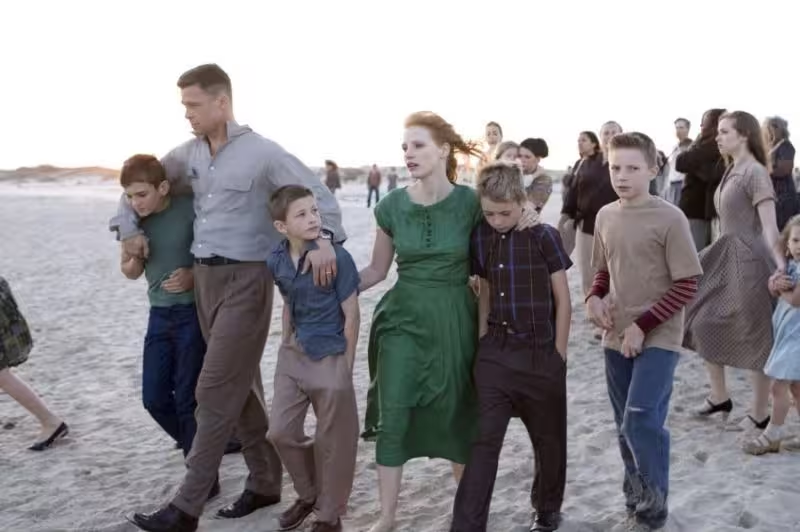
The Tree of Life culminates in a transcendent, ambiguous finale. In the present, Jack has a vision. He walks through a doorframe onto a vast, dreamlike beach at the end of time. Here, in a form of spiritual afterlife or collective memory, all the dead are reunited. Jack is reconciled with his younger self, his brothers, and his parents.
His mother, finally at peace, releases R.L. to the universe, whispering, “I give him to you. I give you my son.” The film does not offer a concrete heaven but a poetic resolution: acceptance, forgiveness, and the understanding that every life, in all its joy and suffering, is part of a vast, incomprehensibly beautiful whole.
The mysterious light from the beginning flickers once more, suggesting a divine, enduring presence.
The Tree of Life Analysis
Direction and Cinematography
Terrence Malick’s direction is less about plotting and more about channeling emotion and philosophy through imagery. His signature style—the “roving, intrusive eye” of the camera, the whispered voiceovers, the reverence for nature—reaches its apex here. He creates a film that feels both intimately subjective and cosmically objective.
Emmanuel Lubezki’s cinematography is nothing short of miraculous. Using almost entirely natural light, the camera floats, soars, and lingers, turning suburban Texas into a mythic landscape and the creation of the universe into tactile, awe-inspiring art. It’s a visual language that prioritizes experience over explanation.
Acting Performances:
The performances are masterfully tuned to Malick’s organic style. Brad Pitt delivers one of his finest, most complex roles as Mr. O’Brien, layering the character’s tyranny with palpable regret and love.
Jessica Chastain is luminescent as the angelic yet sorrowful mother, a nearly silent role conveyed through gesture and presence.
The revelation is young Hunter McCracken as Jack, whose face registers the entire tumult of adolescence—adoration, rebellion, guilt—with stunning authenticity. Sean Penn, though with less screen time, embodies the adult Jack’s weary spiritual desolation perfectly.
Script and Dialogue:
There is no traditional screenplay to analyze. The “script” is a framework for images and emotions. Dialogue is sparse, often overlapping, and feels snatched from real memory.
The power lies in the voiceovers—fragments of prayer, doubt, and questioning that guide the emotional current. The pacing is deliberately meditative, which some find challenging, but it is essential for the film’s contemplative, liturgical rhythm.
Music and Sound Design:
The soundscape is integral to the film’s transcendental effect. Alexandre Desplat’s original score provides a delicate, haunting foundation.
However, the film soars on its use of classical music, including soaring requiems by Berlioz and Preisner, and the recurring, delicate harpsichord of Couperin’s Les Barricades Mystérieuses, which becomes the tender musical link between the stern father and his lost musical son, R.L. The sound design merges the cosmic (roaring nebulae) with the mundane (rustling grass), blurring the line between the epic and the everyday.
A Comprehensive Discussion of the Themes in The Tree of Life
Terrence Malick’s The Tree of Life is less a conventional narrative and more a philosophical inquiry rendered in light, sound, and memory. Its power derives from the interconnected web of themes it explores, each acting as a lens through which to examine the central, agonizing question posed by the death of a child: “Where is God?”
The film offers no simple answers but builds a resonant thematic architecture that suggests meaning through juxtaposition and spiritual contemplation.
1. The Central Duality: The Way of Nature vs. The Way of Grace
This is the film’s primary thematic framework, introduced directly by Mrs. O’Brien. The “Way of Grace” is not merely kindness but a fundamental orientation toward the world.
It is characterized by selflessness, forgiveness, love, wonder, and a trusting surrender to a divine plan. Mrs. O’Brien embodies this, moving through her world with ethereal patience, teaching her sons to see the sacred in everyday life. Conversely, the “Way of Nature” is defined by self-interest, ambition, struggle, and dominance.
Mr. O’Brien believes one must fight to get by in a cruel world, and he instills this harsh discipline in his sons, fearing that grace will render them weak.
The film’s genius is in refusing to wholly sanctify one and demonize the other. Grace, while beautiful, can be passive and unable to prevent suffering. Nature, while often brutal, is driven by a desire to provide and protect. Young Jack’s entire psychological conflict is the internal war between these two inherited modes of being.
The film suggests that a complete human life involves navigating the tension between them, and that true maturity may lie in integrating the strength of nature with the compassion of grace.
2. Theodicy: Questioning God in the Face of Suffering
The film opens with a quote from the Book of Job, squarely placing the problem of theodicy—why do bad things happen to good people if God is good and all-powerful?—at its core. R.L.’s death is the inexplicable tragedy that fractures the family’s world.
The mother’s whispered “Why?” hangs over the entire film. Malick’s audacious response is to juxtapose this intimate grief with the birth of the universe. This is not a dismissal of human pain but a radical contextualization.
It implies that to understand one life (and death), we must consider the entirety of existence, from the first cell to the dying star.
The film argues that God’s ways are beyond human comprehension (“Where were you when I laid the foundations of the Earth?”).
The suffering of the O’Briens is not explained but is placed within a vast, mysterious tapestry that also contains breathtaking beauty.
The answer to “Why?” is not a logical proposition but an experiential one: a glimpse of a cosmos where creation and destruction, life and death, are inseparable parts of a whole.
3. Memory, Time, and Subjectivity
The Tree of Life is constructed as a fluid stream of consciousness, primarily from adult Jack’s perspective.
Time is not linear; it is emotional. The film captures how memory works—not as a clear narrative, but as sensory fragments: the feel of a parent’s hand, the light through a door, the texture of grass, the sound of a sigh.
The 1950s Texas childhood is not presented as objective fact but as a remembered dream, tinged with nostalgia, guilt, and longing.
This treatment of time elevates the personal to the mythical. Jack’s specific memories of his brother, his father’s anger, and his mother’s comfort become universal archetypes of childhood experience.
The film suggests that our past is not a locked archive but a living, shaping force, and that reconciliation requires revisiting these memories not just with analysis, but with felt emotion.
4. Cosmology and the Human Scale
The celebrated creation sequence is not a mere special effects interlude; it is the thematic heart of the film. By placing a suburban family drama alongside the formation of galaxies and volcanoes, Malick performs a radical act of scaling.
He asks: What is a single human life against 13.8 billion years? The film’s answer is paradoxical. On one hand, we are infinitesimally small, fleeting specks. On the other, we are the universe become conscious of itself, the culmination of an epic journey from star-dust to sentience.
The pivotal dinosaur scene, where one creature places its foot on the head of another wounded one, then chooses to walk away, is crucial. It posits that mercy, or a precursor to grace, entered the narrative of life long before humanity.
This means that the conflict between nature (brute force) and grace (mercy) is woven into the fabric of existence itself, not just human morality.
5. Fatherhood, Sons, and the Cycle of Influence
The film offers a deeply nuanced portrait of patriarchal influence. Mr. O’Brien is a tragic figure—a man whose own dreams of artistic greatness (as a musician) have curdled into frustration, which he projects onto his family as controlling rage.
He loves his sons but believes love must be tough to prepare them for a world that “betrays.” His failure is his inability to separate his personal disappointments from his paternal duty.
Jack inherits this conflict. He rebels against his father’s tyranny but sees the same capacity for cruelty and dominance within himself. The film captures the terrifying moment a son realizes he has internalized the very traits he hates.
The final, tentative apology from the father (“I was hard on you”) and Jack’s cold rejection of it show the deep, lasting wounds of this dynamic. The cycle is only broken in the visionary finale, where forgiveness becomes possible outside of linear time.
6. Transcendence, Forgiveness, and the Vision of Unity
The controversial beach ending is the thematic culmination. It represents a state of consciousness beyond earthly life—perhaps an afterlife, a collective unconscious, or a moment of spiritual epiphany.
Here, the constraints of time, grievance, and separateness dissolve. The dead are restored, and the living are reconciled with their younger selves and each other.
This vision provides the emotional resolution the plot denies.
It is the answer to the mother’s grief: “I give him to you. I give you my son.” It is an act of ultimate grace—releasing her attachment and returning her loved one to the divine mystery. For Jack, it is the moment of forgiveness, where he can finally see his parents not as forces that wounded him, but as flawed, loving individuals who were also navigating their own pain.
The doorframe he walks through is a threshold into this state of acceptance, suggesting that peace is found not in answering life’s questions, but in transcending the ego that demands the answers.
In conclusion, The Tree of Life uses the specific story of the O’Briens as a portal to explore the most universal themes: our search for God amidst suffering, the war within us between our baser and higher instincts, the haunting power of memory, and our profound, beautiful, and bewildering place in a vast cosmos.
It is a film that argues, through sheer poetic force, for a perspective of awe and grace as the only viable response to the unanswerable mystery of life and death.
Comparison
The most immediate comparison is to Stanley Kubrick’s 2001: A Space Odyssey in its ambition to visualize cosmic evolution and humanity’s place within it.
However, where Kubrick is coolly technological, Malick is fervently spiritual and emotional. Within Malick’s own filmography, it is the grand synthesis of themes he explored in Days of Heaven (nature’s beauty and cruelty) and The Thin Red Line (the spiritual cost of a violent world). It stands apart from most coming-of-age dramas by framing a single childhood as a event of universal significance.
Audience Appeal
This is unequivocally a film for cinephiles, lovers of visual poetry, and viewers comfortable with contemplative, non-linear storytelling. It may frustrate casual viewers seeking a straightforward plot.
Its reception was famously divided at its Cannes premiere, but it ultimately won the Palme d’Or. It went on to earn three Oscar nominations (Best Picture, Director, Cinematography) and topped countless critics’ year-end lists, including those from Sight & Sound and the BBC, which later ranked it 7th in its 100 Greatest Films of the 21st Century poll.
Personal Insight and Lessons
Watching The Tree of Life today, in an era of fragmented attention and relentless noise, feels more vital than ever. Its central lesson is the practice of attention itself—to the pain of our past, the beauty of the present world, and the mystery that contains both.
The Tree of Life teaches that healing begins not by forgetting our childhood wounds or our parental inheritances, but by facing them with brutal honesty and then, through an act of spiritual imagination, granting them a form of grace.
In a modern culture often dominated by the “Way of Nature”—competition, cynicism, and material striving—the film is a profound plea for the “Way of Grace”: for kindness, forgiveness, and the recognition of sacred wonder in the everyday.
It reminds us that our personal stories, however small or painful, are connected to something vast. This isn’t escapism; it’s a reorientation of perspective that can make living with loss and uncertainty not just bearable, but meaningful.
The Tree of Life Quotes
- “The only way to be happy is to love. Unless you love, your life will flash by.” – Mrs. O’Brien
- “Was I false to you?” – Mr. O’Brien to Jack.
- “I give him to you. I give you my son.” – Mrs. O’Brien, at the end.
Pros and Cons
Pros:
- Some of the most stunning and ambitious visuals in cinema history.
- Deeply powerful, naturalistic performances, especially from the child actors.
- A profoundly moving philosophical and spiritual exploration.
- A transcendent, unforgettable score and sound design.
- A unique, poetic film structure that challenges and rewards.
Cons:
- Deliberately slow, meditative pacing that will test some viewers’ patience.
- An abstract, non-linear narrative that avoids conventional plot.
- Can feel overly earnest or spiritually grandiose to some sensibilities.
Conclusion
The Tree of Life is a monumental cinematic achievement. It is challenging, awe-inspiring, and emotionally devastating in equal measure.
While its experimental nature means it won’t connect with everyone, for those willing to submit to its current, it offers an experience like no other—a film that feels less watched and more lived through.
It is a must-watch for anyone who believes film can be a form of prayer or profound philosophical inquiry.
Rating: 5/5 Stars
