
Last updated on May 13th, 2025 at 03:35 pm
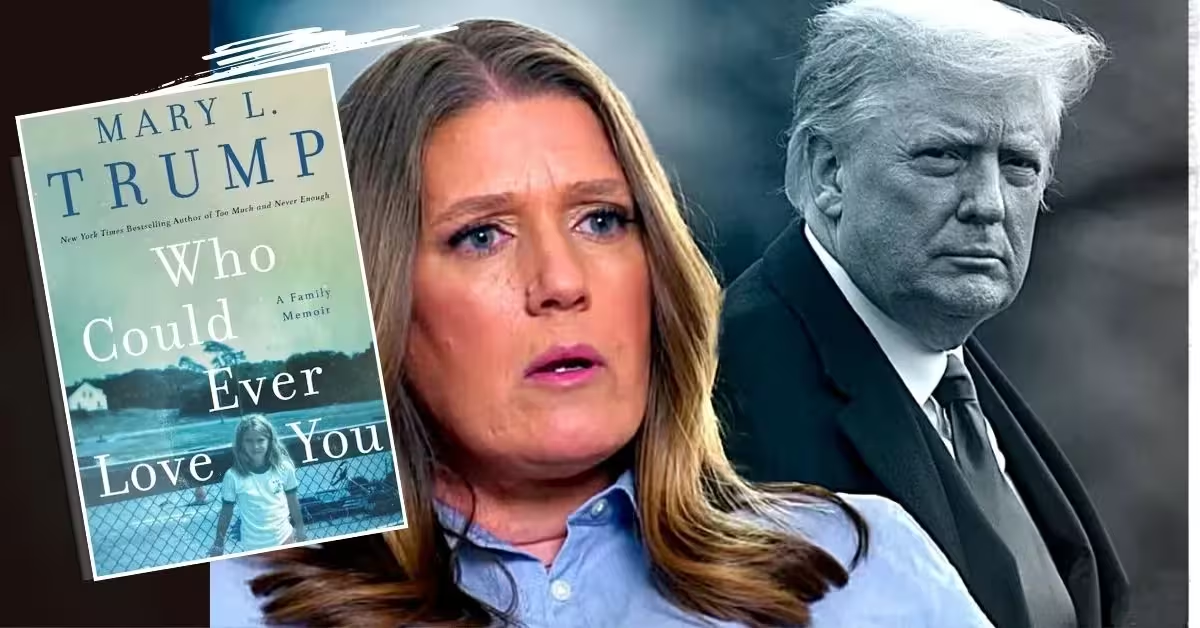
Mary Trump has once again taken aim at her family in her third book in four years, Who Could Ever Love You. This latest work portrays the Trump name as both a sanctuary and a torment, delving deep into the family’s dysfunction. Imagine it as a burn book where everyone gets scorched.In the prologue, Trump reflects on a 2021 stay in a medical facility, writing, “As the needle was inserted into my arm, I exhaled. The ketamine coursing through me was a desperate measure—a manifestation of my desperation.”
She continues, “I’m here because five years ago, I lost control of my life. I’m here because the world around me fell apart, and I don’t know how to find my way back.”
Trump candidly admits, “I’m here because Donald Trump is my uncle.”
Despite her high level of self-awareness, Trump’s personal agency remains ambiguous. At times, she grapples with the burden of her surname but cannot disown her family’s legacy.
Her previous bestsellers include “Too Much and Never Enough: How My Family Created the World’s Most Dangerous Man” and “The Reckoning: America’s Trauma and Finding a Way to Heal.” Her third book follows “All in the Family: The Trumps and How We Got This Way,” a recent memoir by her estranged older brother, Fred C. Trump III.
Trump paints a grim picture of her childhood home life, likening her mother, Linda Clapp, to the character in “Mommy Dearest.” She describes Clapp as coldly indifferent, recalling how Clapp refused to take her to the hospital during severe asthma attacks and instead placed her in her own bed.
“Next to me, she slept, her breathing shallow and steady,” Trump writes. “It was the loneliest sound.”
Even when Clapp was battling cancer, she continued to alienate and demean her daughter. Phone conversations were marked by Clapp’s convenient claims of Mary being inaudible. As an adult, Trump had no need to mask her feelings anymore. “I’d spent enough of my life feeling as if I might suffocate with her beside me doing nothing. I could no longer feel fear—hers or mine—only a searing rage.”
Trump’s father, Fred Trump Jr., was absent and emotionally distant. His struggle with alcoholism, his divorce from Clapp, and his early death left a void. Despite his shortcomings, Mary and her brother Fritz loved him. However, Fred Sr., their grandfather, repeatedly belittled Fred Jr., leading to a family feud and eventual disinheritance.
Mary and Fritz’s legal battle over their inheritance only drove them further apart, exacerbated by Fritz’s disapproval of Mary’s life choices, including her same-sex relationship and late motherhood.
Mary’s critique of her uncle Donald is scathing, rooted in childhood experiences of bullying and cruelty. She recalls Donald Trump’s attempts at throwing a baseball with a level of aggression that often missed its mark, causing her physical discomfort.
Her recollections also include Robert Trump, Donald’s now-deceased younger brother, who once kicked a soccer ball at her already bruised eye, later brushing off her pain with a casual demeanor.
Who Could Ever Love You’s epilogue contrasts sharply with the earlier chapters. In June 2020, Robert Trump’s attempt to block the publication of “Too Much and Never Enough” failed. He passed away weeks later, and Donald Trump’s eulogy at the White House highlighted the complexities of their relationship.
In a hopeful closing, Mary Trump describes a winter evening in New York, where the city’s glow symbolizes a potential for redemption. She reflects, “The lights of my city shone behind me. Though I can’t know if redemption or forgiveness is within reach, I felt the world opening up again. I leaned back, breathed deeply, and took it all in.”
Mary Trump’s journey mirrors the themes of Jay McInerney’s “Bright Lights, Big City,” which ends with a poignant scene of rebirth through simple, sensory experiences. For Trump, her life has been a series of profound lessons and harsh realities.
Table of Contents
From Private Life to Public Critic: The Story of Mary Trump
Early Life and Family Background
Mary Lea Trump, born on May 3, 1965, in New York City, is the daughter of Fred Trump Jr., a commercial pilot with Trans World Airlines, and flight attendant Linda Clapp.
Her grandfather, Fred Trump Sr., was a prominent real estate tycoon in Brooklyn and Queens. Fred Sr. initially hoped that Fred Jr. would succeed him in the family business, but differences in temperament and lifestyle choices led to a rift between father and son.
Fred Jr.’s struggles with alcoholism resulted in his untimely death in 1981 when Mary was just 16 years old, an event that had a profound impact on her life.
Education and Career Development
After her father’s death, Mary Trump pursued higher education, studying English literature at Tufts University in Massachusetts and then at Columbia University.
There, she developed a particular interest in the works of William Faulkner, focusing on themes of familial decline and societal change. She later earned a PhD in clinical psychology from the Derner Institute of Advanced Psychological Studies at Adelphi University.
Over the years, she taught courses in developmental psychology, trauma, and psychopathology, eventually founding her own business, the Trump Coaching Group.
Legal Disputes with the Trump Family
The Trump family faced internal legal battles after Fred Trump Sr.’s death in 1999, which revealed long-standing tensions. Mary and her brother Fred III contested their grandfather’s will, believing its terms unfairly excluded them.
They alleged that their uncles and aunts, including Donald Trump, had influenced Fred Sr.’s decisions in his final years. In retaliation, the Trump siblings cut off Fred III’s medical insurance, a critical blow given that his son William required expensive care for a neurological disorder.
The dispute eventually ended in a settlement, with Mary and her brother reluctantly relinquishing their stake in the family business.
Public Criticism of Donald Trump
For most of her life, Mary Trump stayed out of the public eye, but in 2020, she made headlines with her book Too Much and Never Enough, a detailed account of her experiences within the Trump family.
InWho Could Ever Love You, she offered a psychological analysis of her uncle Donald Trump, accusing him of narcissistic personality disorder and describing his behavior as the result of unresolved emotional issues.
Who Could Ever Love You provided a rare insider’s perspective on the former president and his upbringing, sparking widespread media attention.
10 things Who Could Ever Love You reveals
1. Mary Trump’s Ketamine Therapy Was a Last-Ditch Effort to Stay Alive
Despite her public image as a strong commentator, Mary was spiraling privately: “Ketamine flowing through my body felt like an act of desperation—it was an act of desperation”. She had become so socially isolated and disassociated that she couldn’t leave her apartment, even as others resumed life post-COVID.
“I’m here because Donald Trump is my uncle.” —Mary, explaining her mental collapse to a psychiatrist.
2. Her Uncle Donald Trump Was a Living Trauma Trigger
Mary’s very identity became unbearable: “There was a new part of the story I couldn’t control… I’m here because Donald Trump is my uncle”. She links Donald’s ascension with a personal breakdown, reinforcing how family legacy can destroy individual identity.
3. Freddy Trump Jr. Was a Talented Pilot, Not a Failure
Her father Freddy succeeded in TWA training and flew major routes, but his family mocked him: “You’re a goddamned chauffeur in the sky,” said Fred. Donald added: “You’re just a glorified bus driver”. That contempt broke him.
4. Mary Witnessed Her Father Threaten Her Mother with a Rifle
Mary recalls trauma from early childhood: “I was under three years old the night my father pointed a hunting rifle at my mother’s head”. Though memory is fragmentary, the emotional weight shaped her entire worldview.
5. The Trump Family Worshipped Power and Contempt
Fred Sr. celebrated ruthlessness and saw compassion as weakness: “Donald only mattered to Fred to the extent that he could use him”. Freddy, who showed empathy and artistic passion, was systematically broken by his father.
6. Her Mother Linda Couldn’t—and Didn’t—Protect Her
During a terrifying asthma attack, young Mary approached her sleeping mother: “I can’t breathe.” Linda pulled back the comforter—but then turned away. “Her breathing was even, unlike mine”. This moment of maternal indifference haunted Mary into adulthood.
7. Freddy Trump Was Emotionally Imprisoned by His Family
Even after trying to recover and restart his career, Fred Sr. kept Freddy powerless: “Relegated to his suffocating childhood bedroom and a maintenance crew… Fred seemed to enjoy wielding the complete power of the torturer”.
8. Their Life Looked Glamorous—but Was Built on Collapse
Mary grew up around yachts, seaplanes, and cocktail parties. But it was all an illusion. Her parents’ marriage was strained, her father drank heavily, and she later realized the wealth was never a buffer against decay.
9. Mary Experienced Early Sexual Trauma That Was Buried and Unacknowledged
Though briefly mentioned, there is a disturbing allusion to childhood trauma involving “Antonio,” which is handled with careful silence. The emotional impact is felt throughout her narrative and connects to her adult dissociation and trauma responses (contextual inference based on gun incident chapter and surrounding family behavior).
10. Writing the Memoir Was Her Act of Reclamation and Survival
Mary’s final breakthrough came during ketamine treatment: “I don’t want to die.” She texted it to everyone. That moment was her emotional anchor—and writing Who Could Ever Love You became her weapon against generational silence and cruelty.
“This is not how I ever imagined I’d be measuring my life, but here we are, Donald and I… The difference now—he’s not the only one with power”.
Later Work and Personal Life
In addition to her role as an author and family critic, Mary Trump launched a podcast and wrote a second book, The Reckoning, in 2021. She has become a regular commentator on major news networks, offering critiques of her uncle’s political actions.
In her personal life, she has remained relatively private, sharing only that she is gay, divorced, and a mother to her daughter Avary, conceived through IVF.
Mary continues to live in New York City and focuses on writing, activism, and occasional media appearances, solidifying her role as a vocal critic of her famous relative.
