
Historical fiction is one of the best ways to feel history—through characters you care about, stakes you can’t ignore, and eras that come alive in vivid detail. This curated list balances classics and modern bestsellers across continents and centuries, with quick “where/when,” spoiler-light plot overviews, and adaptation notes when available.
Historical fiction works best when it shrinks history. Not by making it less important—but by making it touchable: a marriage contract, a ration card, a courtroom transcript, a lullaby, a fan covered in secret writing. The novels below are chosen with one guiding idea: the past becomes real when you can feel what it cost an ordinary person to live through it.
You’ll find sweeping multi-generation sagas, psychologically sharp war narratives, and books that rebuild worlds most textbooks flatten. Some are famous classics; others are modern standouts. All of them pull you into a time and place with enough emotional truth to make you look up afterward and think, Wait—this really happened (or could have).
Historical fiction does more than just dress up modern stories in period costumes. At its best, it acts as a time machine for empathy, allowing us to live within the consciousness of people from eras we can never visit.
While tales of royalty and great generals abound, some of the most powerful works in the genre shift the spotlight away from the centers of power to the margins, giving voice to the silenced, the ordinary, and the overlooked.
Table of Contents
Why historical fiction still matters
If you’re reading for pleasure, historical fiction is a time machine. If you’re reading to understand people, it’s something more useful: a practice ground for empathy.
The best historical novels tend to do at least one of these things:
- Restore erased perspectives (colonized peoples, women, the displaced, the “unimportant”).
- Expose the machinery behind the era (laws, wars, caste, religion, race, labor).
- Track consequences across generations—how one decade “leaks” into the next.
Historical fiction does more than just dress up modern stories in period costumes. At its best, it acts as a time machine for empathy, allowing us to live within the consciousness of people from eras we can never visit.
While tales of royalty and great generals abound, some of the most powerful works in the genre shift the spotlight away from the centers of power to the margins, giving voice to the silenced, the ordinary, and the overlooked.
The following list of 25 best historical fictions books I read and curated not by simple ranking, but by the unique historical lenses they provide.
From the intimate bonds of women in restrictive societies to the brutal legacies of colonialism and the quiet revolutions of the domestic sphere, these novels transform our understanding of the past by asking: whose story hasn’t been told?
Background
A book is usually considered historical fiction when it’s set in a real past time period and uses the social, political, and cultural realities of that era as more than just scenery.
Some novels stick closely to documented events (often featuring real figures), while others are “historical-adjacent,” using a real setting but fictional plots. The best ones do both: gripping storytelling and a convincing sense of time and place.
The 30 best historical fiction books
1. Homegoing by Yaa Gyasi (2016)
Where/when it lives: From 18th-century Ghana through generations in Ghana and the United States.
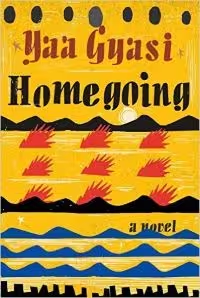
Plot: Two half-sisters begin the story on opposite sides of the Atlantic slave trade—one drawn into power near Cape Coast Castle, the other forced into captivity and shipped away.
Each chapter follows a descendant, building a chain of lives shaped by warfare, colonialism, enslavement, and migration.
Over centuries, the novel shows how trauma and resilience echo through families, and how history is never “over”—it’s inherited, resisted, and re-made.
Why Read This? It’s structurally brilliant: a generational mosaic that makes cause-and-effect across centuries feel personal.
Personal note: I was fascinated by the psychosocial inheritance of history—how pain and resilience travel through generations.
2. War and Peace by Leo Tolstoy
Where/when it lives: Russia during the Napoleonic Wars, spanning war and home-front life among aristocratic families.
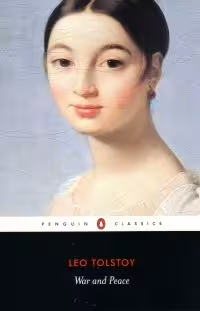
Plot: A sweeping cast—idealists, romantics, skeptics, and soldiers—collide as Napoleon’s campaigns reshape Russia and the lives of the Rostovs, Bolkonskys, and Bezukhovs.
The novel moves between glittering salons, battlefield chaos, and intimate turning points: love, betrayal, faith, ambition, and grief. It’s both a character-driven epic and a meditation on how history happens—through decisions, accidents, and forces beyond any one person.
Why Read This? Few novels match its scale and psychological depth; it’s the blueprint for the modern historical epic.
Personal note: I was fascinated by how love, ego, and duty get reshaped when history starts moving faster than people can.
Adaptation: Famously adapted multiple times; a major example is Sergei Bondarchuk’s four-part Soviet film series (released in installments 1965–1967).
3. Wolf Hall by Hilary Mantel (2009)
Where/when it lives: England, 1500–1535, in the orbit of Henry VIII and Thomas Cromwell’s rise.
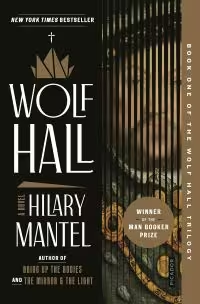
Plot: Thomas Cromwell—often villainized in popular memory—becomes the novel’s sharp, pragmatic center as England trembles through religious upheaval and royal obsession. Through Cromwell’s eyes, you watch alliances form and collapse, reputations get engineered, and survival become an art.
The book treats power as something built in rooms, letters, and quiet favors—not just battles. It’s tense, witty, and strangely intimate for a political story.
Why Read This? Mantel makes court politics read like a thriller—without flattening anyone into heroes or monsters.
Personal note: I loved the psychosocial tension of reinvention—watching Cromwell survive by reading people, not just politics.
Adaptation: A TV adaptation aired in 2015 (covering this book and its sequel).
4. The Name of the Rose by Umberto Eco (1980)
Where/when it lives: An Italian monastery in 1327, where theology, politics, and fear are combustible.
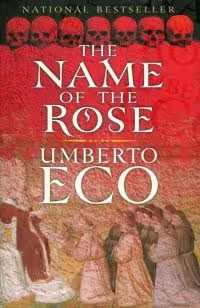
Plot: A learned Franciscan and his novice arrive at an isolated monastery—then bodies begin to appear. What looks like simple murder becomes a labyrinth of forbidden texts, doctrinal battles, and institutional paranoia.
The investigation is intellectual as much as criminal: the novel asks what truth costs, who gets to guard knowledge, and how power hides behind piety. Atmospheric, philosophical, and slyly suspenseful, it’s a medieval mystery with a razor edge.
Why Read This? It’s a rare blend: page-turning whodunit + big ideas, with an unforgettable setting.
Personal note: I couldn’t stop thinking about how fear controls knowledge, and how institutions turn doubt into brutality.
Adaptation: A 1986 film adaptation directed by Jean-Jacques Annaud.
5. The Pillars of the Earth by Ken Follett (1989)
Where/when it lives: 12th-century England, amid civil war, church power, and the slow miracle of cathedral-building.
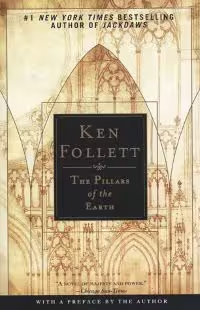
Plot: In the fictional town of Kingsbridge, lives intertwine around an audacious goal: build a cathedral that will outlast violence and politics.
A stonemason with a dream, a resilient woman fighting for security, monks trying to hold a community together, and nobles hungry for control all push the story forward.
The novel turns engineering and architecture into high drama, while showing how war and ambition crush ordinary people—and how some still build anyway.
Why Read This? If you like big casts and relentless momentum, this is historical fiction in “binge” form.
Personal note: I found it oddly moving that a long, difficult build can become a kind of shared hope across generations.
Adaptation: A TV miniseries adaptation released in 2010.
6. Pachinko by Min Jin Lee (2017)
Where/when it lives: Korea and Japan across the 20th century, focused on the Korean diaspora in Japan.
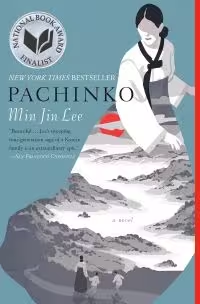
Plot: Beginning with a young woman’s hard choices, the novel follows generations of a Korean family whose lives are shaped by colonization, war, migration, and discrimination in Japan.
As children grow into adults—and then parents—the story shows how identity becomes both inheritance and battleground. It’s intimate about love and family, but also unsparing about prejudice, economic survival, and what it means to belong somewhere that refuses to claim you.
Why Read This? It’s a modern epic that makes history personal, without ever losing narrative drive.
Personal note: I couldn’t stop thinking about belonging—how a family keeps its dignity even when society won’t grant it.
Adaptation: An Apple TV+ series premiered in 2022 (with later seasons following).
7. All the Light We Cannot See by Anthony Doerr (2014)
Where/when it lives: World War II Europe, including Nazi-occupied France (notably Saint-Malo) and Germany.
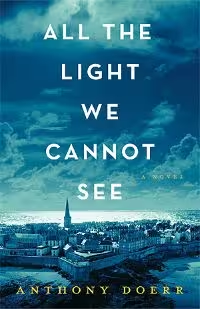
Plot: Two young lives run on parallel tracks: a blind French girl navigating occupation and a German boy pulled into the war machine through his talent for radios. The novel moves in a nonlinear pattern, building suspense as the characters draw closer to a collision point. It’s rich in sensory detail, obsessed with signals and silence, and emotionally tuned to small acts of courage—especially the kind that happen when survival itself feels like resistance.
Why Read This? It’s lyrical without being slow—and it captures WWII through innocence, science, and moral pressure.
Personal note: I couldn’t stop thinking about signals—how people try to reach one another through fear and noise.
Adaptation: A Netflix miniseries adaptation was released on November 2, 2023.
8. Beloved by Toni Morrison (1987)
Where/when it lives: Post–Civil War America, centered on a formerly enslaved family in Cincinnati, haunted by the past.
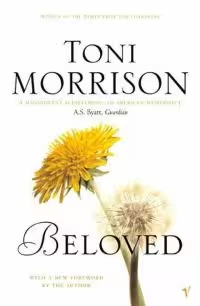
Plot: A mother who escaped slavery tries to build a life after emancipation, but her home becomes a pressure chamber of memory, grief, and unresolved horror. When a mysterious young woman appears, the boundary between trauma and the supernatural begins to blur.
The novel refuses neat timelines: it reveals history in flashes, returning to what was endured and what was done to survive. It’s devastating, poetic, and fiercely moral about the long afterlife of slavery.
Why Read This? Because it confronts history as lived experience—messy, painful, and impossible to “move on” from cleanly.
Personal note: I was shaken by how the past refuses to stay in the past—how trauma can occupy rooms, bodies, and relationships.
Adaptation: A 1998 film directed by Jonathan Demme, based on the novel.
9. Shōgun by James Clavell (1975)
Where/when it lives: Japan at the turn of the 17th century, during political transformation and external pressure.
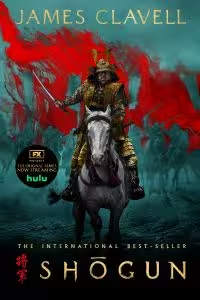
Plot : An English sailor shipwrecks in Japan and becomes a pawn—then a student—in a world of strict codes, shifting loyalties, and looming civil conflict. As he learns language, strategy, and culture, powerful leaders maneuver toward national dominance, balancing diplomacy with brutality.
The novel dramatizes cultural collision without making it a simple “outsider conquers” tale; it’s more about negotiation, adaptation, and the cost of becoming someone new in a place that doesn’t need you.
Why Read This? It’s immersive historical adventure with real political weight—ideal if you want epic scope and intrigue.
Personal note: I loved the psychology of cultural negotiation—how learning a new world can unmake and remake you.
Adaptation: Adapted into TV series in 1980 and again in 2024.
10. I, Claudius by Robert Graves (1934)
Where/when it lives: Ancient Rome, from Julius Caesar’s assassination (44 BCE) through the Julio-Claudian dynasty into Caligula’s reign.
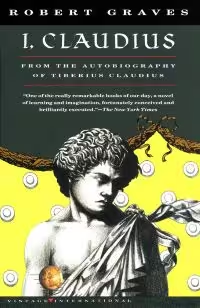
Plot: Told as the “autobiography” of Claudius—stammering, underestimated, and therefore overlooked—this novel turns imperial Rome into a brutal family drama of assassinations, propaganda, and survival.
Claudius watches relatives rise and fall through poison, betrayal, and political theater, while he quietly learns how power really works. It reads like a scandal chronicle, but it’s also a sharp study of how history gets written by winners (and rewritten by survivors).
Why Read This? If you love palace intrigue, it’s one of the most influential “inside the empire” historical novels ever written.
Personal note: I was hooked by the survival psychology of being underestimated—“invisibility” felt like the most dangerous superpower.
Adaptation: BBC made a 1976 TV adaptation (based on I, Claudius and Claudius the God).
11. Les Misérables by Victor Hugo (1862)
Where/when it lives: 19th-century France, with major focus on Paris and the years around the 1832 uprising.
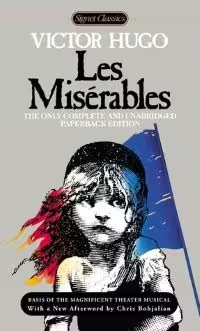
Plot: Jean Valjean, imprisoned for stealing bread, tries to rebuild his life under the relentless pursuit of Inspector Javert. Around them, France churns with poverty, inequality, and revolutionary ideals—drawing in Fantine, Cosette, Marius, and the doomed youth at the barricades.
The story moves from intimate moral choices to sweeping social critique, insisting that compassion and justice aren’t abstractions—they’re decisions made under pressure, again and again.
Why Read This? It’s the gold-standard “social justice epic”—emotionally huge, morally intense, and still culturally alive.
Personal note: I loved how the book makes compassion feel revolutionary, not sentimental—like a choice you fight for.
Adaptation: Countless adaptations exist across media since the novel’s publication. A prominent modern screen version is the 2012 musical film directed by Tom Hooper (adapted from the stage musical, which is based on Hugo’s novel).
12. A Suitable Boy by Vikram Seth (1993)
Where/when it lives: Newly independent India, 1951–52, across multiple cities and families.
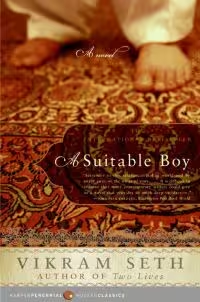
Plot: Mrs. Rupa Mehra is determined to find a “suitable” husband for her daughter Lata—who, inconveniently, wants love on her own terms. Around that central dilemma, the novel expands into a panoramic portrait of post-Partition India: politics, class, religious tension, education, art, and family duty.
It’s intimate and massive at once, turning everyday choices—who to marry, what to study, where to live—into a map of a nation figuring itself out.
Why Read This? If you want “big-cast immersion” like War and Peace, but in 1950s India, this is the cornerstone.
Personal note: I loved how marriage and love decisions become a lens for a whole nation trying to define itself.
Adaptation: A BBC television miniseries aired in 2020.
13. The English Patient by Michael Ondaatje (1992)
Where/when it lives: World War II, primarily at an Italian villa during the Italian campaign, with memories reaching into North Africa.
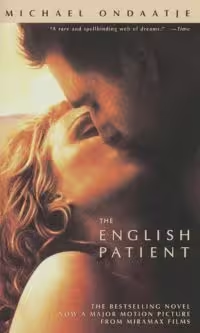
Plot: Four people share a ruined Italian villa: a badly burned man known only as “the English patient,” a Canadian nurse, a Sikh sapper, and a thief-soldier.
Their days are shaped by wounds—physical, moral, romantic—and by stories that surface in fragments. The novel works like memory: nonlinear, intimate, and revealing. As the patient’s past emerges, love and betrayal become inseparable from the politics of war, mapping desire onto empire and violence.
Why Read This? It’s historical fiction as lyric mosaic—perfect if you like layered narration and emotional aftershocks.
Personal note: I was drawn to how war turns people into fragments, and how love can’t always put them back together.
Adaptation: Adapted into a major 1996 film directed by Anthony Minghella. (
14. Outlander by Diana Gabaldon (1991)
Where/when it lives: Starts just after World War II, then time-travels to 18th-century Scotland (notably 1743).
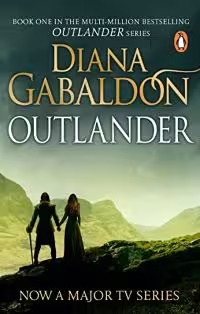
Plot: Claire Randall, a former wartime nurse, is thrown from 1940s life into 18th-century Scotland—an era of clan politics, danger, and deep suspicion toward outsiders. To survive, she’s forced into alliances that reshape her identity, especially as she forms a complicated bond with Jamie Fraser. The novel blends romance with real historical tensions, asking what “home” means when time itself becomes the border.
Why Read This? It’s the gateway for readers who want history with momentum: adventure, politics, and a strong emotional core.
Personal note: I enjoyed the psychological whiplash of displacement—starting over when everything familiar becomes foreign.
Adaptation: Yes—the TV series premiered on Starz on August 9, 2014.
15. The Book Thief by Markus Zusak (2005)
Where/when it lives: Nazi Germany during World War II, on the civilian home front.
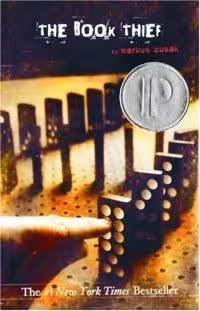
Plot: Narrated by Death, the story follows Liesel Meminger, a foster child who discovers words as both shelter and rebellion. As bombs fall and fear tightens around ordinary life, she “borrows” books, learns to read, and builds a fragile community in a brutal era—while her family hides a Jewish man in their basement.
The novel is tender without being soft: it shows how language can save, endanger, and memorialize all at once.
Why Read This? The perspective is unforgettable—darkly gentle, emotionally sharp, and unusually humane for a war novel.
Personal note: I found the focus on words powerful—language as shelter, resistance, and remembrance.
Adaptation: A 2013 feature film adaptation was released.
16. The Red Tent by Anita Diamant (1997)
Where/when it lives: A reimagined biblical-era world, centered on Dinah (daughter of Jacob and Leah).
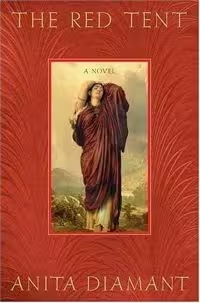
Plot: This novel retells an ancient story through Dinah’s voice, shifting the focus from patriarchs to women’s inner lives: sisterhood, fertility, ritual, and survival. The “red tent” becomes a sanctuary where women share knowledge and strength during menstruation and childbirth.
Through love, loss, and political marriage, Dinah’s life turns into a lens on how histories erase women—and how fiction can restore them with texture, agency, and grief the original record refused to hold.
Why Read This? If you like mythic retellings with emotional realism and women-centered worldbuilding, this is foundational.
Personal note: I loved how it recenters women’s inner worlds—ritual, community, and the body as history.
Adaptation: A Lifetime TV miniseries aired in December 2014.
17. The Underground Railroad by Colson Whitehead (2016)
Where/when it lives: The antebellum American South and beyond, reimagining the Underground Railroad as a literal subterranean train system.
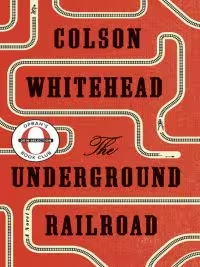
Plot: Cora escapes a Georgia plantation and flees through a fantastical-but-deadly America where each state reflects a different face of racial terror—some openly violent, others chillingly “benevolent.”
The book fuses historical realism with speculative invention to show how oppression mutates rather than disappears. It’s relentless, but never empty: Cora’s drive for freedom is portrayed as both physical flight and inner refusal, a quiet defiance that keeps reinventing itself.
Why Read This? It’s historical fiction with a modern engine—formally bold, emotionally urgent, and widely recognized (including Pulitzer recognition).
Personal note: I loved how it recenters women’s inner worlds—ritual, community, and the body as history.
Adaptation: Yes—a 10-episode miniseries premiered on Amazon Prime Video on May 14, 2021.
18. March by Geraldine Brooks (2005)
Where/when it lives: The American Civil War (notably 1862), reframing Little Women through the absent father’s wartime experience.
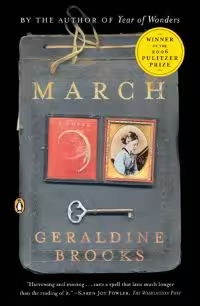
Plot: Mr. March leaves his family to serve the Union cause, and the novel follows what Little Women leaves offstage: the moral compromises, battlefield realities, and racial complexities that test his idealism.
As he moves through war-torn landscapes and tangled human relationships, he’s forced to confront how “good intentions” can still participate in harm. The book reads as both a character study and a revision—showing how war reshapes a person long before they ever come home.
Why Read This? It’s a smart, empathetic “missing chapter” to a classic—while standing strongly on its own as Civil War fiction.
Personal note: I liked how it challenges idealism—how good intentions still collide with moral compromise.
19. Midnight’s Children by Salman Rushdie (1981)
Where/when it lives: Modern India around independence and Partition, beginning at midnight on Aug. 15, 1947, and unfolding through the country’s post-independence transformations.
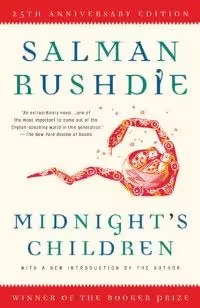
Plot: Born in the first hour of independence, Saleem Sinai grows up “handcuffed to history,” his life tangled with the nation’s turning points.
Through exuberant, magical-realist storytelling, the novel links private fate to public upheaval—family secrets, political shocks, and shifting identities. It’s both intimate and panoramic: a coming-of-age story that doubles as an allegorical chronicle of a country reinventing itself, at great cost.
Why Read This? You get a bold, unforgettable way to understand history—not as dates, but as lived chaos, memory, and myth.
Personal note: I was captivated by how memory, myth, and politics blur—like a country telling its story through one life.
Adaptation: A 2012 film adaptation directed by Deepa Mehta, based on Rushdie’s novel.
20. Atonement by Ian McEwan (2001)
Where/when it lives: 1935 England, then World War II-era England and France, and later-life reflection in present-day England.
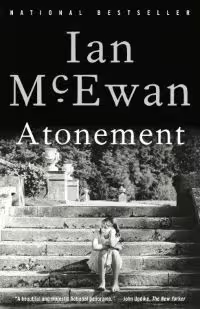
Plot: On a blistering summer day in 1935, a young girl’s misinterpretation spirals into an accusation that fractures multiple lives.
Years later, that single “mistake” becomes a lifelong burden—woven through war, separation, and the desperate need to repair what can’t truly be repaired. The novel is part family drama, part war story, part meditation on storytelling itself: who gets to narrate damage, and whether art can ever count as atonement.
Why Read This? It’s devastatingly readable while quietly interrogating guilt, memory, and the ethics of narration.
Personal note: I was struck by how one misreading can fracture lives, and how guilt can become a lifelong identity.
Adaptation: A 2007 film version of the story appeared in 2007.
21. A Gentleman in Moscow by Amor Towles (2016)
Where/when it lives: Moscow, beginning in 1922, when Count Alexander Rostov is sentenced to house arrest inside the Hotel Metropol—life unfolding across Soviet decades.
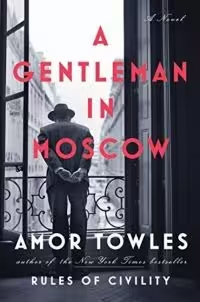
Plot: A former aristocrat is spared death but condemned to a smaller life: he may not leave the Metropol.
What sounds like a narrow premise becomes a richly social novel, as the Count builds friendships, routines, and quiet influence within the hotel’s walls. Over time, the Metropol turns into a miniature world—where politics arrives in whispers, love appears unexpectedly, and dignity becomes a daily practice.
The tension isn’t “escape” so much as: how do you live fully when history locks the doors?
Why Read This? It’s warm, witty, and philosophical—an elegant reminder that confinement doesn’t end a life; it changes its scale.
Personal note: I loved the paradox that confinement can still produce a rich inner life—grace as a daily practice.
Adaptation: A TV series based on the novel premiered on Paramount+ on March 29, 2024, starring Ewan McGregor.
22. Brooklyn by Colm Tóibín (2009)
Where/when it lives: Ireland in the early 1950s, then Brooklyn, New York—an immigrant story shaped by distance, duty, and new possibility.
Plot: Eilis Lacey leaves a cramped, opportunity-starved life in Ireland (where work is scarce) and emigrates to New York, expecting a better future and finding homesickness instead. Slowly she builds a new self—job, friendships, love—until news from home pulls her back into old obligations.
The emotional engine is quiet but fierce: Eilis must decide whether identity is something you inherit or something you choose, and whether “home” is a place, a person, or a promise you can’t break.
Why Read This? If you like subtle, human-scale historical fiction, this is a masterclass in longing, restraint, and life-altering choices.
Personal note: I found the homesickness painfully real—like identity split between who you were and who you’re becoming.
Adaptation: A 2015 film adaptation (Nick Hornby screenplay; John Crowley director) was released.
23. Sea of Poppies by Amitav Ghosh (2008)
Where/when it lives: 1838, on the eve of the First Opium War (1839–42), across the Indian Ocean world aboard the ship Ibis.
Plot: A repurposed ship—the Ibis—draws together a volatile mix of people: convicts, sailors, indentured laborers, and those fleeing caste, debt, or violence. As the voyage begins, personal reinvention collides with the machinery of empire: the opium economy, colonial rule, and the coming war.
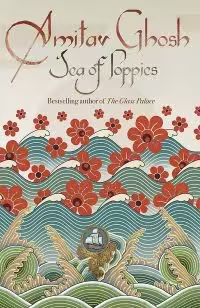
The novel thrives on momentum and language—full of grit, humor, and danger—while showing how “global trade” often means bodies in motion under coercion, and survival as improvisation.
Why Read This? It’s an epic with texture—polyphonic, historically grounded, and genuinely transportive.
Personal note: I was energized by its voice—bold, funny, and fearless—making the ancient world feel immediate.
Adaptation: A TV series adaptation of Ghosh’s Ibis trilogy was reported as in development (announced in 2019).
24. Things Fall Apart by Chinua Achebe (1958)
Where/when it lives: British Nigeria, as missionaries and colonial government intrude into Igbo society (notably in the 1890s, per Britannica).
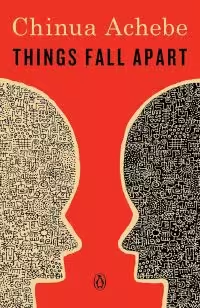
Plot: Okonkwo is celebrated for strength, discipline, and status—but his fierce fear of weakness makes him brittle. When tragedy forces exile, and he later returns, he finds his community altered: Christian missionaries and colonial authority have arrived, changing law, belief, and belonging.
The novel’s power is its balance—deep respect for Igbo life and complexity, paired with an unsentimental view of internal tensions. Watching the world shift beneath Okonkwo becomes both personal tragedy and cultural rupture.
Why Read This? Because it shows colonization not as an abstract “event,” but as a slow dismantling of meaning, pride, and community.
Personal note: I found the tragedy deeply human—pride and fear meeting irreversible change.
Adaptation: Yes—there was a 13-part Nigerian TV adaptation that premiered in 1987.
25. The Emperor’s Babe by Bernardine Evaristo (2001)
Where/when it lives: Roman London (Londinium) in AD 211, in the era of Emperor Septimius Severus (reigned 193–211).
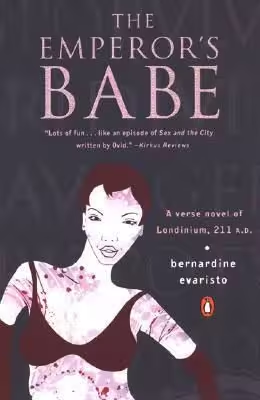
Plot: Zuleika, a teenage girl of Nubian heritage in Roman Londinium, is pushed into a marriage of status—and then pulled into scandal, desire, and danger as she chases freedom on her own terms. Told as a verse novel, it’s fast, funny, and sharply modern in attitude while still rooted in the realities of empire. Beneath the swagger is a serious project: restoring a vivid Black presence to Britain’s ancient past, and refusing the “monochrome” myth of history. (
Why Read This? It’s historical fiction that feels alive—formally inventive, socially incisive, and wildly readable in verse.
Personal note: I was energized by its voice—bold, funny, and fearless—making the ancient world feel immediate.
Adaptation: Yes—adapted into a BBC Radio 4 play in 2013 (noted on Evaristo’s official site).
26. The Night Watchman by Louise Erdrich (2020)
Where/when it lives: Primarily 1953–1954 on the Turtle Mountain Chippewa Reservation (North Dakota), during the push for U.S. “termination” policy.
Plot: A night watchman and tribal council member begins writing letters and organizing resistance to a federal bill that threatens tribal sovereignty and identity. Alongside his political fight, younger characters chase work, love, and survival—some leaving for cities, others trying to hold community together at home.
The novel layers humor, tenderness, and outrage, showing how policy becomes personal, and how collective action starts with exhausted people refusing to be erased.
Why Read This? It’s a powerful blend of intimate community life and high-stakes history—deeply human, not “issue-first.”
Personal note: I found the psychosocial weight of “paper decisions” fascinating—how a law can threaten belonging, and how ordinary routines become quiet resistance.
27. The Song of Achilles by Madeline Miller (2011)
Where/when it lives: Mythic Bronze Age Greece and the Trojan War, told through an intensely personal lens.
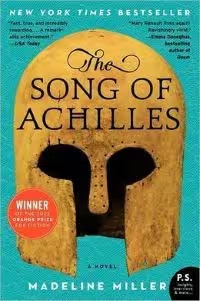
Plot: Patroclus, an exiled prince, forms a bond with Achilles—brilliant, half-divine, and destined for war. As they grow from boys into fighters, their relationship becomes the emotional center of a story driven by prophecy, pride, and the machinery of legend. The novel reframes epic heroism into something tender and tragic: love under fate, and humanity under myth.
Why Read This? It’s a rare retelling that feels both epic and intimate, with a clean emotional arc that makes the ending land hard.
Personal note: I was captivated by the psychology of devotion—how love can feel like refuge, identity, and doom all at once.
Adaptation: A screen adaptation has been reported as in development in the past, but later reporting indicated the project fell apart; there’s no released adaptation I can confirm.
28. The Good Earth by Pearl S. Buck (1931)
Where/when it lives: Rural China in the 1920s, centered on peasant life, land, famine, and social upheaval.
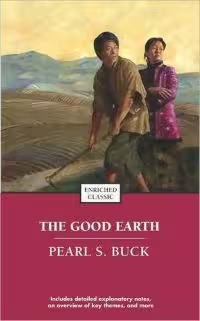
Plot: Wang Lung begins as a poor farmer whose fortunes rise through relentless labor and devotion to the land. As wealth arrives, so do fractures—inside the family, inside values, inside desire.
The novel traces how survival can harden into hunger for status, and how prosperity can quietly dismantle what struggle once held together. It’s both family saga and social portrait, grounded in daily work and moral consequence.
Why Read This? It’s a classic because it makes economic change feel emotional—ambition, shame, and love mapped onto soil and seasons.
Personal note: I was fascinated by how attachment to land becomes identity—and how upward mobility can subtly rewire a person’s ethics.
Adaptation: There’s a major 1937 film adaptation of the novel.
29. Kristin Lavransdatter by Sigrid Undset (1920–1922)
Where/when it lives: Medieval Norway, following Kristin’s life across youth, marriage, faith, and consequence.
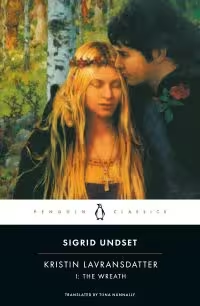
Plot: Kristin grows up in a world shaped by family honor and Christian devotion, but her romantic choices pull her into conflict with social expectation and spiritual certainty.
Across the trilogy, love is never just love—it’s reputation, power, motherhood, guilt, and survival.
The story’s force comes from its realism: Kristin isn’t a symbol; she’s a whole person living inside a strict moral universe, making decisions that ripple for decades.
Why Read This? It’s one of the strongest “life over time” historical novels—psychologically rich, morally serious, and unusually grounded in daily medieval reality.
Personal note: I loved the psychosocial realism—how desire, duty, faith, and pride keep renegotiating who Kristin is allowed to be.
Adaptation: Yes—adapted into a 1995 Norwegian film directed by Liv Ullmann.
30. The House of the Spirits by Isabel Allende (1982)
Where/when it lives: Chile, 1910s–1970s, through generations of a family as politics and class conflict intensify.
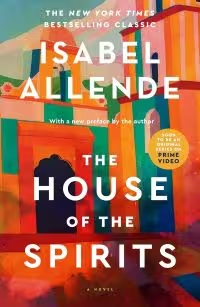
Plot: Through a family’s loves, betrayals, marriages, and grievances, the novel builds a sweeping portrait of a nation moving toward crisis.
The supernatural appears as part of the household’s emotional logic—visions, omens, and “impossible” moments that feel natural inside the story’s reality. Over decades, tenderness battles cruelty, and personal power struggles mirror national ones, until private life and political violence become inseparable.
Why Read This? It’s a masterclass in multi-generational storytelling—romantic, political, and driven by character rather than lectures.
Personal note: I was fascinated by how family myths and national history blur—how people explain trauma through stories when reality becomes unbearable.
Adaptation: Adapted into a 1993 film written/directed by Bille August, based on the 1982 novel.
Conclusion: History as a Human Mosaic
The true power of historical fiction lies not in its ability to catalog dates and events, but in its capacity to breathe life into the dust of the past. The 30 novels discussed here achieve this by steadfastly focusing on the human scale of history—the whispered secret on a fan, the weight of a stolen book, the silent resolve in a political meeting, the ghost of a child’s laugh.
They remind us that history is not a monologue delivered by the powerful, but a chaotic, heartbreaking, and beautiful chorus of countless individual voices.
By seeking out these perspectives—from the margins, the homes, and the inner lives of people across time—we do more than just learn about the past. We practice a deeper form of empathy and begin to see the threads that connect their struggles, joys, and resilience to our own present moment. Let this list be a starting point for listening to that chorus.
Pick a lens that intrigues you, and let these masterful storytellers guide you into the intimate, overlooked, and profoundly human corners of our shared world.
I hope this thematic journey through these 30 remarkable books has offered you a new way to explore historical fiction. If a particular theme—like family sagas across cultures or novels centered on wartime resilience—captured your interest, I would be happy to suggest further reading in that specific vein
