
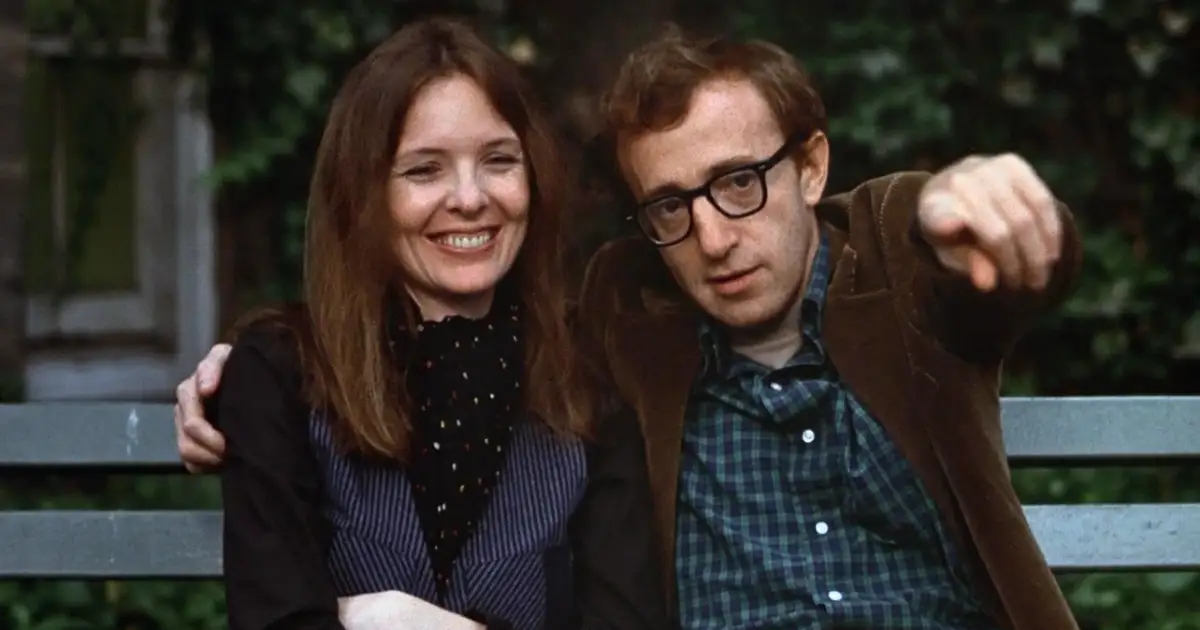
Have you ever watched a film that dissects the anatomy of a failed relationship with such brutal honesty and wry humour that it feels less like a movie and more like a therapy session? Annie Hall is precisely that—a cinematic landmark that reshaped romantic comedy.
Directed by and starring Woody Allen, with Diane Keaton in her Oscar-winning role, this 1977 masterpiece transcends its genre to offer a poignant, neurotic, and endlessly witty exploration of love, identity, and existential angst.
For me, it remains a startlingly relevant artifact, a film that captures the specific agony and ecstasy of modern romance with a clarity that few have matched before or since. It is, without doubt, one of the essential titles on our list of 101 must-watch films.
Table of Contents
Background
Emerging from the creative ferment of 1970s New York, Annie Hall marked a significant pivot in Woody Allen’s career.
Previously known for broad, surreal farces like Sleeper, Allen collaborated with Marshall Brickman on a script originally titled Anhedonia (the inability to feel pleasure).
The project was a deeply personal gamble. According to biographer John Baxter, Allen consciously decided to “sacrifice some of the laughs for a story about human beings,” influenced by his own psychoanalysis and a desire to create something more nourishing.
The film’s production was a journey of discovery. Allen’s first collaboration with the legendary cinematographer Gordon Willis, known as the “Prince of Darkness” for his work on The Godfather, was initially seen as an odd pairing.
Yet, it proved transformative. Shot over ten months from May 1976, the film evolved dramatically in the editing room. Editor Ralph Rosenblum’s first assembly was a sprawling, surreal two-hour-and-twenty-minute cut.
They later refocused the entire narrative around the central relationship, a decision that crystallised the film’s emotional core and forged its enduring legacy.
Annie Hall Plot Summary
Annie Hall begins with comedian Alvy Singer (Woody Allen) breaking the fourth wall. He directly addresses us, confessing his confusion and heartache. “Annie and I broke up,” he states flatly, launching into a neurotic, non-linear autopsy of their relationship.
The film is the dissection, and we are his unwilling, complicit witnesses.
We see glimpses of Alvy’s childhood in Brooklyn, living literally under the Coney Island rollercoaster—a perfect metaphor for the chaotic, looming anxiety that defines his life. As a boy, he’s already obsessed with the universe’s expansion and the futility of existence, much to his mother’s chagrin.
This foundational neurosis shapes the adult Alvy, a successful but deeply insecure comic terrified of California, anti-Semitism, and, most of all, the inevitable decay of all things, including love.
The narrative then stitches together key moments from his romance with Annie Hall (Diane Keaton).
They meet playing tennis doubles with friends. Their first awkward conversation on her balcony is brilliantly undercut by “mental subtitles” revealing their frantic inner doubts—he worries she thinks he’s a jerk, she frets he sees her as a “yo-yo.”
This technique immediately establishes the film’s central theme: the vast, often comic gulf between what we feel and what we say.
Their relationship unfolds in a series of vibrant, messy vignettes.
There’s the chaotic, hilarious attempt to cook live lobsters in a Hamptons kitchen, a scene of pure, unscripted joy. We see their cultural clash during split-screen dinners with their families—Alvy’s loud, Jewish Brooklyn relatives juxtaposed against Annie’s silent, Waspy Midwestern clan.
The film argues that love isn’t just about two people, but about the worlds they each inhabit.
As they grow closer, fissures appear. Alvy, possessive and pedantic, tries to mould Annie, pushing her into therapy and adult education classes.
Annie, initially adorably scatterbrained, begins to find her own voice and confidence, notably through her singing. The turning point arrives with the introduction of slick music producer Tony Lacey (Paul Simon). He represents a glamorous, Californian ease that is the antithesis of Alvy’s New York intellectualism.
In a devastatingly quiet moment on a flight back from Los Angeles, they mutually agree it’s over. The romance succumbs not to a dramatic betrayal, but to the slow, sad erosion of compatibility.
The film’s ending is a masterpiece of bittersweet resignation. In a final attempt, Alvy flies to Los Angeles to propose to Annie, who now lives with Tony.
She gently, firmly refuses.
Back in New York, Alvy does what an artist does: he rewrites reality. He stages a play about their relationship where she accepts his proposal. The final scene shows them meeting by chance after both have moved on.
They share a warm, platonic lunch, reminisce fondly, and part ways. As Annie drives off, Alvy’s voiceover returns, telling a joke about a man who won’t give up his psychiatrist because “we need the eggs,” despite the mess and insanity.
The metaphor is clear: relationships are irrational, crazy, and absurd, but we keep seeking them out because we need the connection, the “eggs.”
The film concludes not with a neat resolution, but with the lingering, melancholy acceptance of love’s impermanence, underscored by Annie singing “Seems Like Old Times” on the soundtrack.
Annie Hall Analysis
1. Direction and Cinematography
Woody Allen’s direction here is deceptively sophisticated. He abandons the frantic pacing of his earlier farces for a conversational, neurotic rhythm.
His visionary choice was partnering with Gordon Willis, who bathed New York in a muted, grey overcast palette, contrasting it with the harsh, “hot golden light” of Los Angeles.
This visual dichotomy perfectly externalises Alvy’s psyche: New York is his familiar, intellectual cloister; California is an alien, superficial landscape.
Willis also employed unusually long takes, with an average shot length of 14.5 seconds—far longer than the era’s norm. This allows conversations to breathe, making the dialogue feel real, unrehearsed, and deeply revealing.
2. Acting Performances
The film is a landmark of character acting. Woody Allen essentially perfected his screen persona here: the hyper-verbose, anxiety-ridden Jewish intellectual.
But the film belongs to Diane Keaton. Her Annie is a creation of astonishing depth. She navigates the character’s journey from a charmingly insecure “la-di-da” girl to a self-assured woman with subtle grace.
The chemistry between them is electric because it feels authentic, born from their real-life history. In supporting roles, Tony Roberts provides a solid foil as Alvy’s successful friend, and a young Christopher Walken is memorably unsettling as Annie’s quiet, possibly homicidal brother.
3. Script and Dialogue
The screenplay, which topped the Writers Guild of America’s list of the 101 funniest ever written, is a marvel.
Its strength lies not in punchlines but in the painfully accurate rhythm of intellectual, defensive, and flirtatious conversation.
The dialogue is a weapon and a shield for the characters. It’s packed with cultural references (Marshall McLuhan, Fellini) that define Alvy’s world, but its true genius is in capturing how people actually talk—with interruptions, non-sequiturs, and unspoken subtext.
The pacing, reshaped in the edit, masterfully balances laugh-out-loud moments with profound sadness.
4. Music and Sound Design
In a departure from his earlier films, Allen uses music sparingly, a choice influenced by Ingmar Bergman.
The diegetic songs are pivotal: Annie’s nightclub performances of “It Had to Be You” and “Seems Like Old Times” are character moments that chart her growing confidence. The latter becomes the film’s melancholic anthem.
The sparing use of orchestral music, like Mozart’s “Jupiter Symphony” during a countryside drive, makes those moments of fleeting harmony between the couple all the more powerful and poignant.
5. Themes and Messages
Annie Hall is a rich tapestry of themes. On the surface, it’s about the failure of love, but it digs deeper into Jewish identity in WASP America, the tyranny of intellectualism, and the pervasive influence of psychoanalysis on modern life.
It contrasts New York’s neurotic energy with Los Angeles’s placid emptiness.
Ultimately, its most enduring message is about the stories we tell ourselves to make sense of heartbreak.
Alvy reconstructs his memory into a narrative he can live with, suggesting that perhaps the “eggs” we need aren’t perfect love, but the stories that help us endure its loss.
Comparison
Compared to Allen’s earlier zany comedies like Bananas, Annie Hall is a quantum leap in maturity and depth.
It shares DNA with European art-house films, particularly Ingmar Bergman’s relationship dramas, but filters them through a distinctly New York Jewish comedic sensibility.
In the romantic comedy genre, it dismantled the fairy-tale endings of classic Hollywood. Later films like When Harry Met Sally… and (500) Days of Summer are direct descendants, but few have matched its unflinching willingness to sit with the sadness that often accompanies love, rather than resolving it.
Audience Appeal
This is a film for cinephiles, romantics, and neurotics. Its heavy reliance on dialogue, cultural references, and psychological insight may not appeal to viewers seeking light escapism.
It is ideal for adults who appreciate character-driven stories, intelligent humour, and films that provoke thought long after the credits roll. While a product of the 1970s, its emotional core is timeless.
Awards
Annie Hall achieved a stunning awards sweep. At the 50th Academy Awards, it famously beat Star Wars for Best Picture.
It won four Oscars: Best Picture, Best Director (Allen), Best Actress (Keaton), and Best Original Screenplay (Allen and Brickman).
It also won five BAFTA Awards, including Best Film, and a Golden Globe for Keaton. In 1992, it was enshrined in the National Film Registry for being “culturally, historically, or aesthetically significant.”
Personal Insight and Lessons
Watching Annie Hall today is a startling experience. Over four decades later, its diagnosis of romantic malaise feels more acute than ever.
In an age of dating apps and curated online personas, Alvy and Annie’s struggle to communicate authentically is the central drama of modern connection.
We still perform versions of ourselves, terrified the other person will see our “yo-yo” inner self, just as they did on that balcony.
The film’s exploration of therapy culture is also remarkably prescient. Alvy and Annie’s simultaneous therapy sessions, shot with them on either side of a split-screen, hilariously underscore how introspection can sometimes lead to parallel monologues rather than mutual understanding.
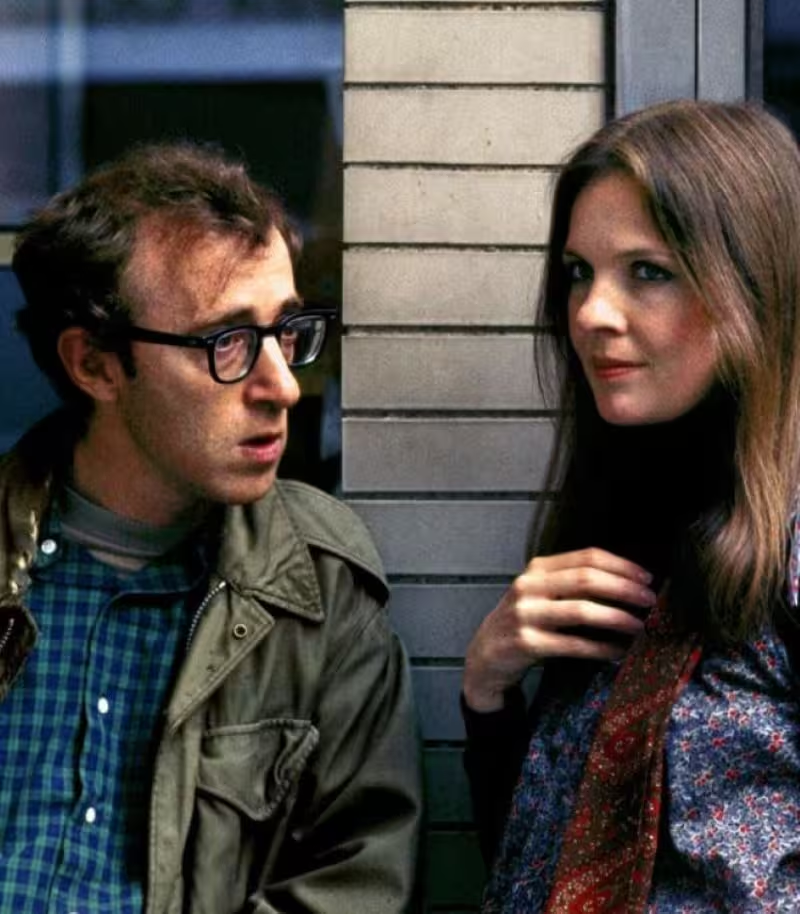
It asks whether we analyse love to death, using intellectualism as a barrier against its raw, terrifying vulnerability.
Furthermore, its take on personal growth resonates deeply. The relationship ends not because someone is a villain, but because Annie outgrows it.
Her journey from a nervous woman seeking approval to an independent artist is a powerful arc of self-actualisation.
The film understands that sometimes, the most profound act of love is letting someone go so they can become themselves, even if it destroys you. The final lesson is not cynical, but strangely hopeful.
By accepting the “eggs” analogy, we accept that human connection, for all its chaos and guaranteed pain, is the irrational project that makes life meaningful. We keep trying, we keep telling ourselves the story, because the alternative—a life without those messy, heartbreaking eggs—is a life not fully lived.
Annie Hall Quotes
- “A relationship, I think, is like a shark. It has to constantly move forward or it dies. And I think what we got on our hands is a dead shark.”
- (Alvy to Annie) “You’re a real Jew, aren’t you? You’re just like my Grammy Hall. She hated Jews, too. She thought they just made money. But she was the one! Is she ever, I’m telling you.”
- (Final voiceover) “This guy goes to a psychiatrist and says, ‘Doc, my brother’s crazy. He thinks he’s a chicken.’ And the doctor says, ‘Well, why don’t you turn him in?’ And the guy says, ‘I would, but I need the eggs.’ Well, I guess that’s pretty much how I feel about relationships.”
Pros and Cons
Pros:
• Diane Keaton’s iconic, Oscar-winning performance.
• Woody Allen’s sharp, intelligent, and painfully funny screenplay.
• Groundbreaking narrative structure and cinematic techniques (split-screen, fourth-wall breaks).
• A poignant and realistic exploration of love and heartbreak.
• Gordon Willis’s masterful cinematography that defines the film’s mood.
Cons:
• Woody Allen’s specific neurotic persona can be grating for some viewers.
• The heavy use of 1970s New York cultural references may alienate younger audiences.
• The pacing is deliberate and conversational, which some may find slow.
Conclusion
Annie Hall is not just a film; it’s a cultural and emotional benchmark. It redefined what a romantic comedy could be, injecting it with neurosis, intellectualism, and heartbreaking truth.
While the personal legacy of its director is complex, the film itself remains a towering achievement in American cinema. It is a must-watch for anyone interested in the art of filmmaking, the complexities of human relationships, or simply a brilliantly crafted story that makes you laugh and sigh in equal measure.
It fully earns its place as one of the 101 best films you need to see.
Rating: 5/5 Stars
