
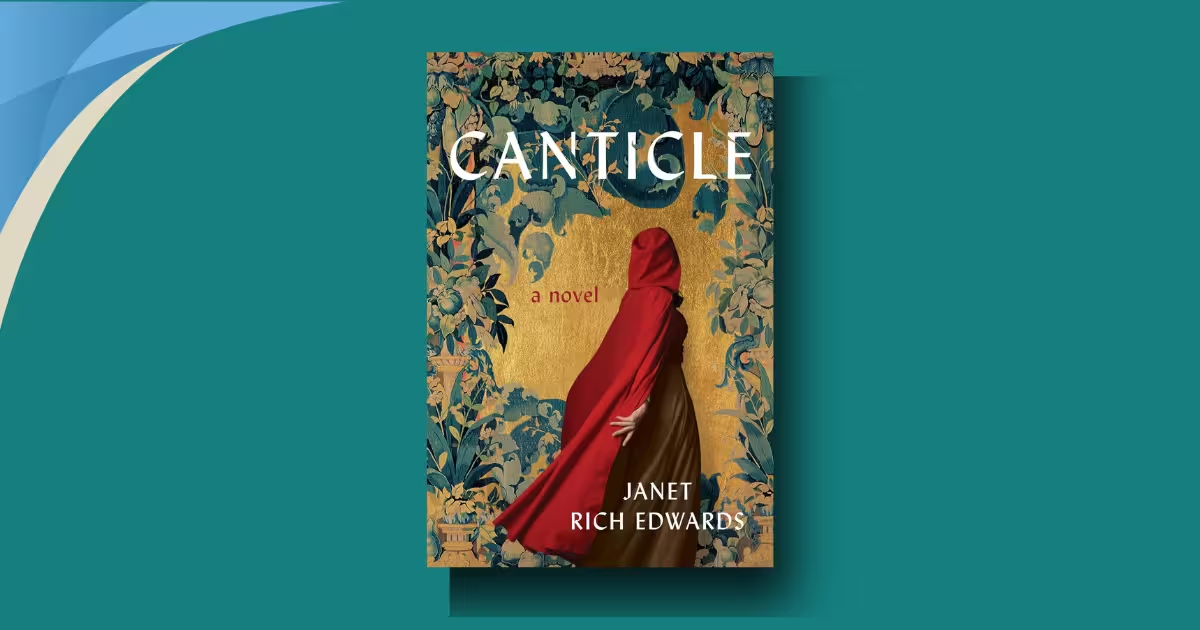
Canticle tackles a timeless problem: what happens when a young woman’s hunger for God collides with a system that wants her obedient, silent, and useful.
It’s also about the peril of being believed—because belief can turn a human being into a public commodity.
And once a crowd decides you’re holy (or fraudulent), you don’t get to live quietly again.
Canticle is a medieval coming-of-faith story where devotion becomes both a private refuge and a public weapon—especially when a woman’s inner life stops fitting inside the Church’s rules.
Evidence snapshot
Edwards explicitly grounds the novel in medieval women’s spirituality, noting that Canticle “relies on the lives and often the very words of medieval mystics,” and she points readers toward those original sources.
Historically, this setting is plausible: beguines1 were laywomen living pious, celibate lives outside convent structures, especially in the Low Countries.
And Bruges’ famous beguinage (Ten Wijngaarde) is commonly dated to the mid-13th century (often 1245), aligning closely with the novel’s world.
If you like historical fiction that does not modernize the past into comfortable attitudes then Canticle is for you, because it leans hard into the era’s God-saturated imagination.
If you want medieval women written with overtly modern sensibilities, or you dislike intense religious interiority, this may not land.
If you’re curious about beguines, anchoresses, mysticism, and how “miracles” can be socially engineered, this is a strong fit.
Table of Contents
1. Introduction
Canticle is a historical novel by Janet Rich Edwards, published by Spiegel & Grau (New York) in 2025.
The book frames “canticle” in its devotional sense—“a song of praise,” and also “a story or song of spiritual devotion and ecstasy.”
Edwards’ bio in the edition you shared notes she is also a professor (epidemiology and family medicine) and a recipient of literary fellowships, which matters because the book reads like someone who can handle both research and human mess.
2. Background
This story lives in thirteenth-century Bruges, a city of canals, cloth, and class friction, where women’s options tend to be marriage, convent, or some form of social disappearance.
Beguines matter here because they represent a rare middle path: semi-religious communities of women, often economically active, living devoutly without being fully enclosed nuns.
That independence—women praying, working, and even handling texts—could look like sanctity to ordinary people and like danger to authorities.
3. Canticle Summary
Aleys begins as a girl steeped in saints’ stories, watching martyrdom like other children watch theater, except she feels the pull in her bones—“Privately, Aleys thinks they should take the saints more seriously,” and she wonders how to get herself martyred.
That childhood hunger isn’t cute foreshadowing; it’s the engine, because Canticle treats longing as a force that can outgrow the container meant to hold it.
At the same time, the novel gives Aleys a quiet intellectual rebellion: she and a young scholar friend (the public synopsis identifies him as a scholar and hints at romance) share Latin in secret—something that feels like intimacy and danger at once.
Then the ground shifts: the friend chooses the monastery, Aleys’ family finances tighten, and her father promises her to a powerful guild leader—so she runs, and that flight becomes her first true act of agency.
She finds shelter among beguines, women whose competence is almost blunt: they work, negotiate, treat sickness, and carry faith without waiting for male permission.
Inside the begijnhof, the book makes the politics concrete: there are women translating and circulating texts, and there is surveillance—“It’s the man… Who’s been buying up translations,” a warning that the bishop’s attention has teeth.
Aleys is placed into the gritty mercy of hospital labor—bedpans, blood, sores—and the prose refuses to romanticize devotion as clean.
And that’s where the “miracle problem” truly begins: in one pivotal scene, Aleys prays over a dying boy, repeating the Ave Maria until it turns “tender,” and something in the room changes in a way the narrative treats as real experience, not metaphor.
Part 2
The “miracle” elevates Aleys into a role she never requested: not just devout, but useful to people who want proof, spectacle, and certainty.
At this point, the Church-side machinery becomes explicit: Bishop Jan’s interior logic is practically an accounting sheet—he needs a way “to monetize the miracles,” and whether Aleys is real or not, he can still leverage her toward Rome.
Even staged tests don’t stay staged; during a public “healing” performance, Aleys feels “a tingle” in her hands and acts fast, and the crowd is told they’ve witnessed miracles whether or not anyone understands what truly happened.
The beguines, meanwhile, respond like a living organism—lamps up in every window, prayers merging into a “fast-pleading river,” their hope pressing onto Aleys like a physical weight.
As Aleys is drawn deeper into religious enclosure (the anchoress path), the book shows the psychological double-edge: regimented prayer can be steadiness, but it can also become a corridor where obsession echoes louder.
Friar Lukas (and the men around him) embody that danger, twisting scripture into coercion, pressing Aleys toward “obedience” as if it’s the same thing as faith.
The novel goes darker and more intimate here: Lukas uses spiritual authority to corner Aleys, and her internal narration turns biblical—she thinks of Isaac bound for sacrifice—because she realizes she’s being made into an offering for someone else’s theology.
From there, the endgame tightens into public judgment: Aleys is marched across hot cobblestones toward a court where “she will be judged by men,” and the language makes the power imbalance feel architectural.
The execution sequence is staged with both intimacy and mass psychology: Aleys is bound to the stake, the beguines stand closest—steady, unsentimental, present—and they hold blank parchment as if daring the world to write them out.
Then the fire: the bishop narrates the expected horror (blistering, screams), but Aleys is “silent, eyes to the sky,” and the scene fractures into competing perceptions.
One authority figure sees only a woman consumed; another sees a reversal—“the flames are consumed by the woman,” and the square becomes a contagion of wonder.
The ending stays deliberately split: the beguines keep vigil and rumors spread—“She vanished… no remains, no relics,” some believing she burned entirely, others believing she survives.
The last movement shifts away from Aleys-as-spectacle and back to women-as-continuity: the beguines protect the blind beguine, keep practical care at the center, and the text insists their ideas will be smuggled, hidden, and revived.
The closing tone is both apocalyptic and calm—history keeps turning, and so do they.
4. Canticle Analysis
4.1 Canticle Characters
Aleys is built as a collision point—earnest, stubborn, often lonely—and from the start she’s drawn to martyrdom not as death-wish but as a shortcut to meaning.
Bishop Jan is not a cartoon villain; his cold clarity is what’s frightening, because he treats holiness as an asset class and scandal as a tool.
Lukas is the novel’s most disturbing portrait of corrupted intimacy: he can sound like a guide, but he leverages scripture and confession to erase Aleys’ consent.
Katrijn and Ida represent the beguine brain-trust—women moving knowledge through markets, weighing risk, hiding translations, and refusing to be naive about power.
Marte reads like loyalty without ornament: she is there at the hardest moments, and the epilogue positions her as a keeper of quiet hours and written memory.
4.2 Canticle Themes and symbolism
The most potent theme is who gets to interpret God: the beguines hold blank parchment at the stake like a symbolic claim that the Word is not property.
Another is spectacle versus spirit: Aleys’ prayer over the boy is inward and bodily, but the institution tries to flatten it into a public test.
The book also treats translation as revolution—a quiet literacy insurgency—which aligns with real scholarship describing beguines as economically active laywomen whose piety didn’t fit standard categories. (De Gruyter Brill)
Finally, the ending makes “miracle” itself symbolic: not a solved mystery, but a fork in collective memory—what people choose to believe becomes the afterlife of Aleys.
5. Evaluation
Strengths: Edwards’ prose can be physically vivid, from hospital dampness to the sensory logic of prayer, and it handles medieval religiosity without apology.
Weaknesses: if you want irony as a safety rail, this book removes it; the intensity can feel relentless, and the ambiguous miracle-ending will frustrate readers who need clean answers.
Impact: what lingers is the uncomfortable idea that institutions can fear a woman’s inner life more than they fear actual violence, because it’s harder to police.
Comparison with similar works: the Washington Post explicitly notes some readers may think of Lauren Groff’s Matrix, but argues Canticle is bolder in its Christ-saturated fidelity to the period, and Sarah Dunant’s blurb frames it as faith in opposition to “politics and entrenched power.”
6. Personal insight with contemporary educational relevance
Reading Canticle next to modern data makes its “who gets knowledge” question feel less medieval than we’d like to believe.
The novel’s quiet fight over women’s access to texts echoes a present where literacy and power still correlate strongly—World Bank data tracks adult female literacy globally as a key development indicator, with major regional gaps still visible.
And the beguines’ labor—care work, nursing, keeping bodies alive—lands differently when we remember that unpaid care work remains enormous in scale: the ILO notes more than 16 billion hours of unpaid domestic and care work every day worldwide, disproportionately done by women.
So here’s the classroom angle I’d actually teach: control the narrative, control the labor, control the bodies—and you don’t need to burn anyone at a stake to do it.
Students can map Aleys’ “miracle” arc onto modern attention economies: once a person becomes a symbol, institutions (and crowds) will fight to own the meaning of her existence.
I’ve written about The Name of the Rose—another story where language, authority, and forbidden knowledge collide—so Canticle makes a natural thematic companion for readers drawn to faith, power, and texts as danger
7. Canticle Quotes
“Canticle: a song of praise.”
“There must be a way to monetize the miracles.”
“We will all go to God when he calls… but we can ease each other’s way.”
“It’s not enough. She knows it’s not enough.”
“She was silent, eyes to the sky.”
“He saw what he saw. Others saw more.”
“There are rumors later. She vanished.”
“In every stroke of the bell, the world entire is born and dies…”
8. Conclusion
Canticle is a novel about devotion that refuses to behave politely, and that refusal is exactly why it feels alive.
I’d recommend it to readers who want medieval historical fiction with spiritual intensity, beguine history, and high moral stakes—especially if you enjoy stories where “sanctity” and “threat” can be the same word depending on who’s speaking.
If you want a neat moral or a neatly explained miracle, the book will keep slipping out of your hands, the way Aleys does.
Notes
- Beguines were medieval lay women (and sometimes men, called Beghards) in Northern Europe who formed semi-religious communities, living devotionally, working, and caring for the poor and sick without taking permanent vows, offering an alternative to traditional marriage or cloistered life, and creating unique, self-sufficient walled complexes known as Beguinages ↩︎
